Inspiration
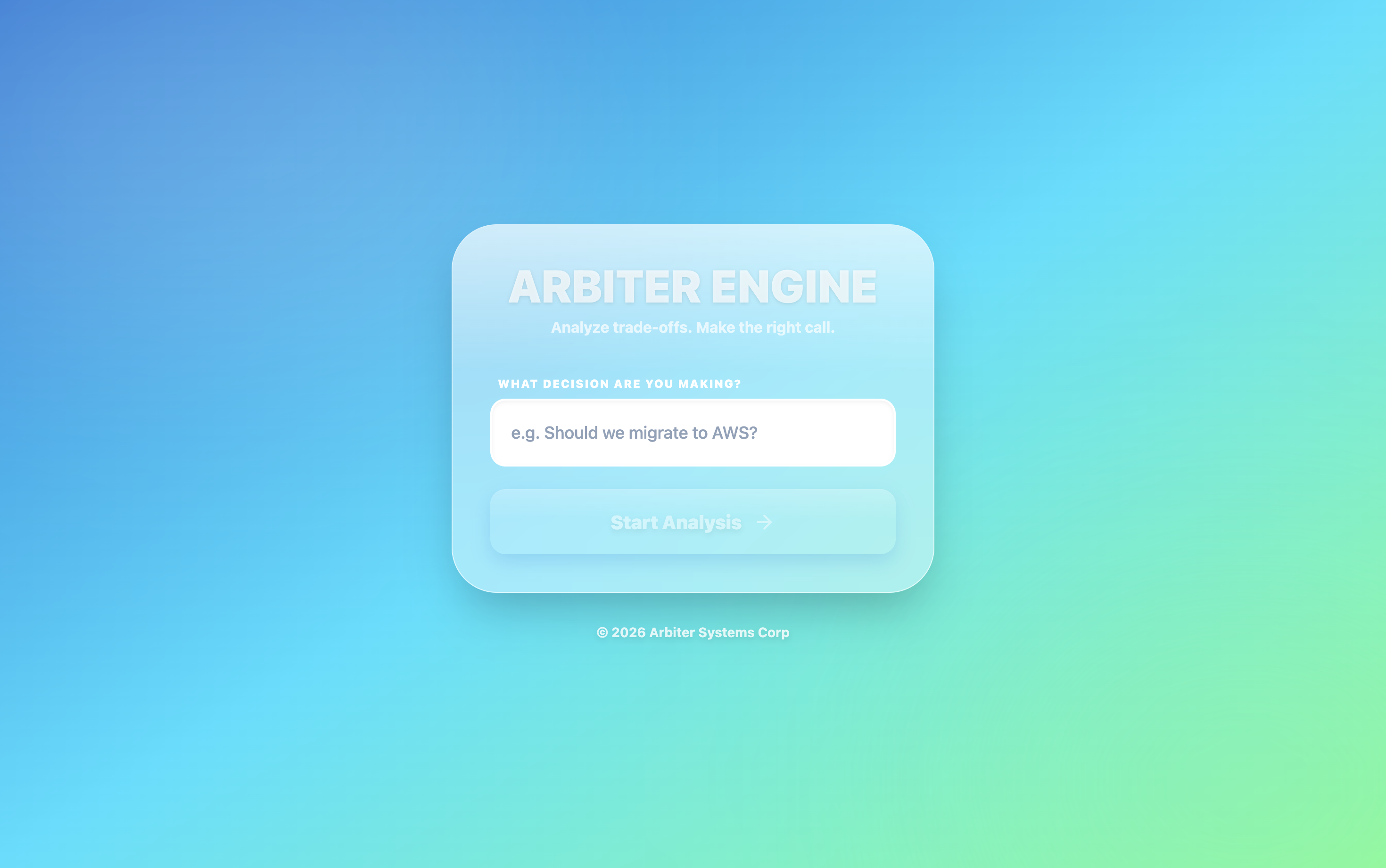
In an era of information overload, decision-makers are buried under PDFs and "data noise." We realized that while AI is great at summarizing, it rarely decides. We wanted to build a tool that doesn't just talk about data, but weights evidence, ranks possibilities, and acts as a digital "Arbiter" to bridge the gap between raw evidence and strategic action.
What it does
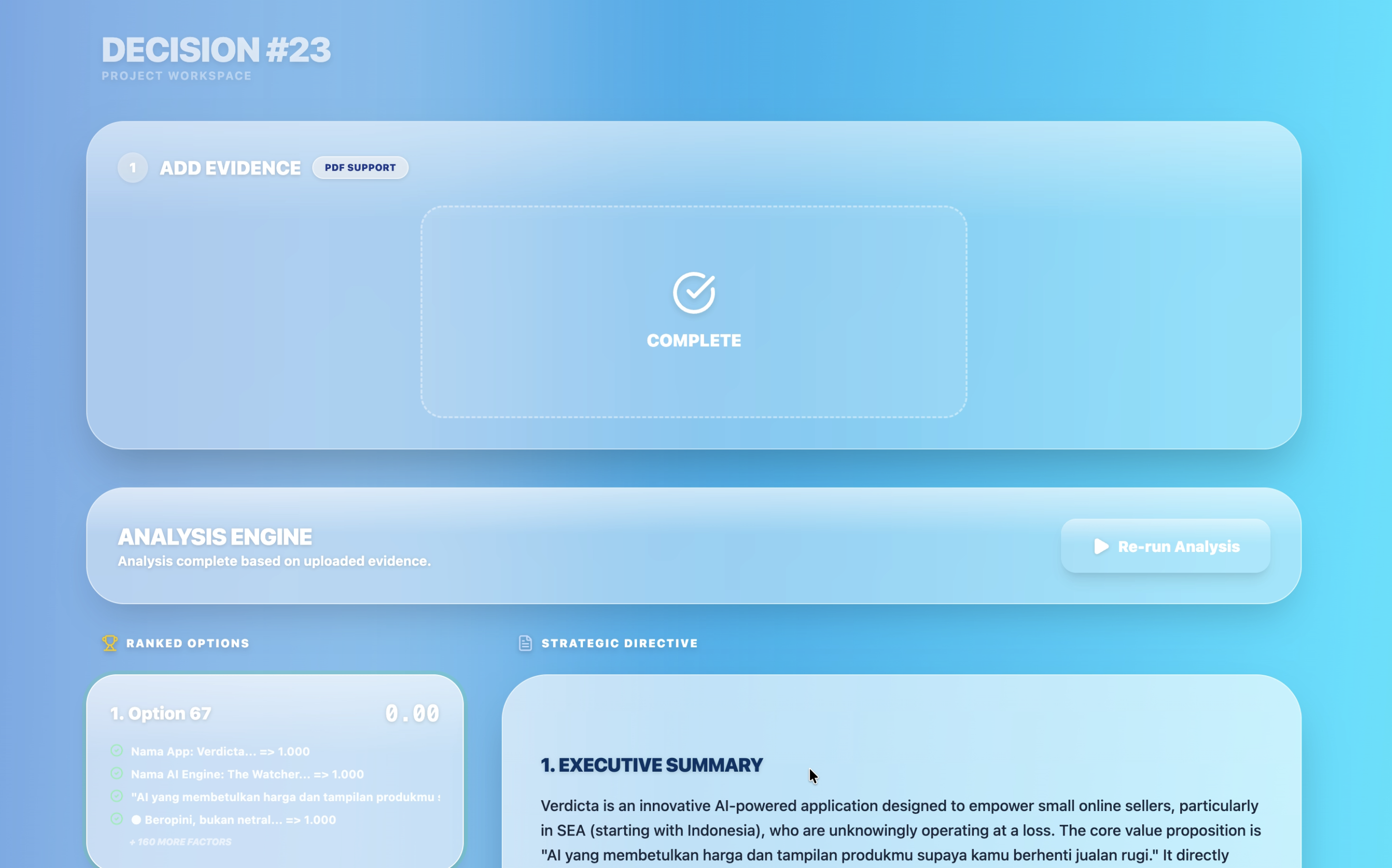
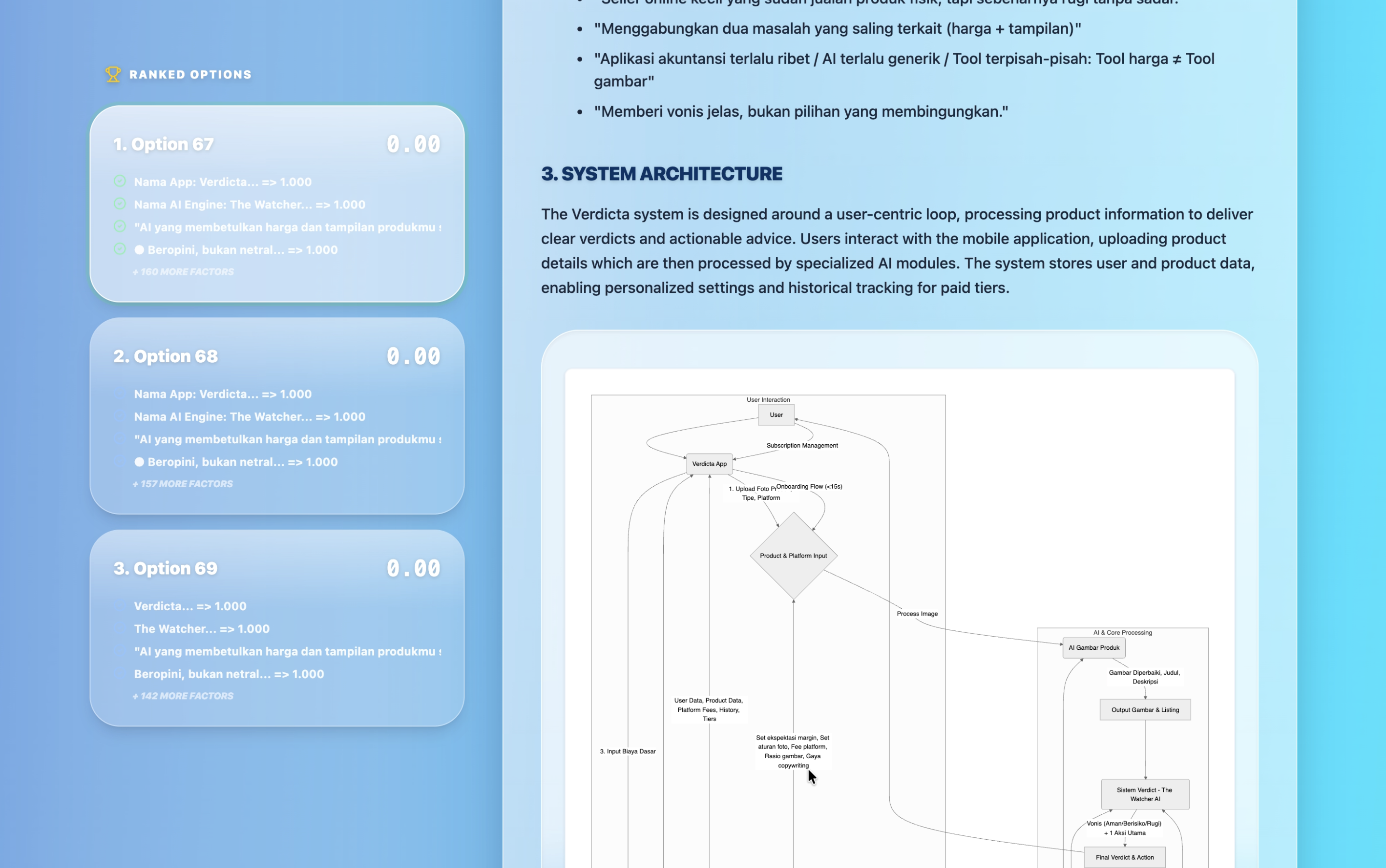
Arbiter is an AI-driven Strategic Analysis Engine. Users upload unstructured evidence (PDFs, project briefs, PRDs), and the engine extracts key claims to rank potential options. It then generates a comprehensive Consultant Report, complete with a strategic rationale, system architecture diagrams (via Mermaid.js), and a technical roadmap, ensuring every decision is backed by verbatim source evidence.
How we built it
We built Arbiter using a modern, scalable stack:
Frontend: React and TypeScript with Tailwind CSS for a sleek, executive dashboard. State Management: TanStack Query (React Query) for efficient data fetching and caching. AI Engine: Google Gemini 3 for document processing and complex reasoning. Backend: A Python-based API that handles document parsing, prompt engineering, and strict anti-hallucination logic. Visuals: Integrated Mermaid.js for real-time architectural visualization.
Challenges we ran into
The biggest hurdle was hallucination control. We didn't want an AI that "guessed" the budget or the tech stack; we needed one that remained strictly faithful to the source text. Fine-tuning the "Silence Policy" in our prompt engineering was a delicate balance—ensuring the AI would say "Not specified" when data was missing rather than making up a plausible but false reality.
Accomplishments that we're proud of
We successfully implemented a Verbatim Evidence System. Every strategic recommendation made by Arbiter can be traced back to a specific quote in the uploaded documents. We are also proud of the seamless integration of Mermaid.js, which allows non-technical users to see a "Strategic Directive" transformed into a visual system flow instantly.
What we learned
We learned that the quality of AI output is directly tied to contextual boundaries. By forcing the model to act as a CTO/Architect, we discovered it provides much higher quality technical specifications than when asked for a general summary. We also deepened our understanding of asynchronous state management in React when dealing with long-running AI analysis.
What's next for Arbiter
The next phase for Arbiter involves Multi-Agent Collaboration, where different AI "personae" (e.g., a Legal Agent, a Financial Agent, and a Technical Agent) debate the options before the final "Arbiter" ranking is produced. We also plan to add RAG (Retrieval-Augmented Generation) to support massive libraries of thousands of documents without hitting context limits.
Built With
- fastapi
- gemini
- mermaid
- postgresql
- python
- react
- tailwindcss
- tanstackquery
- typescript

Log in or sign up for Devpost to join the conversation.