Inspiration
Agents are starting to hold credentials for money, tools, and accounts. The default pattern is still a session token: authenticate once, then everything the agent does for the next hour is “you.” That is the wrong shape for high-stakes actions.
We did not set out to build another bank. We set out to build an authorization protocol — a layer any product can sit on — where:
- approval is bound to one exact action, and
- human presence is still required when that action executes,
without turning heart rate into a password or shipping physiology to the provider.
Wearable = liveness. Passkey = identity. Downstream apps verify a signed assertion; they never see a heartbeat.
What it does
Araxia is a presence-conditioned, action-bound authorization protocol.
It is meant to sit under agentic products — banking, payments, ops tooling, privileged access — as the security / authentication / enforcement layer. The product proposes; Araxia decides whether that exact proposal may run.
Protocol guarantees
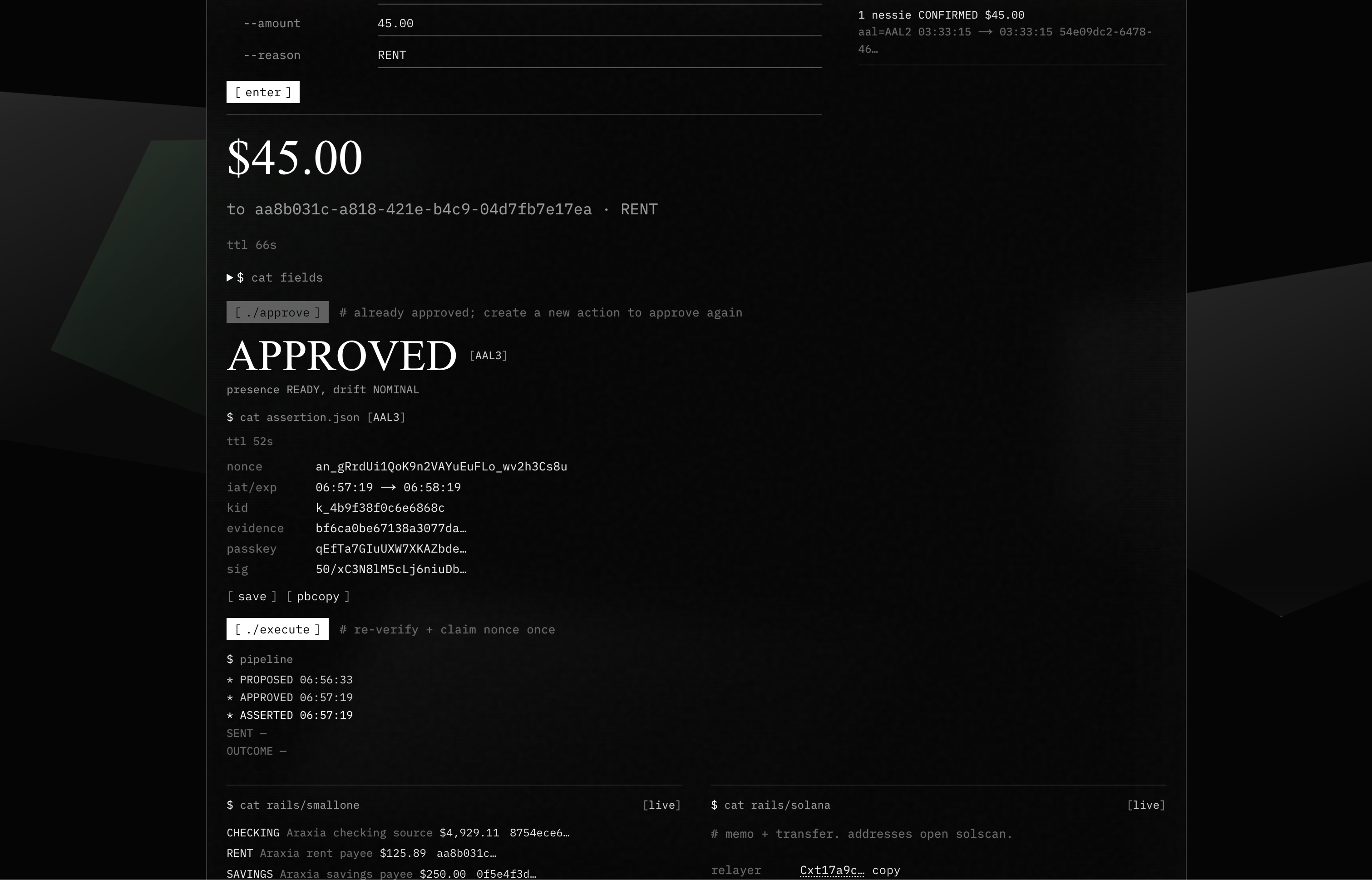
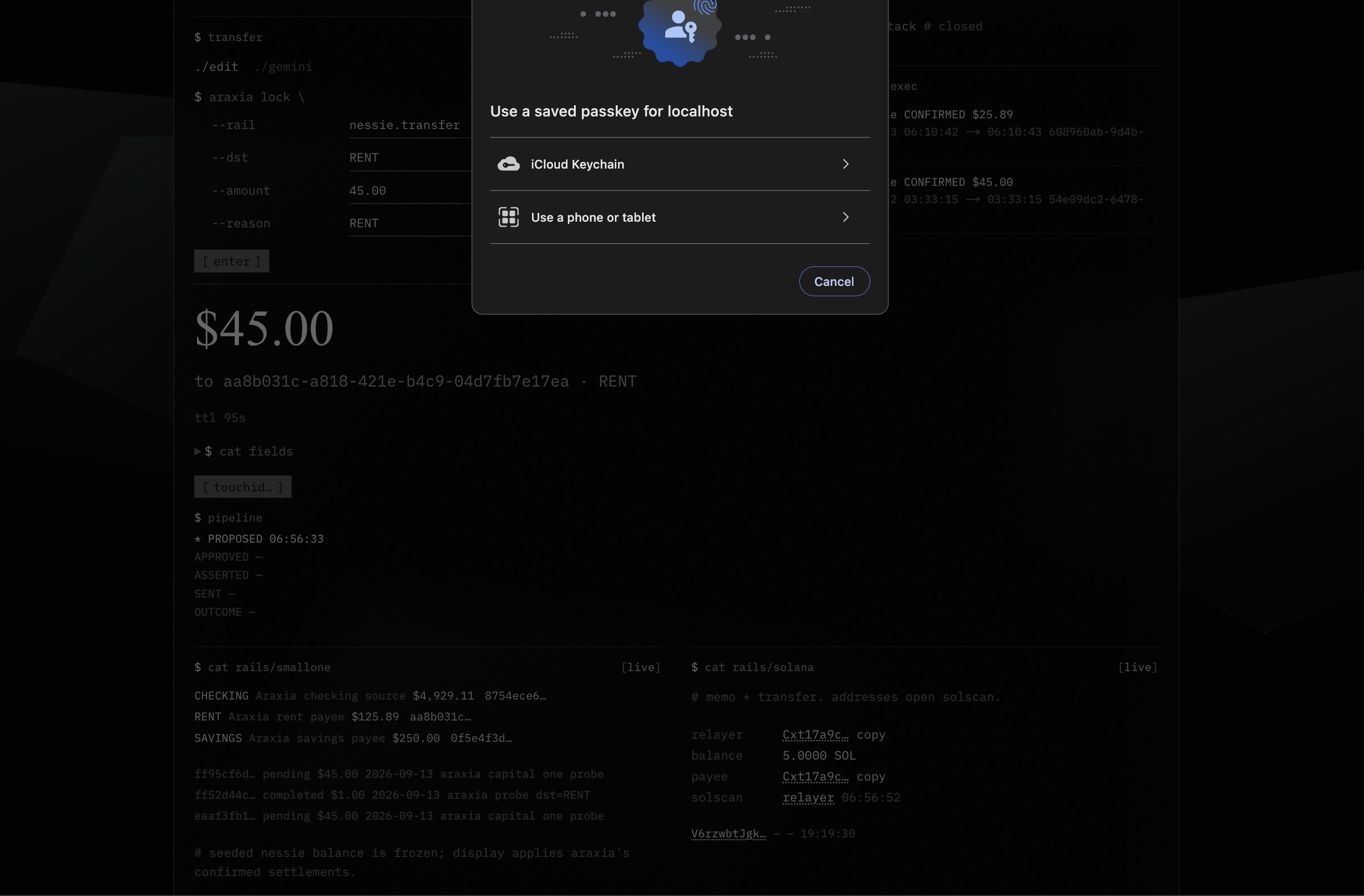
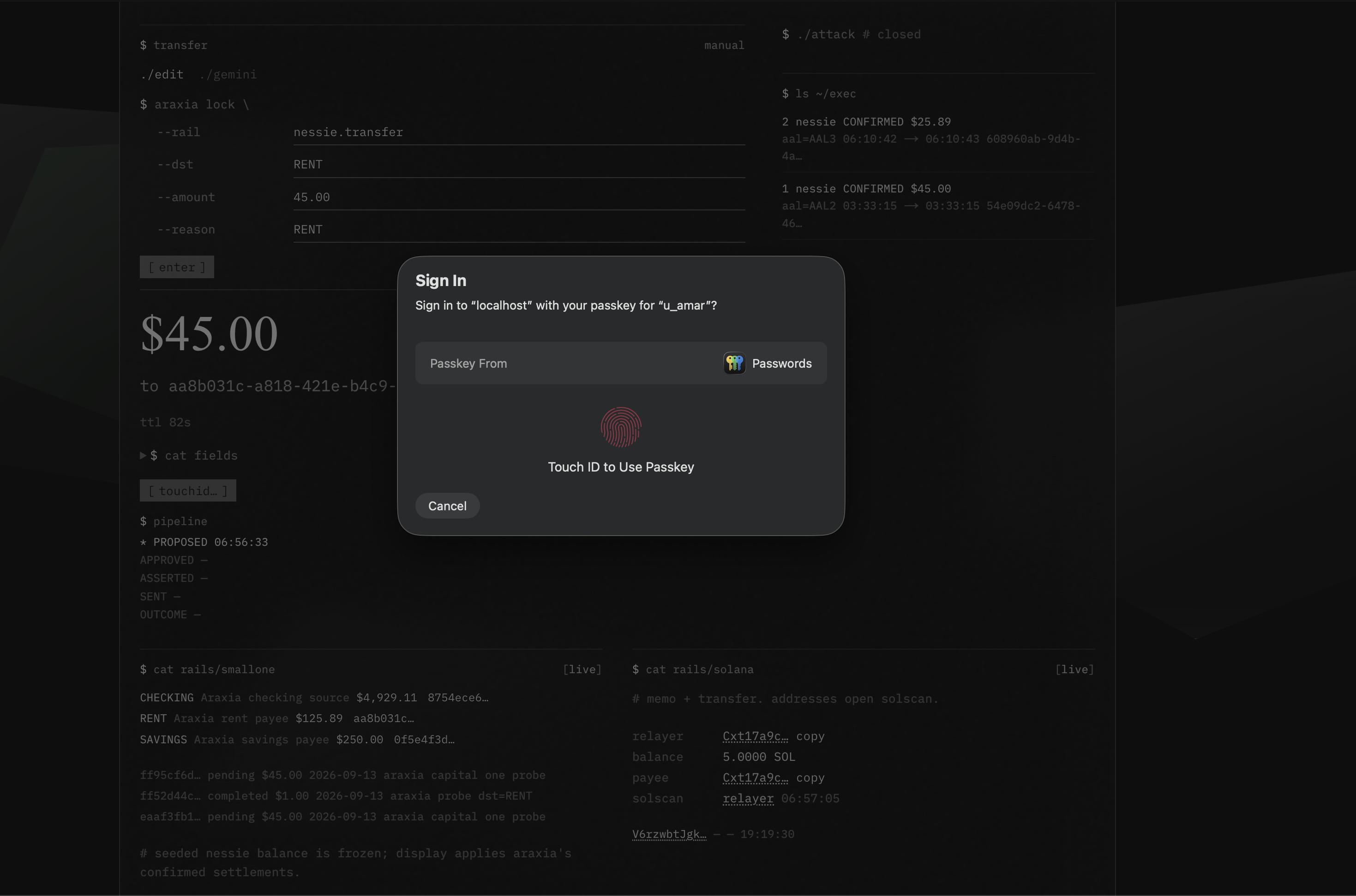
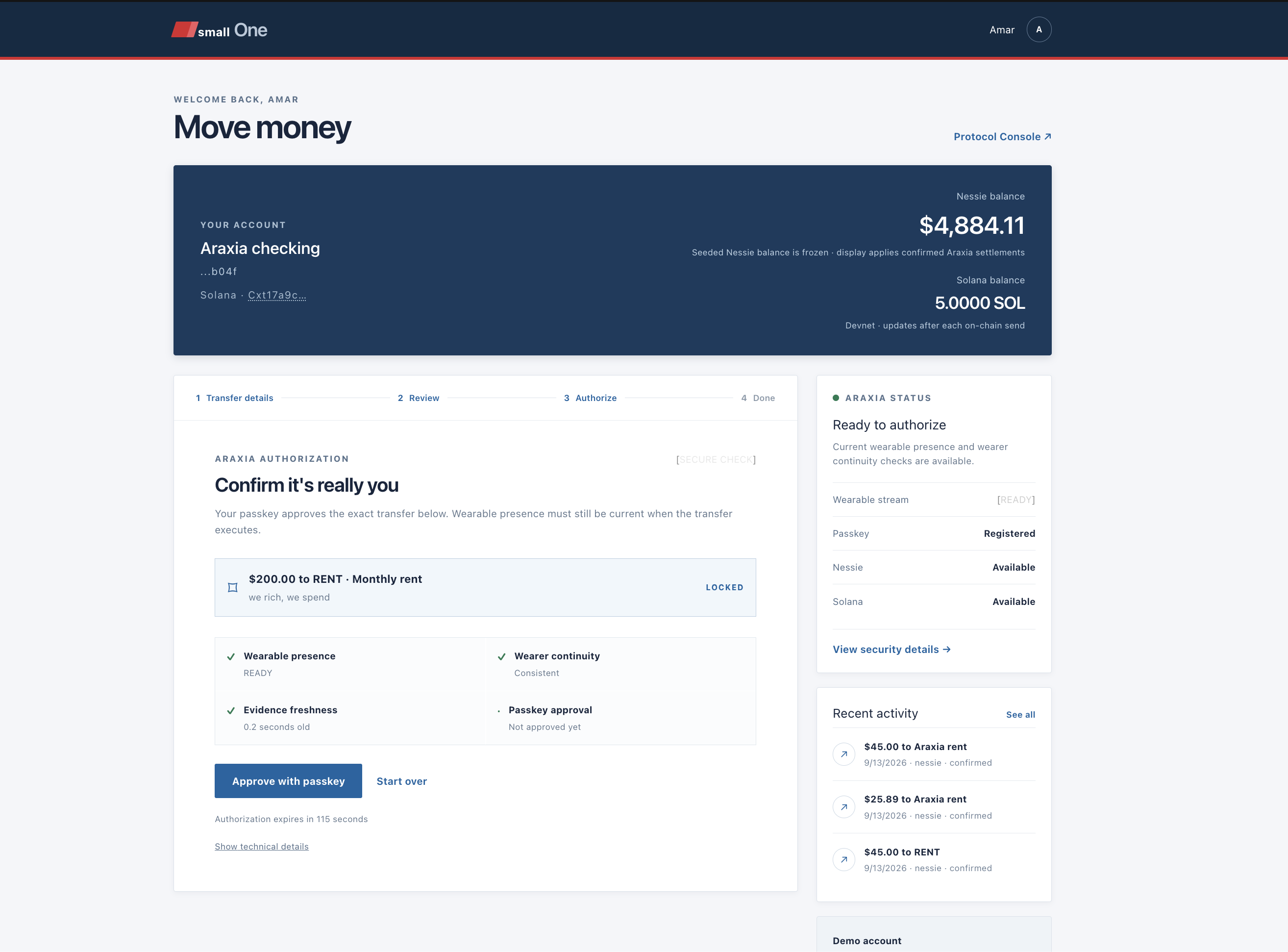
- Action-bound approval. A WebAuthn passkey (Touch ID) signs the digest of a canonical action (op, destination, amount, currency, nonce, expiry). The issuer wraps it in an Ed25519 assertion over canonical JSON. Change one byte and verification fails.
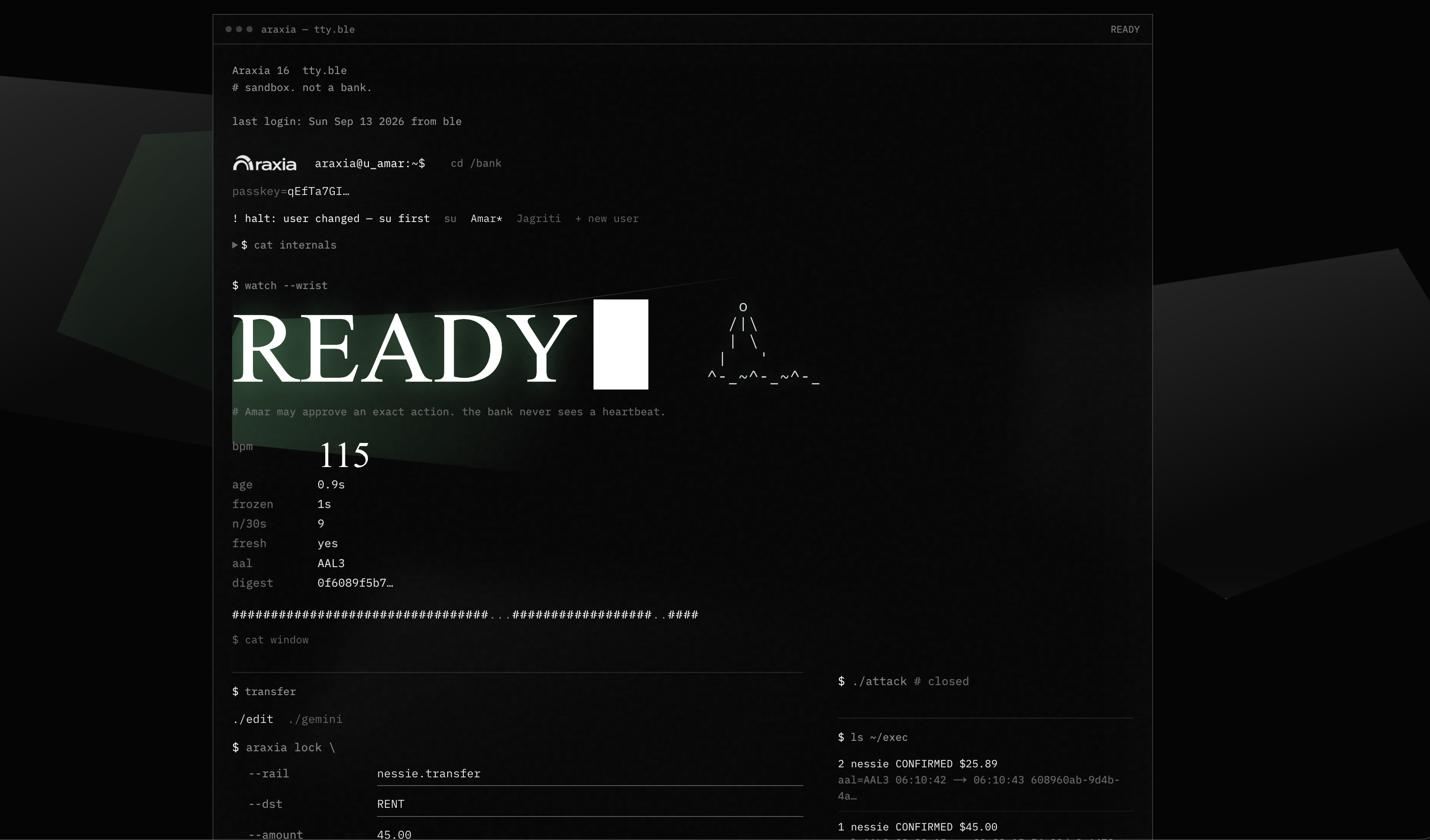
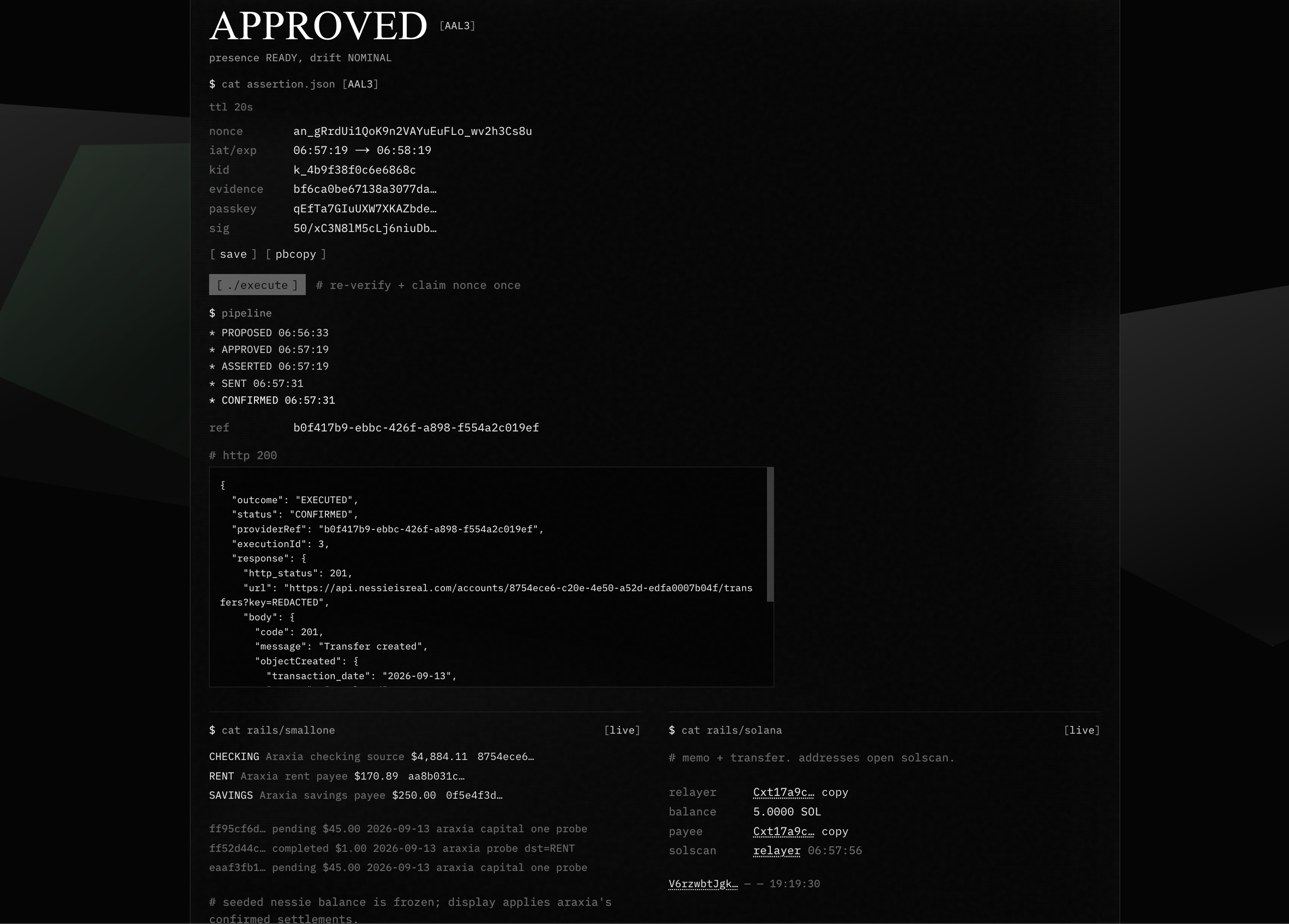
- Presence-conditioned execution. A wearable (Fitbit Air over BLE) feeds a local bridge that computes presence from variation, not packet arrival. Presence is checked at approval and again immediately before execute. No live human → no execution.
- Single-use. The assertion nonce is claimed atomically. Replay fails.
- Offline verifiable. Downstream systems (or a judge) can check an exported assertion without trusting our UI:
npx araxia-verify assertion assertion.json --issuer <hex>
Presence rule (measured, not assumed). Off-wrist the Air freezes BPM at 1 Hz instead of stopping. We mark the stream stale when the same value persists for at least eight seconds:
$$ \mathrm{STALE} \iff \text{same BPM for } t \ge 8\,\mathrm{s} $$
What a product plugs in
| Hook | Role |
|---|---|
| Propose | Agent / UI builds intent; server revalidates against its allowlist (Gemini demo: prompt injection cannot add a payee) |
| Approve | Passkey ceremony bound to the action digest |
| Evidence | Enrolled bridge posts signed window stats (raw BPM never leaves the laptop) |
| Execute | Claim nonce → re-check READY → call your rail |
| Verify | Independent verifier package / CLI |
Reference use cases (not the product)
- tty console (
/) — protocol control plane: presence, team handoff, attack lab. - Small One (
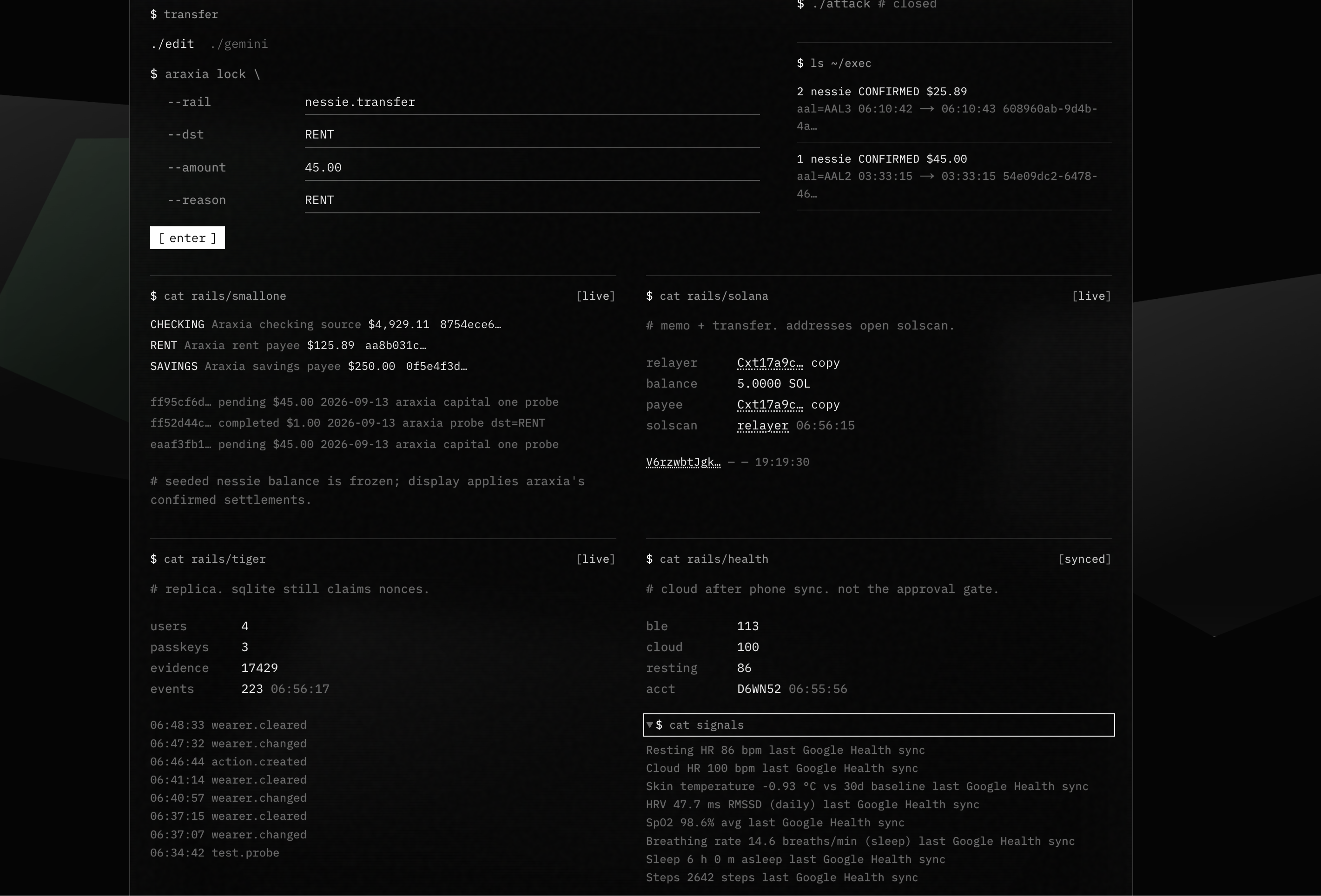
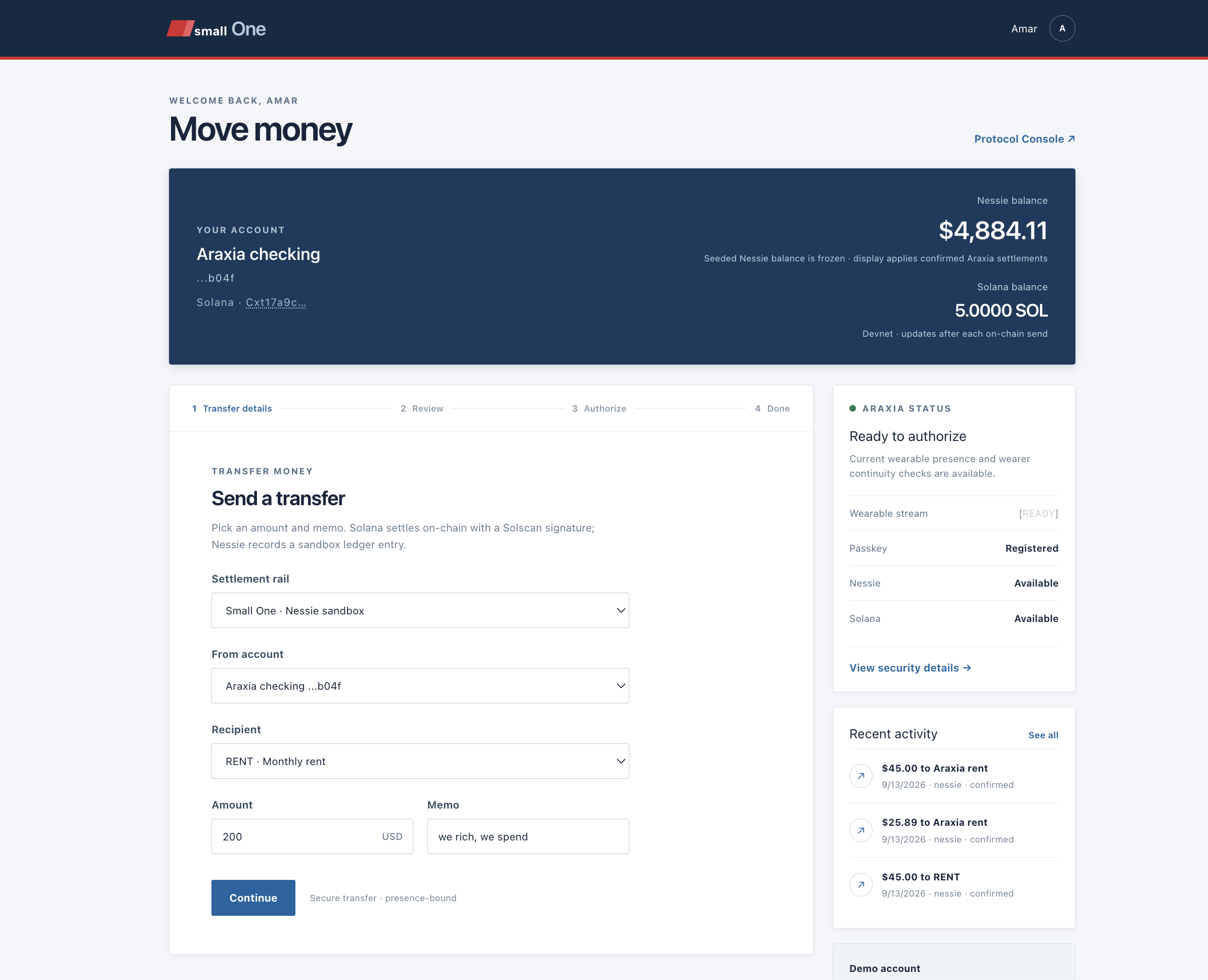
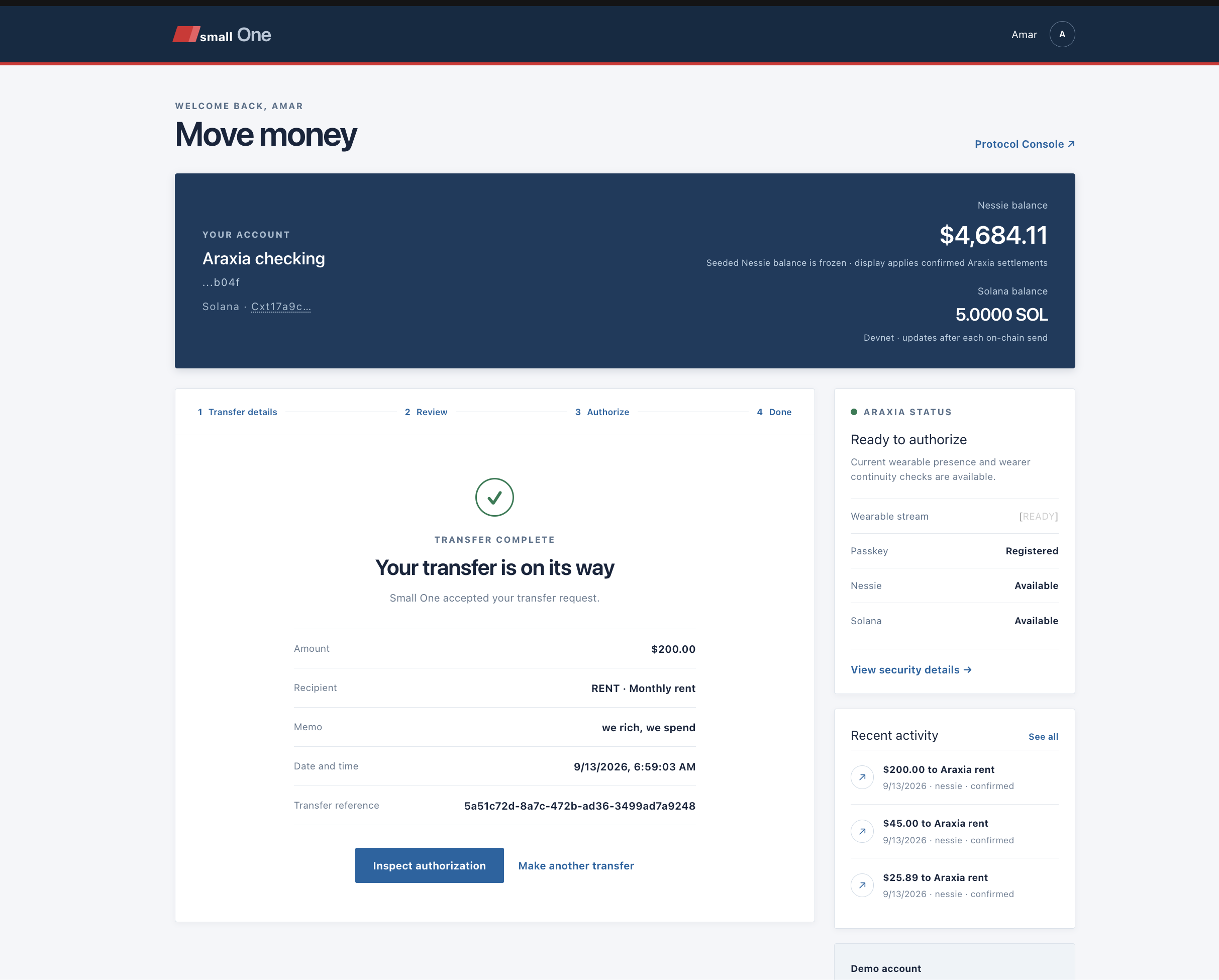
/bank) — fictional bank on top of Araxia: same assertion, two rails (Nessie sandbox + Solana devnet). Proves the layer is rail-agnostic. - Persona gates passkey enrollment; teammates share one band with explicit, passkey-gated handoff.
Nessie records every transfer we post, but its sandbox leaves seeded balances frozen (verified live). The demo overlays confirmed settlements on the displayed balance and says so — honesty is part of the protocol story.
How we built it
| Layer | Stack | Job |
|---|---|---|
| Hardware | Fitbit Air + bleak on macOS |
GATT map of Heart Rate Service 0x180D; packets always 01 <bpm> |
| Bridge | Python, Ed25519 | HRS decoder, presence state machine, signed window stats |
| Protocol service | Next.js 16, SQLite, WebAuthn | Digest-as-challenge, atomic nonce claim, dual presence check |
| Reference apps | Console + Small One | Show the layer under a real UX |
| Example rails | Nessie + Solana + Gemini + Persona + TigerData | Propose, enroll, settle, audit |
| Verifier | @araxia/verify CLI |
Third party checks an assertion with no access to our service |
Presence states: READY · WARMING · STALE · DISCONNECTED.
The per-wearer BPM model can only lower assurance (step-up). It never grants and it never identifies.
165 automated tests across bridge, service, and verifier (including 12 mutation tests and a claim-once concurrency test: 8 threads \(\times\) 25 attempts \(\rightarrow\) exactly one execution).
Raw captures and thresholds: capture/hardware_gate.md. Claims we make and refuse: CLAIMS.md.
Challenges we ran into
- Protocol vs product temptation. Judges see a bank UI first. We kept Small One as a reference app and the tty as the control plane so the layer stays legible.
- The band lies. Off-wrist it freezes on the last BPM. A naive “packets arriving = human present” check fails. We defined presence by variation and measured the worn plateau before picking \(t = 8\,\mathrm{s}\).
- Nessie’s
TransferCreateschema has no payee field and does not move seeded balances. Destination lives in the description; displayed balances are settlement-overlaid and labeled honestly. - No idempotency key on Nessie → timeout is
UNCERTAIN, not a retry (protocol-level honesty about rail failure modes). - macOS CoreBluetooth cannot bond from code; one-time “Get started” in Google Health while connected.
- Overlapping BPM ranges across wearers → no identity-from-BPM. Handoff is explicit: halt on break + mismatch, switch under passkey.
Accomplishments that we're proud of
- A protocol with a clear trust boundary: passkey + issuer key as root; wearable as a condition, not a biometric password.
- A measured hardware finding (off-wrist freeze) that shaped the presence machine.
- Rail-agnostic assertions: one signed document executes on Nessie and Solana (nonce in the Solana memo).
- Claim-once under concurrency + mutation tests; an independent verifier so the layer is not “trust our server.”
- A claims matrix that includes what we refuse to say.
What we learned
- Ship a layer, demo a product. The bank proves usefulness; the protocol is what another team would integrate.
- Liveness ≠ identity. Wearable answers “is a human still here?”; passkey answers “which one?”
- Read the device. GATT dump first: the Air has no RR intervals, no skin-contact bit, no temperature. Design around what exists.
- Sandboxes have their own truths. Say what the rail actually does.
What's next
- Attestation for the bridge signer (TEE / secure element) so the collector is no longer a trusted party.
- Drop-in SDKs / policy packs so any app can propose → approve → execute without forking our console.
- Step-up policies per amount and destination, with the wearer model as one input.
- Rails with real idempotency so
UNCERTAINcan reconcile itself. - More reference apps (ops agents, privileged access) once the finance demo has earned trust.
Flow (optional gallery caption)
any product ──propose──▶ Araxia protocol
wearable ──presence──▶│  passkey signs exact action
                      └── READY? ──▶ your rail (Nessie / Solana / …)

Log in or sign up for Devpost to join the conversation.