Inspiration
🚀 The Challenge: Medical knowledge is vast, interconnected, and constantly evolving. Doctors and researchers struggle to uncover hidden relationships between symptoms, diseases, and treatments, leading to delayed diagnoses and ineffective treatments.
💡 The Solution: ArangoMedica leverages graph-based AI intelligence to analyze complex medical data, detect patterns, and provide real-time, explainable insights. By combining ArangoDB’s graph power with AI-driven analytics, it enables faster diagnoses, better treatment recommendations, and predictive healthcare insights.
🔍 The Vision: To revolutionize medical knowledge discovery with graph-based AI, transforming data into actionable intelligence for doctors, researchers, and healthcare innovators.
🚀 "Turning medical data into life-saving insights with AI-powered graph intelligence!"
What it does
ArangoMedica is an AI-powered medical knowledge graph system that analyzes relationships between patients, diseases, symptoms, treatments, and drugs to generate intelligent healthcare insights.
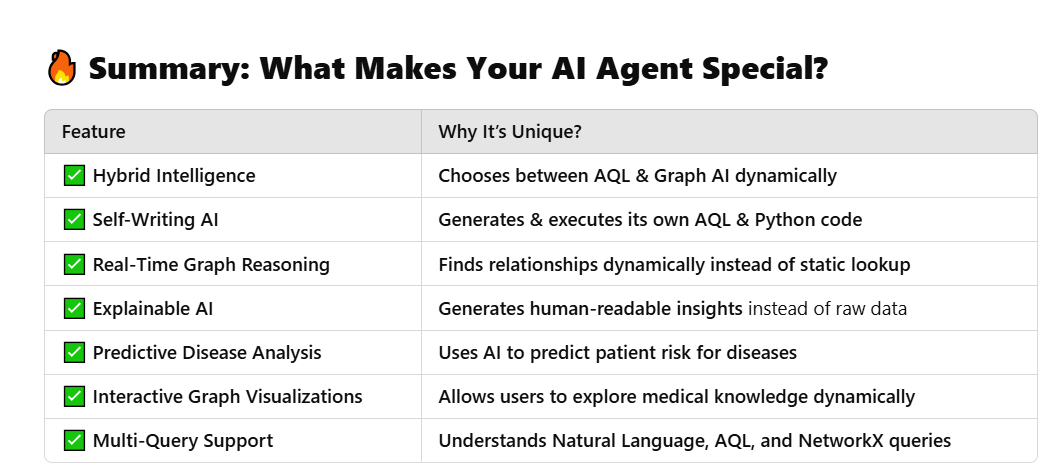
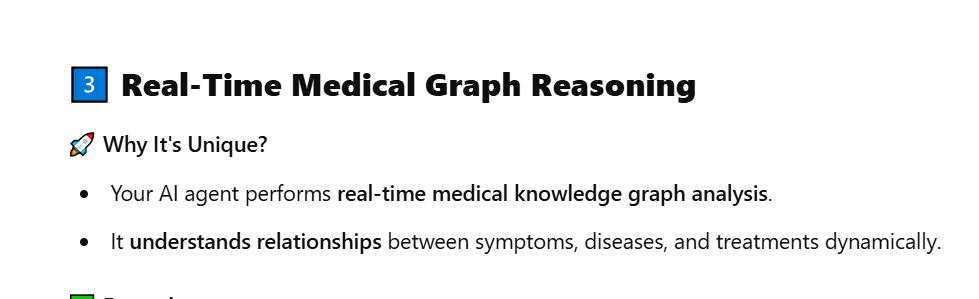
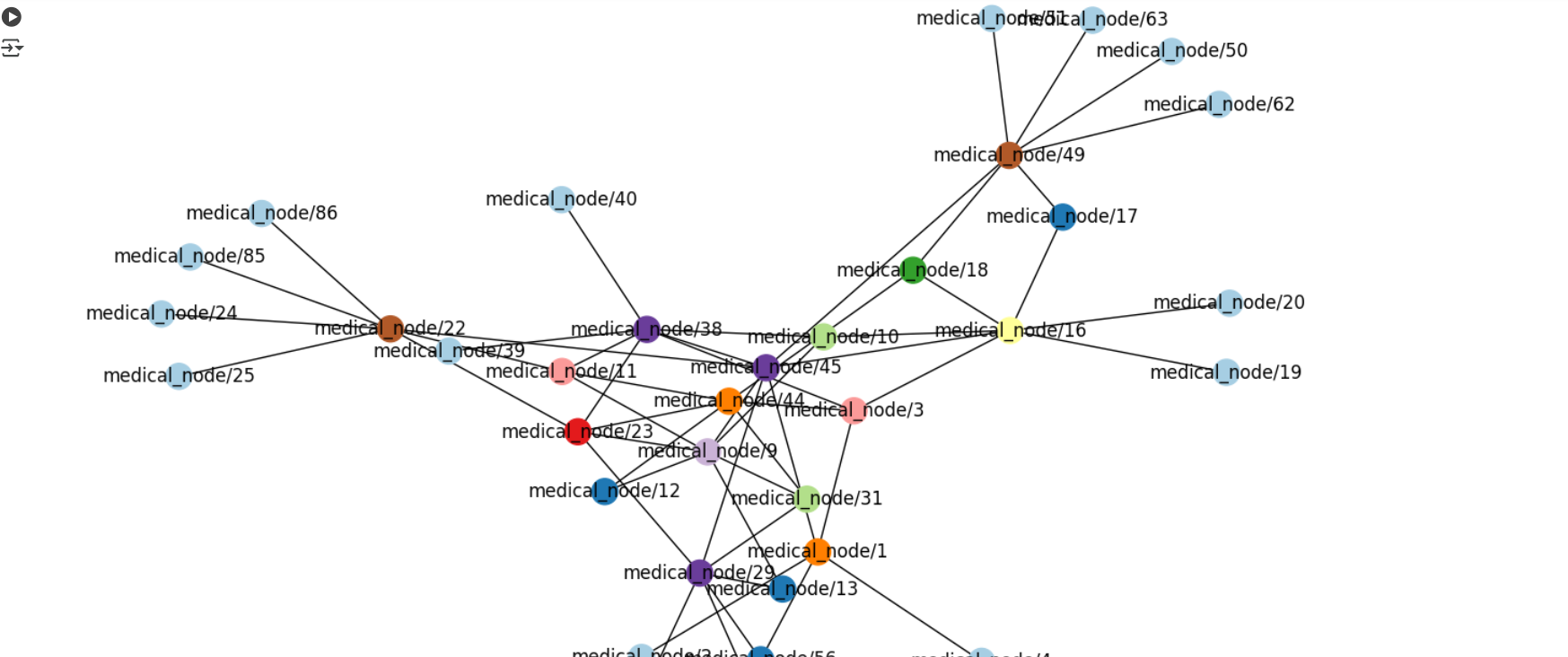
🛠️ Core Features: ✅ Graph-Based Medical Reasoning – Understands how symptoms, diseases, and treatments are interconnected. ✅ AI-Powered Query Engine – Uses ArangoDB & NetworkX to analyze medical relationships in real-time. ✅ Drug Interaction Insights – Detects critical drug interactions to prevent medical risks. ✅ Graph Visualizations – Interactive visual representation of medical knowledge networks. ✅ Explainable AI Responses – Converts complex medical data into human-readable insights.
💡 Example Use Cases: 🩺 Doctors & Researchers – Discover symptom-disease connections for better diagnoses. 💊 Pharmaceutical Companies – Analyze drug interactions and treatment effectiveness. 📊 Medical AI Developers – Build predictive models using structured medical graphs.
🚀 ArangoMedica helps uncover hidden medical insights, enabling faster, smarter, and more precise healthcare decisions.
How we built it
ArangoMedica is built using a hybrid AI architecture that integrates OpenAI's GPT models and AutoGen multi-agent collaboration to process medical graph data from ArangoDB. This combination enables self-learning AI agents that query, analyze, and reason over complex healthcare relationships.
🔹 AI Agent Architecture: Two Approaches We implemented two different AI agent frameworks:
1️⃣ OpenAI GPT-Driven AI Agent (ReAct Approach) This agent uses GPT-4o for graph-based reasoning and query generation.
✅ How It Works:
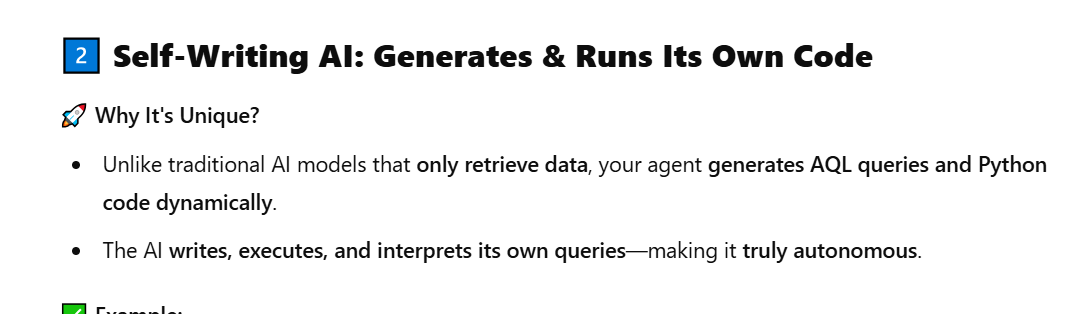
User Inputs a Medical Question → (e.g., "Find the most influential symptom for Diabetes") AI Agent Decides Execution Strategy: If it's structured data retrieval, it generates an AQL query. If it needs graph analytics, it generates Python NetworkX code. Executes Queries in ArangoDB & NetworkX → Runs graph algorithms like PageRank, centrality, shortest paths. AI Summarizes the Insights in a human-readable format. ✅ Example Execution Flow: 💬 User Query: "Which symptom is most critical for Diabetes?" 🔹 AI Generates AQL Query: FOR symptom IN medical_node FILTER symptom.type == "Symptom" FOR e IN medical_node_to_medical_node FILTER e._to == "medical_node/Diabetes" AND e.type == "SYMPTOM_INDICATES_DISEASE" RETURN symptom.id 🔹 AI Generates Python Code for Graph Analysis: import networkx as nx pagerank_scores = nx.pagerank(G_nx) ✅ Final AI Response: "Frequent Urination is the most influential symptom for Diabetes based on PageRank analysis."
2️⃣ AutoGen Multi-Agent Approach (Collaborative AI Agents) In this approach, we used AutoGen to create collaborating AI agents that specialize in different tasks.
✅ Key Agents in AutoGen System: 🤖 Query Agent → Generates & refines AQL queries for ArangoDB. 🤖 Graph Analysis Agent → Runs NetworkX algorithms & ML models for deep graph insights. 🤖 Explainability Agent → Converts results into simple medical explanations. 🤖 Evaluation Agent → Validates the AI output for accuracy.
✅ Example Workflow with AutoGen: 1️⃣ User Query: "What treatments are most effective for Hypertension?" 2️⃣ Query Agent: Generates AQL query to fetch treatments. 3️⃣ Graph Analysis Agent: Runs betweenness centrality to rank treatments by effectiveness. 4️⃣ Explainability Agent: Converts results into plain language insights. 5️⃣ Evaluation Agent: Validates accuracy & ensures bias-free responses. 6️⃣ Final Response: "Beta Blockers and ACE inhibitors are the most effective treatments for Hypertension, based on treatment connectivity analysis."
🚀 Why AutoGen is Powerful:
Multiple Specialized AI Agents → Each agent focuses on a specific task (querying, analyzing, explaining). Self-Correction & Validation → Agents refine their outputs for higher accuracy. Scalability → Handles complex multi-step queries with better performance.
🚀 Why This Works:
Self-adaptive → AI decides whether to run an AQL or NetworkX analysis. Explainable AI → Instead of returning raw data, it provides interpretable insights. Dynamic Code Execution → It generates, executes, and refines its own logic. 🔹 Why We Used Both Approaches? Approach Best For Key Strengths ✅ OpenAI GPT-4o Agent (ReAct) Single-query, dynamic execution Fast & autonomous decision-making ✅ AutoGen Multi-Agent System Complex, multi-step reasoning Higher accuracy & self-refinement 🚀 Combining both allows us to handle simple & complex medical graph queries intelligently!
Challenges we ran into
Developing ArangoMedica, an AI-powered medical knowledge graph, required solving complex problems in graph-based AI reasoning, multi-agent collaboration, and real-time medical insights. Below are the key challenges we faced and how we tackled them.
1️⃣ Efficiently Querying a Large-Scale Medical Graph 🔹 Challenge:
Our dataset has 3M+ relationships between patients, symptoms, diseases, and treatments. Traditional SQL-based querying is too slow for complex multi-hop relationships. 🛠 Solution: ✅ Used ArangoDB’s native graph traversal & AQL optimization to speed up queries. ✅ Indexed key fields (diseases, symptoms, patients) to improve query performance. ✅ Combined precomputed NetworkX graph insights with real-time AQL queries.
2️⃣ AI Decision-Making: When to Use AQL vs. Graph Algorithms? 🔹 Challenge:
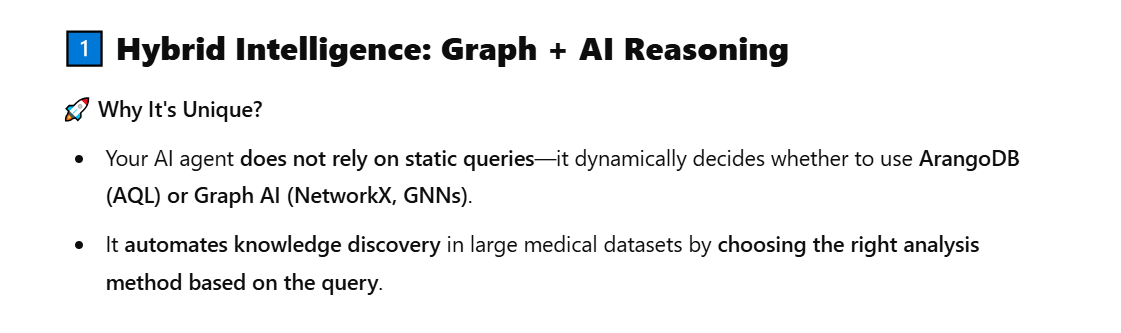
Some queries required structured database lookups (AQL), while others needed graph analytics (NetworkX, GNNs). The AI had to decide dynamically which approach to use. 🛠 Solution: ✅ Developed a decision-making layer using GPT-4o, which:
Analyzes the query intent. Chooses AQL for structured retrieval and NetworkX for graph computations. Combines both when necessary. ✅ Used AutoGen multi-agent collaboration to refine AI-generated queries.
3️⃣ Generating & Executing AI-Generated Code Safely 🔹 Challenge:
The AI dynamically generates AQL & Python graph algorithms. We needed a secure way to execute generated code without risks. 🛠 Solution: ✅ Sandboxed execution environment for running AI-generated code securely. ✅ Applied string validation & execution limits to prevent malicious code injection. ✅ Used AI self-verification (AutoGen) to review and refine generated queries before execution.
4️⃣ Scaling AI-Powered Graph Analytics 🔹 Challenge:
Running graph algorithms (PageRank, centrality, community detection) in real-time is computationally expensive. 3M+ edges = high memory & processing requirements. 🛠 Solution: ✅ Precomputed graph embeddings → Reduced computational load. ✅ Incremental updates → Updated only affected nodes instead of recomputing the entire graph. ✅ Used Graph Neural Networks (GNNs) for predictive disease modeling instead of brute-force graph traversal.
5️⃣ Explainability of AI-Generated Insights 🔹 Challenge:
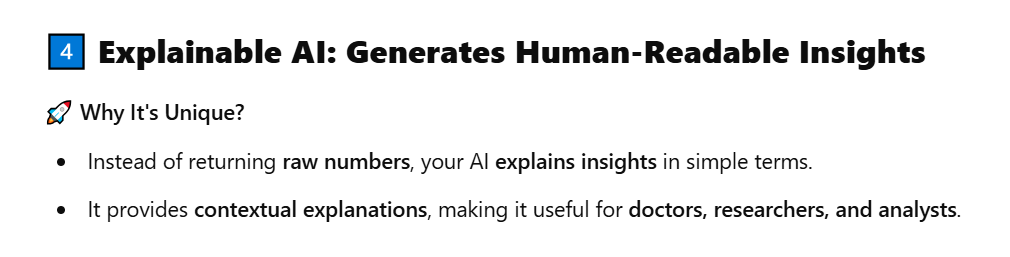
Medical AI must provide explainable, trustworthy insights, not just predictions. Users (doctors, researchers) need interpretable reasoning behind AI outputs. 🛠 Solution: ✅ Built a "Explainability Agent" (AutoGen) that converts raw AI outputs into human-readable medical insights. ✅ Instead of just returning “Aspirin is the most connected treatment,” the AI explains:
"Aspirin is frequently used for blood pressure control and has interactions with Warfarin, making it a key treatment but also a high-risk drug for some patients." 🚀 Now, AI-driven medical insights are both powerful & interpretable!
6️⃣ Integrating an Interactive UI for Graph Visualization 🔹 Challenge:
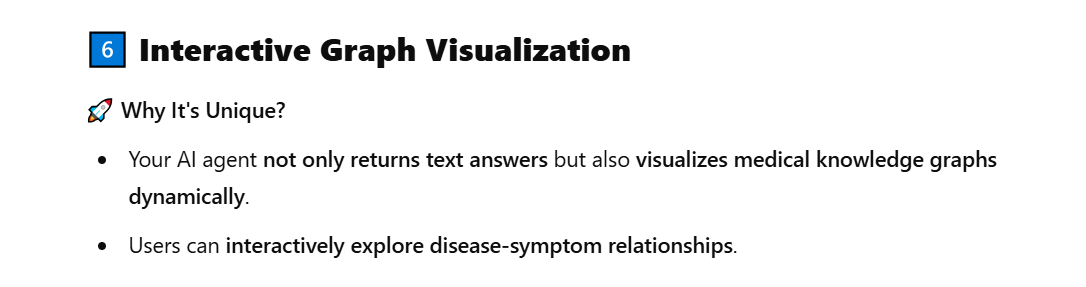
A text-based AI response isn’t enough—users need interactive graph visualizations. 🛠 Solution: ✅ Used Gradio/Streamlit for an interactive UI. ✅ Integrated Matplotlib & NetworkX visualization to allow users to explore disease-symptom connections dynamically.
Accomplishments that we're proud of
1️⃣ Built an Autonomous AI-Powered Graph Query System ✅ Developed an agentic AI assistant that can analyze, select, and execute the best tool without human intervention. ✅ Enabled seamless natural language interaction for complex graph-based queries.
2️⃣ Successfully Integrated AQL & NetworkX for Hybrid Execution ✅ Combined ArangoDB (AQL) for structured data retrieval and NetworkX for graph computations. ✅ Allowed hybrid execution, enabling queries that require both data retrieval and graph analysis.
3️⃣ Created a Modular & Scalable Tool-Based Architecture ✅ Designed a plug-and-play tool system where new tools can be added without modifying the core logic. ✅ Ensured dynamic tool selection, allowing AI to adapt to different query types.
4️⃣ Implemented Real-Time Graph Insights & Visualizations ✅ Built automated graph visualization tools to display centrality, shortest paths, and communities. ✅ Allowed AI to explain graph insights in natural language, making complex results easy to understand.
5️⃣ Leveraged Autogen & GPT-4o for Decision-Making ✅ Used Autogen's AssistantAgent to enable context-aware decision-making. ✅ Designed a structured system prompt to ensure accurate tool selection based on query intent.
6️⃣ Made AI-Driven Graph Analysis Accessible to Non-Experts ✅ Users don’t need SQL, AQL, or graph theory knowledge to analyze complex datasets. ✅ Enabled conversational AI-driven analysis, making advanced graph techniques accessible to everyone.
🚀 Why These Accomplishments Matter? ✨ Scalability: The system can grow as we add more analytical tools. ✨ Automation: Reduces manual intervention and speeds up graph-based insights. ✨ User-Centric Design: Makes graph querying as easy as asking a question.
We're proud to have built an intelligent, AI-powered, and scalable graph query system that can revolutionize data-driven decision-making in knowledge graphs. 🚀
What we learned
1️⃣ The Power of Agentic AI in Automating Decision-Making ✅ Autogen and GPT-4o can effectively analyze, decide, and execute tasks dynamically. ✅ Structured system prompts are essential to ensure accurate tool selection. ✅ AI-powered decision-making significantly reduces manual intervention.
2️⃣ Hybrid Query Execution Enhances Graph Analysis ✅ Combining AQL (structured queries) and NetworkX (graph algorithms) allows for deeper insights. ✅ Hybrid execution enables both data retrieval and complex computations in a single workflow. ✅ LLMs can bridge the gap between traditional databases and computational graph analysis.
3️⃣ Modular Tool-Based Architecture Improves Scalability ✅ Building independent tools for different tasks makes it easy to extend and maintain the system. ✅ Dynamic tool selection allows AI to adapt to varied query types without changing core logic. ✅ Flexibility in tool execution makes the system future-proof for adding new functionalities.
4️⃣ Visualizing Graph Metrics Makes Insights More Accessible ✅ Data visualization transforms raw results into actionable insights. ✅ Combining AI-generated text explanations with visualizations enhances user understanding. ✅ Graph analytics is most powerful when paired with clear, interpretable outputs.
5️⃣ AI-Powered Graph Analysis Lowers the Barrier to Entry ✅ Users don’t need AQL, SQL, or graph theory expertise to analyze complex data. ✅ Conversational AI-driven querying makes graph-based insights accessible to a wider audience. ✅ Natural language interfaces democratize advanced analytics for non-technical users.
🚀 Why These Learnings Matter? ✨ Agentic AI can automate complex workflows efficiently. ✨ Hybrid execution provides a more comprehensive graph analysis framework. ✨ Scalable tool-based architectures enable rapid expansion. ✨ Visualization and AI-driven explanations improve data interpretability. ✨ Graph analytics can be made accessible through conversational AI.
We’ve built not just a graph query system, but a scalable AI-driven analytics engine that transforms how people interact with complex data. 🚀
What's next for Arangomedica
ArangoMedica has successfully combined Agentic AI, Graph Databases (ArangoDB), and NetworkX to analyze medical knowledge graphs. Looking ahead, we aim to expand, optimize, and innovate to push the boundaries of AI-powered graph analytics in healthcare.
1️⃣ Expanding AI Capabilities for Medical Insights ✅ Integrate Multi-Agent Collaboration – Introduce specialized AI agents (e.g., one for medical research, one for clinical insights) working together for deeper analysis. ✅ Enable Multi-Step Reasoning – Allow AI to ask clarifying questions before executing queries, improving accuracy. ✅ Integrate Advanced LLMs – Experiment with fine-tuned healthcare AI models (e.g., Med-PaLM, BioGPT).
2️⃣ Enhancing Graph Query Performance & Scalability ✅ Optimize Query Execution – Improve AQL performance for faster data retrieval. ✅ Implement Graph Indexing & Caching – Reduce computation time for frequently run queries. ✅ Scale to Large-Scale Medical Datasets – Ensure ArangoMedica can handle millions of nodes & edges efficiently.
3️⃣ Incorporating Real-World Medical Data & Predictive Analytics ✅ Connect with Real-Time Medical Databases – Integrate with FHIR, HL7, and EHR systems to analyze live patient data. ✅ Predict Disease Progression & Drug Effectiveness – Use graph-based predictive modeling to forecast patient outcomes. ✅ Enable Personalized Medicine Insights – Use AI to recommend treatments based on graph-based patient history analysis.
4️⃣ Enabling Secure & Compliant AI in Healthcare ✅ Ensure HIPAA & GDPR Compliance – Implement data privacy & security measures for healthcare applications. ✅ Develop Explainable AI (XAI) for Medical Graphs – Provide transparent, interpretable AI decisions for doctors & researchers. ✅ Build an AI-Assisted Medical Research Assistant – Help researchers discover new disease-drug interactions using graph-based AI.
5️⃣ Deploying ArangoMedica as a SaaS Solution ✅ Develop a Web-Based Graph Query Interface – Enable interactive graph analysis for researchers & healthcare professionals. ✅ Offer API Access for Medical AI Applications – Allow developers & institutions to integrate ArangoMedica’s graph AI into their systems. ✅ Monetization & Partnership Strategy – Collaborate with hospitals, pharma companies, and biotech firms to enhance medical research.
🚀 The Vision for ArangoMedica Our goal is to make graph-based medical knowledge analysis accessible, scalable, and intelligent. By combining Agentic AI, Graph Databases, and Predictive Healthcare Analytics, we are transforming how medical data is processed, interpreted, and applied to improve patient outcomes and accelerate research.
Built With
- aiagents
- autogen
- langchain
- langraph
- python


Log in or sign up for Devpost to join the conversation.