-
-
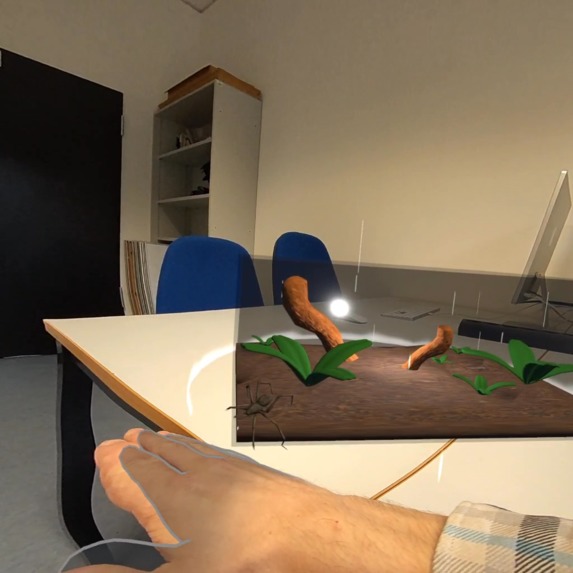
First Contact.
-
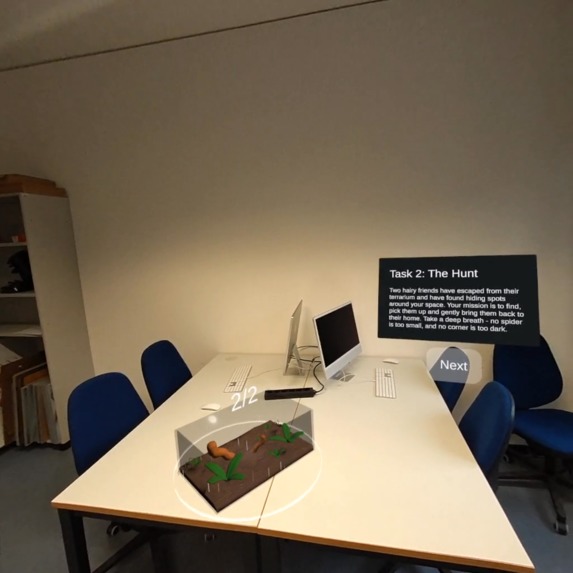
Overview.
-
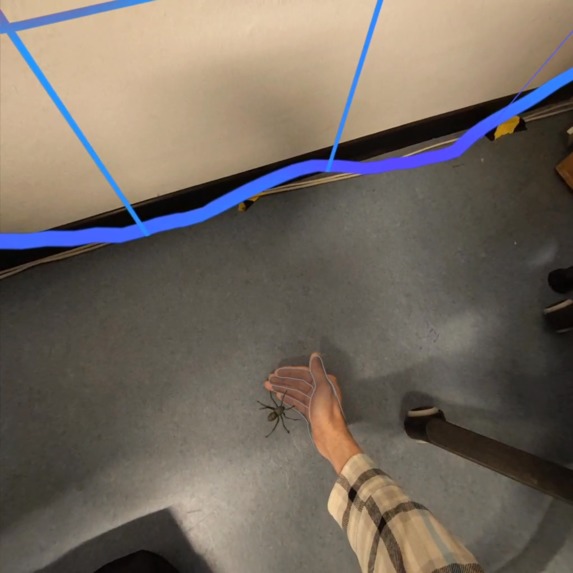
Safely Escorting the Spider Home.
-
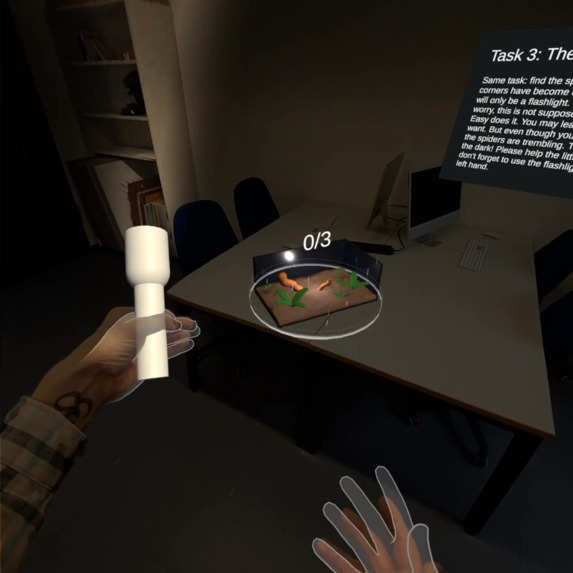
Hunting Spiders in the Dark with a Flashlight.
Inspiration
During a VR meeting, we discussed the idea of participating in the "Meta Quest Presence Platform Hackathon 2024."
After brainstorming various concepts, including a Mixed Reality (MR) pet simulator featuring a dog, we realized that our ideas exceeded our current resources and the given timeline.
However, one of these ideas captivated us, shifting our focus to spiders and the almost intuitive fear associated with them. Through an MR challenge, a safe environment can be created, allowing people to gently approach these animals.
What it does
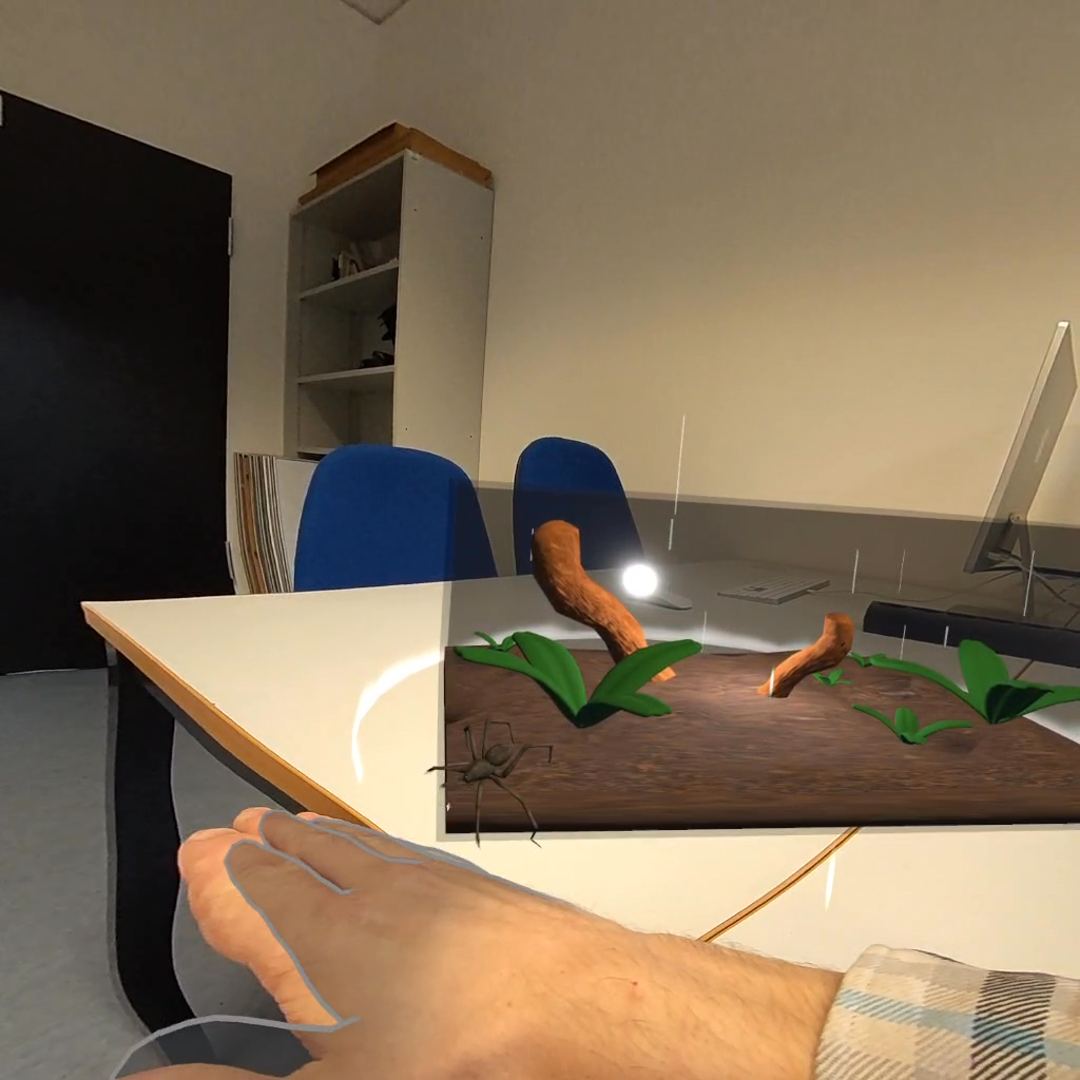
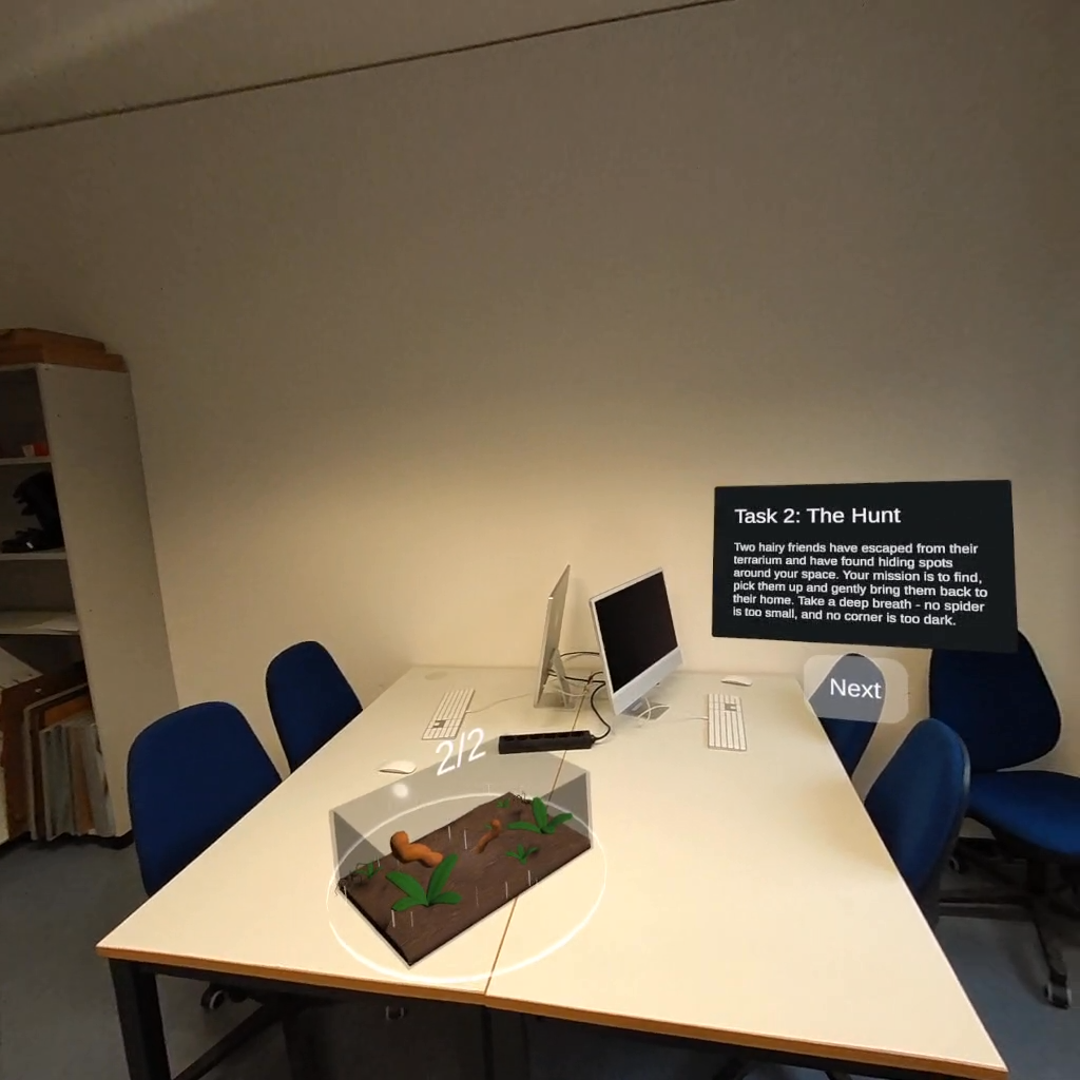
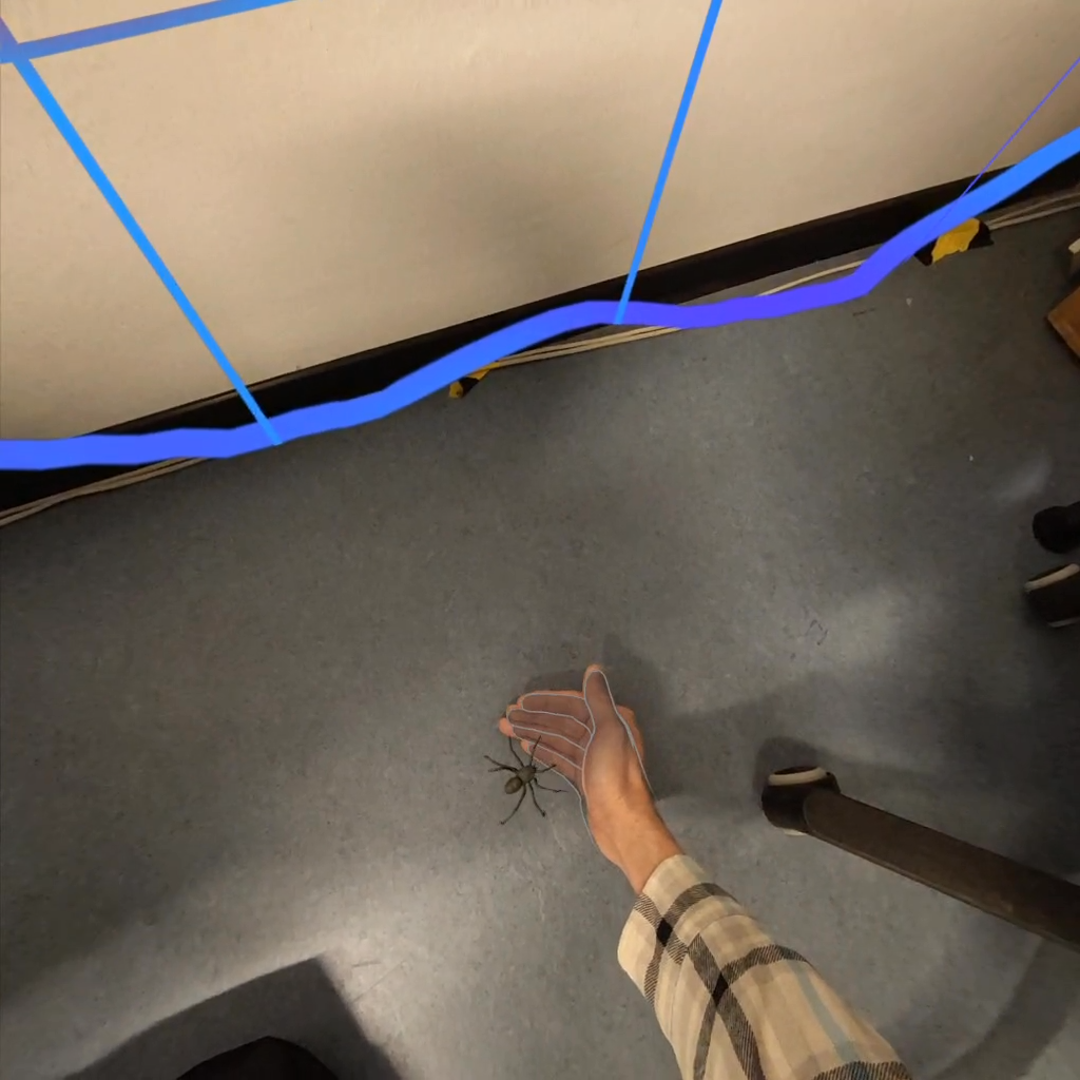
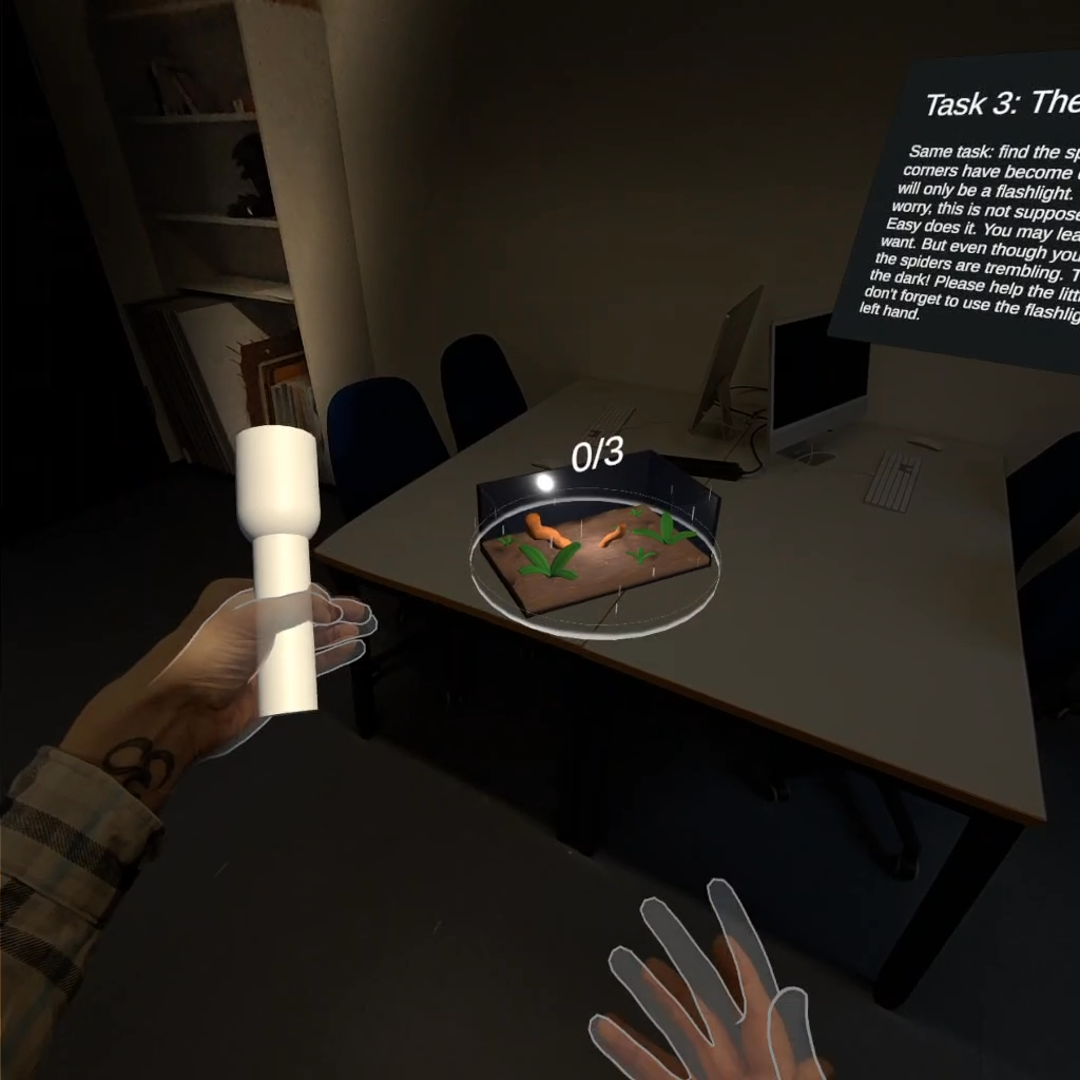
Arachnophil is an immersive Mixed Reality (MR) challenge designed to help individuals overcome their fear and disgust of spiders. It features three tasks, carefully designed to gently develop a sense of familiarity.
The tasks increase in complexity and level of interaction:
- Approaching the spider & holding it in your hand.
- Searching for the spider hiding in the room.
- Finding the spider & safely bringing it home from the darkness.
This gradual escalation not only deepens immersion but also systematically accustoms players to the presence of spiders in MR. Ensuring the participants' sense of safety is a critical focus to prevent deepening any aversions and fears. Throughout the experience, they maintain control over the situation.
Arachnophil offers a unique approach to overcoming arachnophobia.
„The analysis revealed that the repeated administration of the AR app led to significantly lower subjective fear in the BAT compared to the control group ... “1
Our Users
The application of virtual realities in therapeutic contexts, especially for treating phobias, leads to positive outcomes. Therefore, we want to specifically target individuals suffering from arachnophobia.
At the beginning of the development process, we encountered a scientific study examining the use of VR to reduce arachnophobia among participants:
"The increasing success of using virtual reality (VR) in therapeutic settings has been documented in several studies. Virtual reality exposure therapy (VRET) has been demonstrated to be an effective and empirically validated alternative to in vivo exposure for several specific phobias."2
However, we invite everyone to take on the challenge!
How we built it
Roles within our team are defined. Once we agreed on a concept, we were able to start with the individual development processes simultaneously:
- Working on the Unity project,
- designing 3D assets and textures in Blender and
- writing task texts and required documents.
Challenges we ran into
The biggest challenge was the initial brainstorming. Bringing us to a playable & simple concept that also provides real value was difficult. We also stumbled over the temptation to develop a horror-like application, as it's so easy to exploit the use and symbolism of spiders in this genre.
We chose the opposite. We aimed to balance gentle & immersive interaction with constructive handling of fear. With this background, we developed a concept that hopefully meets the needs of our target audience.
Accomplishments that we're proud of
This event is a first for us as a team, and we wanted to take on the challenge. We are all perfectionists, and in the past, this has made the development of our ideas and projects bigger than they are. The realization that we work well as a team, efficiently and successfully, is an extremely valuable experience for us.
For the first time, we were able to complete a project - and we had fun doing it! We experienced self-efficacy as a team, managed our resources, and succeeded in developing a playable MR prototype.
Furthermore, we have opened up a new dimension for our game development ideas.
What we learned
- We've learned that we can complete a project and we don't need perfectionism.
- We've developed an understanding of how Augmented Reality (AR), Virtual Reality (VR), and Mixed Reality (MR) can be beneficially used in therapeutic contexts. This includes a preliminary sense of the technical possibilities and development potentials in gamification.
"The use of AR in the treatment of mental disorders is still in its infancy. A few studies have shown that desktop computer-based AR can be successfully used to reduce fear in small animal phobia (cockroaches and spiders)."3 - We explicitly dealt with arachnophobia. In a self-test, we overcame and fought the deep-seated feeling of aversion towards spiders.
What's next for Arachnophil
Further development offers numerous possible paths:
- Implementation of spiders of various sizes, shapes & colors
- Adding other insects
- Expansion through more challenges
- Intensification through a selectable mode and difficulty level (for thrillseekers, perhaps a horror level nevertheless?)
Special thanks to all our testers.
Acknowledgement
1,2,3 https://www.phobys.com/_files/ugd/b0c4cb_5ac534e2e27f44369392ecb2f5dff97e.pdf
APIs used
- Passthrough API
- Grab Interaction
- Effect Mesh
- Hand Tracking
- Poke Interaction
- Virtual Hands
Sources
- YouTube (Spawner & DepthAPI)
- oculus-samples (DepthAPI)
- IK-Wall-Walking-Spider (Spider)
- meta-xr-all-in-one-sdk (Meta XR All-in-One SDK)
- meta-xr-interaction-sdk-ovr-samples (Flash Light & Meta XR Interaction SDK OVR Samples)
- ChatGPT (Voiceover & Cover)


Log in or sign up for Devpost to join the conversation.