Inspiration
Traditional learning can sometimes feel disconnected from the tangible world, especially when dealing with concepts as vast as space. Building on previous explorations into AR-based learning, we wanted to bridge the gap between digital textbooks and physical play. We were inspired by the idea of using mixed reality to bring the solar system directly into a student's environment, utilizing familiar, nostalgic characters to make complex astronomical facts accessible, memorable, and incredibly fun.
What it does
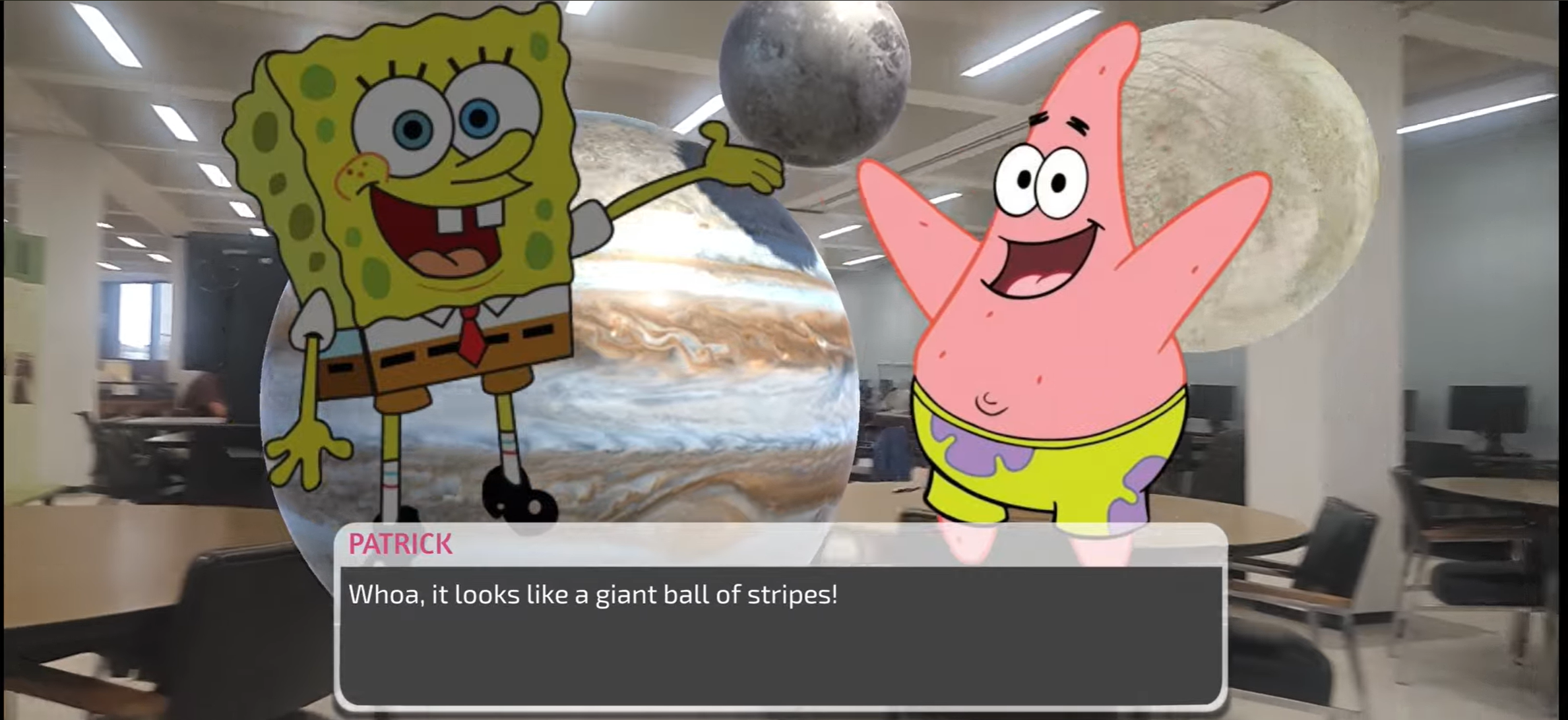
The Jupiter Mission: Orbit & Aim is an immersive, mixed-reality educational game that transforms any physical room into an interactive solar system.
Spatial Exploration: A massive, scaled model of Jupiter and its four Galilean moons (Io, Europa, Ganymede, and Callisto) float directly within the user's real-world environment.
Gamified Learning: Users step into the shoes of a "Space Ranger." Instead of clicking through slides, they physically aim and shoot at specific moons to trigger the next learning module.
Character-Driven Narrative: Iconic pop-culture characters like SpongeBob, Patrick, and Buzz Lightyear serve as virtual guides. They appear dynamically in the space, delivering fully voiced, bite-sized facts about everything from Jupiter's rotation speed to the active sulfur volcanoes on Io.
How we built it
The experience was developed from the ground up using the Unity game engine. To bring the solar system directly into the user's physical environment, we heavily utilized Augmented Reality (AR) SDKs to enable full-color passthrough and spatial tracking.
Challenges we ran into
One of the core challenges in Augmented reality is anchoring digital objects so they feel like they genuinely occupy the physical space, rather than just floating unnaturally on a screen. Calibrating the passthrough environment so the massive scale of Jupiter felt awe-inspiring—without clipping through the real-world floor or overwhelming the user's field of view—took extensive iteration. Additionally, balancing the pacing of the game was tricky; we had to ensure the audio dialogue from the characters synced perfectly with the appearance of the text boxes and the user's physical actions.
Accomplishments that we're proud of
We are incredibly proud of the seamless fusion of education and gaming. It’s one thing to build an AR app, but it’s another to create an environment where the user genuinely feels like they are playing a game while absorbing facts about hydrogen gas planets and magnetic fields. The interaction loop—listen to the briefing, identify the target, take the shot, and learn the lore—feels tight, rewarding, and highly engaging.
What we learned
Building this project was an incredible deep dive into the Unity game engine and the practical capabilities of modern AR tech. We learned firsthand how to balance technical development with user-centered design, particularly when it comes to UI spacing in a mixed-reality environment.
What's next for AR Jupiter Mission: Orbit & Aim
We plan to expand this from a single planetary mission into a comprehensive, multi-module AR educational platform. A major next step is replacing the static dialogue with dynamic, AI-driven conversations. By integrating tools like LangChain and lightweight Large Language Models, we want to allow users to ask characters unscripted, real-time questions about space. We are also looking into replacing the controller-based mechanics with pure hand-tracking gestures for a more frictionless, natural interaction, and eventually mapping out the entire solar system!
Built With
- andriod-development
- augmented-reality
- c#
- unity

Log in or sign up for Devpost to join the conversation.