Use Case Title:
Ocean Plastic Pollution Education
Description:
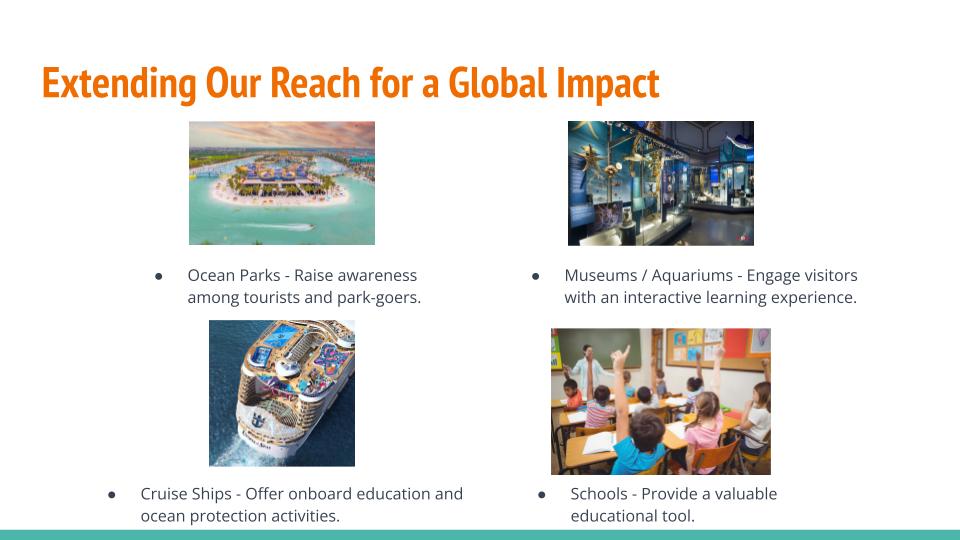
Can be used in schools, museums, cruise ships, and ocean parks to help educate people on the ocean ecosystem and affects of ocean plastic pollution. It uses Google AI for interactivity which can be customized via prompt injection depending on the audience's level of understanding and interest. Outside of schools, there is also an option to try to raise money for ocean cleanup efforts. The target audience for this use case mentioned above can engage with the ocean in an immersive environment and begin interacting with their environment as if they are in the ocean. Given the fact that very very few people actually have the opportunity actually snorkel or deep dive into the ocean for an immersive experience. Therefore, the scale and complexity of the ocean and be lost on people when they study via books or the internet. AquaVista seeks to bridge the experiential gap by creating an immersive environment for the student to experience while learning more about the topic via Google's AI (PaLM 2). The google AI will interact with the student via chat and provide information. The AI has been designed to be an expert on ocean plastic pollution. Depending on the student's level and familiarity, the AI can be customized to meet their level of understanding and interest. The student can also chat with the AI to obtain more information. We believe this solves the problem by providing a bridge between experience and actual interest in the educational material. Studies have shown that when people can visualize and clear identify the problem, they are much more likely to take an interest and study the topic on their own. In our schools today, the educational material is mostly delivered via lectures, books, and assignments with the ocean rarely discussed despite covering 70% of the Earth. We hope this immersive environment can help inspire people to learn about the ocean and understand the threats of plastic pollution.
Tutorial for Use and Best Practices:
Step 1: Installation and Setup
- Download the OceanAware VR application (recommend in Unity so can use Google API key) - If utilizing APK, sideload into Quest headset (see instruction here: https://www.uploadvr.com/sideloading-quest-how-to/)
- Input Google Makersuite API key in GoogleAPI GameComponent (Refer to Github instruction for location) Step 2: Initial Configuration
- Open the application and go through the initial setup, calibrating your VR equipment as needed. Step 3: Navigation
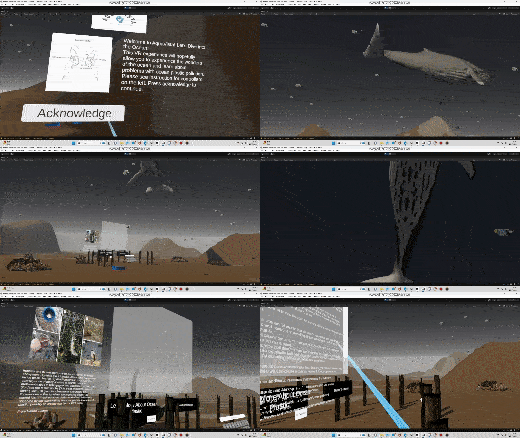
- Use your VR controllers to navigate through the ocean environment.
- Approach different species like whales and fish Step 4: Interaction with Google AI Chat
- Go to the menu area and click on 'Learn More', use keyboard to chat with Google AI.
- Follow the prompts and engage in a conversation with the AI to learn more about the issue. Step 6: Viewing Plastic Pollution
- In the VR environment, you'll also encounter visuals of plastic pollution. Take time to observe and interact to learn more. Step 7: Taking Action
- The Google AI Chat can provide you with actionable steps you can take in the real world to contribute to ocean cleaning efforts.
- Optional: Can click 'Do Something About it' to donate to ocean plastic cleanup
Impacts on Learning:
Immersive Experience
- The use of VR allows for an immersive experience that traditional learning tools like books and videos can't provide. Users can walk alongside ocean creatures and observe plastic pollution first-hand, making the learning experience much more impactful. Interactive Learning
- Google AI Chat enables real-time, interactive learning. Users can ask questions and receive instant answers, deepening their understanding of the topic in a conversational manner. Emotional Engagement
- Seeing the plastic pollution in a lifelike VR environment can evoke emotions that drive home the gravity of the issue, making the learning experience more memorable and potentially inspiring action. Personalized Learning
- AI can adapt to the user's level of knowledge and interest, providing customized information and resources. Multi-Sensory Learning
- The combination of visual, auditory, and even tactile (through VR controllers) stimuli enhances retention and understanding. Without This Use Case:
- Learning would be more passive and less engaging, relying on traditional methods like reading articles or watching documentaries.
- The emotional impact of seeing plastic pollution might not be as strong, reducing the urgency to act.
- Opportunities for interactive and personalized learning would be limited, potentially leading to a less comprehensive understanding of the subject. In summary, the combination of VR and AI provides a multifaceted, engaging, and highly effective learning experience that traditional methods would struggle to match.
Limitations and Ethical Considerations:
Limitations Hindering Learning
- Accessibility: Not everyone has access to VR equipment or a fast internet connection for AI functionalities, which may exclude some users from this learning experience.
- Learning Curve: Some users might find it challenging to adapt to VR or interact with an AI, thus slowing down their learning process.
- Overwhelm: The richness of the VR environment and the depth of information provided by AI could overwhelm some users, making it difficult to focus on the educational content.
- Technical Issues: Glitches, lags, or other technical issues could disrupt the learning experience. Biases
- Data Bias: The AI chatbot is only as good as the data it's trained on. If the data is biased, the AI's responses will be too, potentially leading to misinformation.
- Design Bias: The VR environment might inadvertently emphasize or underrepresent certain aspects of ocean conservation based on the developers' biases or limitations. Validity of AI-Generated Results
- Transparency: Providing details on how the AI chatbot was trained, including the data sets used, can help users evaluate the validity of the information provided.
- Expert Review: Having the content and AI responses vetted by experts in the field of ocean conservation can enhance credibility.
- User Feedback: Encouraging and analyzing user feedback can help in continuously refining the AI's accuracy and reliability. Ethical Considerations:
- Informed Consent: Users should be made aware of how their data will be used, especially in interactions with AI.
- Emotional Manipulation: Care should be taken to present the grim realities of ocean pollution in a manner that is scientifically accurate.
- Inclusivity: Efforts should be made to ensure the application is accessible and inclusive.
Inspiration
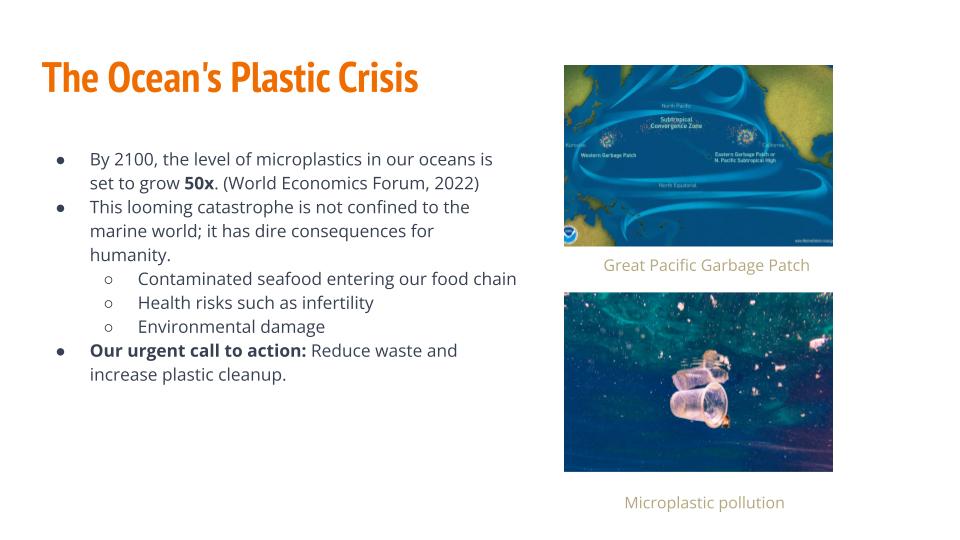
Water covers 70% of the Earth yet the classroom curriculum at most schools mostly ignore what happens in the ocean. Plastic pollution is increasing exponentially and threatening not just marine ecosystem, but also human health. According to research, by 2050 there will be more plastic than fish in the world's oceans. We wanted to educate and find solutions to the problem of ocean plastic pollution.
What it does
Participate in a compelling VR experience that raises awareness about the importance of ocean preservation and cleanup. Users can immerse themselves in a virtual environment where they can experience the beauty of the ocean, learn about the plastic pollution issue, and even be part a of the solution.
How we built it
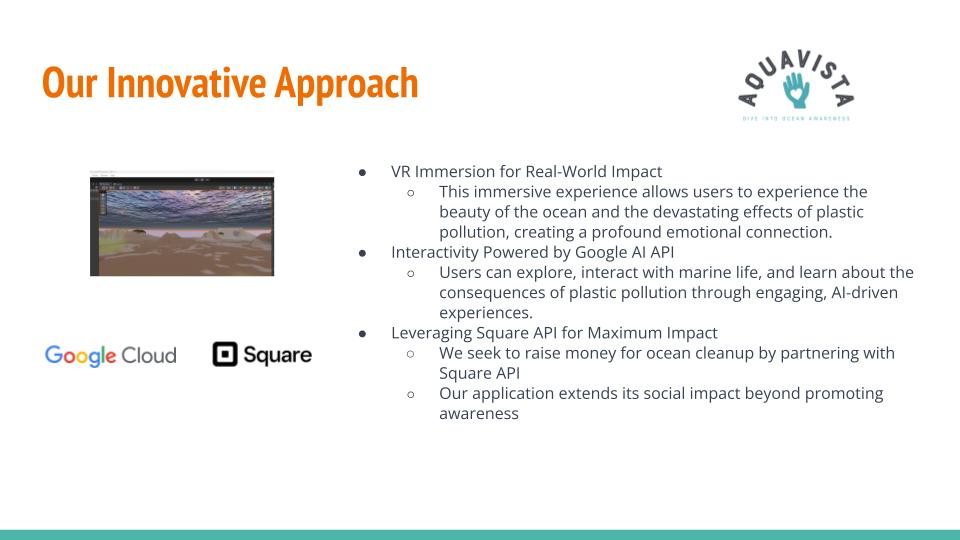
Used the Unity game engine to create immersive ocean VR world with fauna and organisms. Imported various packages and wrote scripts for the interactivity of the environment. Then we integrated the Google PaLM2 API text and chat for information interactivity and Square API for donations to ocean cleanup. The square API would only be available to adult learners who already have a source of income, it will not be available to K12 curriculums.
Challenges we ran into
Unity's game engine can support a lot of interactivity but there's a high processing cost for recreating the complexities of an ocean ecosystem. Unity doesn't have a out of the box API management system so had to write custom scripts for integrating Google AI PaLM2 and Square API.
Accomplishments that we're proud of
Used a game engine to create an enriching experience that seeks to educate and potentially address a real world issue while integrating AI & Payment APIs.
What we learned
How to leverage both Google and Square API's together for a good cause as well as learning how to use them by reading their documentation.
What's next for AquaVista
Try to create a non-profit based on the idea. Seek partnerships with ocean related organizations such as Museums, Aquariums, Ocean Parks, and Schools. We will provide an immersive education tool for low to no cost. At Schools the VR application will focus on education and exclude donation possibility. For adult based education at Museums, Aquariums, and Ocean Parks, it will allow end-user donations for ocean cleanup.


Log in or sign up for Devpost to join the conversation.