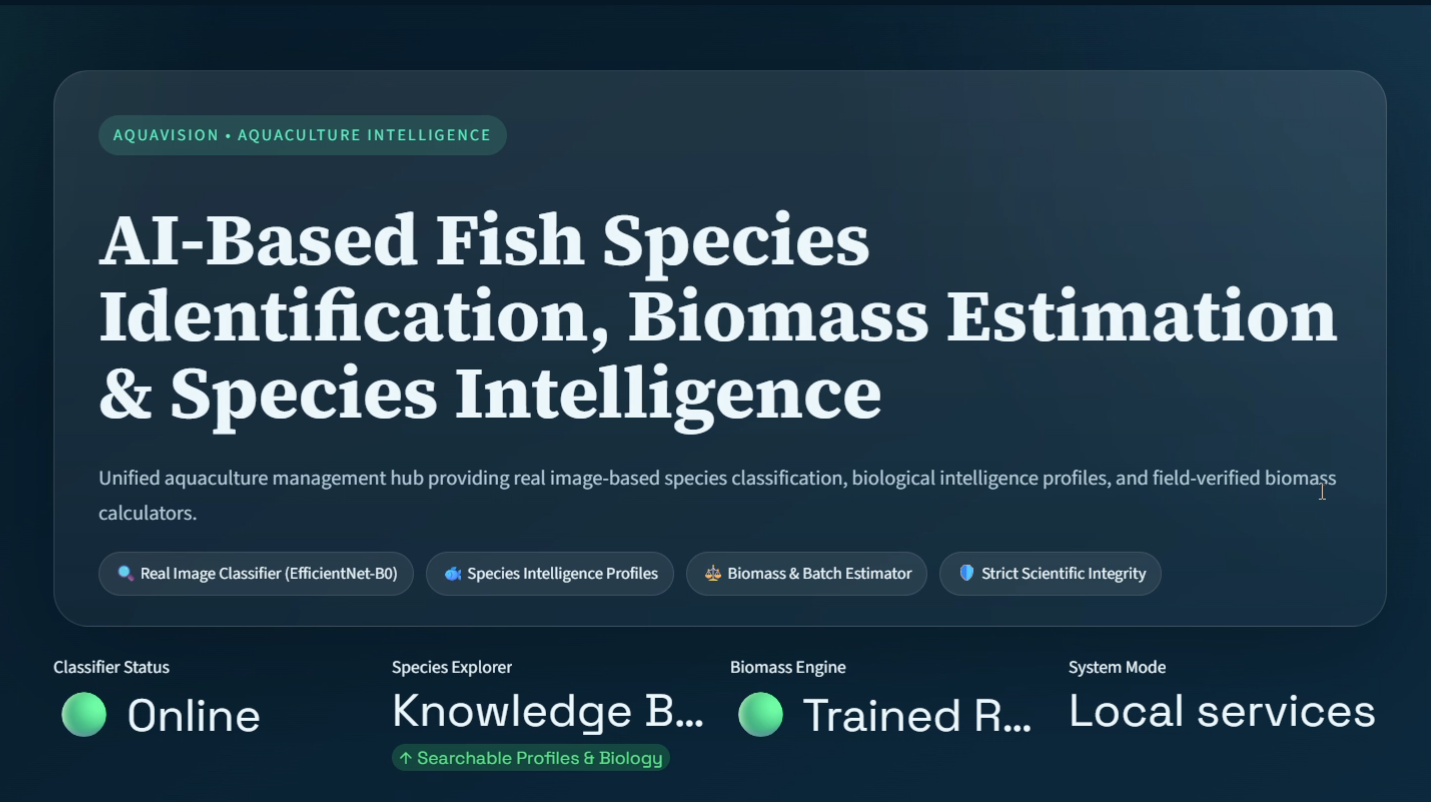
AquaVision — AI-Powered Fish Species Identification and Biomass Estimation
- Inspiration
I was inspired by the vast opportunities to explore both technical innovation and business applications in aquaculture. AI offers significant potential to address real-world challenges in food-related industries, including aquaculture and seafood businesses. I wanted to build a project that would help me explore computer vision, machine learning, biological data, and software development while connecting these technologies to practical industry needs.
- What It Does
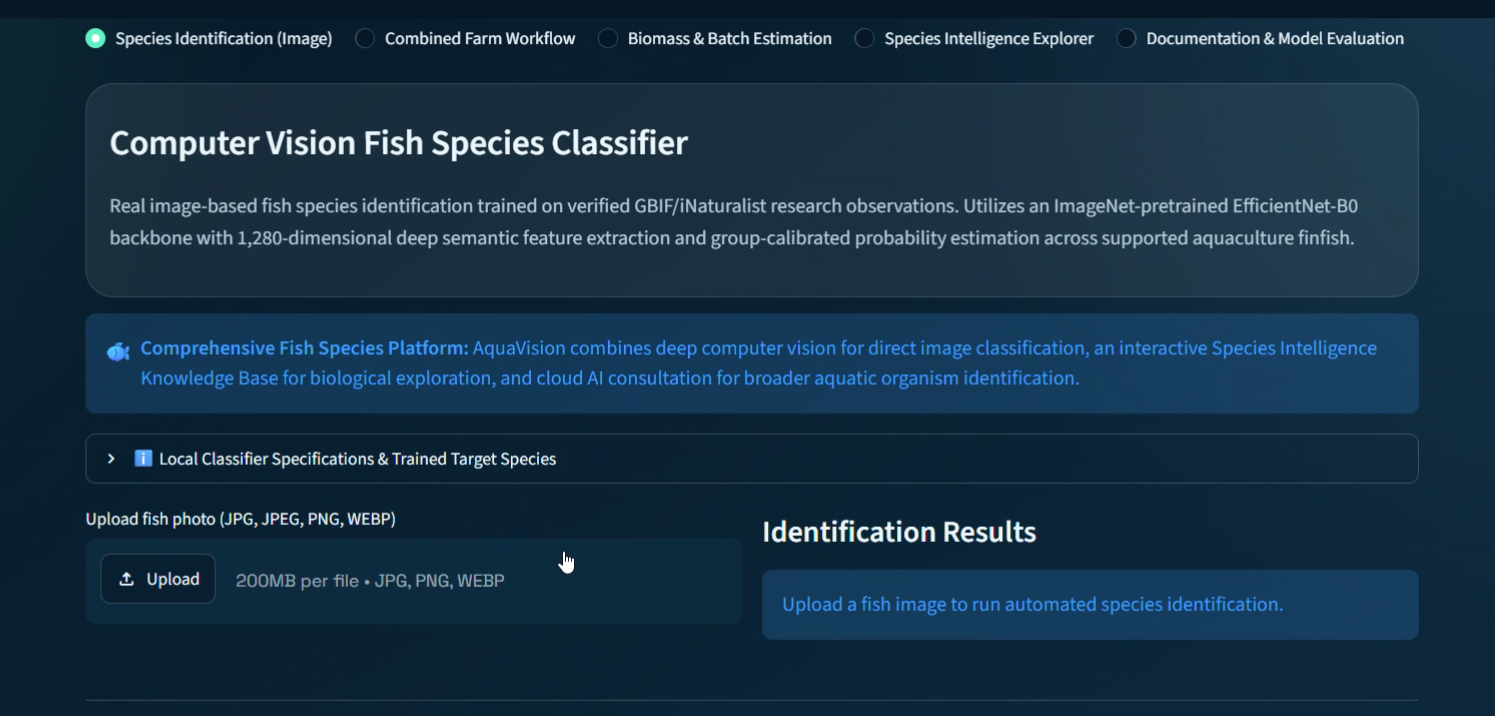
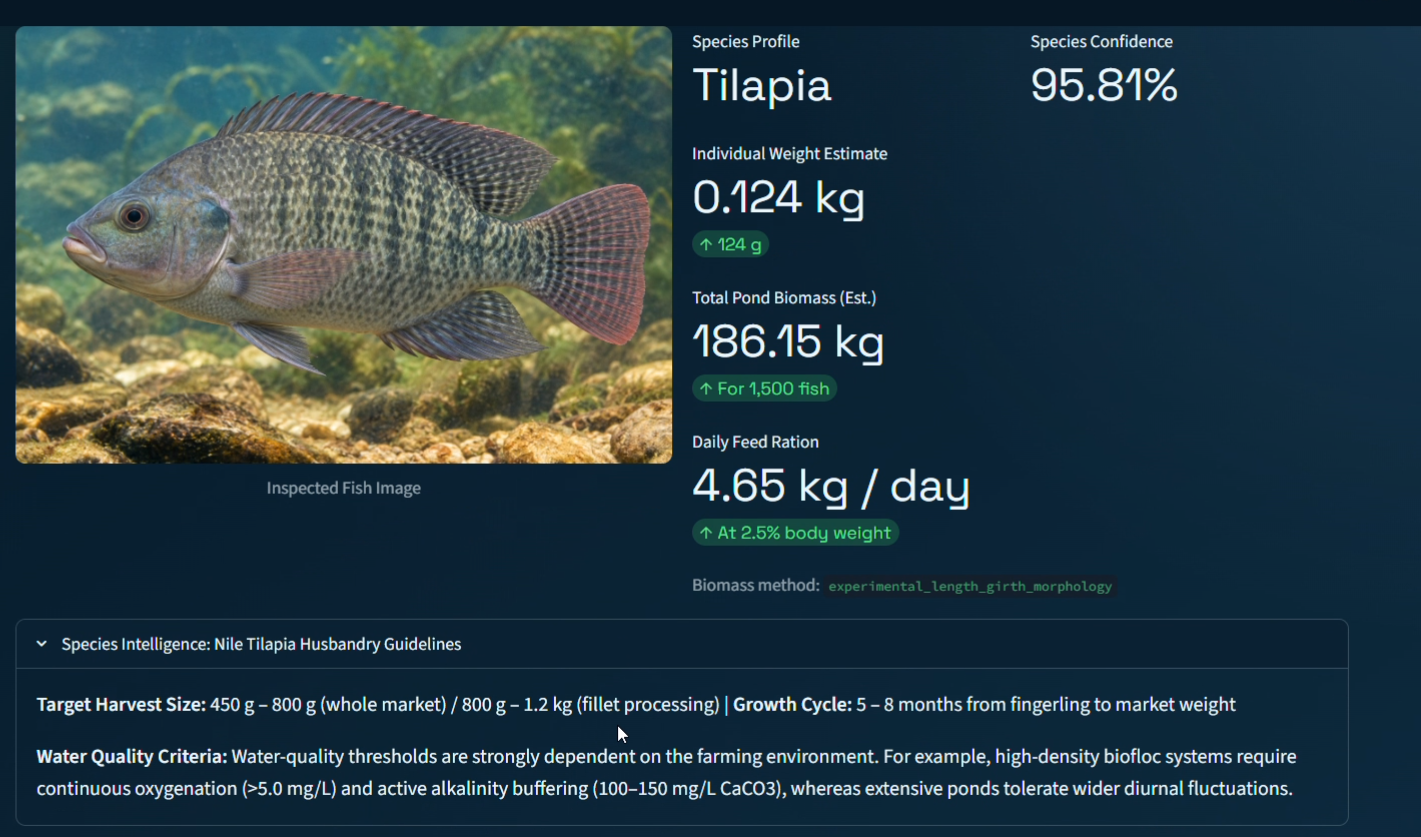
AquaVision is an AI-powered application designed to identify fish species and estimate biomass. It uses computer vision and machine learning to predict fish species from uploaded images. It also estimates individual fish weight using fish length and species-specific biological equations, allowing total stock biomass to be calculated using farm-level inputs.
The application integrates FishBase reference data to provide additional species information. Its goal is to support fish farmers and food-related businesses with useful insights for stock assessment, feed planning, and farm management.
- How I Built It
I developed AquaVision using Python, a pretrained EfficientNet-B0 feature extractor, and a machine-learning classification pipeline. Streamlit provides the user interface, while FastAPI supports backend services. I also integrated FishBase reference data to build a searchable species information system.
The project combines computer vision, machine learning, biological equations, data processing, and API-based application development into a software-based solution.
- Challenges We Faced
One of the main challenges was developing a reliable fish species classifier with limited training data. Evaluating model performance and preventing data leakage were also important considerations. Another challenge was connecting species identification with meaningful biomass calculations while ensuring that the application presented results clearly.
These challenges helped me understand the importance of dataset quality, model evaluation, and the limitations of AI predictions.
- What I Learned
Through AquaVision, I gained practical experience in computer vision, machine learning, feature extraction, classification, API development, data integration, and model evaluation. I also learned how to connect technical implementation with real-world business requirements and how to identify areas for future improvement.
- AI + Business Impact
AquaVision demonstrates how AI can connect technological innovation with practical business needs. In aquaculture and seafood-related industries, better access to fish identification, stock assessment, and biomass estimates could support more informed operational decisions.
The project aims to reduce manual effort and support feed planning and farm management. With broader datasets, rigorous validation, and feedback from real aquaculture businesses, AquaVision could be developed further into a more reliable decision-support tool for the food industry.
Built With
- azure
- genai
- machine-learning
- n8n

Log in or sign up for Devpost to join the conversation.