Inspiration
We kept coming back to a simple question: what good is environmental data if the people making water decisions cannot easily turn it into action?
Weather and environmental systems can produce large amounts of rainfall, soil-moisture, temperature, and other measurements. But for a farmer, water manager, or community operator, another chart is not necessarily helpful. They need to know what changed, whether it matters, and what they should do next.
That gap inspired AquaSignal.
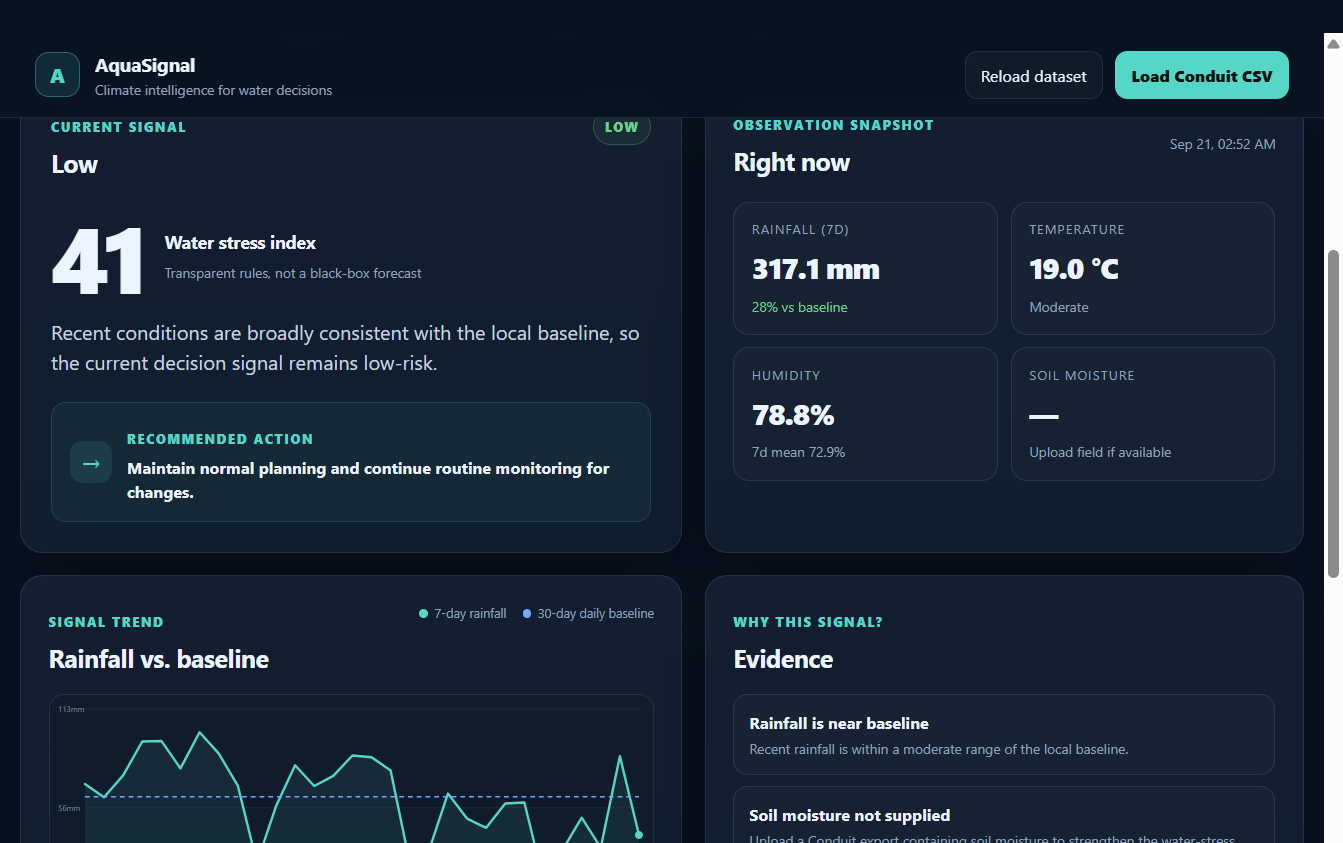
We wanted to build something that respects the reality of the user: they may not have time to interpret multiple datasets, understand statistical anomalies, or monitor dashboards all day. AquaSignal turns environmental observations into a simple risk signal, supporting evidence, and an actionable recommendation.
What We Built
AquaSignal follows a simple pipeline:
Environmental data → Risk detection → Evidence → Decision → Action
Instead of leading with raw measurements, the interface leads with the decision context. For example, when recent rainfall falls below its historical baseline and supporting environmental signals indicate increasing water stress, AquaSignal can surface a Watch or Elevated signal and explain the evidence behind it.
The goal is not to replace human judgment. It is to make that judgment faster and better informed.
How We Built It
We built AquaSignal as a lightweight web application designed around the Hack The Weather challenge and its emphasis on turning data into insight and impact.
The MVP includes:
- Environmental-data ingestion from CSV exports
- Automatic recognition of common field-name variations
- Rolling baseline calculations
- Anomaly and risk-signal logic
- Supporting evidence for every signal
- Action-oriented recommendations
- Responsive dashboard experience
- Clear separation between observed data and derived insights
We deliberately chose a transparent rules-and-baseline approach for the MVP instead of hiding the decision inside a black-box model. A judge or user should be able to ask, "Why did AquaSignal issue this signal?" and receive a comprehensible answer.
What We Learned
One of our biggest lessons was that more data does not automatically create more value.
The challenge is not simply collecting environmental measurements. The harder problem is translating those measurements into something a person can understand and act on.
We also learned that trust has to be designed into the product. A risk score without evidence is easy to dismiss. AquaSignal therefore exposes the observations and logic supporting each signal rather than presenting an unexplained number.
Finally, we learned to design from the decision backward: start with the action the user needs to take, then determine which evidence is actually necessary to support it.
Challenges
The biggest challenge was balancing ambition with reliability.
Environmental intelligence can become extremely complex once forecasting, spatial modeling, historical trends, and multiple data sources are introduced. For a hackathon MVP, trying to solve everything would have produced a complicated system that was difficult to validate and even harder to explain.
We instead focused on one clear job: identify meaningful changes in environmental conditions and turn them into an understandable water-risk signal.
Another challenge was data accessibility and consistency. Real-world datasets do not always arrive with perfectly standardized field names or structures. We designed the ingestion layer to be tolerant of common variations while keeping the underlying calculations explicit.
Why AquaSignal Matters
AquaSignal is built around a simple belief:
The value of environmental intelligence is not the data point itself. It is the better decision that data enables.
We are starting with a focused MVP, but the longer-term vision is to evolve AquaSignal into a decision-support layer for water management—connecting richer environmental data, location-aware risk analysis, alerts, and increasingly precise recommendations.
For us, the project is not about predicting everything.
It is about helping people notice important changes earlier, understand why they matter, and know what to consider doing next.
Built With
- analysis
- analytics
- app
- artificial
- climate
- css
- csv
- data
- environmental
- html
- intelligence
- javascript
- learning
- machine
- processing
- python
- react
- risk
- tech
- visualization

Log in or sign up for Devpost to join the conversation.