-
-
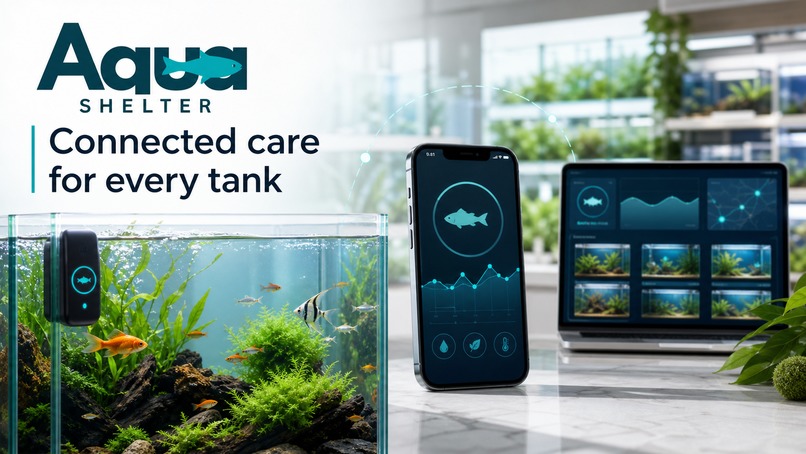
AquaShelter connects mobile and web aquarium care through tank monitoring, fish identification, tasks, and health guidance.
Inspiration
What it does
How we built it
Challenges we ran into
Inspiration
AquaShelter began with a personal loss. I lost one of my fish when life became busy and routine aquarium care slipped. By the time I recognized the warning signs, it was too late.
I built AquaShelter so aquarium care would not depend on memory alone, and so other fishkeepers would not have to experience the same loss.
What it does
AquaShelter is a connected aquarium-care platform for fishkeepers and aquarium shops.
It helps users:
- Manage aquariums, creatures, water conditions, and maintenance tasks.
- Receive reminders when important care becomes due.
- Identify unknown fish from a photo.
- Search a catalog containing 2,232 fish and more than 2,300 aquarium creatures, including plants, corals, and invertebrates.
- Follow a guided Fish Sick workflow.
- Select affected fish and record symptoms.
- Submit measured water parameters or complete a no-kit safety questionnaire.
- Review possible fish health problems and diseases, likely causes, risk levels, unsafe-treatment warnings, and recommended next steps.
- Save results to diagnosis history without losing the original tank context.
- Keep tanks, tasks, notifications, profiles, credits, and health cases synchronized between Android and the web.
- Allow aquarium shops to manage their tanks and follow connected customer tanks.
AquaShelter provides structured aquarium-care guidance and does not replace a qualified aquatic veterinarian.
How we built it
AquaShelter combines a native Android application with a PHP and MySQL web platform.
The Android app communicates with authenticated production APIs instead of relying on isolated local demo data. Mobile actions are reflected on the live server and use the same business rules and data model as the website.
The application includes responsive Android interfaces, server-backed tank and creature management, maintenance tasks, notifications, diagnosis history, profile management, billing credits, fish identification, and guided fish-health workflows.
The current runtime diagnosis integration uses GeminiDiagnosisAdapter. OpenAI Codex with GPT-5.6 was used as the core engineering environment during OpenAI Build Week.
How I used Codex and GPT-5.6
Codex helped me:
- Navigate and understand a large existing Android and web codebase.
- Map website workflows into secure mobile APIs.
- Implement and validate authenticated server integration.
- Refactor connected Android flows.
- Compare mobile interfaces against design references.
- Automate connected-device testing with ADB.
- Investigate synchronization, responsive-layout, navigation, and state-management problems.
- Run contract tests across login, tanks, tasks, notifications, billing, and profile features.
- Prepare and document the public submission repository.
I made the final product, design, and engineering decisions while Codex and GPT-5.6 accelerated implementation, testing, validation, and iteration.
Challenges
The largest challenge was maintaining functional parity between a mature website and a native Android application.
Every mobile action had to use the correct server process, update the shared data model, handle authentication, and remain consistent across different devices and screen sizes.
Other challenges included removing conflicting legacy screens, maintaining responsive layouts, handling offline states, preventing duplicated local data, and validating complete multi-screen workflows rather than testing isolated buttons.
Accomplishments
- Connected Android and web experiences using shared live data.
- Built guided fish identification and fish-health workflows.
- Added real tank, creature, task, notification, profile, and credit synchronization.
- Created support for both individual fishkeepers and aquarium shops.
- Established automated testing and visual validation workflows.
- Built a scalable aquarium database experience with incremental loading and caching.
What I learned
I learned that AI-assisted engineering still requires careful product judgment, server validation, visual review, and end-to-end testing.
Codex was most valuable when used as an engineering partner across the complete system rather than only as a code generator.
What's next
- Publish the Android application on Google Play.
- Expand the aquarium-creature catalog.
- Improve health guidance with additional expert-reviewed data.
- Add more localization and accessibility support.
- Continue improving notification and preventive-care intelligence.
AquaShelter - Identify. Understand. Protect.


Log in or sign up for Devpost to join the conversation.