Inspiration
What it does
How we built it
Challenges we ran into
Accomplishments that we're proud of
What we learned
What's next for AquaSentinel
🌊 AquaSentinel
From Citizen Observations to Actionable Water Intelligence
Inspiration
Urban freshwater ecosystems are closely connected to the health of communities, wildlife, and the environment, yet many streams, ponds, canals, and rivers are not continuously monitored.
We were inspired by a simple question:
«What if an ordinary citizen could report a change in a stream, and that observation could become useful environmental intelligence?»
A photograph of cloudy water, an unusual smell, dead fish, or visible waste may seem like an isolated observation. However, when these observations are collected over time and combined with environmental data, they can reveal patterns that would otherwise be difficult to notice.
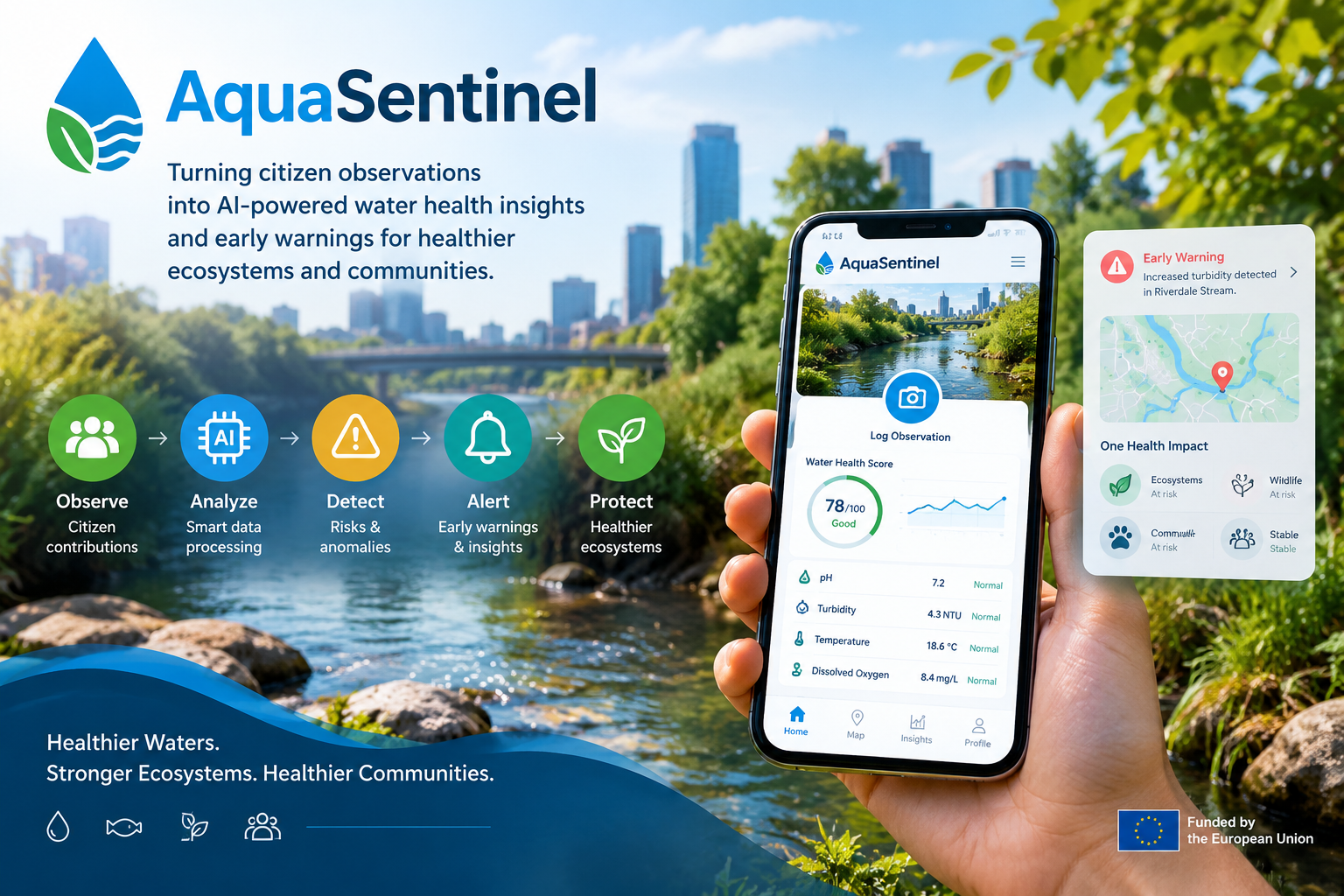
This led us to AquaSentinel, an AI-assisted citizen-science platform designed around the One Health principle: healthy ecosystems contribute to healthier communities.
💡 What AquaSentinel Does
AquaSentinel transforms citizen observations into understandable and actionable insights.
The workflow is:
Observe → Analyze → Detect → Alert → Protect
Citizens can submit observations about a water body through a guided interface, including:
- Water appearance
- Unusual odour
- Visible waste
- Foam or algae
- Fish and aquatic-life observations
- Dead animals or fish
- Photographs
- Location and time
AquaSentinel then combines these observations with historical information to produce a Water Health Score, identify unusual changes, and provide an explainable assessment.
Instead of simply displaying raw environmental data, the platform answers questions such as:
- Is the ecosystem condition changing?
- Is this observation unusual compared with previous observations?
- What indicators contributed to the detected risk?
- How reliable is the citizen observation?
- Does the situation require human verification?
🤖 Responsible AI
A major design principle of AquaSentinel is that AI should assist environmental assessment, not replace human judgment.
The system does not claim that a photograph proves chemical contamination or that an observation constitutes a medical diagnosis.
Instead, it produces outputs such as:
«Possible ecosystem stress detected — 81% confidence»
along with the evidence that contributed to the assessment.
The system can consider factors such as:
- Changes in water appearance
- Pollution indicators
- Biodiversity observations
- Historical trends
- Nearby citizen reports
- Observation completeness and quality
The AI output is therefore accompanied by an explanation and a recommendation for human verification when appropriate.
📊 Turning Data into a Water Health Score
One of the central features is the AquaScore, a simple 0–100 representation of the observed condition of a water location.
A prototype scoring model can combine several normalized indicators:
[ AquaScore = \sum_{i=1}^{n} w_i x_i ]
where (x_i) represents an environmental indicator and (w_i) represents its corresponding weight.
The score is not intended to replace laboratory measurements. Instead, it provides an accessible way to communicate changes in citizen-generated environmental data.
For example:
78/100 — Good
may indicate relatively stable observations, while:
43/100 — Moderate Concern
may indicate a significant change requiring further investigation.
The system also communicates observation confidence, because citizen-generated data can vary in quality.
🔎 Detecting Environmental Anomalies
AquaSentinel focuses not only on the current state of a water body but also on how that state changes over time.
For example:
Week 1 76 Week 2 74 Week 3 72 Week 4 51
A sudden decrease can trigger an anomaly assessment.
For the machine-learning component, anomaly-detection techniques such as Isolation Forest can be applied to combinations of environmental indicators and historical observations.
The goal is not to automatically declare that pollution has occurred.
Instead, the system identifies:
«“This pattern is unusual and deserves attention.”»
This makes the technology useful as an early-warning and decision-support mechanism.
🌍 The One Health Perspective
AquaSentinel was designed around the idea that environmental health, animal health, and human well-being are interconnected.
Our dashboard therefore separates these dimensions:
🌊 Ecosystem
Possible changes in:
- Water condition
- Biodiversity
- Pollution indicators
- Ecosystem stability
🐟 Animal Health
Possible signs such as:
- Reduced fish observations
- Dead aquatic animals
- Changes in visible biodiversity
👥 Human and Community Relevance
Environmental conditions that may warrant:
- Increased awareness
- Additional monitoring
- Professional environmental assessment
The system deliberately avoids turning environmental observations into unsupported medical conclusions.
🧑🤝🧑 Citizen Science and Verification
A single citizen observation should not automatically generate a major environmental warning.
AquaSentinel therefore supports community verification.
For example:
1 citizen report ↓ Possible anomaly ↓ Nearby citizens verify ↓ Multiple consistent observations ↓ Higher-confidence environmental signal
This creates a feedback loop where citizens are not simply data providers. They become active participants in environmental monitoring.
The platform can also encourage sustained participation through points, monitoring streaks, community challenges, and contributor levels.
🛠️ How We Built It
AquaSentinel is designed as a modular web-based platform.
Frontend
The user interface provides:
- Guided observation forms
- Water-health dashboards
- Interactive maps
- Historical charts
- Alerts
- One Health insights
Backend
A REST API manages:
- Citizen observations
- Locations
- Water-health calculations
- AI assessments
- Alerts
- User participation
Data Layer
The system stores:
- Observation records
- Environmental indicators
- Location information
- Historical scores
- AI confidence and assessment results
AI/ML Layer
Python-based machine-learning components are used for:
- Observation analysis
- Anomaly detection
- Confidence estimation
- Pattern identification
The modular architecture also makes it possible to add future sources such as environmental sensors, weather information, biodiversity databases, or other citizen-science platforms.
🧠 What We Learned
Building AquaSentinel taught us that an environmental AI system is not simply about choosing the most sophisticated machine-learning model.
We learned that data quality, explainability, uncertainty, and user experience are equally important.
A citizen may not know the scientific term for a particular environmental condition, so asking the right simple question is often more valuable than presenting a complicated form.
We also learned the importance of distinguishing between:
observation → indication → assessment → verified finding
These are not the same thing.
This distinction shaped our human-in-the-loop approach and helped us design the system so that AI supports experts and communities rather than attempting to replace them.
🚧 Challenges
- Citizen data is inconsistent
Different people may describe the same water condition differently.
We addressed this through guided questions, structured observations, photographs, confidence scores, and cross-observation comparison.
- AI can be overconfident
An image alone cannot determine every aspect of water quality.
We therefore designed the system to communicate uncertainty and avoid presenting AI predictions as laboratory results.
- Environmental conditions change naturally
Not every change represents pollution or danger.
Historical trends and anomaly detection help distinguish unusual patterns from normal variation, while human verification remains part of the workflow.
- Making complex environmental information understandable
Raw environmental datasets can overwhelm ordinary users.
We solved this by translating complex information into:
scores → trends → explanations → recommended actions
while retaining access to the underlying evidence for researchers and decision-makers.
- Building a useful prototype within hackathon constraints
Instead of attempting to build a complete environmental monitoring infrastructure, we focused on a practical end-to-end workflow:
Citizen observation → AI assessment → Water Health Score → anomaly detection → One Health insight → early warning.
This allowed us to demonstrate the complete concept while keeping the architecture scalable.
🚀 What's Next
AquaSentinel can be expanded beyond the prototype with:
- Real-time water-quality sensors
- Satellite and remote-sensing data
- Weather and climate information
- More advanced computer vision
- Multilingual citizen interfaces
- FHIR-based interoperability
- Integration with existing citizen-science platforms
- More sophisticated predictive models
- Direct workflows for environmental authorities
- Larger-scale deployment across cities and water networks
The long-term vision is a distributed environmental intelligence network where communities, researchers, AI systems, and decision-makers contribute to the same feedback loop.
🌱 Our Vision
AquaSentinel is built around a simple principle:
«The people living around our waterways can be the first observers of environmental change. Technology can help turn those observations into meaningful signals.»
We don't want AI to replace scientists, environmental agencies, or communities.
We want it to help them notice earlier, understand better, and act with more information.
AquaSentinel
Observe. Analyze. Detect. Alert. Protect.
Healthier waters. Stronger ecosystems. Healthier communities.

Log in or sign up for Devpost to join the conversation.