Inspiration
Access to safe drinking water is something most people never have to think twice about — until they do. Whether it's a family relying on well water in a rural area, a traveler in a country with uncertain tap water, or an NGO field team screening a new water source after a disaster, the only reliable way to know if water is actually safe is to send a sample to a lab and wait days for results. By the time the answer comes back, the water has already been used. We wanted to close that gap: what if a certified-grade water safety test could fit in your pocket, cost less than a dinner out, and give you an answer before you've finished setting up camp?
What it does
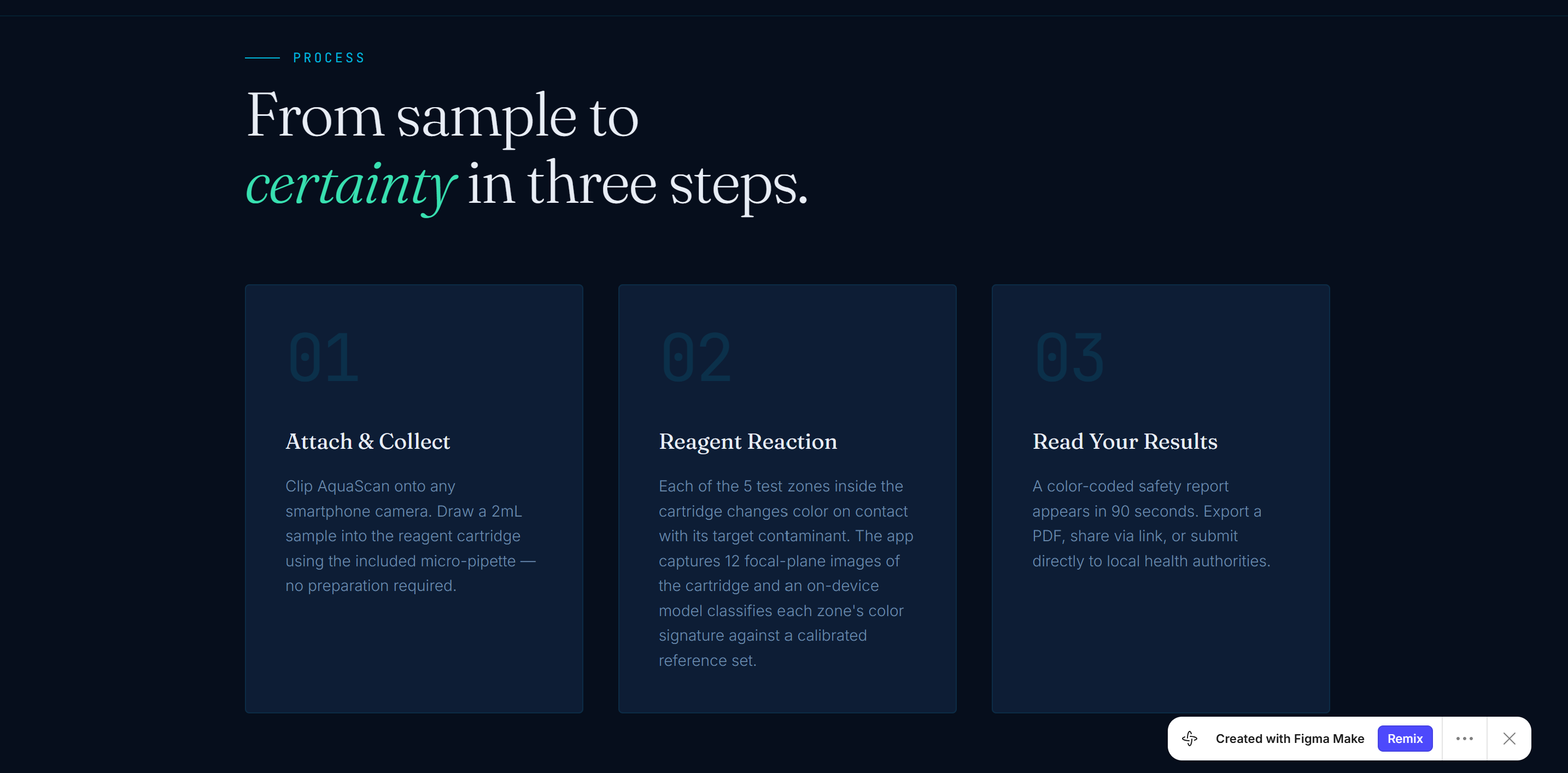
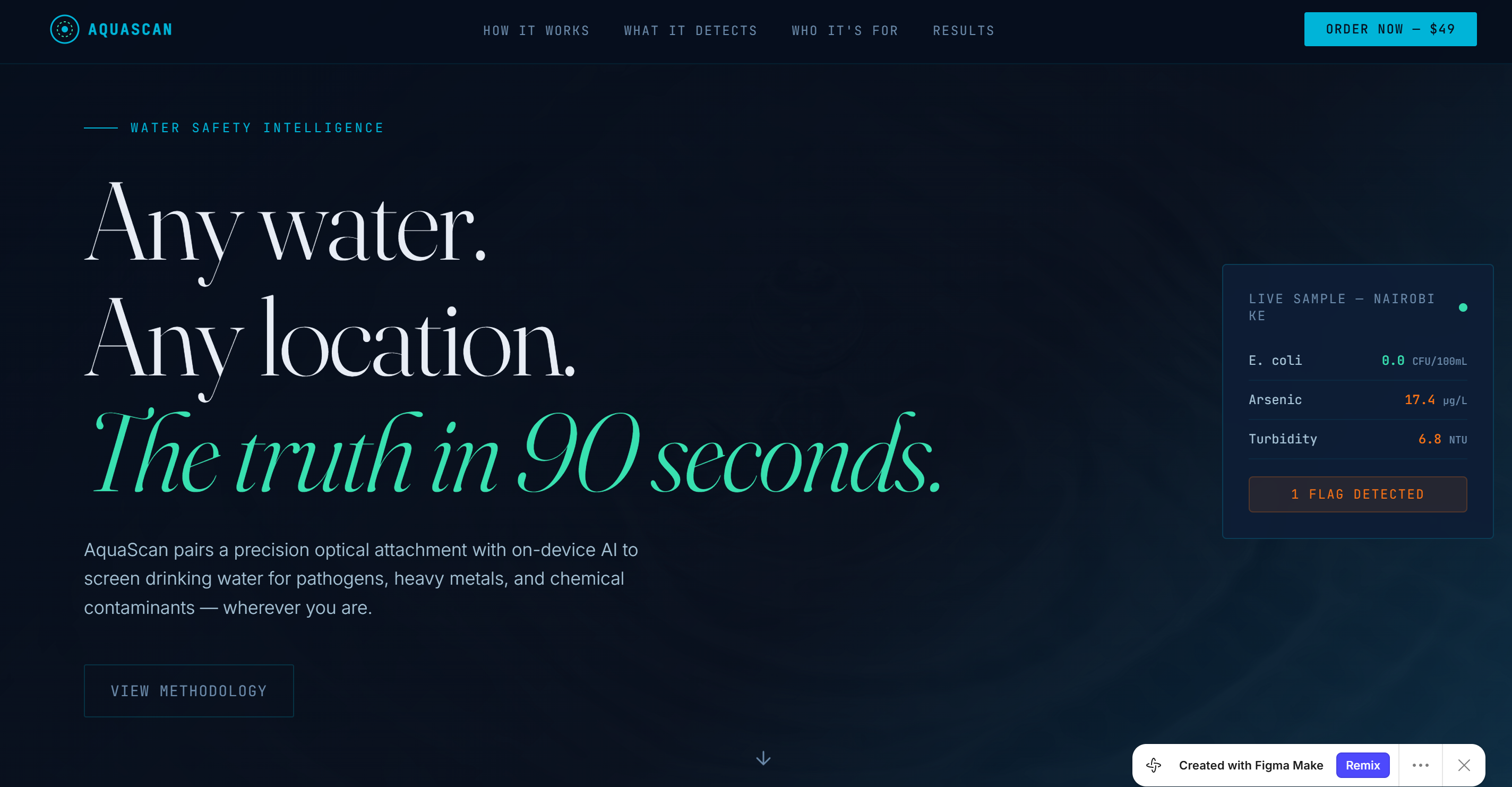
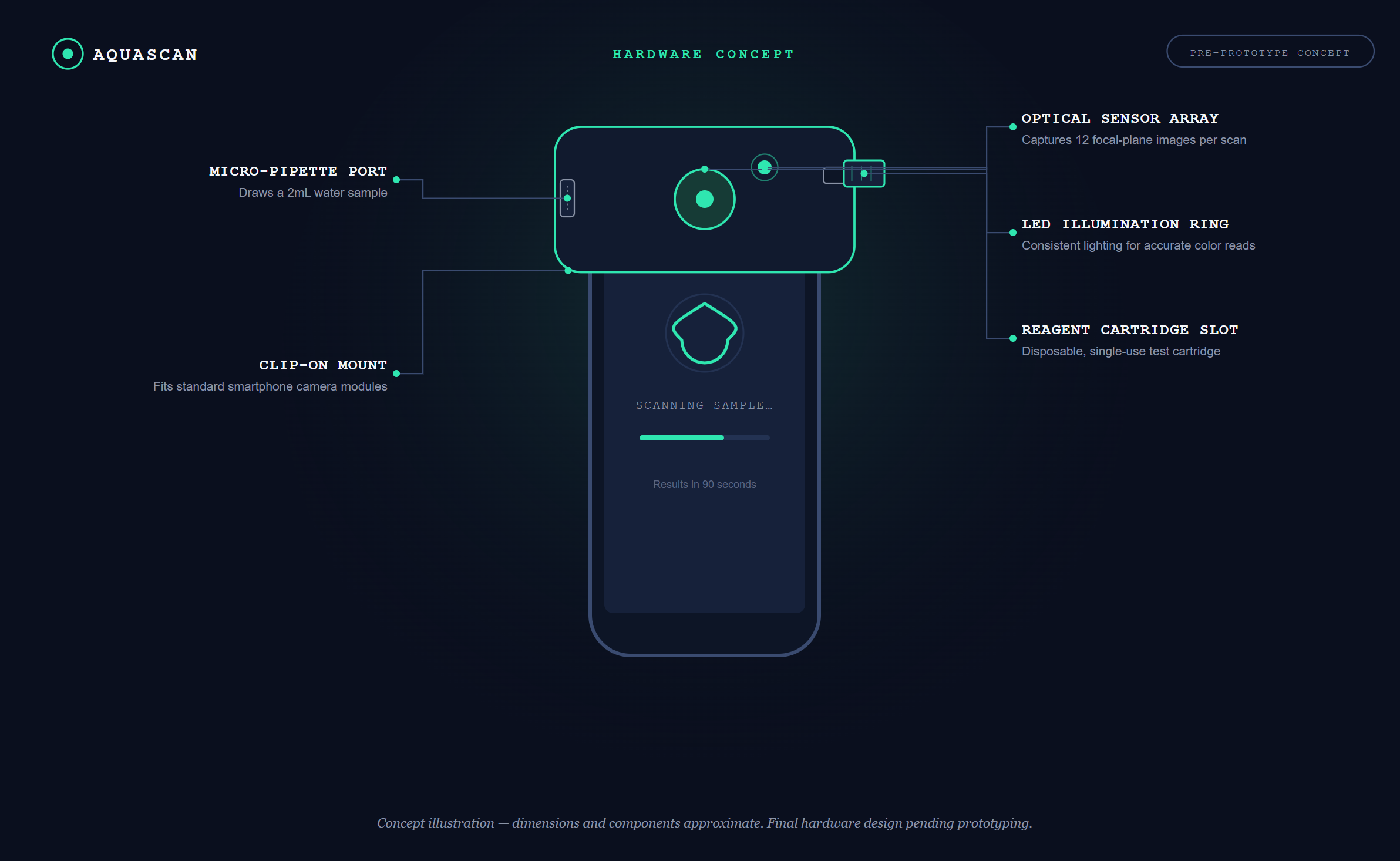
AquaScan is a compact optical attachment that clips onto any smartphone, paired with an on-device AI model that reads a water sample against a panel of contaminant indicators in about 90 seconds. A user draws a small sample using the included pipette into a disposable reagent cartridge; each test zone on the cartridge changes color when it reacts with a specific target — a pathogen indicator, a heavy metal, a turbidity/physical marker. The phone camera captures multiple focal-plane images of the cartridge, and an on-device model classifies each zone's color signature against a calibrated reference set trained on WHO drinking-water guideline thresholds. The result is a clear, color-coded safety report the user can read immediately, export as a PDF, or share directly with a local health authority — no lab, no subscription, no multi-day wait.
How we built it
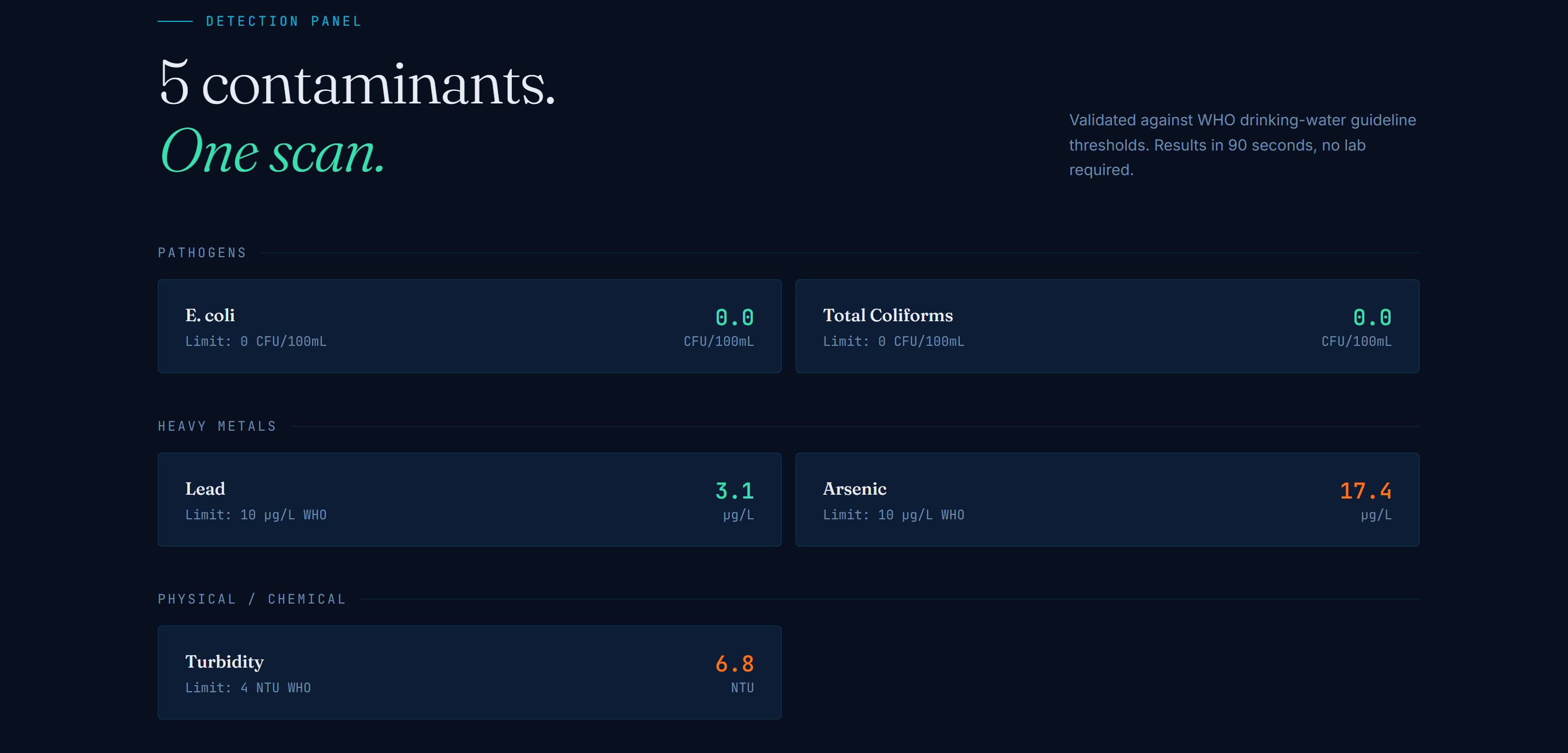
We started from the real bottleneck in water testing: it's not that the science of contaminant detection is hard, it's that lab-grade testing is slow, centralized, and expensive to access. From there we designed AquaScan around a colorimetric-reaction + computer-vision approach, since reagent-based color-change detection is an established, low-cost method for water testing — the innovation is compressing it into a smartphone-attached hardware + on-device AI form factor instead of a lab kit. We prototyped the product experience end-to-end in Figma: the hardware attachment concept, the three-step user flow (Attach & Collect → Scan & Analyze → Read Your Results), and the resulting safety report UI, iterating the design toward a simpler, more scientifically honest presentation — trimming an overloaded contaminant list down to clearly grouped categories (pathogens, heavy metals, physical/chemical) and replacing an unsupported precision claim with a defensible one (validated against WHO guideline thresholds, rather than a fabricated sensitivity percentage).
Challenges we ran into
The biggest challenge was resisting the urge to oversell the technology. Our first draft implied the phone camera alone could directly detect chemical contaminants like arsenic and lead from the water itself, which isn't how optical smartphone-based sensing actually works — it required us to go back and correctly frame the detection mechanism around reagent color-change reactions read by the camera, which is both more accurate and more buildable. We also had to think carefully about calibration: a colorimetric method is only as good as its reference set, and reagent behavior can be sensitive to temperature, lighting, and sample handling, all of which a real implementation would need to control for or explicitly flag as sources of uncertainty.
Accomplishments that we're proud of
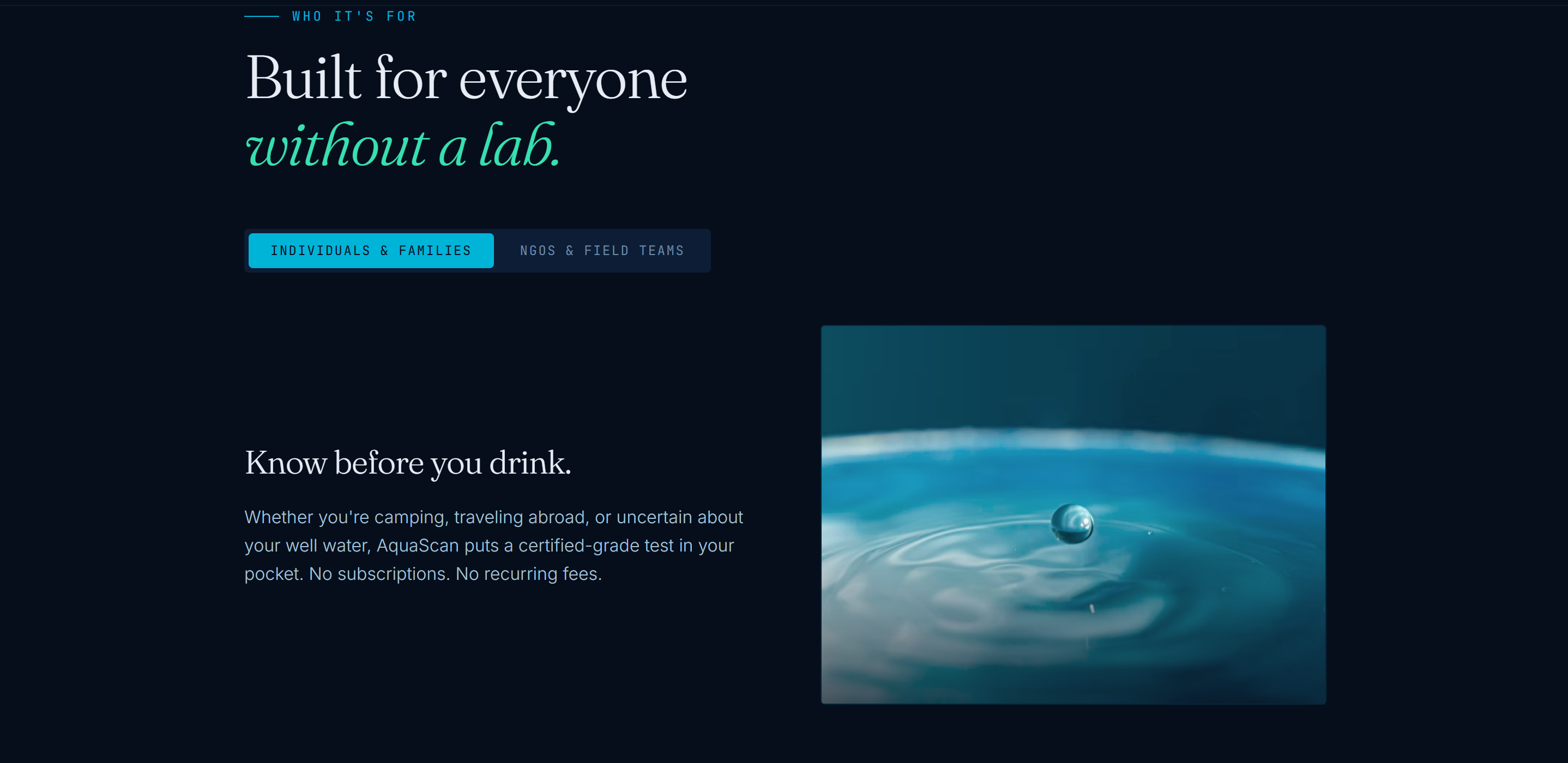
We're proud that AquaScan's design went through a real critique-and-revise cycle instead of shipping the first version — cutting stat overload, correcting the science behind the claims, and landing on a detection method that's both explainable to a non-expert and defensible to a technical judge. We also think the product framing — positioning this as accessible to both individual families and NGO field teams at a single low price point, with no recurring fees — makes the potential impact concrete rather than abstract.
What we learned
We learned that the hardest part of designing a science-based product isn't making it look impressive, it's making sure every claim on the page can survive someone asking "how, exactly?" We also learned a lot about how colorimetric water testing actually works and where its real limitations are, which reshaped both our design and how we'd think about a real feasibility study if this moved past the concept stage.
What's next for AquaScan
Next steps would be validating the reagent-cartridge approach against a small set of known water samples with a real spectrophotometer as ground truth, refining the calibration model to account for lighting and temperature variance, and piloting the design with an NGO field team to see how it holds up outside a controlled setting. Longer term, we'd want to explore expanding the contaminant panel and building a shared, opt-in database of anonymized test results to help map water quality issues geographically over time.
Built With
- figma

Log in or sign up for Devpost to join the conversation.