-
-
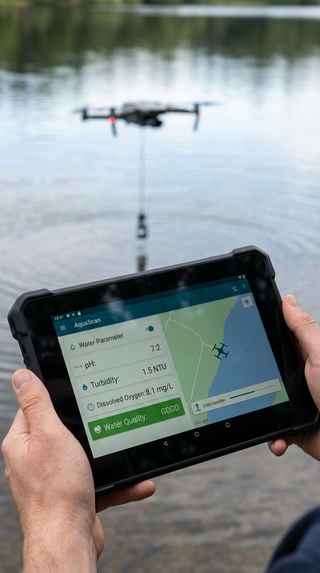
AquaScan

India faces a silent water crisis. From urban drains carrying untreated grey/black water to rural areas relying on unsafe groundwater, water quality testing is either too slow, too expensive, or unavailable. Lab testing takes days, while contamination spreads in hours.
We were inspired to build AquaScan after realizing that water should be tested as easily as scanning a QR code—using AI, sensors, and smartphones to give instant, actionable results at the point of use.
AquaScan is an AI-powered water quality analysis app that instantly detects contamination and assesses water safety.
It can:
Analyze water using UAV portable sensors, mobile cameras, or connected IoT devices
Detect key parameters: pH, turbidity, TDS, hardness, temperature, color, and microbial risk (AI-predicted)
Classify water as Drinkable / Needs Treatment / Unsafe
Identify possible pollution sources (industrial, sewage, agricultural runoff)
Generate real-time reports
Frontend: Mobile app (gemini) for easy use by citizens and field workers
AI Layer:
Machine learning models trained on water quality datasets
Computer vision to analyze color/turbidity via camera
Predictive models for contamination risk
Hardware Integration: Low-cost sensors (pH, TDS, turbidity)
IoT modules for live data streaming
Optional drone-based water sampling
Backend:
Cloud database for geo-tagged water reports
Variability of water samples across regions and seasons
Ensuring accuracy without expensive lab equipment
Training AI models with limited high-quality public datasets
Making the app simple enough for non-technical users
Balancing cost, scalability, and reliability in real-world conditions
Designed a lab-free, instant water testing solution
Reduced water testing time from days to minutes
Built a system usable by citizens, panchayats, municipalities, and disaster teams
Created a platform that can integrate with government water missions
Made water quality data transparent, visual, and actionable
Technology adoption succeeds only when simplicity meets trust
AI can bridge major infrastructure gaps when paired with low-cost hardware
Water problems are hyper-local, so solutions must be decentralized
Collaboration with government and NGOs is essential for real impact
Preventive monitoring is far cheaper than post-crisis response
Integration with Jal Jeevan Mission & Smart City dashboards
AI-based early warning system for contamination outbreaks
Expansion to industrial effluent monitoring
Community-driven water health maps across India
Automated linkage with mobile water treatment trucks
Global deployment for water-stressed regions worldwide

Log in or sign up for Devpost to join the conversation.