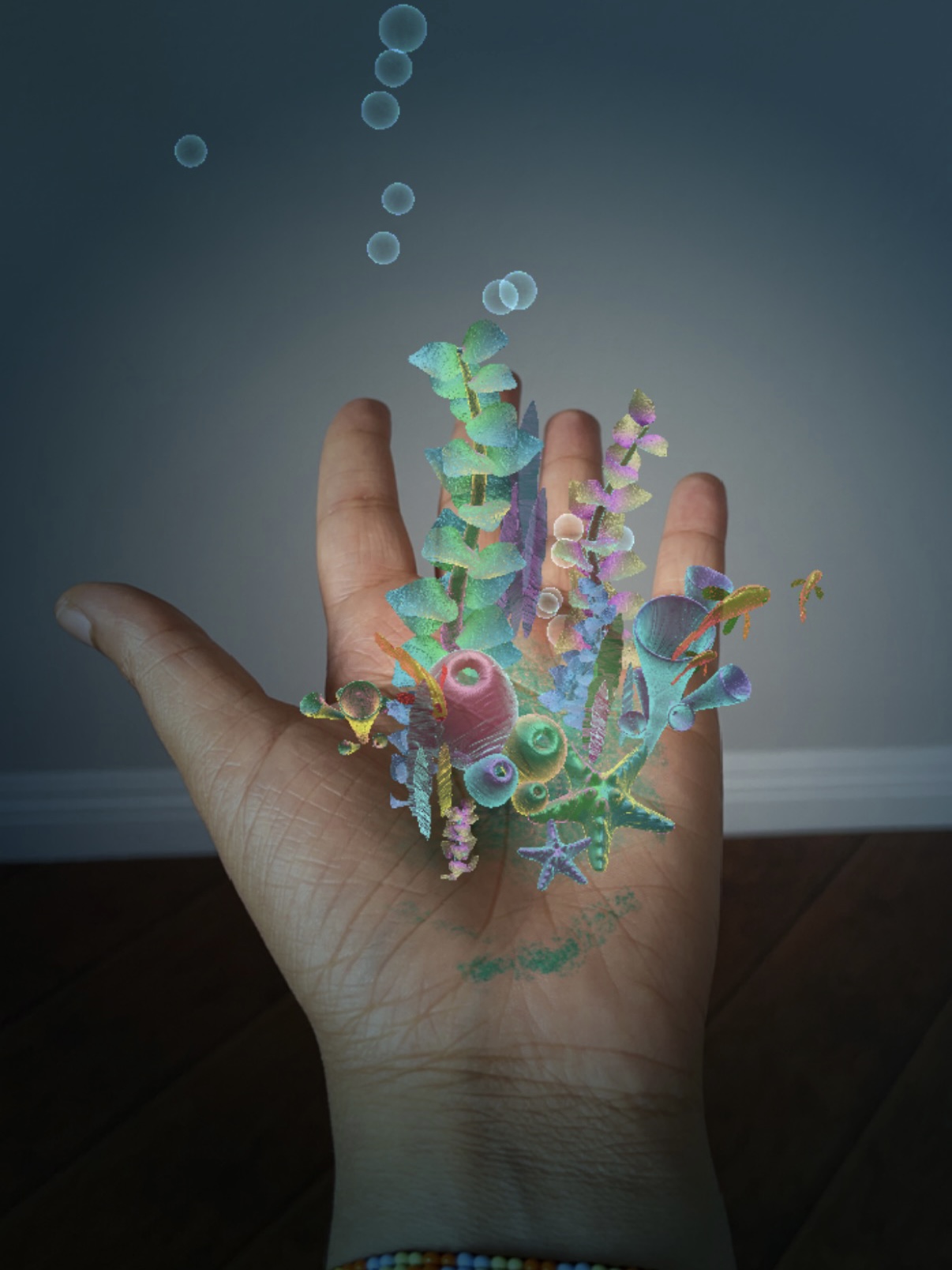
Aquarium is a fun and beautiful lens that uses hand tracking, chain dynamics and 3D animation to create an experience in which the body of the user becomes the canvas for a lively underwater scene.
Inspiration
My main objective behind Aquarium was to mix both digital and physical worlds the most possible, creating a Natural User Interface. By using the user's hand as a platform where the scene is anchored and mixing it with chain dynamics the scene becomes fully interactive, responding to the real environment creating a unique experience for each user.
What it does
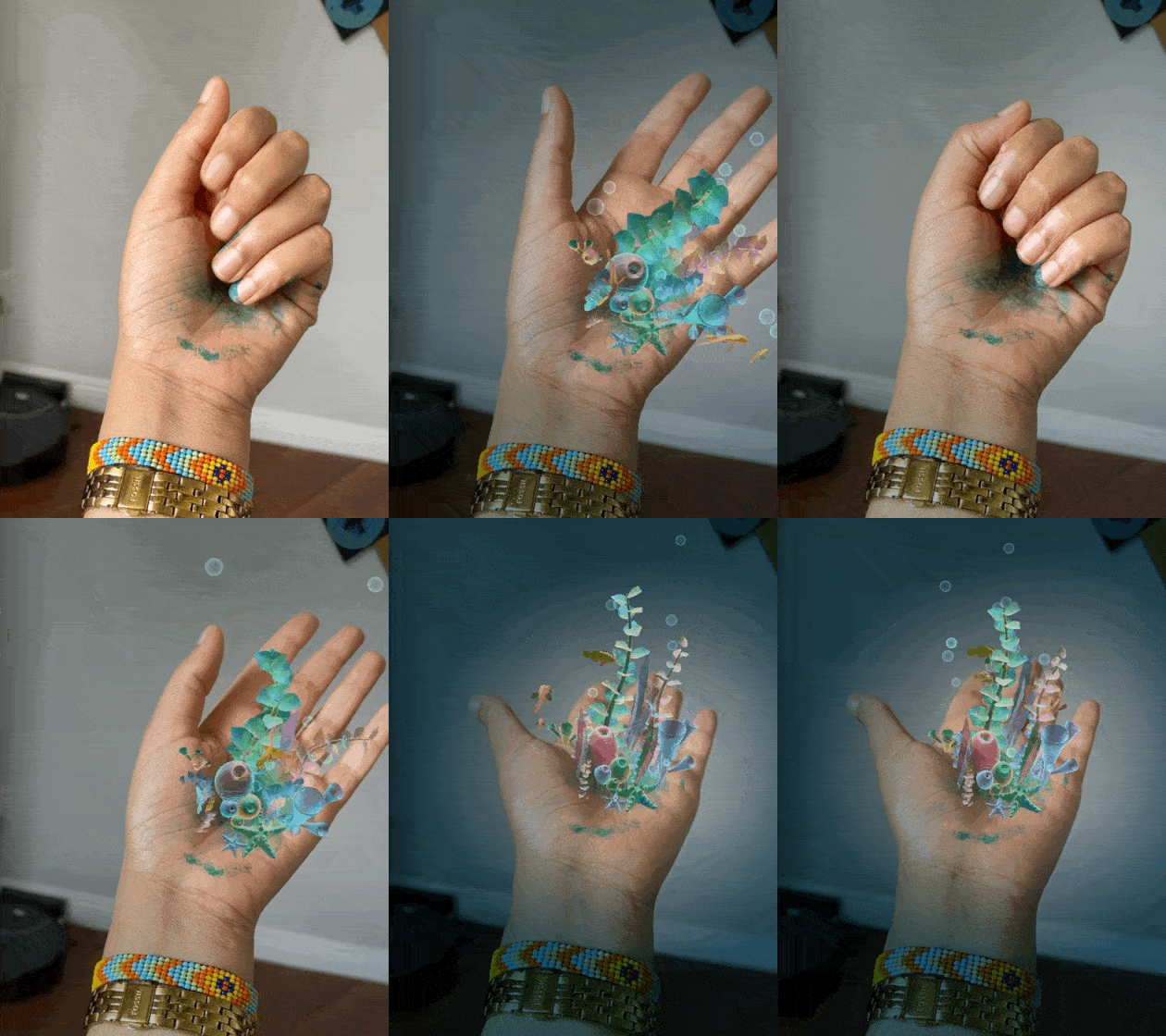
Once the user opens the Lens and instruction to show their hand shows up and a lively aquarium scene with swimming fishes and waving seaweed pops in their hand. From there the interaction on Aquarium is very simple: Shake your hand! A motion that almost any user engages on intuitively when they first open a hand tracking Lens. When the user's move their hand chain dynamics make the scene come alive.
How we built it
Aquarium started with the idea of having a scene hosted on the user's hand as a main way of connection to the physical world and grew from that. Once I set my mind on that, the next task was figuring out the technical steps to make that happen. I started using hand tracking but soon enough I realized that I could combine it with Dynamics to make an even more cool lens. Once I had prototyped the functionality enough to know it was consistent and sustainable, I moved to the drawing board to concept Aquarium.
On a larger scale, Aquarium is part of a series of "Terrariums" I am developing for Snapchat. Miniature landscapes I'd like to observe closely. For this iteration I focused on an underwater scene. Once I had my focus I started by looking at art and design references and sketching how I wanted my scene to look. Once I felt confident in my general idea, I headed to VR and modeled all my pieces using Gravity Sketch, which allows me to get a good sense of how things feel on a real scale. Once my models were ready I moved to cinema 4D where I rigged and animated some of the assets. I wanted to make sure Aquarium could be played in most devices possible, so I reserved the dynamics for some powerful hero elements on the scene.
Once my assets were ready I brought them all to Lens Studio and started laying out the scene. Connecting to chain dynamics the assets that are interactive and making sure everything worked well nicely. One of the most crucial elements in selling the feeling of "this is really anchored in your hand" was including a second hand occluder mesh, additionally to the regular mesh that serves as surface. The last (and my favorite) part was creating the shaders inside Lens Studio. At this point I start checking the frame rate and the lens size very closely, but I had enough space left to add some finishing elements: Bubbles coming from the scene, an interaction that makes the scene disappear where the user closes their hand, and a spotlight effect using custom render targets masks and post effects that makes the Aquarium pop even more on the scene.
Challenges we ran into
The biggest challenge on Aquarium was "Resources management". Creating a scene that feels complete and full with life keeping an eye always on the amount of space and processing power left. To work around this I decided to not spare any expenses on geometry, animation or interaction if I could, but instead make all the shaders dynamically inside Lens Studio. This gave the scene a beautiful ethereal look that I feel is very unique of it.
Accomplishments that we're proud of
My favorite thing of Aquarium is how fun it looks and how easy is to play with it! My parents in their 70's who use no social media, VR or AR, love it.
What we learned
Part of my ethos as a creator is that I should learn something new in every project. Aquarium was for me about mixing interactive elements (Chain dynamics) with baked animations. The other thing that is very unique in Aquarium was the implementation of VR when modeling for AR as a pipeline that really allows me to visualize how things will look very early on, without having to implement everything in Lens.
What's next for Aquarium
As I mentioned earlier, Aquarium makes part of a series of "Terrariums" I am developing for Snapchat. Part of the work I am trying to do with those "Terrariums" is create an artistic body of work inside Snapchat. For my next scene I'd like to push the miniature and the little animations on the scene more. I am thinking of trying a little forest next.
Built With
- cinema4d
- gravitysketch
- lensstudio


Log in or sign up for Devpost to join the conversation.