-
-
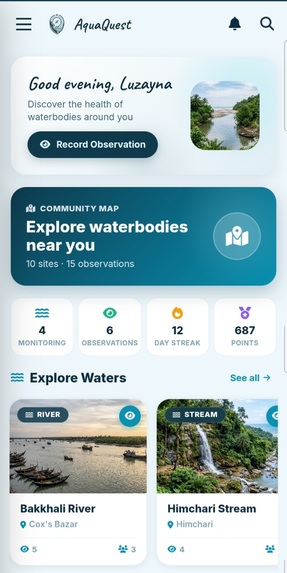
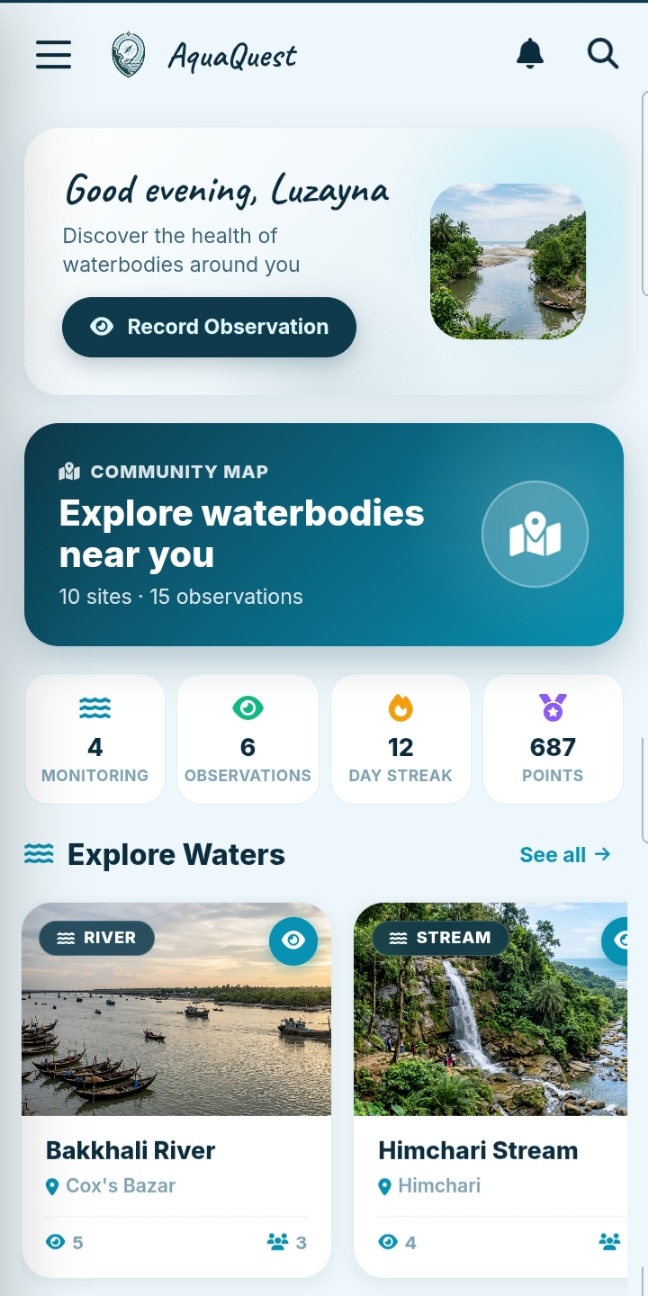
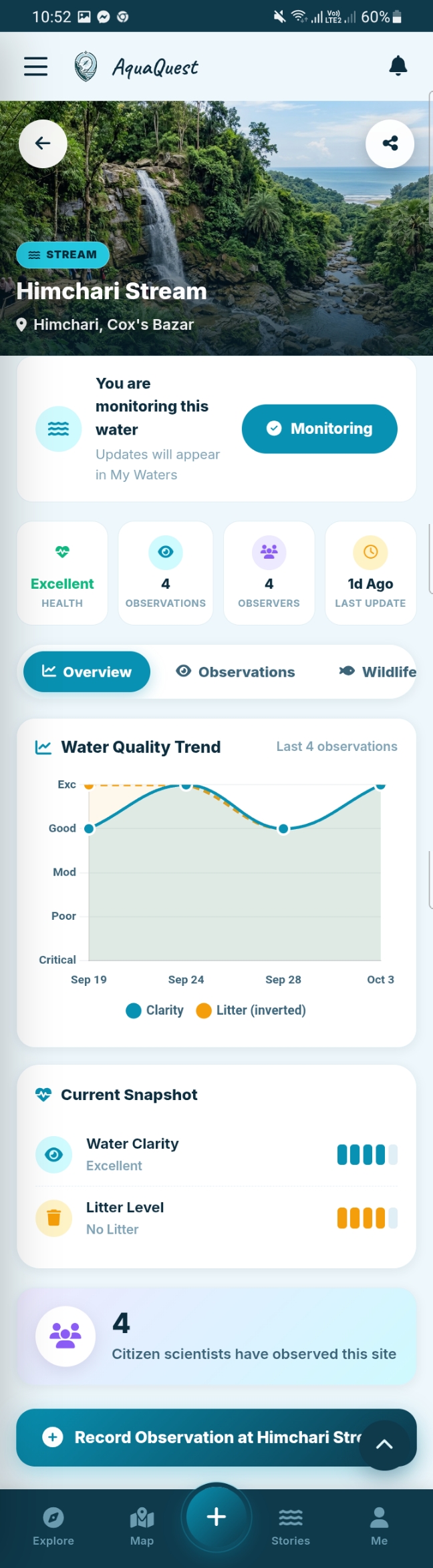
Home dashboard — Explore water health around you
-
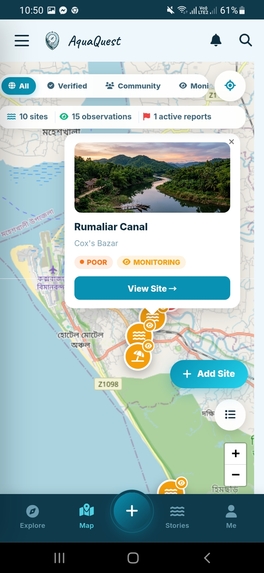
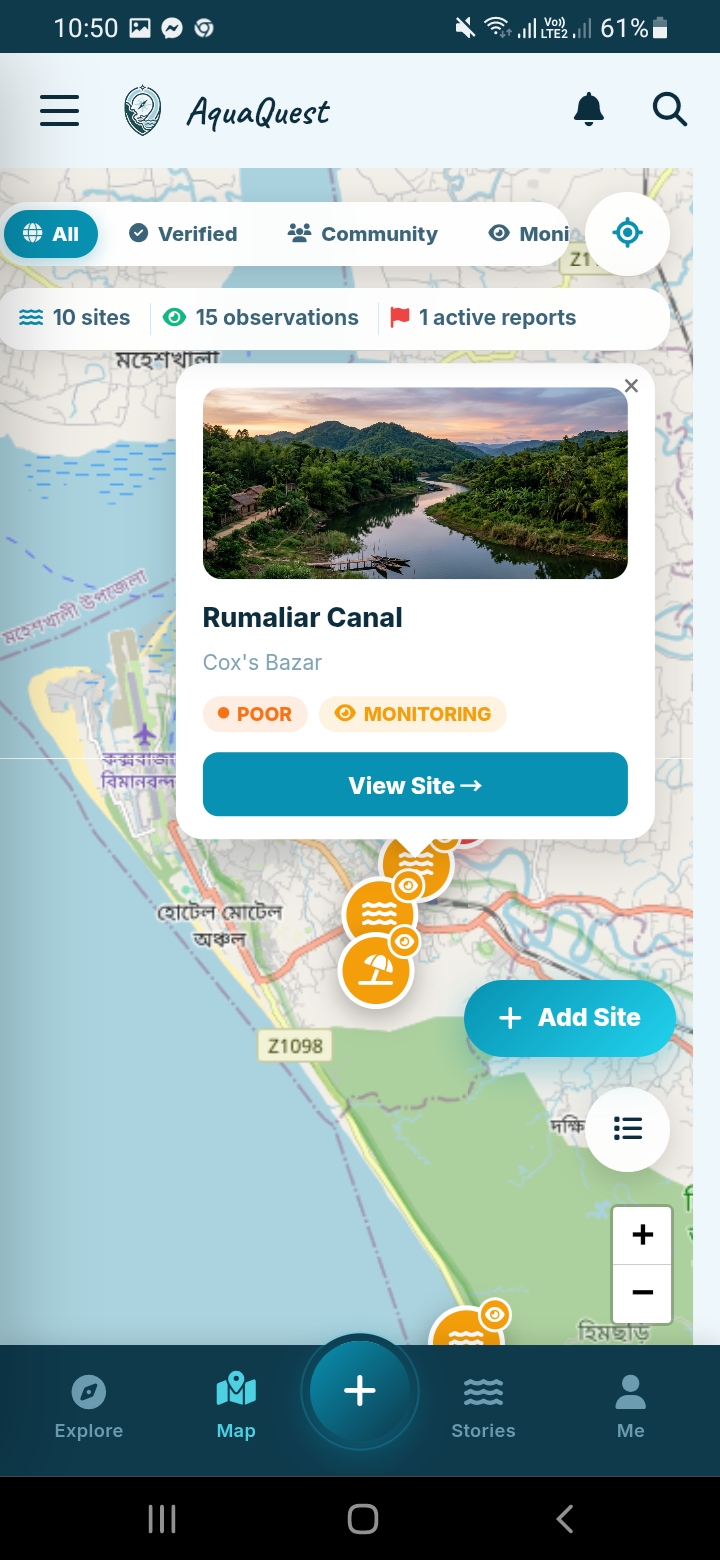
Community Map — Find waterbodies near you
-
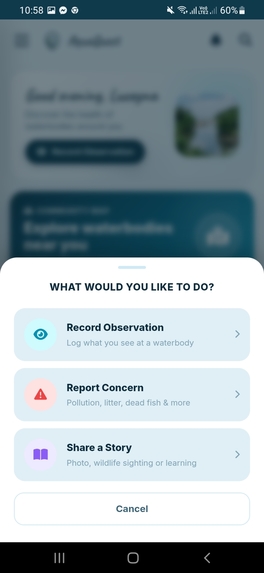
Home dashboard — Explore water health around you
-
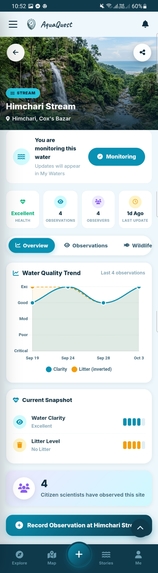
Site detail — Water quality trends & health snapshot
-
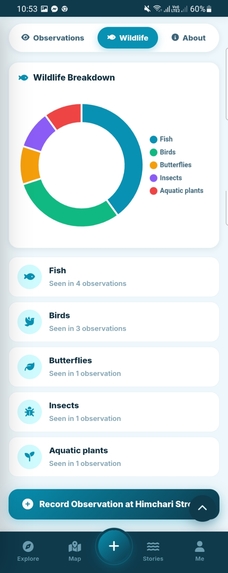
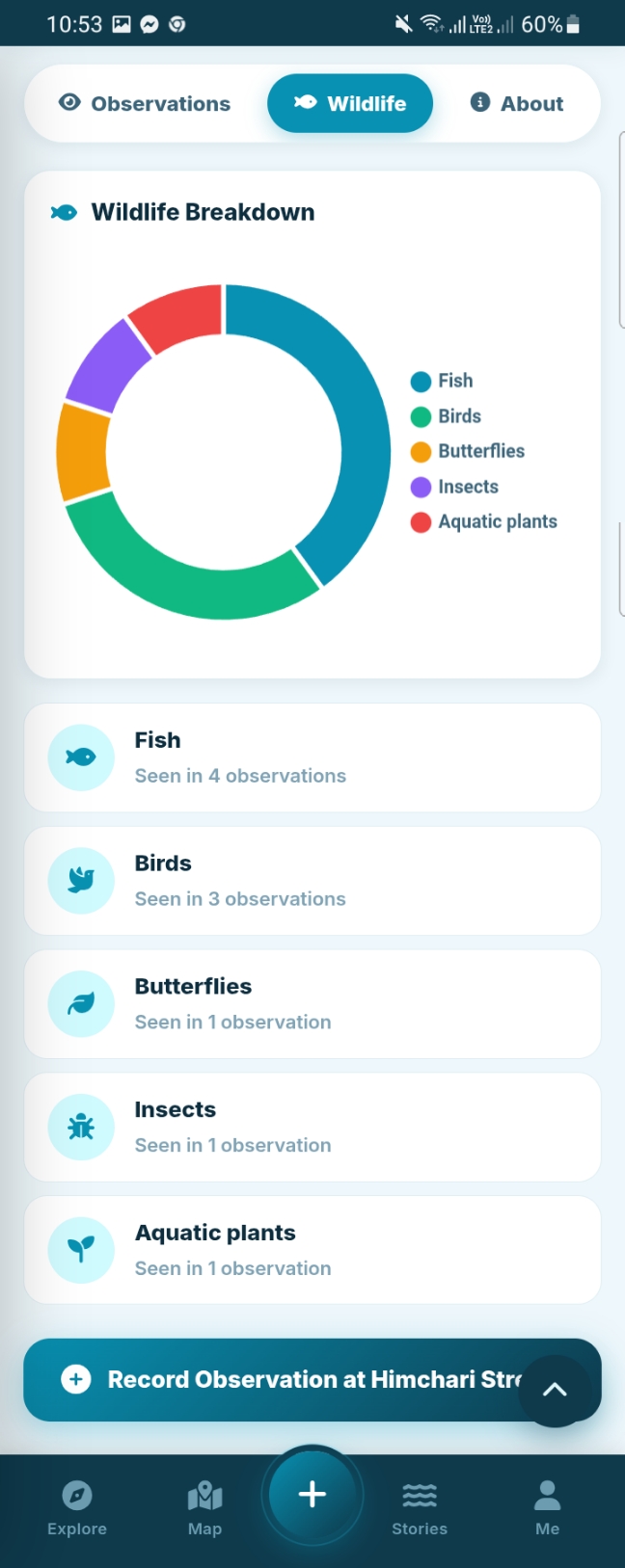
Wildlife breakdown — Biodiversity at a glance
-
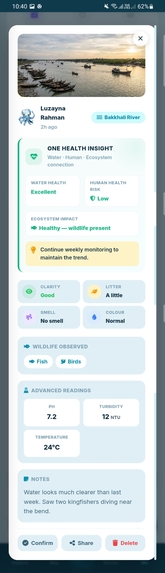
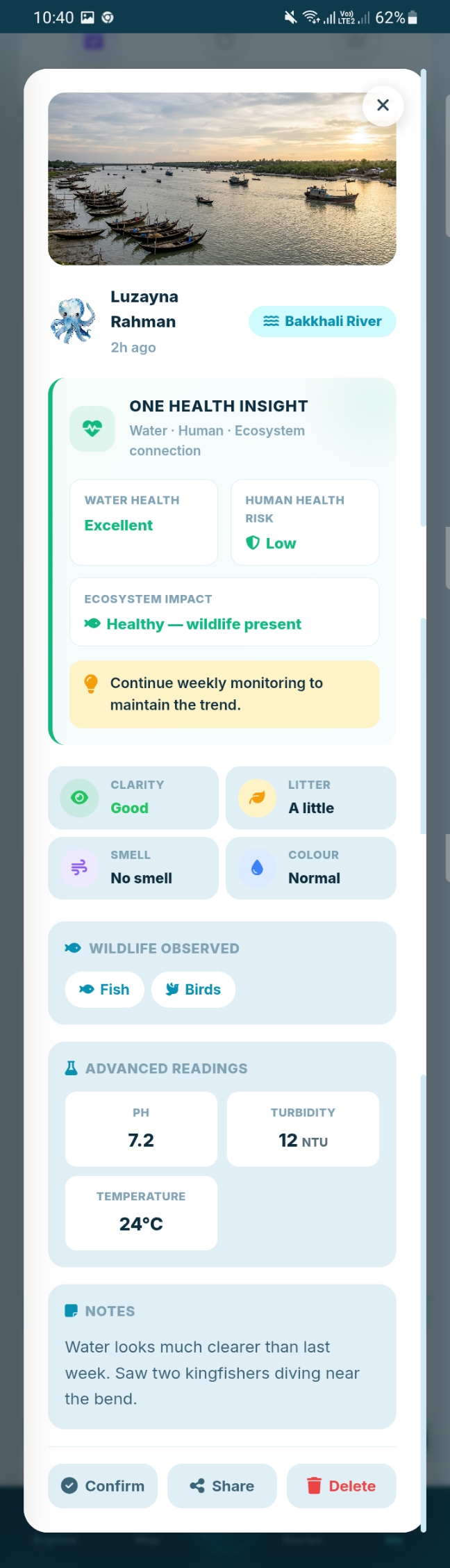
Observation with One Health Insight — Water, human, ecosystem
-
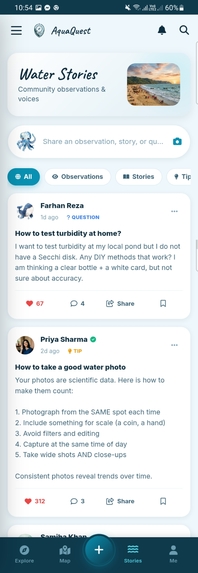
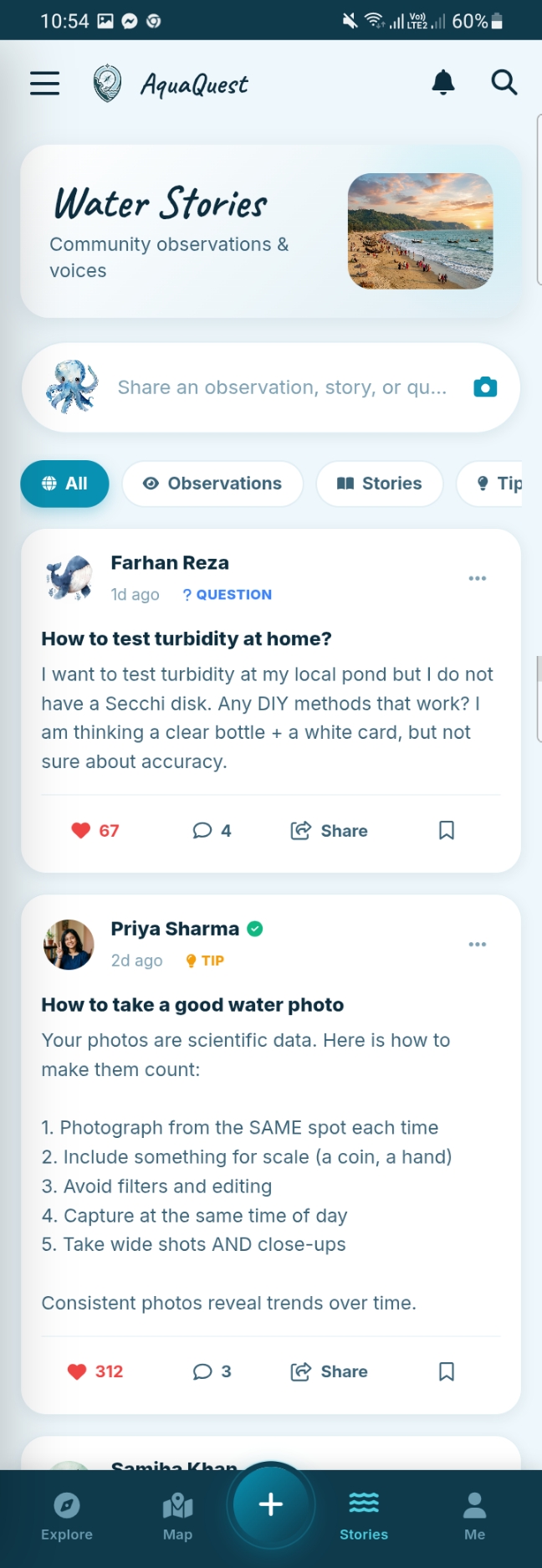
Water Stories — Community feed
-
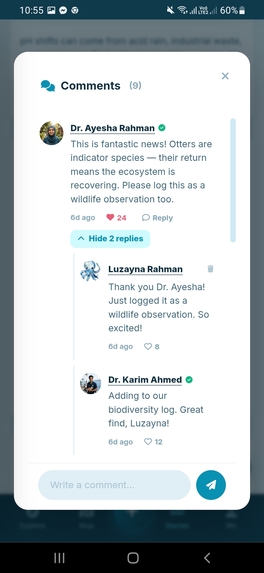
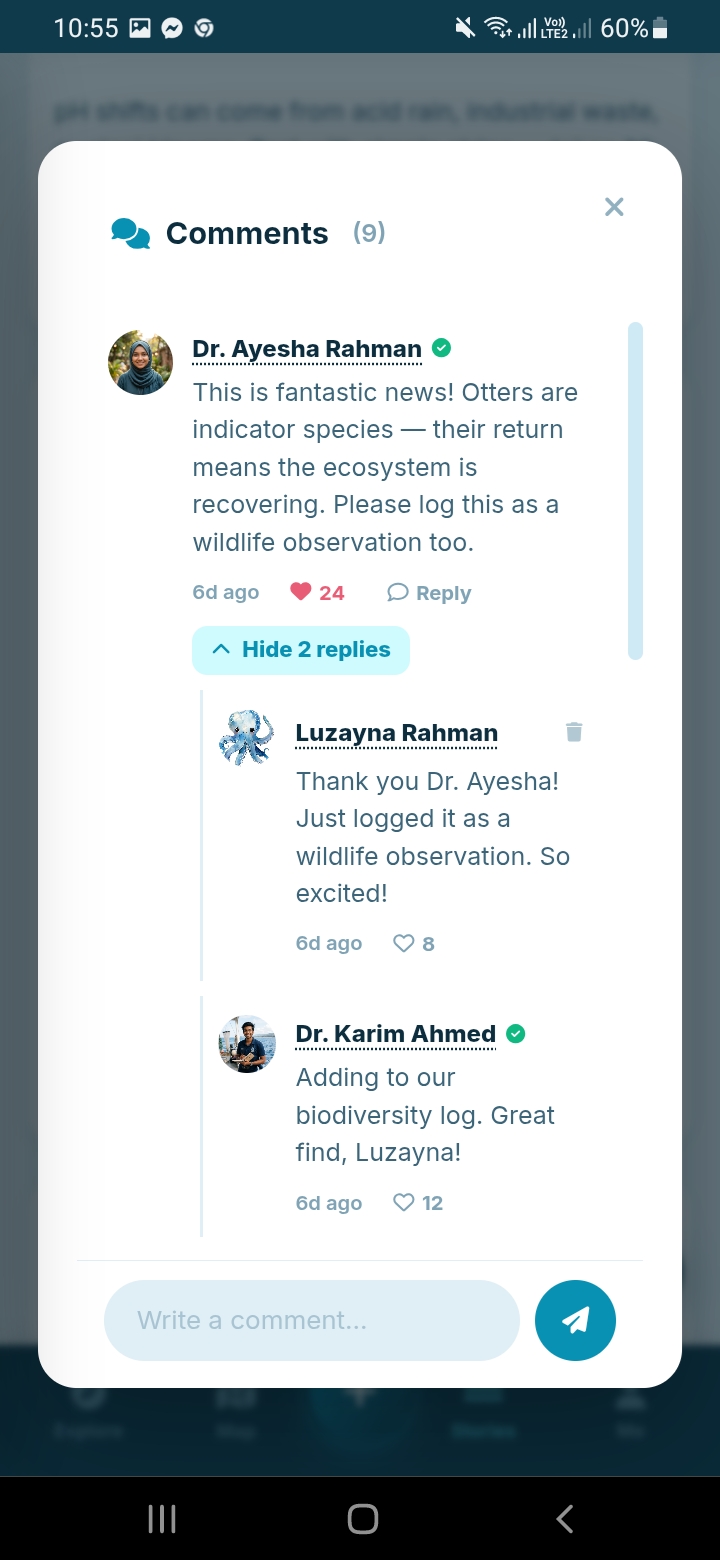
Comments — Threaded discussion with experts
-
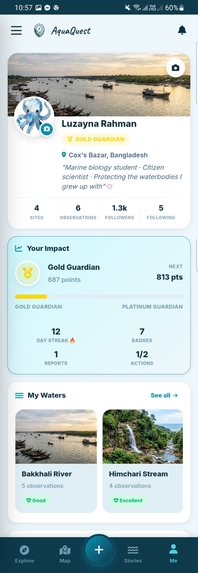
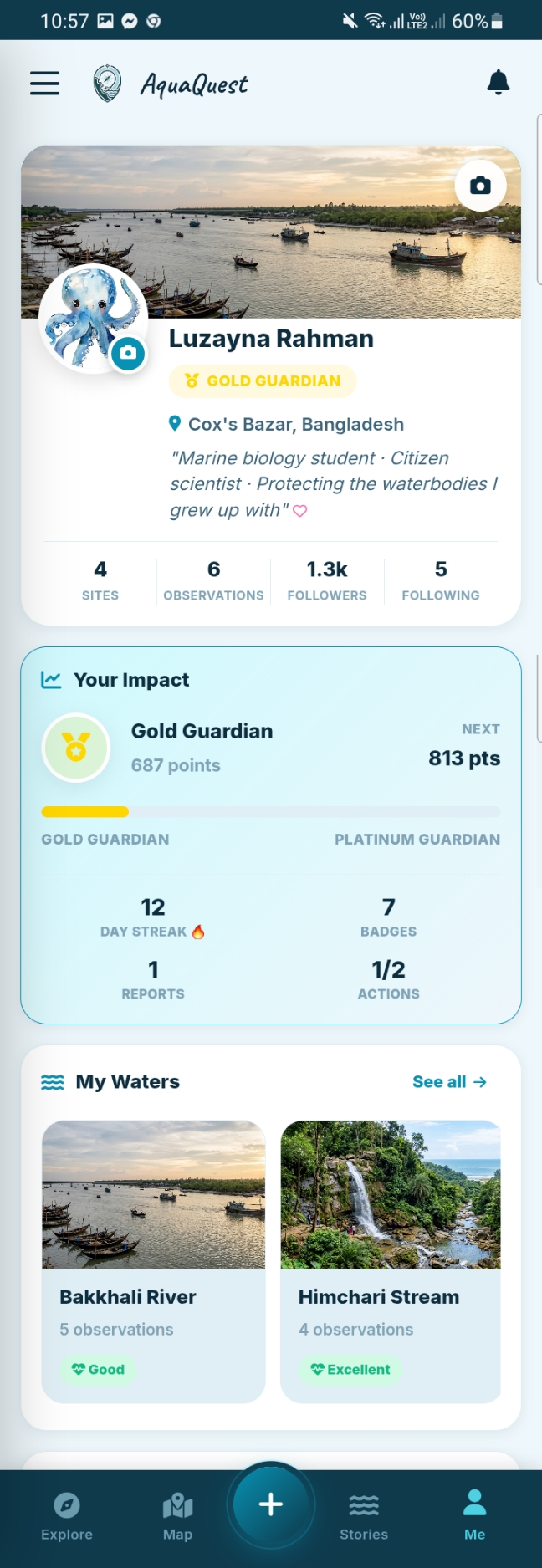
Profile — Impact, badges & contributions
-
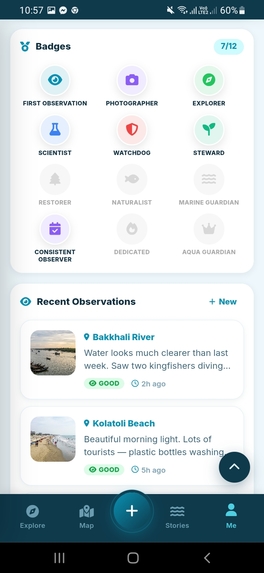
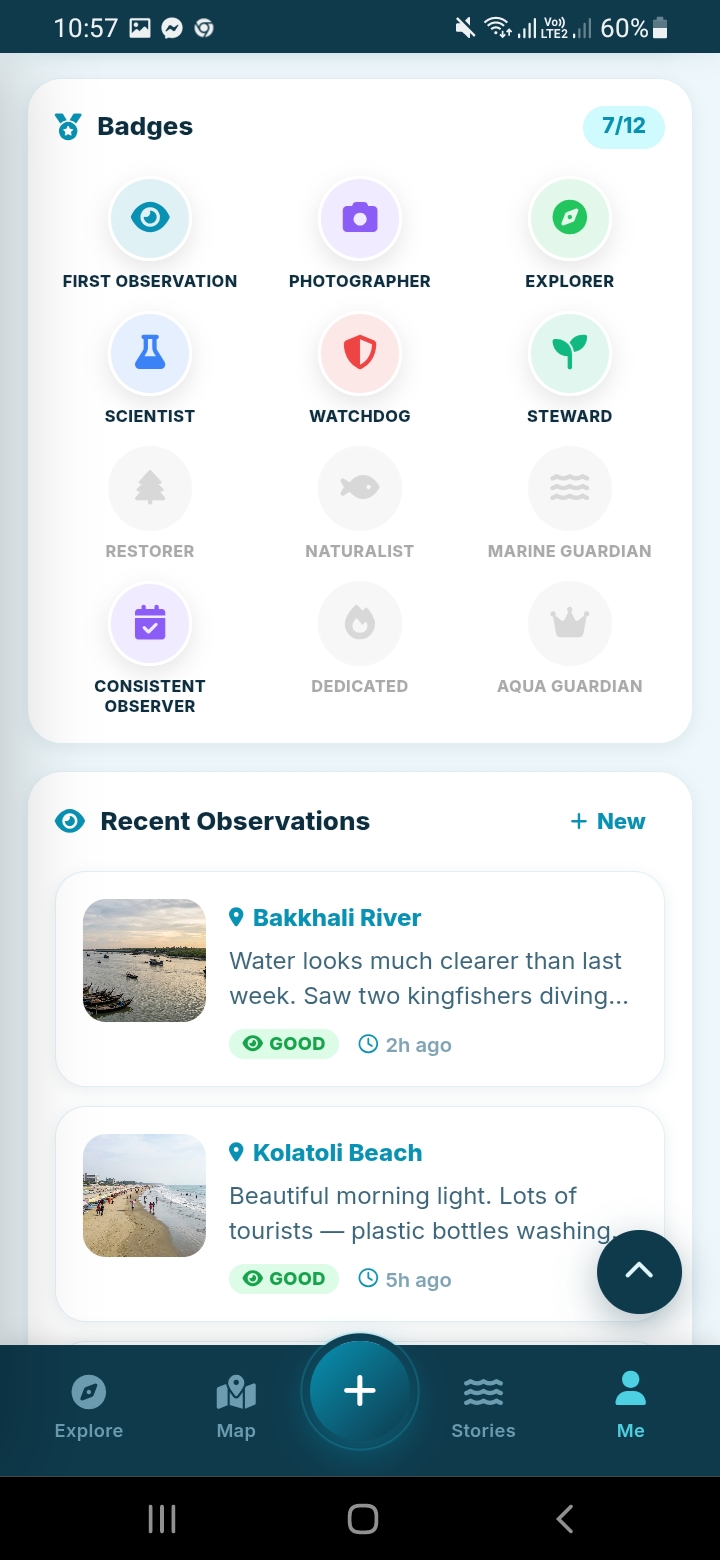
Badges — Gamified citizen science journey
-
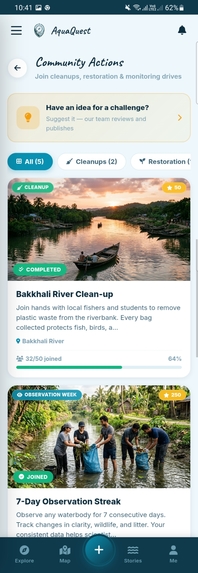
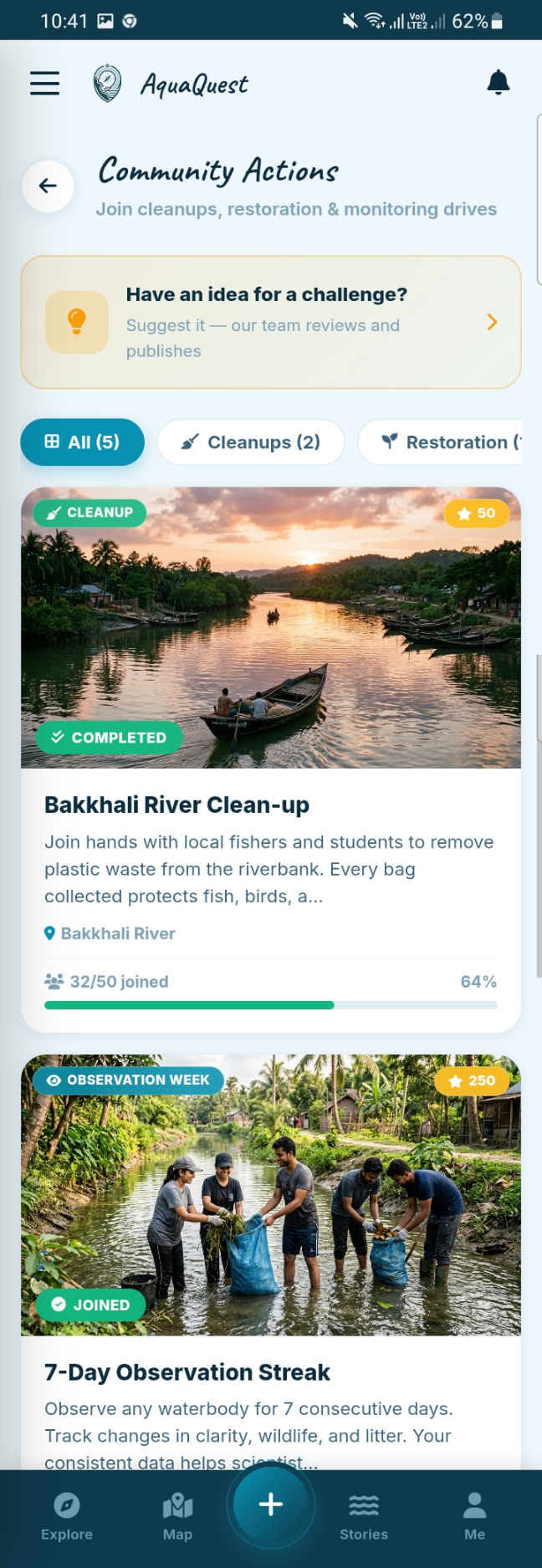
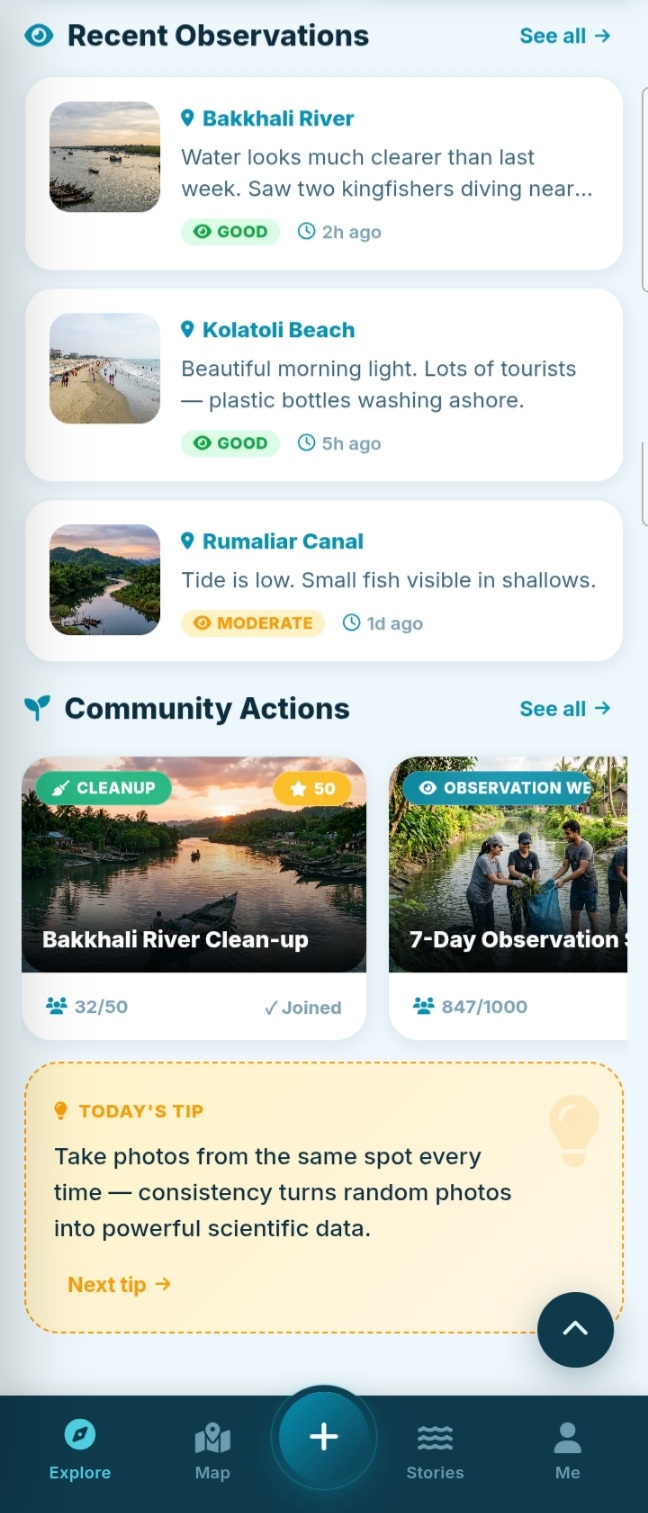
Community Actions — Join cleanups & challenges
-
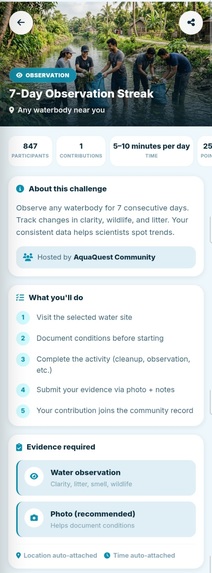
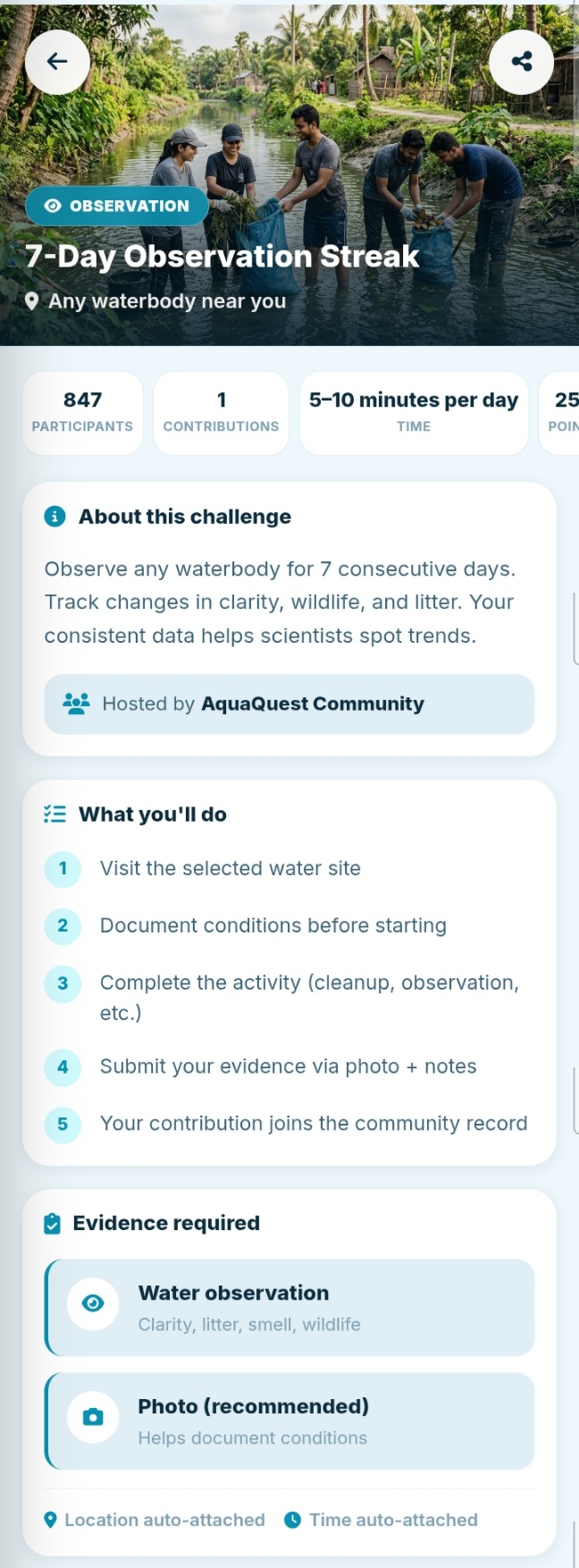
Challenge detail — 7-Day Observation Streak
-
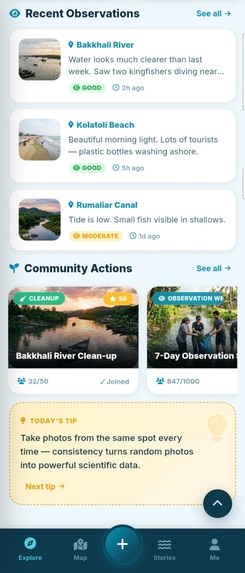
Recent Observations — Community activity feed
Inspiration
Growing up in Cox's Bazar, Bangladesh — a coastal region where rivers, canals, beaches, and wetlands shape everyday life — I saw firsthand how local waterbodies were changing. Litter appearing after tourist weekends. Canals turning dark near old bridges. Fish disappearing from places where they used to be abundant.
At the same time, the people living around these waters were noticing these changes long before any formal monitoring system did. Fishermen knew when the water "smelled wrong." Students noticed plastic piling up. But there was no simple way for their everyday observations to become useful.
The OneAquaHealth IEEE Global Hackathon — focused on urban freshwater ecosystems, citizen science, and the One Health approach — felt like the right place to bridge that gap. The idea behind AquaQuest was simple: people who live around water are already observing it. The technology should just make those observations easier to record, share, and act on.
What it does
AquaQuest is a mobile-first Progressive Web App that turns freshwater citizen science into a guided, evidence-supported, community-driven experience.
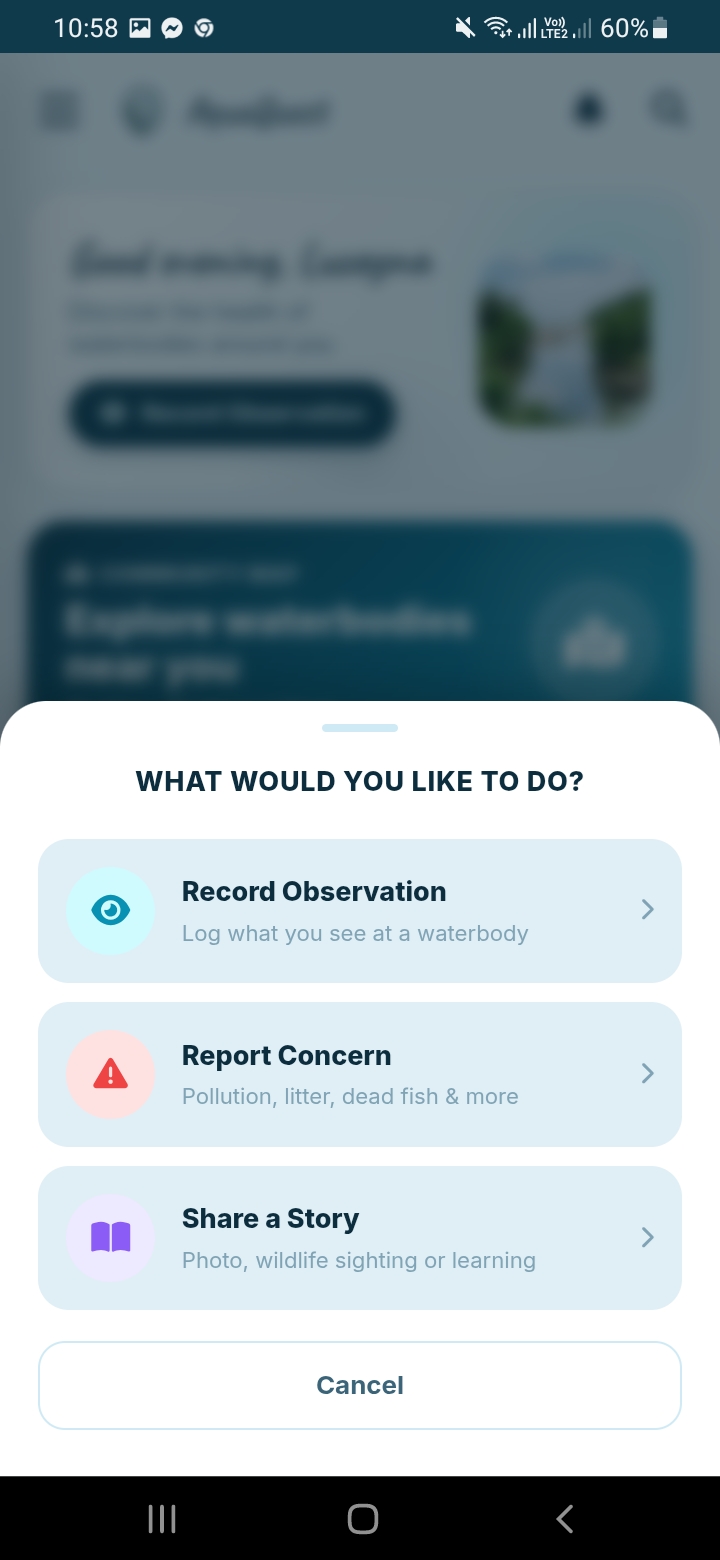
The platform allows users to:
- Explore waterbodies through a map and site directory (rivers, canals, beaches, wetlands, estuaries)
- Observe water conditions using a 5-step guided workflow covering clarity, litter, smell, colour, and wildlife
- Attach photo evidence to observations and reports
- Report environmental concerns such as wastewater discharge, heavy litter, unusual colour, strong smell, blocked waterways, or dead fish
- Understand findings through One Health Insight cards that connect water health → human health → ecosystem impact
- Join community challenges like river cleanups, biodiversity watches, and observation streaks
- Track impact through points, levels, badges, and streaks
- Learn about freshwater ecosystems, biodiversity, water quality, and One Health
- Share stories through a community feed with likes, threaded comments, and replies
The core flow is: Explore → Observe → Understand → Contribute → Act.
How we built it
AquaQuest is built entirely with lightweight, dependency-free web technologies so it can run reliably on any modern mobile device — including phones with limited storage and slow connections.
Tech stack:
- HTML5, CSS3, Vanilla JavaScript (ES6+)
- Leaflet.js — interactive community map
- Chart.js — water quality trends and wildlife charts
- Font Awesome — icons
- Inter + Caveat — typography
- LocalStorage API — persistence
- Service Worker + Web App Manifest — PWA / offline support
- Canvas Confetti — user feedback effects
- jsPDF — data export
Architecture: A modular single-page application organized into:
- Core (app, storage, mode, theme, toast)
- Data (sites, challenges, learn topics)
- Services (mock API layer simulating backend calls)
- Features (observations, contributions, gamification, monitoring, social, notifications, navigation)
- Pages (home, map, site detail, observe, feed, actions, reports, profile, etc.)
- UI (drawer, onboarding, skeleton)
The whole prototype was built from scratch with no build tools, no frameworks, and no backend — using only a phone and Acode editor.
Challenges we ran into
1. Making citizen science feel simple. Environmental terminology easily intimidates non-experts. Finding the right balance between scientific accuracy and everyday language took multiple iterations — for example, replacing "turbidity" with "water clarity" and "eutrophication risk" with "excessive algae growth."
2. Building a complete app experience without a backend. A mock service layer was created to simulate backend-style responses (authentication, sites, observations, contributions), so the frontend talks to structured service functions rather than directly manipulating storage. This keeps the architecture ready for a real backend later.
3. PWA + offline-first on mobile. Service worker caching strategies had to be tuned so that static assets, map tiles, and CDN libraries were available offline while still fetching fresh API data when online (hybrid caching — cache-first for static assets, network-first for APIs).
4. Single-file-per-page discipline on a mobile-only workflow. Developing entirely on an Android phone with Acode meant every file had to stay organized and readable without the aid of desktop tooling. This forced clean modular decisions early on.
5. Photo handling in a browser. Handling user-selected photos required client-side compression (canvas-based resizing) to keep LocalStorage size manageable and prevent app slowdowns on low-end devices.
6. Navigation consistency. Achieving expected back-button behavior across complex flows (sites → site detail → back) required a custom in-app history stack to prevent navigation loops and duplicate entries.
7. Keeping gamification meaningful, not gimmicky. Points, badges, streaks, and levels were deliberately designed to reinforce real environmental participation — not just maximize engagement metrics.
Accomplishments that we're proud of
- Building a fully working PWA with 25+ screens and complete end-to-end flows — entirely from a phone
- Creating a guided observation workflow that feels approachable even for someone with zero environmental science training
- Designing the One Health Insight Card, which automatically explains the connection between water conditions, human health, and ecosystem impact — a feature rarely found in citizen science apps
- Implementing structured community challenges with contribution tracking, evidence requirements, and progress visualization
- Achieving smooth offline-first behavior with proper service worker caching
- Building a rich demo experience with seeded community data so judges can immediately feel the social layer
- Making the entire app installable as a home-screen app on mobile
- Delivering a modular, well-organized codebase that can be extended toward a production backend without rewriting the UI
What we learned
- Accessibility is a design decision, not a checklist. Simplifying language, reducing cognitive load, and guiding users step by step matters more than adding features.
- Community features need real feedback loops. A report that disappears without confirmation feels broken. Users need to see their observations acknowledged, confirmed, and acted upon.
- Gamification works best when it mirrors real impact. Points, badges, and streaks felt meaningful because they represented actual environmental participation.
- A mock service layer pays off. Separating the UI from data operations makes the eventual transition to a real backend dramatically easier.
- PWA is underrated. With just HTML, CSS, and JavaScript, a mobile app experience can be delivered without app store distribution or heavy frameworks.
- One Health is a powerful framing. Connecting water quality to human and ecosystem health gives users a reason to care beyond "the water looks dirty."
- Constraint drives creativity. Building on a phone with limited tooling forced simplicity, clarity, and clean architecture.
What's next for AquaQuest
The prototype demonstrates the first stage of a much larger vision. Planned directions include:
1. Production backend Replace LocalStorage with a secure cloud database and enable real multi-user synchronization.
2. Verified environmental data Integrate official water quality datasets and real-time sensor data (temperature, pH, turbidity) to complement citizen observations.
3. AI-supported observation validation Introduce smart checks to detect inconsistencies, suggest similar observations, and help users refine their submissions.
4. Researcher and municipal dashboards Provide aggregated data views, trends, and site-level analytics for researchers, NGOs, and local government.
5. Early warning system Use aggregated signals across sites and time to detect emerging environmental risks before they escalate.
6. Expanded One Health analytics Deepen the connection between water quality, biodiversity, animal health, and human well-being indicators.
7. Multi-language support Add Bangla and other regional languages to make AquaQuest accessible to more local communities.
8. Interoperability Align data structures with environmental and health data standards (such as FHIR) to enable cross-platform integration.
9. Community growth Partner with schools, fishing communities, and local NGOs to onboard real citizen scientists and start collecting the first real-world datasets.
10. Gamification expansion Introduce seasonal challenges, team-based participation, and community leaderboards to sustain long-term engagement.
The long-term goal is to turn AquaQuest into a trusted citizen science platform where everyday observations — from a fisherman in Cox's Bazar to a student in Dhaka — contribute to a shared understanding of freshwater ecosystem health across Bangladesh and beyond.
Built With
- canvas-confetti
- chart.js
- css3
- es6
- font-awesome
- github
- html5
- javascript
- jspdf
- leaflet.js
- localstorage
- mobile-first
- offline
- progressive-web-app
- pwa
- responsive-design
- service-worker
- vanilla-js
- web-app-manifest


Log in or sign up for Devpost to join the conversation.