Inspiration
Water contamination and pollution are often detected far too late—usually only after visible environmental or health damage has occurred. Communities, livestock, and local ecosystems are frequently exposed to hazardous conditions due to delayed reporting, fragmented citizen complaints, and a lack of real-time predictive tools.
We were inspired to build AquaPulse AI to bridge this critical gap: moving from reactive pollution monitoring to an early-warning, AI-driven decision system that protects human, animal, and environmental health through a unified One Health approach.
What it does
AquaPulse AI is an AI-powered freshwater health platform that converts multimodal user inputs—such as citizen photos, text descriptions (smell/color clues), location, weather context, and historical records—into real-time risk scores and actionable predictive alerts.
Key features include:
- Multimodal Pollution Clue Detection: Analyzes user-submitted images and text reports to detect abnormal pollution patterns and waste clues.
- Predictive Risk Engine: Calculates an anomaly score and forecasts risk escalation rather than just logging static complaints.
- Geospatial Intelligence: Generates live hotspot maps, contamination spread zones, and location-specific risk levels.
- Authority-Ready Reports: Exports detailed PDF and CSV reports for local authorities and decision-makers to streamline rapid response.
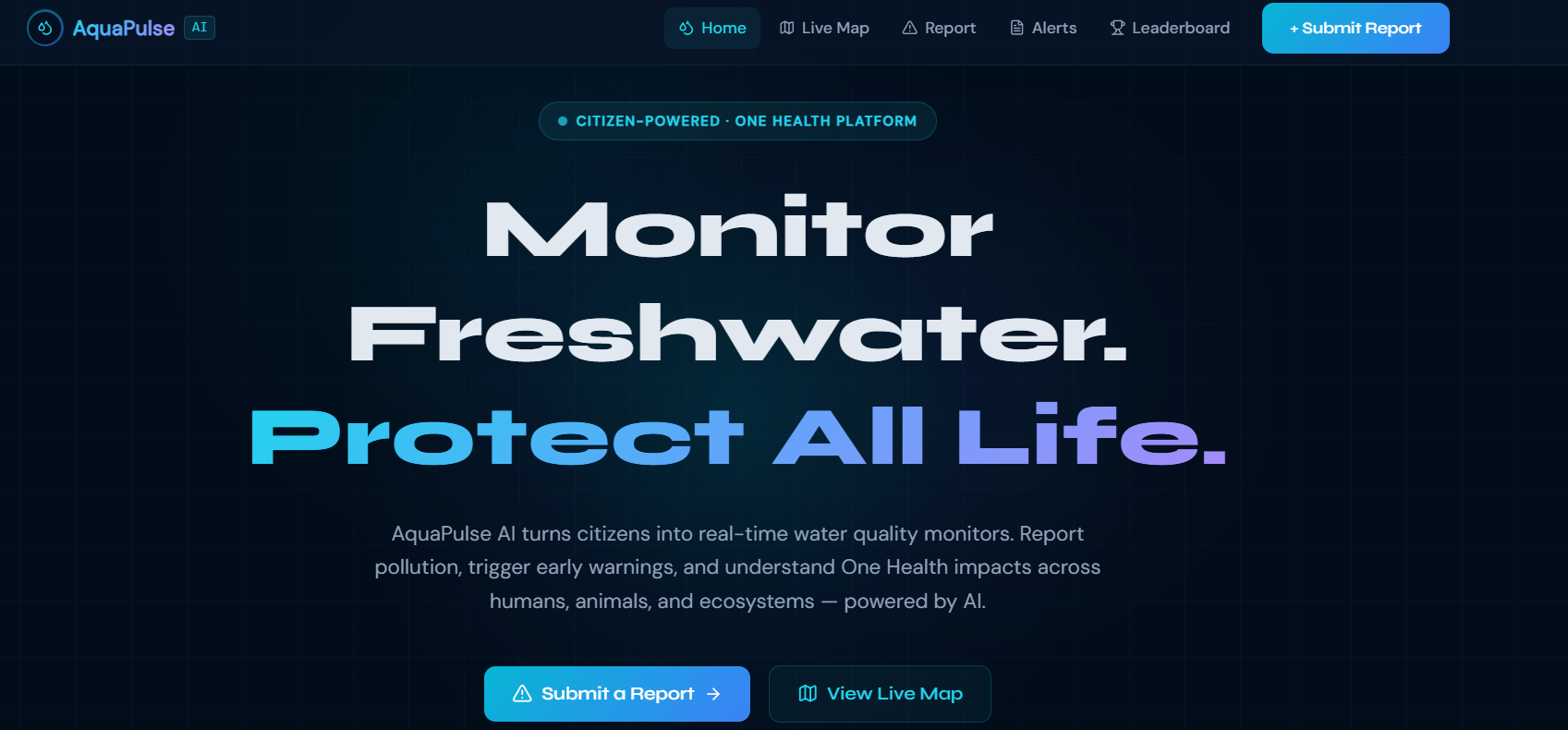
- Community Engagement: Features community missions and leaderboards to incentivize proactive environmental stewardship.
How we built it
AquaPulse AI is designed as a software-first solution built around a robust AI workflow:
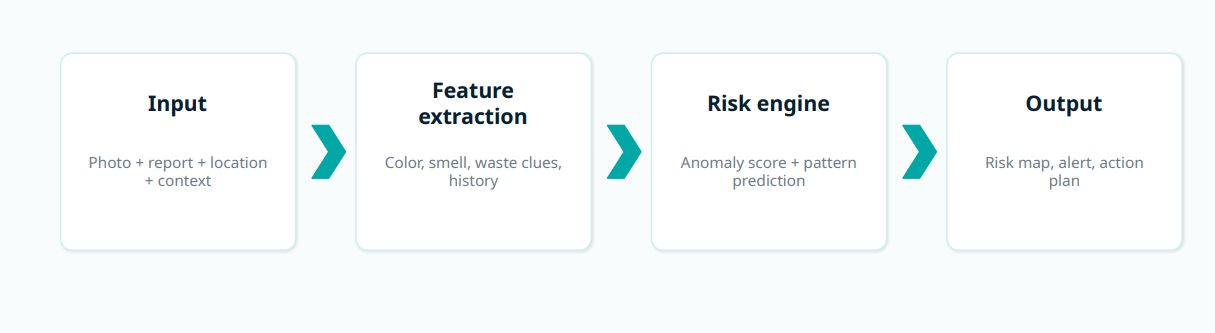
- Input & Data Collection: Citizens upload location data, photographs, and qualitative clues (e.g., unusual odor, cloudiness, or visual waste).
- Feature Extraction: The system processes visual clues, report context, environmental data, and historical trends.
- Risk & Anomaly Engine: An AI pipeline evaluates patterns to calculate a localized Water Health Score and predict risk escalation.
- Actionable Output: Results are mapped onto interactive hotspot maps and converted into alerts and tailored response plans.
Challenges we ran into
- Multimodal Data Integration: Combining unstructured visual clues from photos with text descriptions and geographic data into a coherent, standardized risk engine required careful feature engineering.
- Predictive Scoring Without Hardware: Designing an accurate software-first predictive model prior to integrating physical IoT sensors meant relying heavily on historical patterns, contextual weather data, and visual anomaly detection.
- Balancing Usability & Depth: Creating a intuitive interface for citizen science while ensuring data outputs were detailed enough for municipality-level decision-making.
Accomplishments that we're proud of
- Successfully designed a end-to-end early-warning pipeline moving from simple citizen reporting to predictive risk scoring.
- Integrated a One Health perspective that maps water risk across human, animal, and plant ecosystem impacts.
- Formulated an actionable product roadmap transitioning from local campus/waterbody pilots to municipality-scale multilingual deployments.
What we learned
- Early prediction is significantly more impactful than high-frequency reactive logging.
- Community participation dramatically increases when coupled with visual feedback, clear risk scores, and gamified elements like leaderboards.
- Software-first predictive analytics can provide immediate community value before hardware sensor infrastructure is fully deployed.
What's next for AquaPulse AI
- Pilot Launch: Testing the platform with local campus and community water bodies to refine risk algorithms based on real-world feedback.
- Hardware Integration: Extending the software platform to ingest live data from IoT water quality sensors.
- Municipal & NGO Partnerships: Scaling deployment through local government and environmental NGO collaborations with multilingual support.
Built With
- computer-vision
- fast-api
- leaflet.js
- machine-learning
- mapbox
- python
- react
- tailwindcss

Log in or sign up for Devpost to join the conversation.