-
-
Track 3: AI-Supported Assessment · Responsible XAI & Human-in-the-Loop Governance
-
Track 2: Data-to-Insight · Mondego-Urban Catchment Living Lab
Inspiration
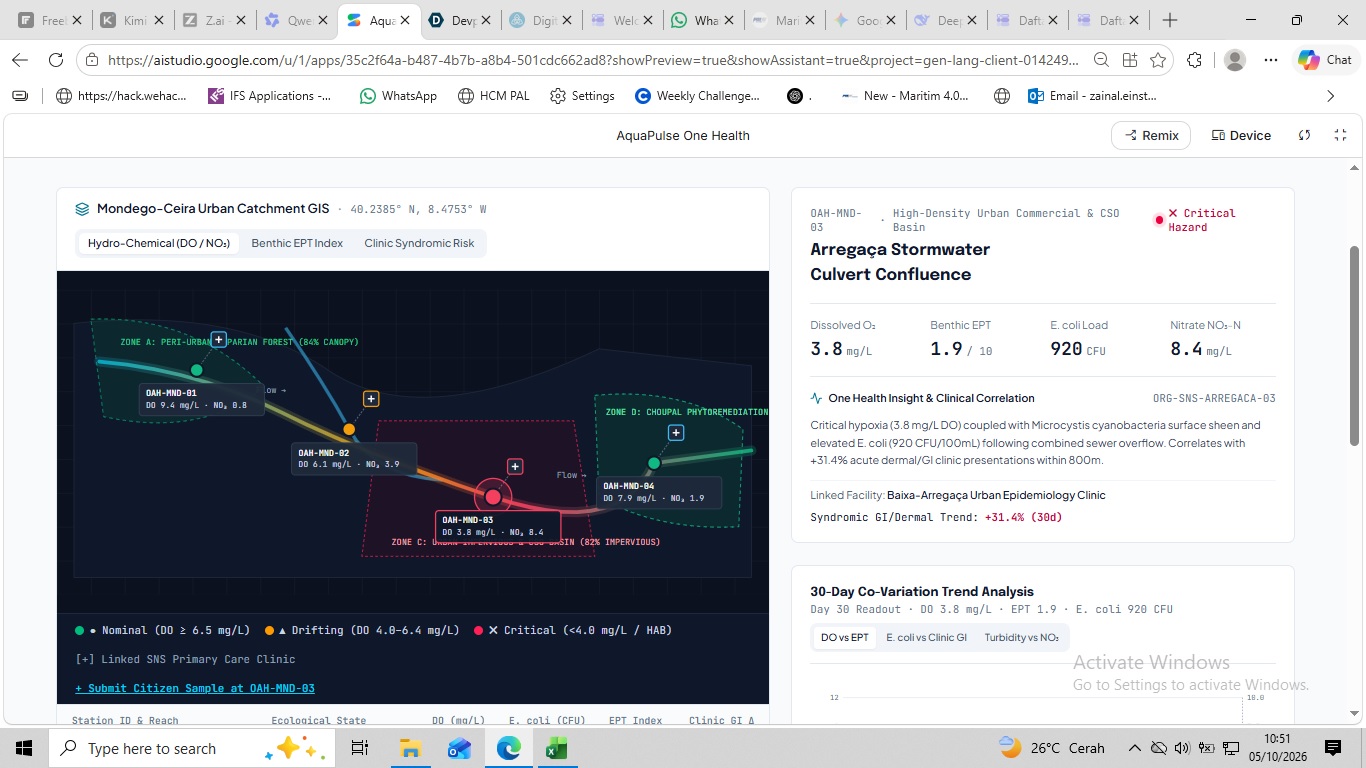
Urban freshwater ecosystems are in crisis, and when pollution or cyanobacterial blooms occur, environmental degradation happens days before local health clinics see a surge in waterborne illness. We were inspired by the One Health vision to bridge this gap—connecting citizen science stream monitoring directly to clinical public health surveillance.
What it does
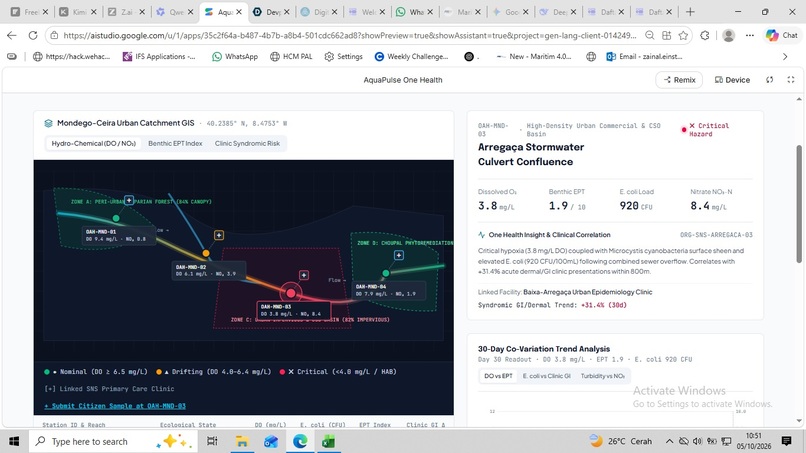
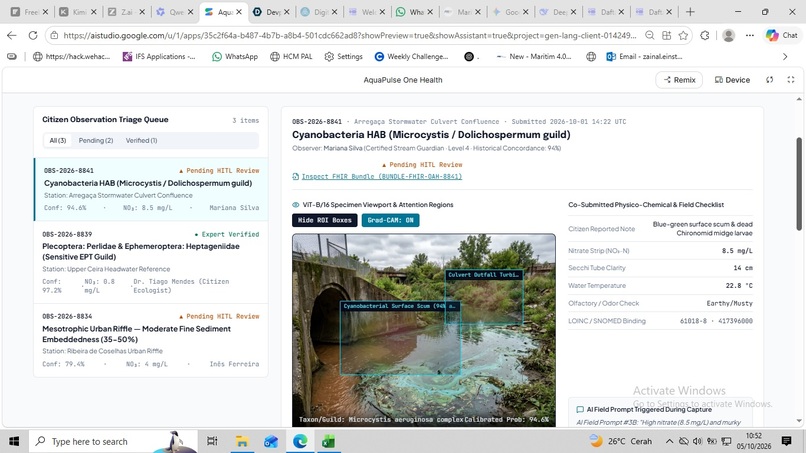
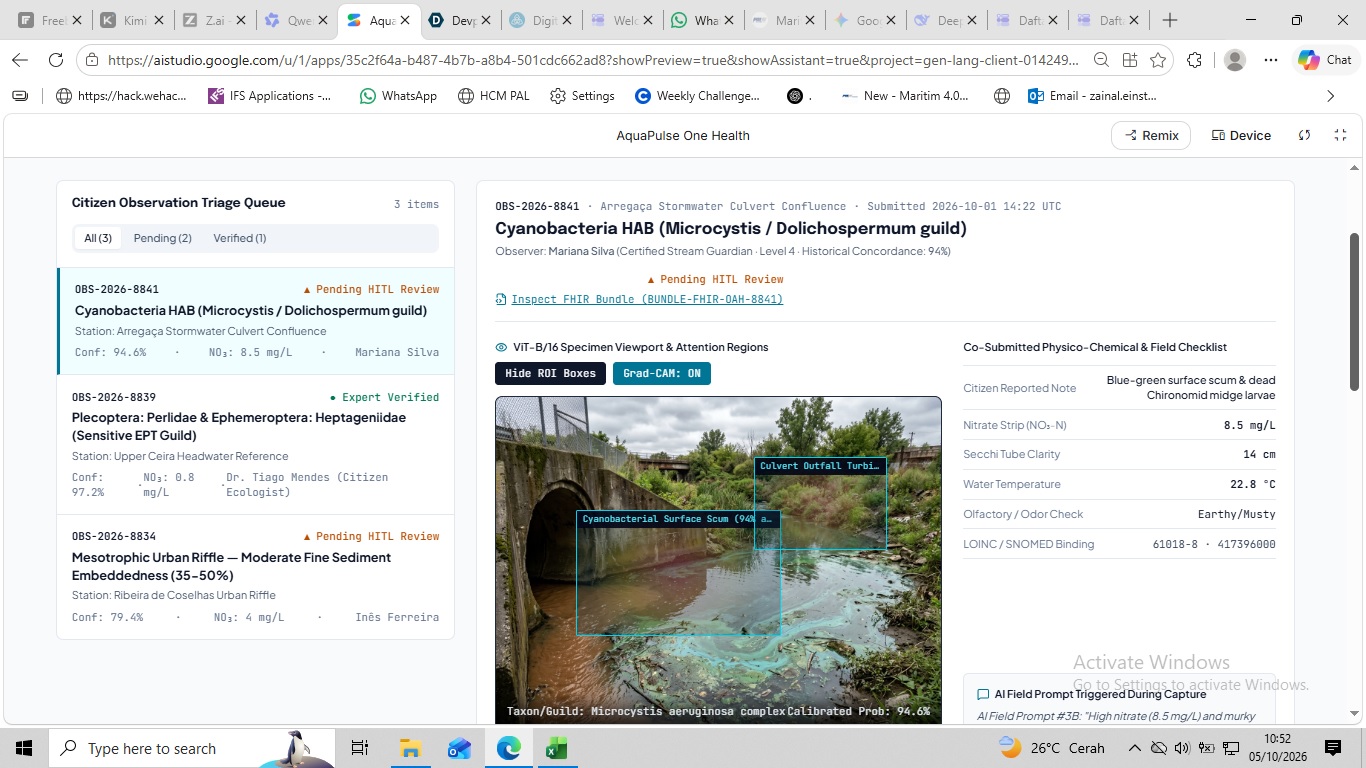
AquaPulse OneHealth is an end-to-end urban freshwater intelligence platform combining four tracks: AI-Supported Assessment (Track 3): Guides citizen field sampling and uses Vision Transformers (ViT-B/16) and TreeSHAP explainability for expert Human-in-the-Loop (HITL) review. Data-to-Insight (Track 2): Fuses verified citizen observations with optical sonde telemetry on an interactive watershed GIS map, tracking EPT benthic biodiversity and syndromic clinic risk. Resilience Informatics (Track 6): Forecasts 72-hour hypoxia and E. coli peaks using a Temporal Fusion Transformer (TFT) and an interactive green-infrastructure simulator. Digital Health Standards (Track 7): Translates ecological observations into validated HL7 FHIR R4 bundles () via cooperative AI agents.
How we built it
Frontend: React 19, TypeScript, Tailwind CSS, Vite, and interactive SVG geospatial/chart canvases. Backend & AI/ML: Python FastAPI, PyTorch (ViT-B/16 & TabNet), and SHAP feature attribution engines. Data & Standards: PostgreSQL/PostGIS, HAPI FHIR R4 server, LOINC (), and SNOMED-CT terminologies.
Challenges we ran into
Translating messy, unstructured citizen smartphone photos and colorimetric test strips into rigid clinical HL7 FHIR R4 schemas without losing biological nuance was tough. We solved this by designing a strict Human-in-the-Loop review queue backed by Grad-CAM attention maps and TreeSHAP confidence scoring.
Accomplishments that we're proud of
Successfully bridging ecology (benthic EPT index) and medicine (HL7 FHIR R4 Observation & DiagnosticReport) in a working interactive prototype. Achieving a seamless multi-agent workflow () that dispatches automated clinic alerts.
What we learned
Environmental monitoring and healthcare IT speak entirely different languages. Using standard clinical terminologies (LOINC, SNOMED-CT, UCUM) is the key to making ecological data truly actionable for public health policymakers and doctors.
What's next for AquaPulse OneHealth
Pilot testing with living labs across European urban catchments (Coimbra, Toulouse, Benevento). Expanding offline PWA support for low-bandwidth field sampling in Global South watersheds.
Built With
- css
- docker
- fastapi
- fhir
- hl7
- loinc
- postgis
- postgresql
- python
- pytorch
- r4
- react
- snomed-ct
- tailwind
- typescript
- vite

Log in or sign up for Devpost to join the conversation.