⭐ Inspiration
**Water loss is not just an infrastructure issue — it is a human crisis.
Our inspiration came from a deeply personal experience. One of our team member’s father is a farmer. Due to an undetected pipeline leakage in the irrigation system, water was continuously lost for days without anyone noticing. By the time the issue was discovered, most of the crops had dried, leading to a financial loss of nearly ₹60,000.
That moment revealed a harsh reality:
Water infrastructure failures are silent, invisible, and extremely expensive.
Across cities, villages, industries, and farms, millions of liters of water are lost every day due to hidden leaks, pressure failures, inefficient monitoring, and delayed response systems.
Most existing systems detect problems only after damage has already occurred.
We asked ourselves a simple but powerful question:
“What if water infrastructure could predict failures before they happen?”
That question became AquaPercent AI.
⭐ What it does
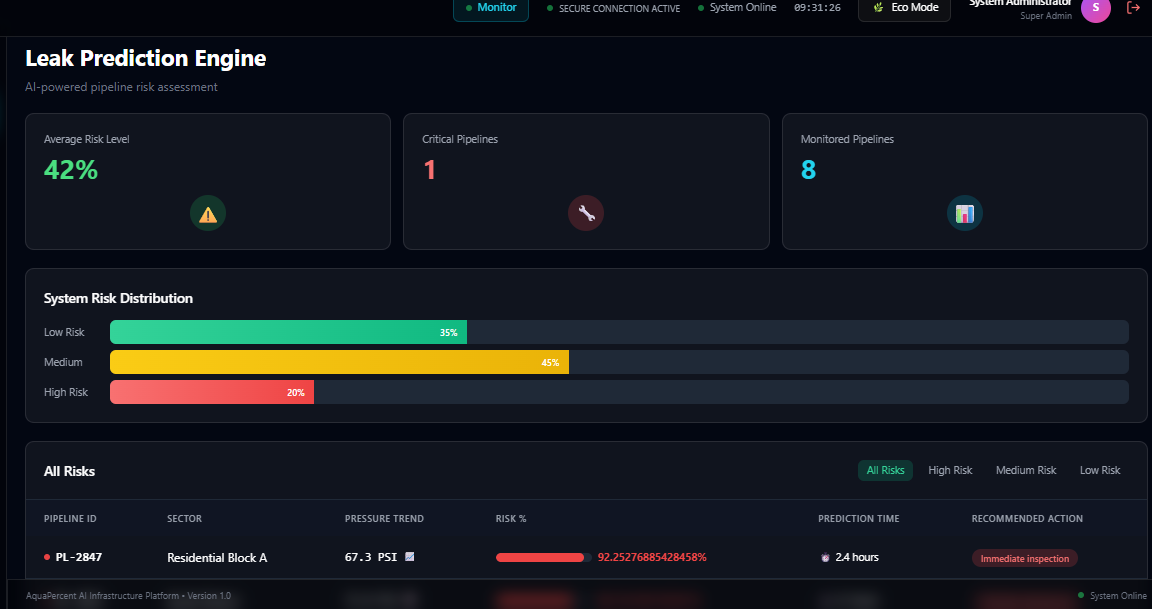
AquaPercent AI is an AI/ML powered predictive water infrastructure intelligence platform designed to monitor, analyze, and forecast water system behavior in real time.
Instead of reacting to failures after damage occurs, AquaPercent AI predicts risks before they escalate.
The platform helps governments, utilities, industries, and farmers:
• Detect pipeline leaks early • Monitor flow and pressure in real time • Predict infrastructure failures using AI • Optimize water distribution efficiency • Reduce water wastage and operational costs • Receive intelligent alerts and risk insights • Make faster, data-driven decisions
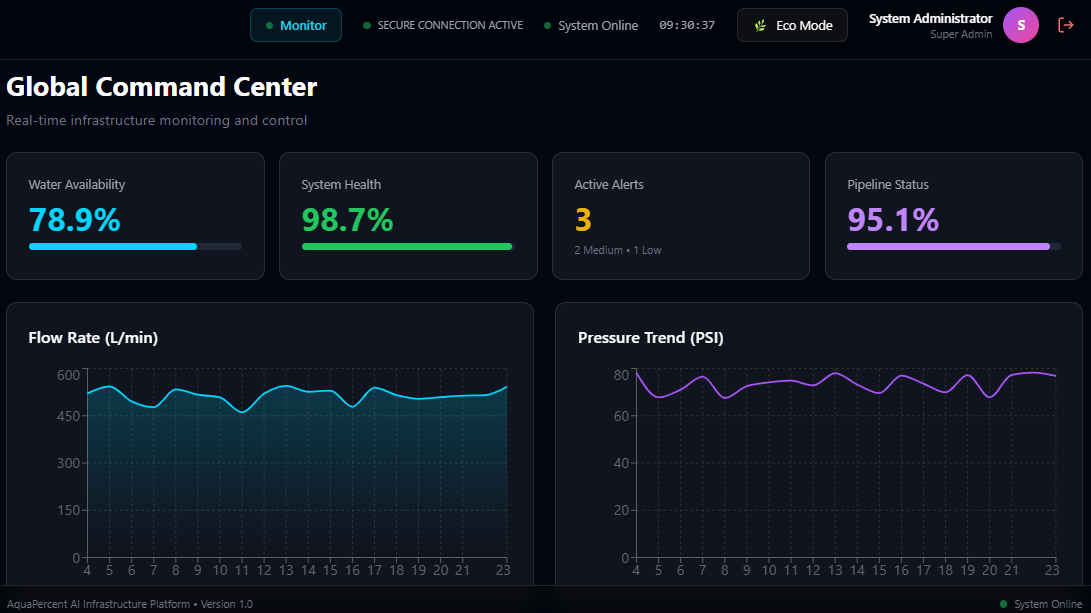
A centralized command dashboard provides live system health monitoring, predictive analytics, infrastructure risk mapping, and operational intelligence.
In simple terms:
AquaPercent AI transforms water infrastructure from reactive monitoring into predictive intelligence.
⭐ How we built it
We built AquaPercent AI as an integrated hardware + software + AI system.
Sensor layer collects real-time data such as flow rate, pressure, and environmental conditions.
IoT microcontrollers transmit this data securely to the cloud.
The cloud platform processes and stores streaming data.
Machine learning models analyze patterns, detect anomalies, and predict failures.
A web-based dashboard provides visualization, alerts, and decision intelligence.
Tech components include:
• IoT sensors and embedded controllers • Real-time data pipelines • Machine learning prediction models • Cloud infrastructure • Interactive monitoring dashboard • Role-based access system • Smart alerting engine
The architecture is modular and scalable, designed to support both rural irrigation networks and large urban infrastructure.
⭐ Challenges we ran into
Building predictive infrastructure intelligence is complex.
One of our biggest challenges was simulating real-time sensor data accurately for testing predictive models. Infrastructure data is dynamic and highly variable, so we had to design realistic data streams and anomaly scenarios.
Another challenge was integrating multiple system components — IoT data ingestion, machine learning prediction, visualization, and alerting — into a seamless real-time platform.
We also focused heavily on user experience, ensuring the system remains understandable for non-technical users like farmers and field engineers.
Balancing technical sophistication with usability was a major design challenge.
⭐ Accomplishments that we're proud of
We successfully built a working predictive monitoring platform that demonstrates how water infrastructure can be intelligently managed.
Key achievements include:
• Real-time infrastructure monitoring dashboard • Predictive leak detection engine • Risk visualization across regions • AI-driven decision intelligence module • Multi-role access system (admin, engineer, citizen, farmer) • Scalable system architecture • Clean, professional, enterprise-grade interface
Most importantly, we transformed a personal real-world problem into a scalable technological solution.
AquaPercent AI shows how AI can protect livelihoods, conserve resources, and modernize infrastructure.
⭐ What we learned
This project taught us that technology has the greatest impact when it solves real human problems.
We learned how predictive analytics can shift systems from reactive maintenance to proactive intelligence.
We gained hands-on experience in:
• Real-time data systems • Infrastructure monitoring design • AI-based anomaly detection • System scalability • User-centered engineering
But the biggest lesson was this:
Sustainability is not just about saving resources — it is about protecting people, livelihoods, and futures.**
Built With
- chart.js
- esp32
- fastapi
- github
- machine-learning
- mongodb
- nextjs
- python
- react
- react-native
- scikit-learn
- tailwindcss


Log in or sign up for Devpost to join the conversation.