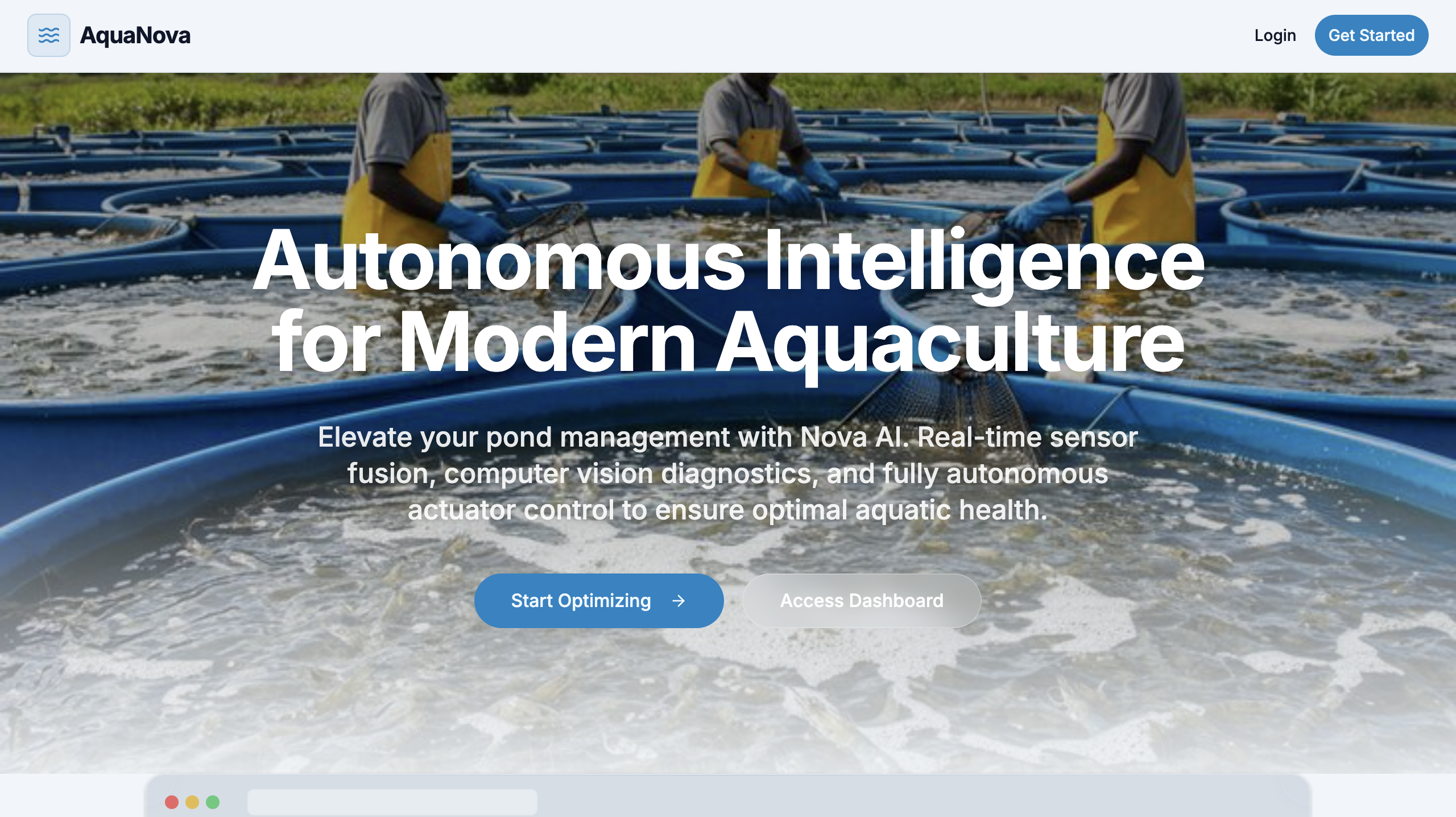
AquaNova Autonomous AI Supervisor for Aquaculture
Inspiration
Aquaculture is one of the fastest-growing sources of food production in the world, yet fish farmers still face a major problem: sudden fish mortality caused by changes in water conditions such as oxygen depletion, toxic ammonia levels, or disease outbreaks.
These changes can occur rapidly, often overnight, and many farmers cannot continuously monitor their ponds. By the time the problem is discovered, it is often too late, leading to significant financial losses and wasted resources.
This inspired us to build AquaNova, an AI-powered system that continuously monitors fish ponds, detects risks early, and autonomously takes action to prevent fish mortality.
Our goal is to bring intelligent automation and AI decision-making into aquaculture management.
What It Does
AquaNova is an autonomous AI supervisor for aquaculture ponds.
The system continuously monitors pond conditions using a combination of environmental sensors and computer vision, analyzes the data using an AI reasoning engine, and automatically responds to dangerous conditions.
Key capabilities include:
- Monitoring water quality sensors such as temperature, dissolved oxygen, pH, ammonia, turbidity, and water level.
- Analyzing pond video streams to detect abnormal fish behavior and possible mortality signals.
- Using an AI reasoning engine to evaluate pond health and environmental risks.
- Automatically activating pond actuuators such as aerators or pumps when conditions become unsafe.
- Sending WhatsApp notifications to inform farmers of decisions and actions taken.
By combining sensor data and visual analysis, AquaNova provides a more complete understanding of pond health and enables proactive intervention.
How We Built It
The backend of AquaNova is built as an AI-driven event pipeline.
Sensor readings and vision observations trigger an analysis workflow where an AI reasoning engine evaluates the pond’s condition and decides whether intervention is needed.
The system architecture includes:
Backend
- Built with FastAPI for the API layer
- PostgreSQL + SQLAlchemy for data storage
- Event-driven pipeline for sensor ingestion and AI decision-making
- Nova 2 lite and Nova multimodal embeddings
AI Decision Engine
The AI reasoner analyzes:
- Current sensor readings
- Recent sensor trends
- Vision-based mortality indicators
- Recent actuator actions
It then produces structured outputs including:
- Pond health score
- Risk level
- Confidence score
- Recommended actions
Vision Monitoring
A vision monitoring worker periodically analyzes pond video frames to detect signals such as:
- Floating fish
- Surface clustering
- Abnormal swimming behavior
- Reduced activity
These signals are converted into a mortality risk score that is incorporated into the AI reasoning pipeline.
Autonomous Action Execution
When the AI recommends corrective actions, the system can automatically trigger:
- Aerators
- Water pumps
- Medication dispensers
- Feeding systems
Each action is logged and executed through actuator APIs.
Communication Layer
The system also integrates a communication layer that:
- Sends WhatsApp notifications to farmers for every AI decision
- During development we simulated sensor readings and vision inputs to test the AI decision pipeline, while designing the system to integrate directly with real aquaculture sensors, cameras, and pond control hardware.
Challenges We Ran Into
Building AquaNova required solving several technical challenges.
One major challenge was combining multiple types of data sensor readings, vision observations, and historical trends into a single decision-making pipeline. Designing a structured AI output format ensured the system could reliably interpret and execute AI recommendations.
Another challenge was designing the system to operate autonomously while remaining safe. We implemented safeguards such as actuator cooldowns, retry mechanisms, and escalation logic to prevent rapid or conflicting actions.
Simulating a realistic aquaculture environment was also difficult during development, so we built a mock sensor and vision pipeline to demonstrate how the system would behave in real-world scenarios.
What We Learned
Through this project we learned how to design AI systems that operate as autonomous supervisors rather than simple prediction tools.
We explored how multimodal data combining sensors and computer vision can significantly improve environmental monitoring systems.
We also learned the importance of designing AI outputs that are structured and actionable, allowing them to directly trigger automated responses in real-world systems.
What's Next for AquaNova
Our vision is to expand AquaNova into a full AI operating system for aquaculture farms.
Future improvements could include:
- Real-time fish disease detection using computer vision
- Predictive models for water quality forecasting
- Multi-pond farm management dashboards
- Mobile applications for farmers
Ultimately, AquaNova aims to help farmers reduce losses, improve productivity, and build more sustainable aquaculture systems.
Built With
- fastapi
- nova
- postgresql
- python
- react
- worker

Log in or sign up for Devpost to join the conversation.