-
-
AQUAMIND
🌱 Inspiration
Water scarcity and groundwater depletion are among the most critical challenges facing agriculture and sustainability. Communities often lack reliable tools to assess water quality, predict stress, and plan usage effectively. We were inspired to build AquaMind to bridge this gap with AI + Machine Learning + Visualization, making groundwater management more data-driven and accessible.
💧 What it does
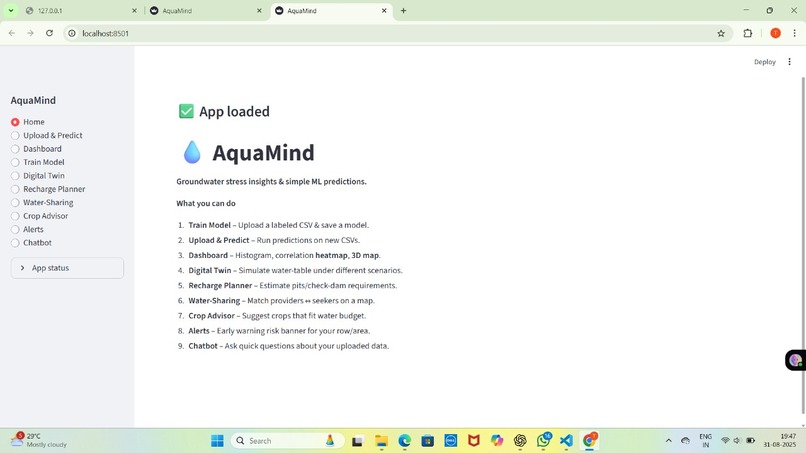
AquaMind provides an AI-powered decision support system for groundwater sustainability. It allows users to:
📊 Upload and analyze water quality datasets (pH, turbidity, hardness, etc.)
🔮 Train models to predict water potability and stress levels
🌍 Visualize data with heatmaps, histograms, and 3D maps
💦 Plan recharge strategies (check-dams, pits)
🤝 Enable water-sharing between regions
🌾 Recommend crops suited for water budgets
🚨 Provide early warning alerts for risk conditions
🤖 Use a chatbot to interact with the data
⚙️ How we built it
Frontend + Backend: Python, Streamlit
ML Training & Prediction: Scikit-learn, Pandas, Numpy
Visualization: Plotly, Pydeck, Matplotlib
Model Persistence: Joblib
Data Handling: CSV datasets for rainfall, extraction, irrigation %, etc.
🚧 Challenges we ran into
Getting all ML libraries and visualizations to work smoothly in Streamlit
Handling missing/imbalanced data in water quality datasets
Time pressure in building multiple features (heatmaps, 3D maps, chatbot)
Synchronizing the demo video + AI voice narration in limited time
🏆 Accomplishments that we're proud of
Built a working end-to-end Streamlit app with ML predictions, visualization, and interactive features
Added multiple innovative modules (Recharge Planner, Crop Advisor, Water-Sharing, Digital Twin)
Successfully created a demo video with AI voiceover to explain the project clearly
Learned to collaborate quickly and bring all parts together under deadline
📚 What we learned
How to integrate ML models into interactive apps with Streamlit
Hands-on practice with data preprocessing and visualization
Using AI tools (like TTS + video editors) to polish hackathon submissions
Importance of planning features in advance to meet deadlines
🔮 What’s next for AquaMind: AI Aquifer Whisperer++
Connect to real-time water datasets (IoT sensors, government APIs)
Improve the chatbot with LLMs for natural language water advisory
Add more accurate hydrological models for recharge simulation
Deploy the app to cloud (Streamlit Cloud / Hugging Face Spaces) for wider access
Extend to policy planning tools for sustainable agriculture and urban use


Log in or sign up for Devpost to join the conversation.