-
-
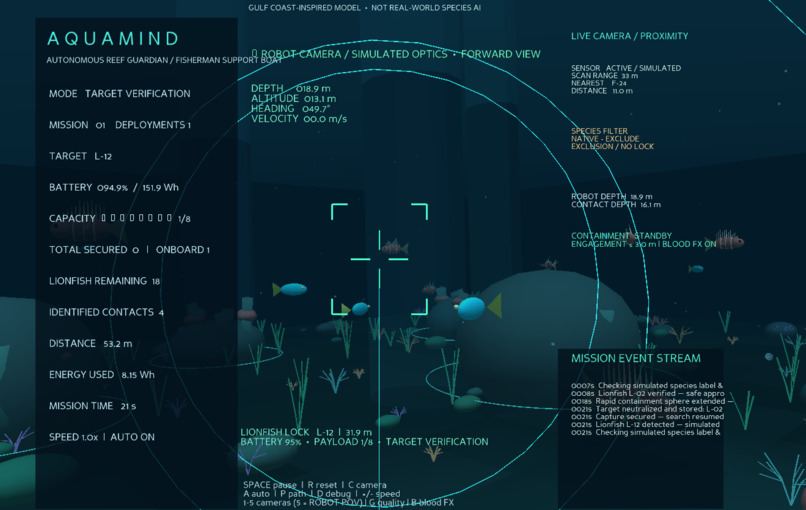
On-Board Camera
-
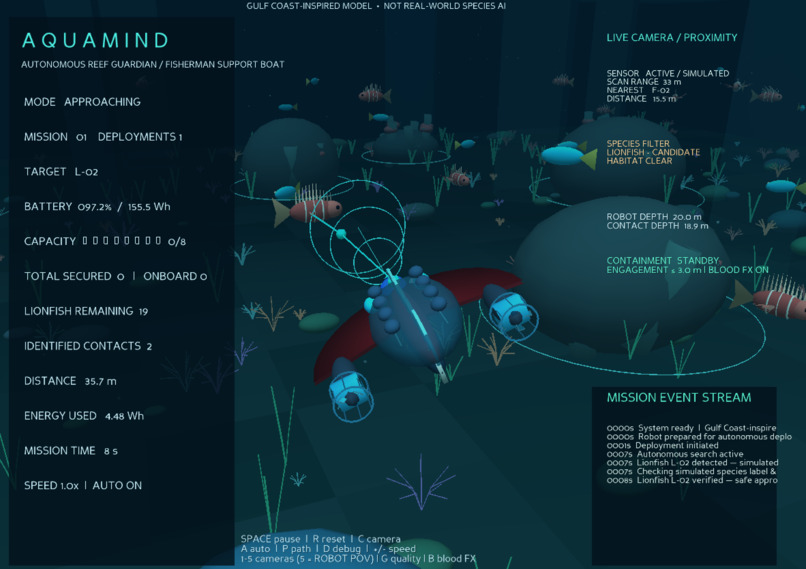
Simulated underwater enviorment
Inspiration
Since we’re studying in Corpus Christi, we wanted to build something related to the ocean and marine conservation. We learned about the damage invasive lionfish can cause to marine ecosystems and started thinking about how automation could make removing them easier and more efficient. Since the hackathon theme was Green AI and Resource Efficiency, we thought this would be a great problem to work on.
What it does
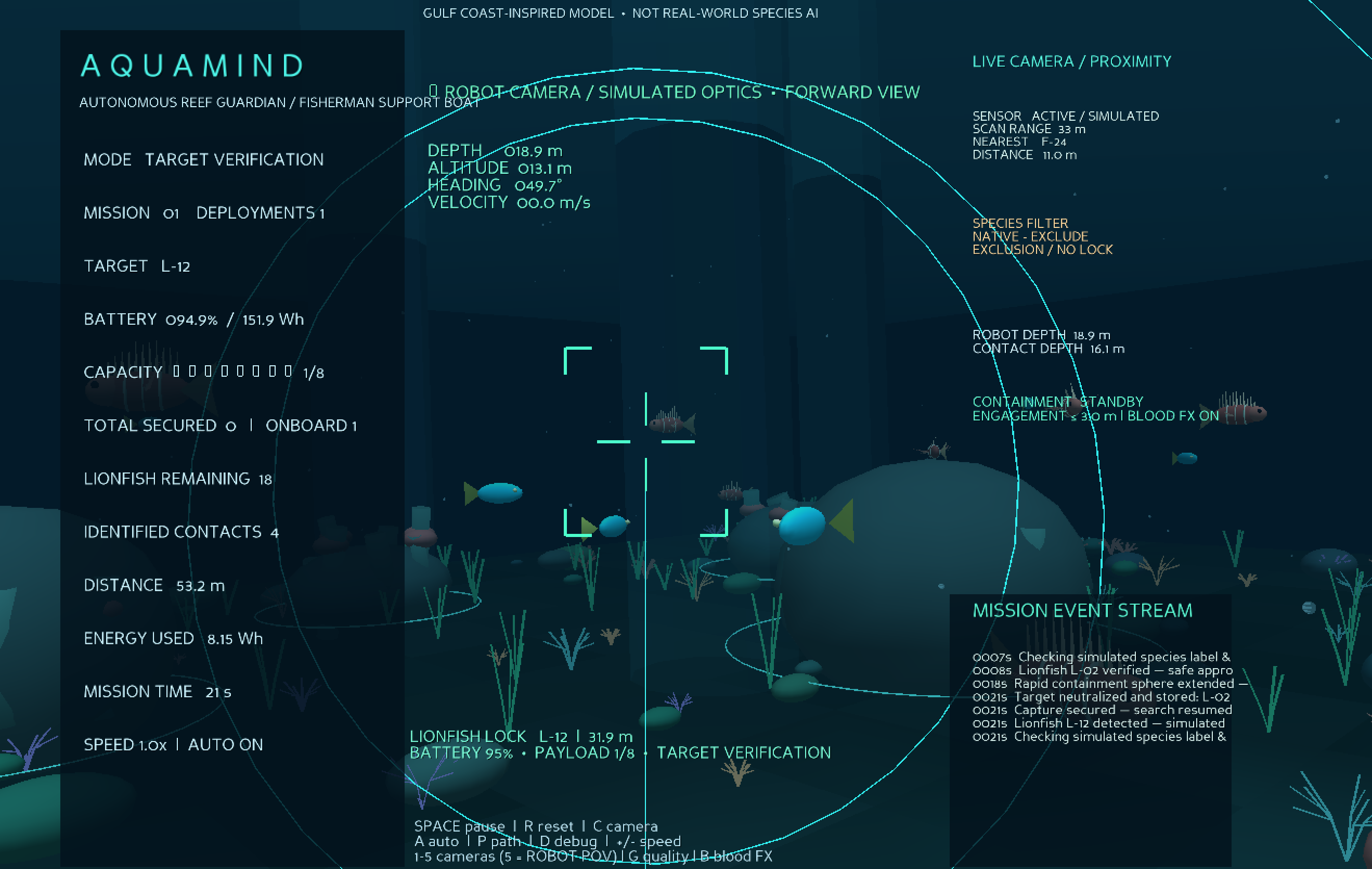
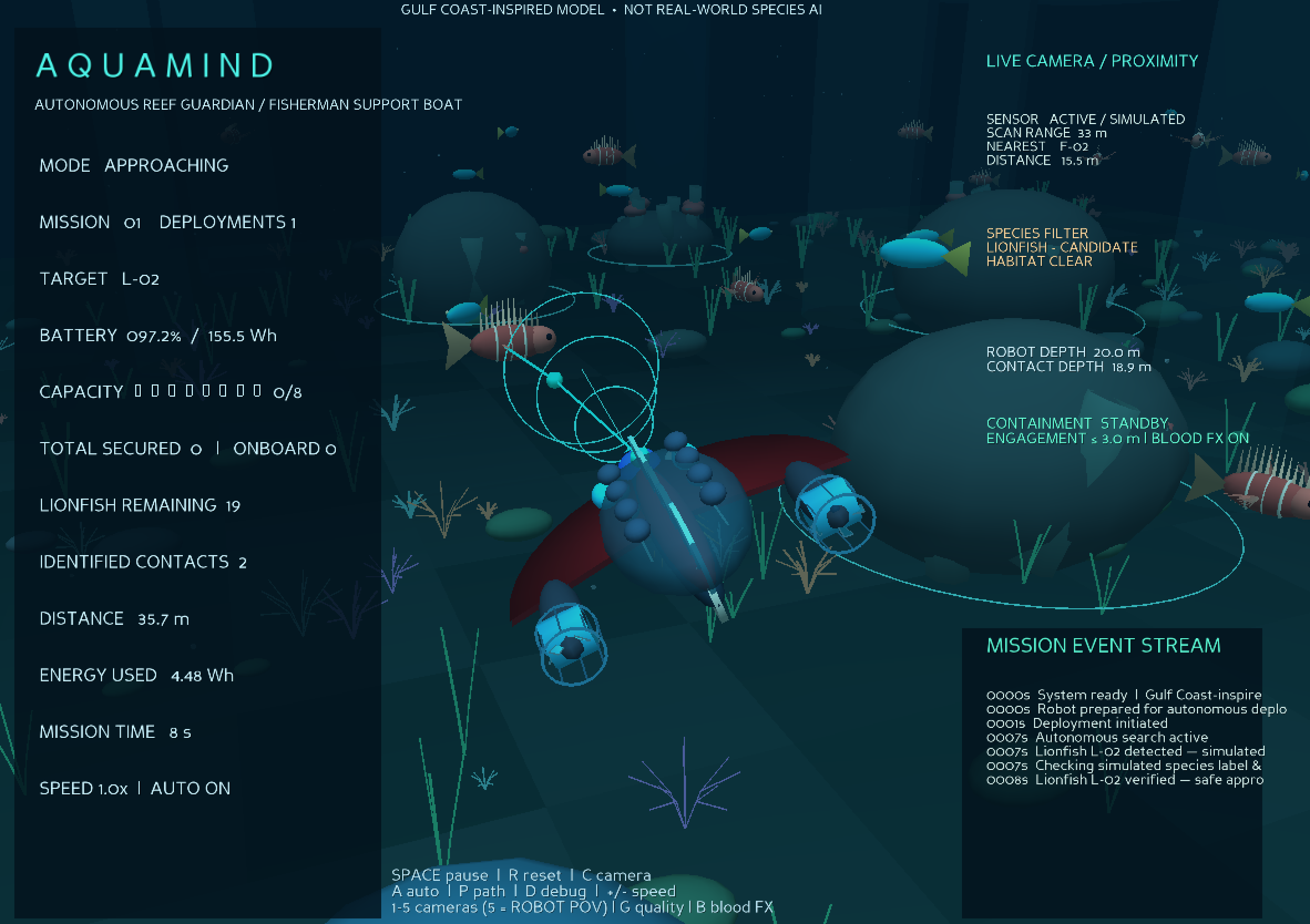
AquaMind is a 3D simulation of an autonomous underwater robot that detects and captures invasive lionfish while avoiding native marine life. The robot searches for lionfish, identifies them, and approaches them using a spearfishing capture method.
It can hold up to 8 lionfish before returning to a fishing boat to unload, recharge, and automatically head back out. It also monitors its battery and plans its movements to avoid wasting energy.
How we built it
We built AquaMind using Python and Panda3D to create the underwater environment, robot, fish, and animations.
We used the A pathfinding algorithm* to help the robot navigate around obstacles and a finite-state machine to control its actions. We also implemented an energy management system that checks whether the robot has enough battery to capture a fish and return safely.
The fish identification currently uses simulated species labels rather than a trained AI model.
Challenges we ran into
Our biggest challenge was getting everything to work together within 24 hours. We had to figure out the robot’s design, how the capture mechanism would work, and how to make sure it avoided native fish.
We also had issues with the propeller animations, camera angles, and running the simulation in VS Code. Getting the robot to complete an entire mission without manual control took quite a bit of trial and error.
Accomplishments that we’re proud of
We’re proud that we managed to turn our idea into a working 3D simulation in just 24 hours. The robot can search for lionfish, navigate around obstacles, capture up to eight fish, return to the boat, recharge, and redeploy.
We’re especially proud of the autonomous navigation and energy management system because we wanted the project to be more than just a good-looking simulation.
What we learned
We learned a lot about 3D development, pathfinding, autonomous systems, and how different parts of a program work together.
We also learned that building something autonomous isn’t just about making it move on its own. It needs to make decisions, manage resources, and respond to its environment. Working under a tight deadline also taught us how important it is to prioritize what matters most.
What’s next for AquaMind
We’d like to train an actual AI model to identify lionfish using underwater camera footage instead of simulated labels. We also want to improve the robot’s design, build a physical prototype, and test different ways to reduce energy consumption.
Eventually, we’d love to work with marine researchers to see whether something like AquaMind could realistically help with in managing invasive species.
Built With
- ai
- python

