-
-
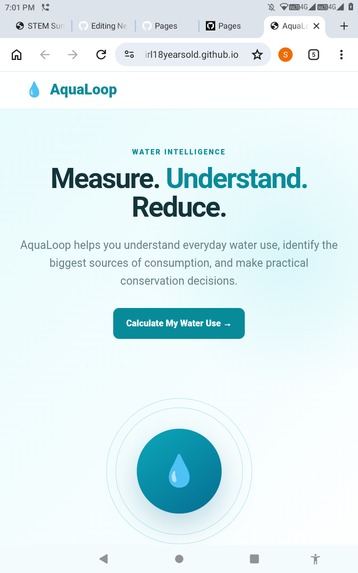
Measure, Understand, Reduce
-
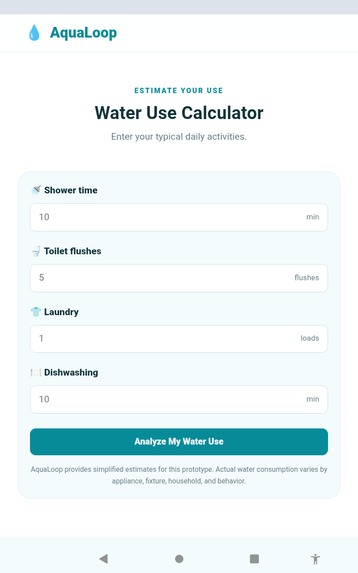
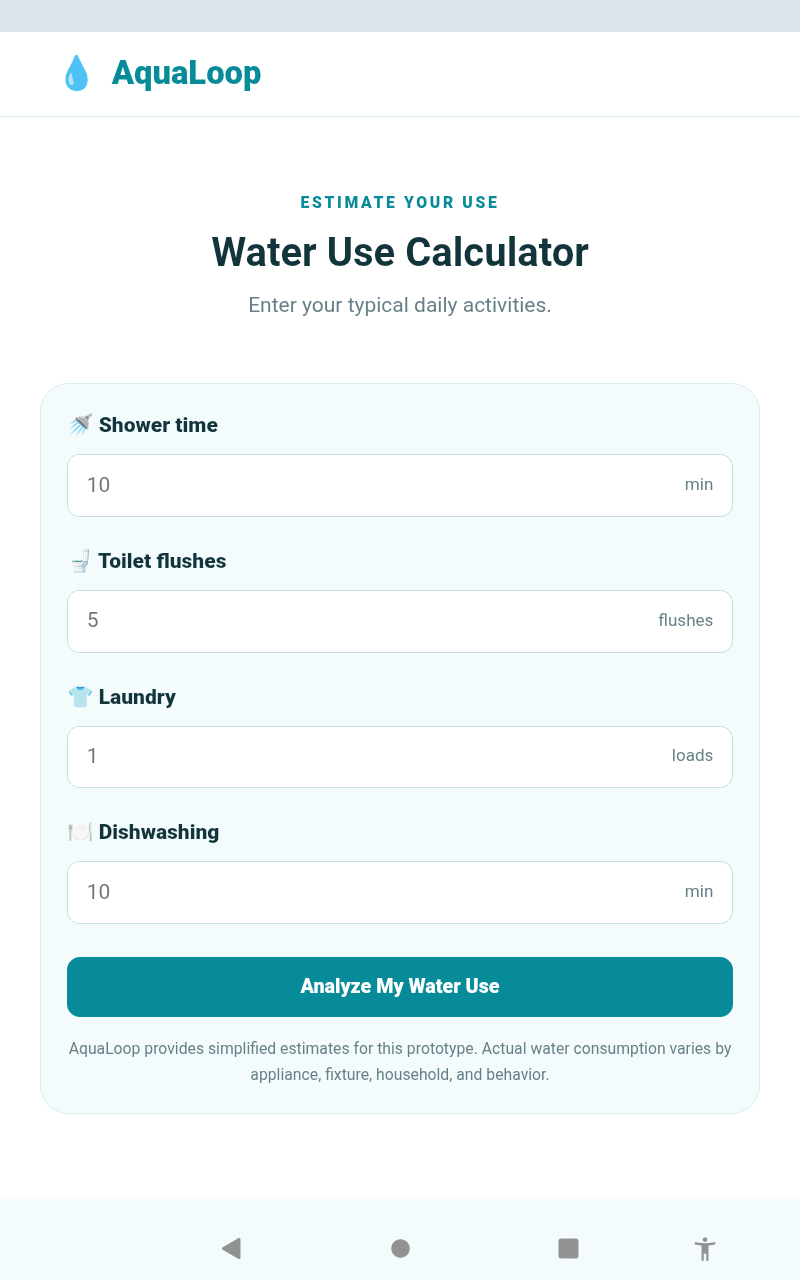
Water calculator
-
-
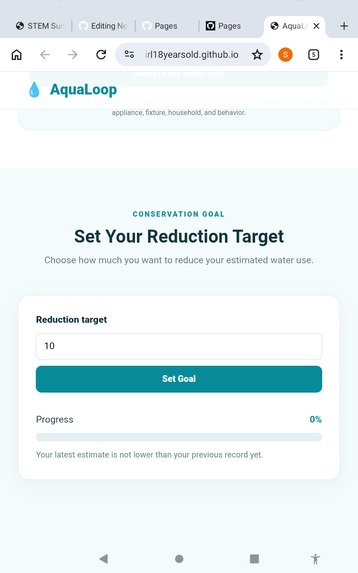
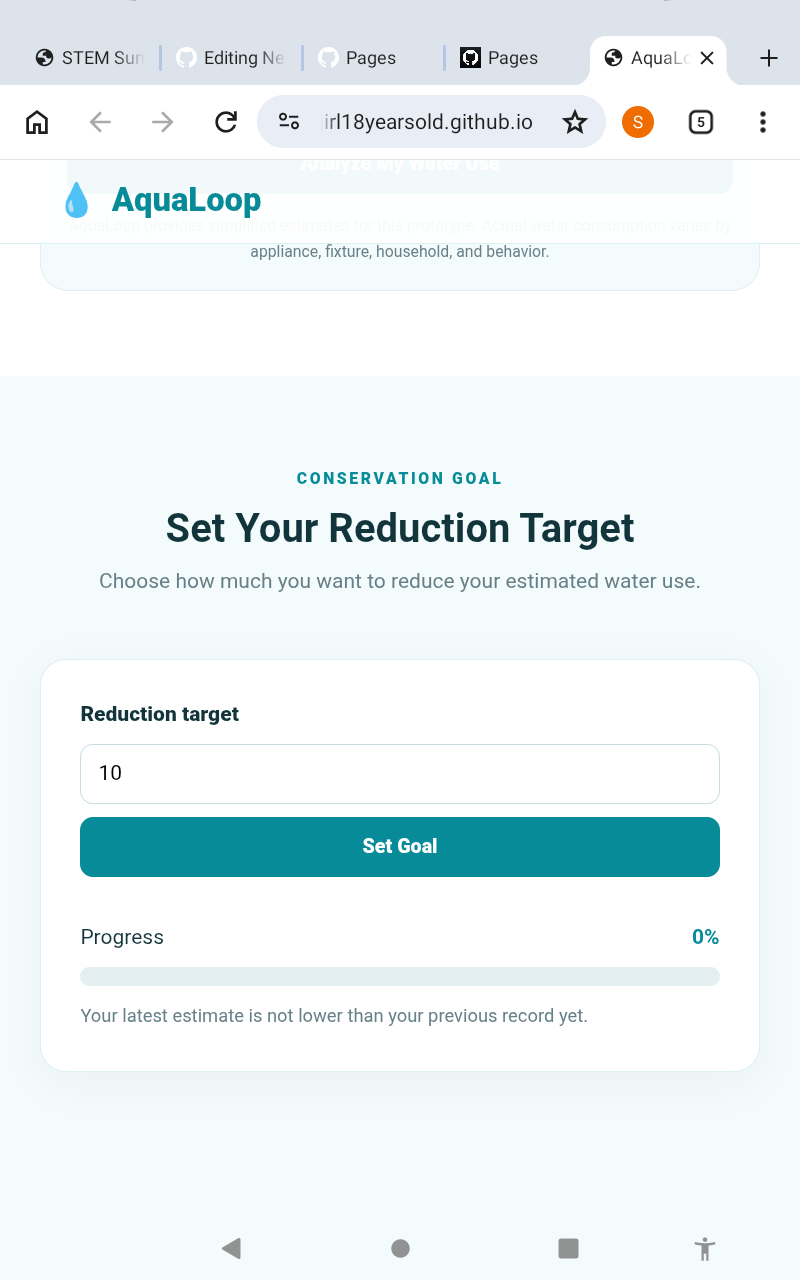
Reduction target
-
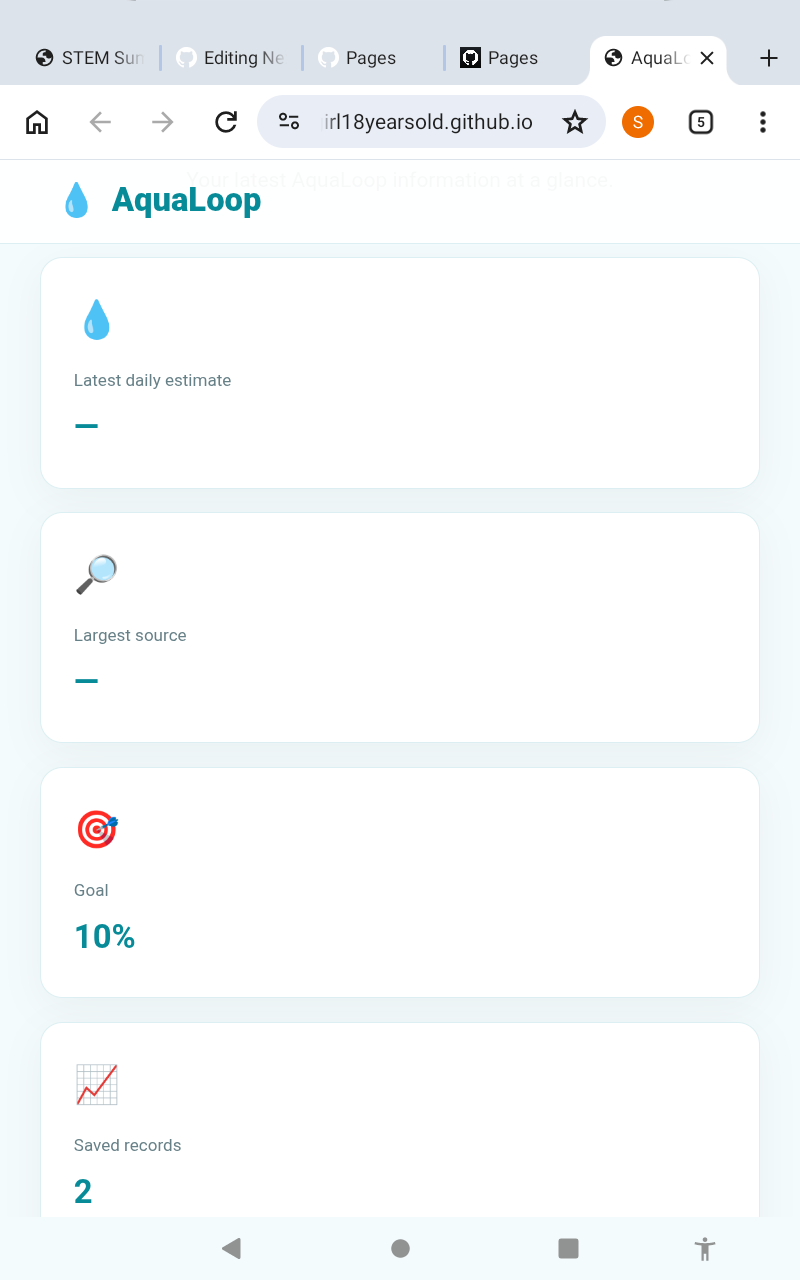
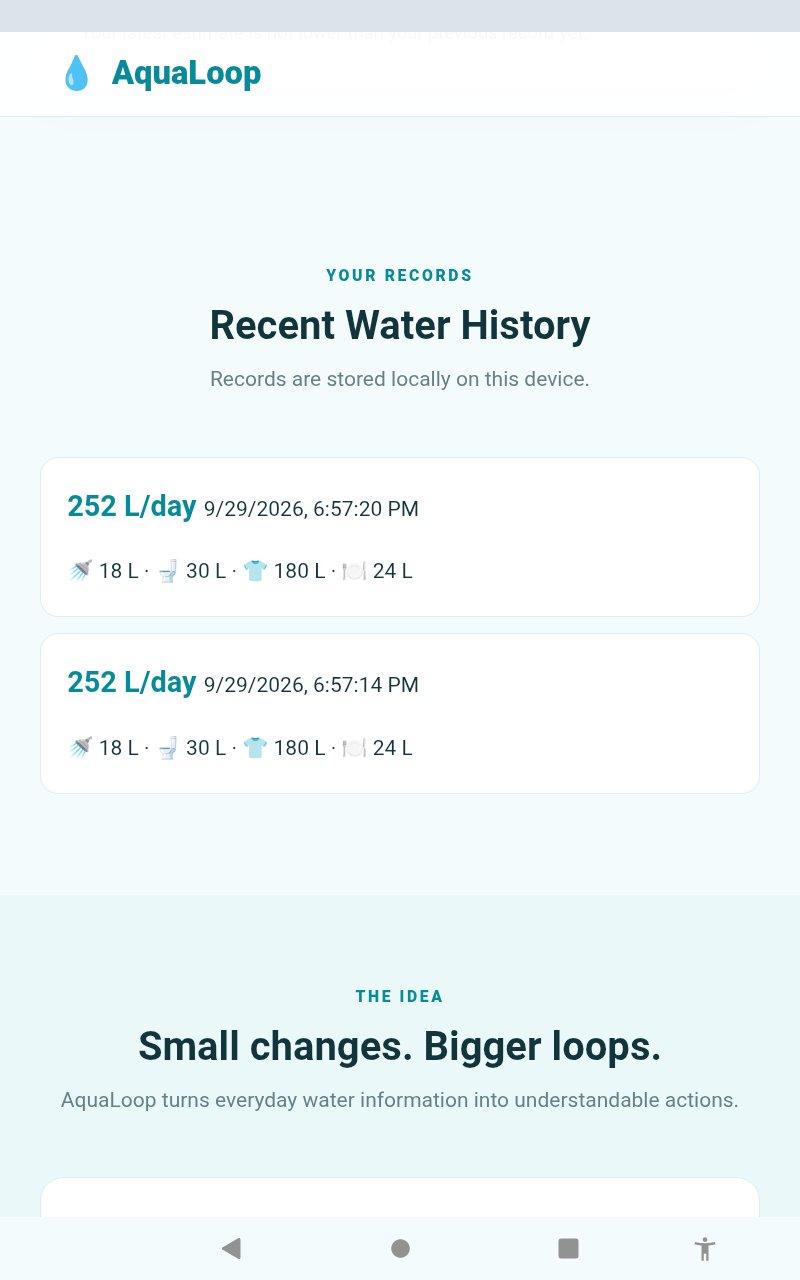
History
-
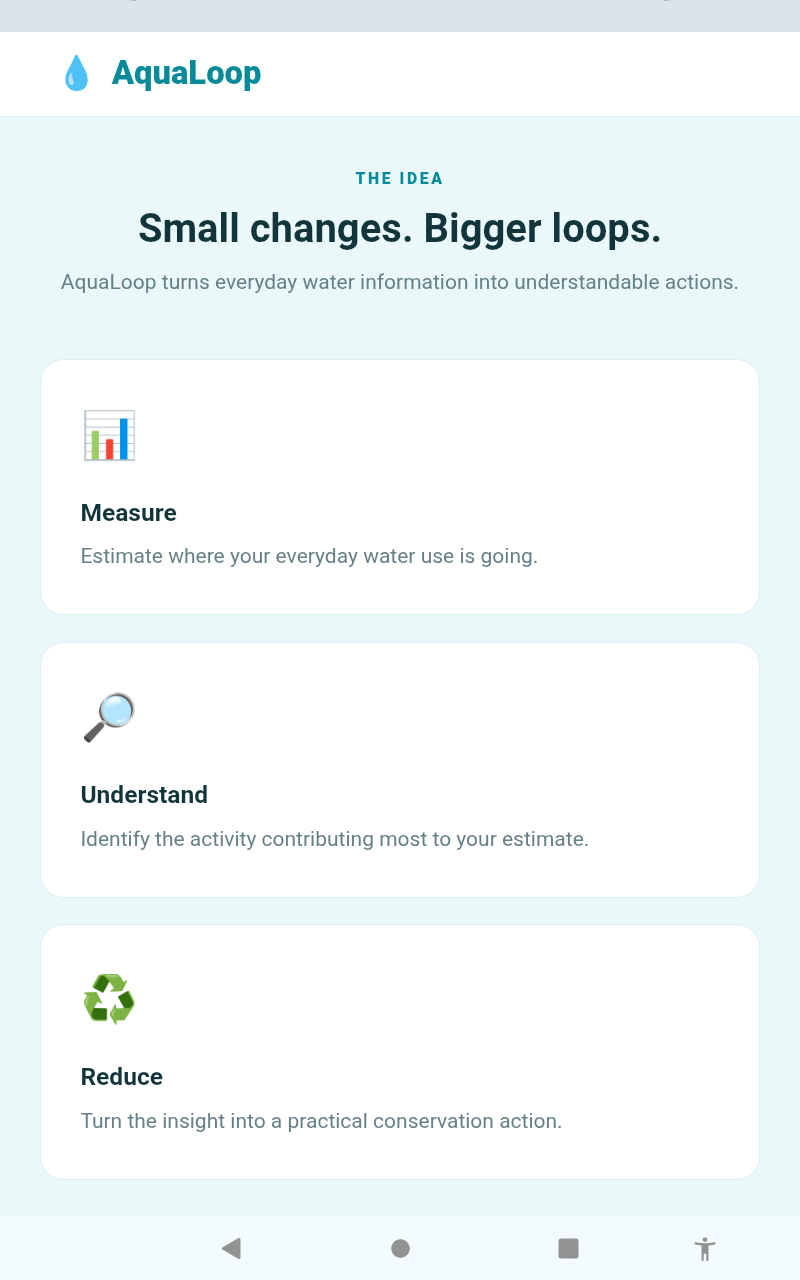
The idea
-
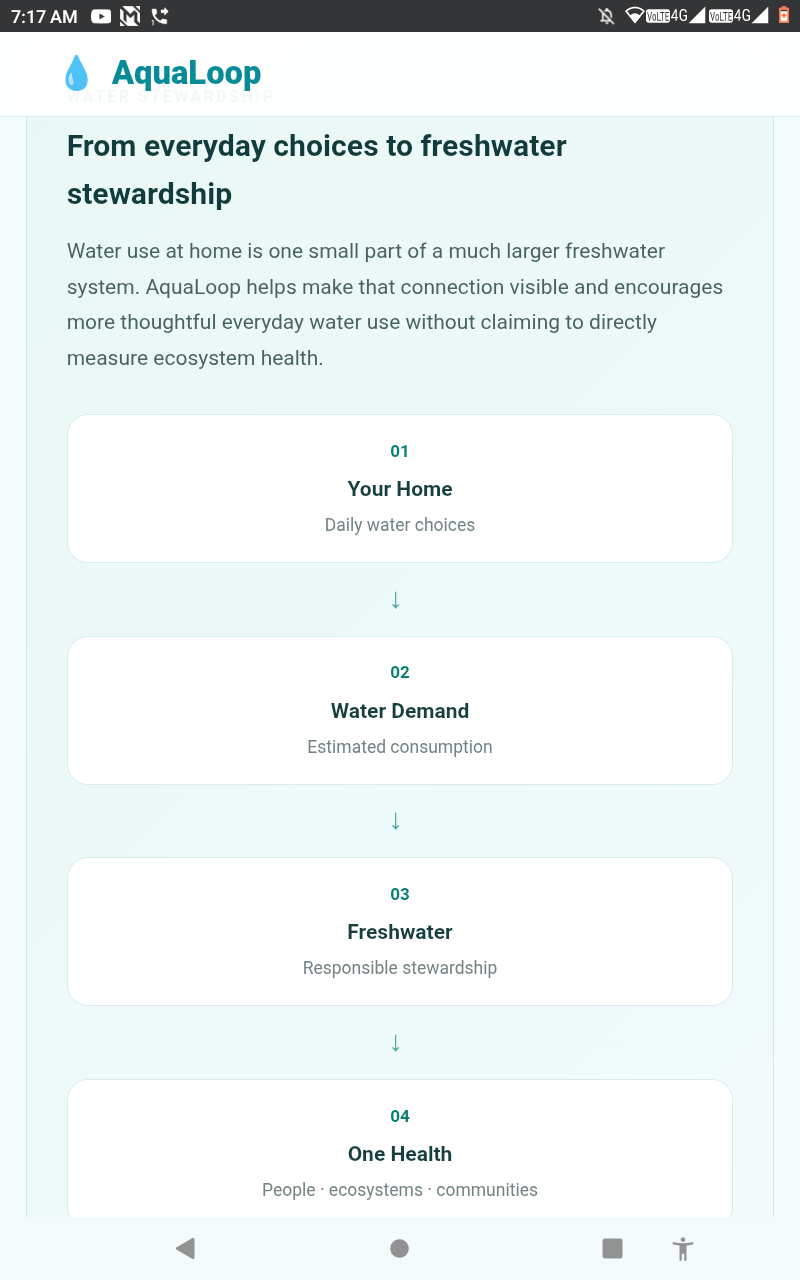
Water stewardship
-
Estimate water use
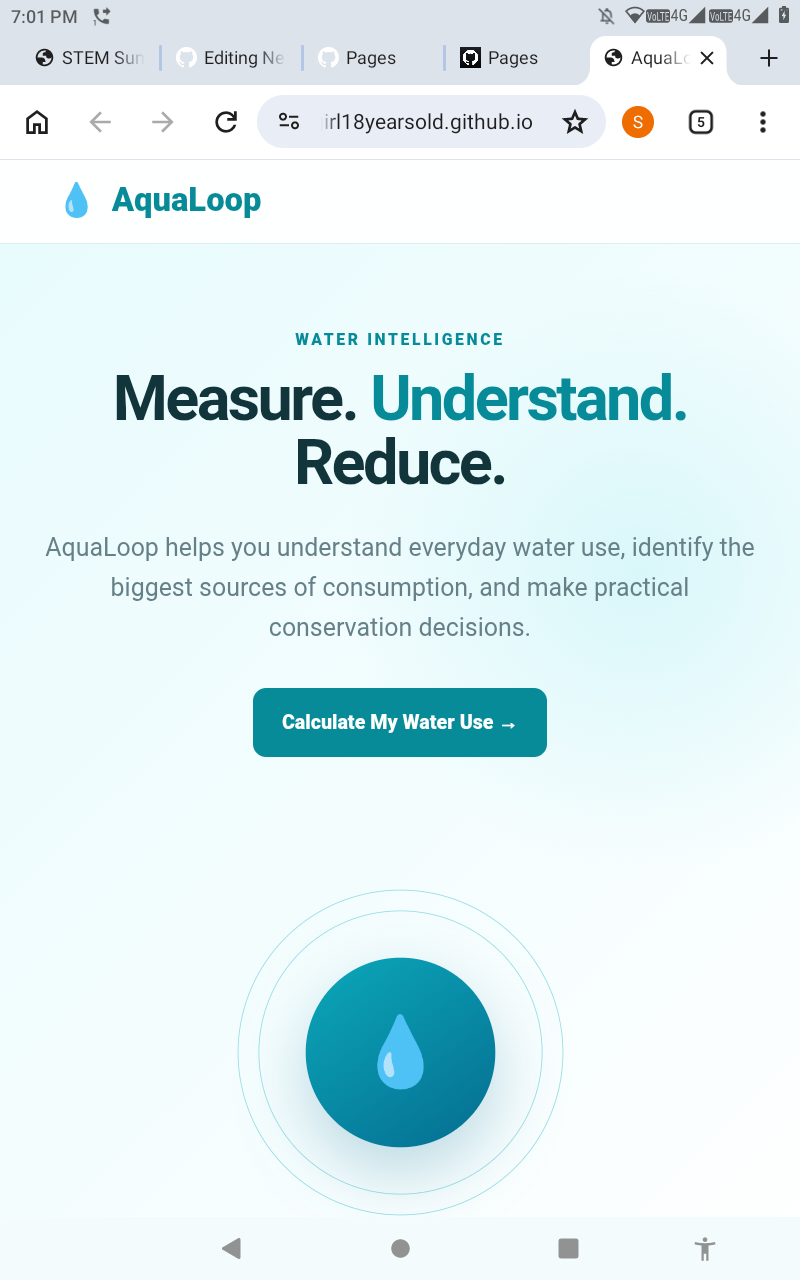
AquaLoop — Measure. Understand. Reduce.
Track Alignment
Primary Track: Awareness & Storytelling
AquaLoop aligns with the Awareness & Storytelling track by turning an everyday activity—household water use—into an understandable experience and connecting personal behavior with the broader idea of freshwater stewardship.
The project uses a simple One Health perspective:
People → Water → Ecosystems → Community Well-being
AquaLoop does not claim to directly measure ecosystem health or environmental impact. Instead, it helps users understand their own water-use behavior and consider how responsible water use fits into a larger freshwater system.
Inspiration
We use water every day, but most of us never know how much we actually use.
Water conservation is often discussed through large statistics about cities, rivers, or global water shortages. Those numbers can feel distant from everyday life.
I wanted to start somewhere more personal.
I asked myself: What if people could see how their ordinary household habits add up?
That question became AquaLoop—a simple tool designed to make invisible water consumption easier to understand and turn awareness into something users can actually reflect on.
As I developed the idea, I wanted it to go beyond a calculator. Water is connected to people, communities, and ecosystems, so I added a Water Stewardship experience that introduces this broader One Health perspective without pretending that a small prototype can measure an entire ecosystem.
What AquaLoop Does
AquaLoop is a personal water-intelligence and awareness tool.
Users enter their everyday household activities, including:
- Showering
- Toilet use
- Laundry
- Dishwashing
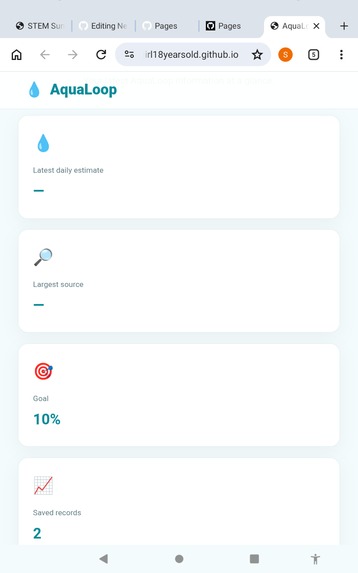
AquaLoop then estimates their:
- Daily water use
- Weekly water use
- Monthly water use
The results break the estimate down by activity, helping users see which habits contribute most to their estimated consumption.
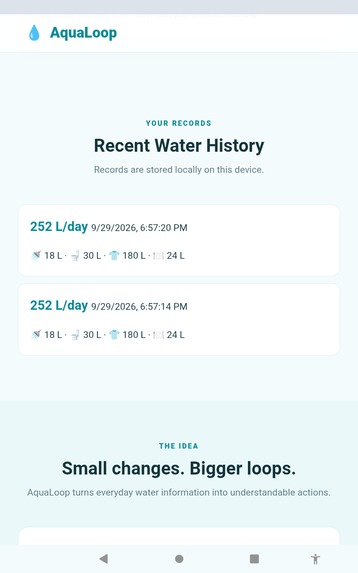
Users can also receive a simple recommendation, set a personal reduction goal, save their records, and review their history over time.
The goal is to move from:
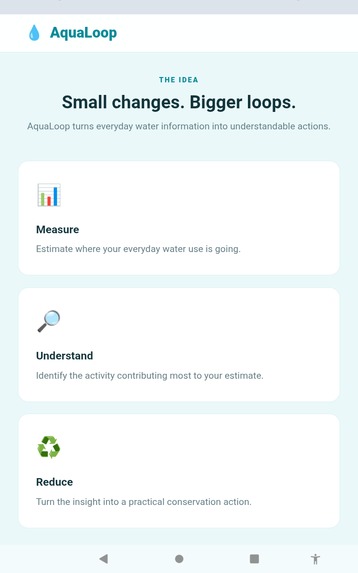
Measure → Understand → Reduce
Water Stewardship & One Health
The new Water Stewardship section extends AquaLoop beyond a personal calculator.
It presents a simple connection:
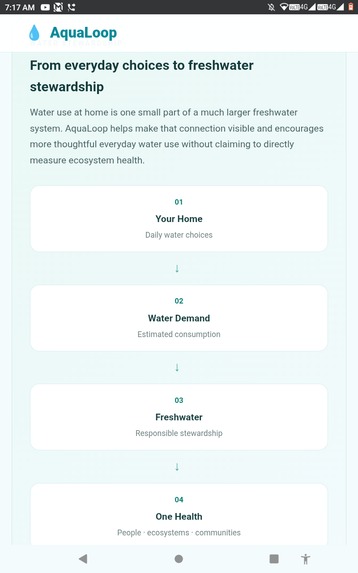
Your Home → Water Demand → Freshwater Stewardship → One Health
The idea is not that one person's water use can be directly translated into an ecosystem-health measurement.
Instead, the section encourages users to recognize that freshwater is a shared resource connecting human activities, communities, and ecosystems.
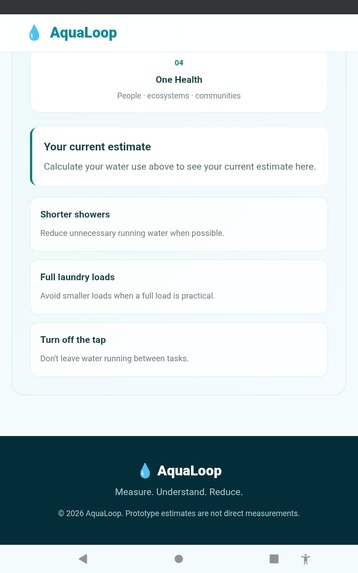
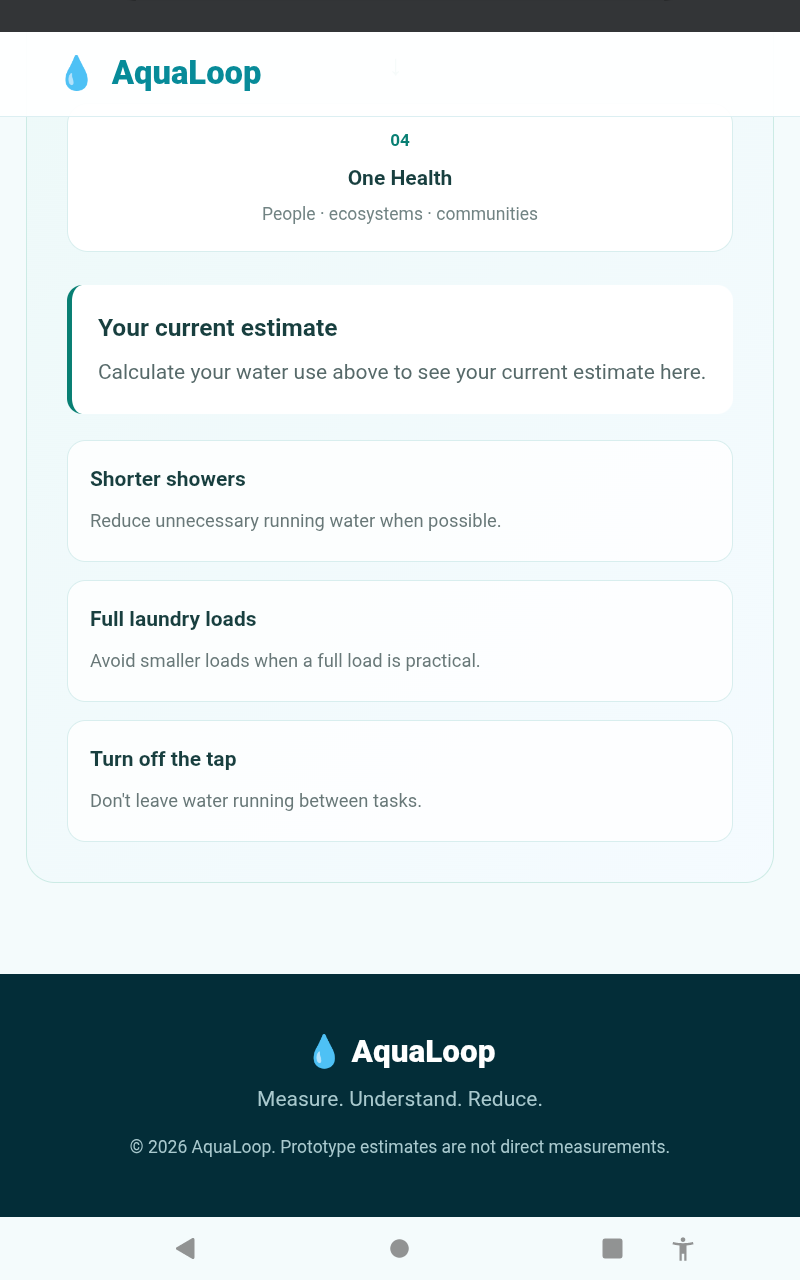
It also provides simple actions such as reducing unnecessary running water, taking shorter showers when practical, and waiting for full laundry loads.
This makes the environmental message actionable without overstating what the current technology can prove.
How I Built It
AquaLoop was built using lightweight web technologies:
- HTML
- CSS
- Vanilla JavaScript
- LocalStorage
- GitHub Pages
The calculator uses simplified prototype rates to estimate water consumption.
LocalStorage allows users to save their goals and usage records directly in their browser without requiring an account or external database.
The Water Stewardship section is implemented as a separate JavaScript module so it can extend the existing application without changing the core calculator logic.
Challenges
One of my biggest challenges was deciding how far the prototype should go.
It would have been easy to add unsupported claims about AI, environmental impact, or ecosystem monitoring just to make the project sound more advanced.
I chose not to do that.
AquaLoop currently does not directly measure household water flow, monitor rivers or lakes, or predict ecosystem health. Its consumption figures are simplified estimates designed for awareness and experimentation.
I wanted the project to be useful while being transparent about what it can and cannot currently demonstrate.
Another challenge was turning a simple calculator into something with a broader purpose. The Water Stewardship section helped me connect individual behavior with the larger freshwater and One Health context without pretending to solve that larger problem.
What I Learned
Building AquaLoop taught me that environmental technology does not always need to begin with a complicated model.
Sometimes the challenge is making information understandable enough for someone to actually use.
I also learned the importance of distinguishing between estimation and measurement.
A number displayed by a computer can look precise even when its underlying assumptions are simplified. Being transparent about those assumptions makes a prototype more trustworthy and gives future development a clearer direction.
Most importantly, I learned that a small personal tool can be designed as an entry point into a much larger conversation about shared resources and responsible technology.
Impact
AquaLoop's current impact is primarily educational and behavioral rather than environmental measurement.
It gives users a way to:
- See an estimate of their everyday water use
- Identify activities contributing to that estimate
- Set a personal reduction goal
- Track their records
- Think about water use through a broader stewardship perspective
The prototype is designed to make the first step—awareness—simple and accessible.
What's Next
The next stage of AquaLoop would focus on improving both accuracy and usefulness.
Future development could include:
- Validated and localized water-use data
- More household activities and detailed inputs
- Improved visualization and analytics
- Research-based conservation recommendations
- Community-level water information
- Integration with reliable freshwater datasets
- More evidence-based connections between water demand and freshwater stewardship
With stronger data and real-world validation, AquaLoop could evolve from a simple awareness prototype into a more evidence-based water-information platform.
Project Status
AquaLoop is currently a working prototype.
The current version demonstrates household water-use estimation, consumption breakdowns, recommendations, personal goals, history tracking, local data storage, and the Water Stewardship experience.
Its current estimates are simplified and should not be interpreted as precise measurements of actual household consumption or ecosystem impact.
The project is intended as a starting point for further research, validation, and development.
Try It
Live Demo: https://aigirl18yearsold.github.io/AquaLoop-/
Built With
HTML · CSS · JavaScript · LocalStorage · GitHub Pages
Built With
- css
- deploy
- git
- github
- html
- javascript
- local
- pages
- storage


Log in or sign up for Devpost to join the conversation.