-
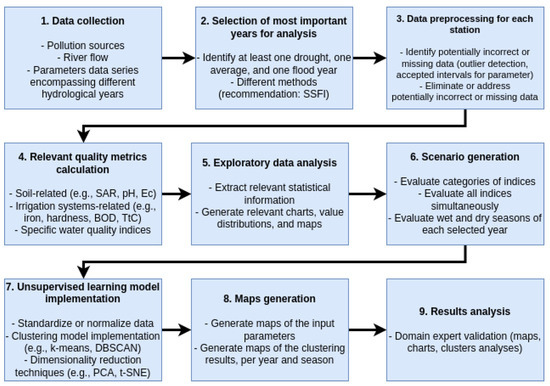
Image 1 for reference
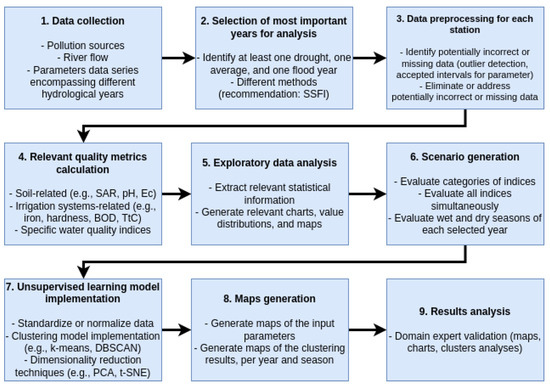
Inspiration
Agriculture is the leading water consumer in the world, accounting for 87% of global water consumption and 60% of all freshwater capture. In India, approximately 80% of the freshwater collected is used for agriculture. However, the water quality can vary considerably in the different regions and seasons. Low-quality irrigation water can impact plant growth, soil quality, and clog irrigation systems. This is a significant problem for localized irrigation.
Therefore, monitoring irrigation water quality is critical for sustainably and adequately managing irrigated agriculture. The global shortage of fresh water is a serious issue that will worsen with increasing demand and the effects of climate change. Precision Agriculture and Smart Irrigation could be essential solutions for addressing these issues. It is fundamental to monitor water quality, especially to measure its impacts on agriculture, ecosystems, and water resources. Several indices can be used to provide a clear overview of the state and comprehensively evaluate surface water quality. However, there are many questions about which parameters are available, the quality and frequency of obtaining these parameters, and the gaps in the available data. Answering these questions is essential to help improve policy-making decisions. Additionally, the better monitoring of water quality can help farmers and governments allocate resources and technologies in agricultural areas, increasing the resilience of water resources to anthropogenic impacts. Nevertheless, the traditional method of evaluating water purity for both drinking and irrigation purposes is characterized by its high cost, time-intensive nature and substantial demand for personnel resources. In this context, automated methods for evaluating and monitoring water quality for irrigation are essential for dealing with large volumes of data. Additionally, it is essential to conduct these evaluations considering different aspects, including soil impacts on irrigation systems.
Our Machine learning (ML) algorithms can help build such automated models by capturing linear and nonlinear relationships between hydrological systems and using parameters in heterogeneous areas subject to different land management systems and varying anthropogenic impacts. Traditionally, the ML is divided into three main areas: supervised, unsupervised, and reinforcement learning.
What it does
Different sources were considered to develop the proposed methodology, including studies on water-quality monitoring, irrigation-water management, and machine-learning applications in India. These studies examined water-quality conditions across different Indian regions and highlighted the challenges associated with monitoring contaminants, seasonal variations, and water availability in agricultural areas. The methodology was designed to address these challenges while considering the diverse climatic, geographical, and agricultural conditions across India. We also considered the main stages of the data lifecycle and ML workflows to ensure that the methodology could efficiently process, analyze, and interpret large volumes of environmental data. The proposed method contains nine components, which are Data Collection, Selection of Important Years for Analysis, Data Preprocessing for Each Station, Relevant Water-Quality Metrics Calculation, Exploratory Data Analysis, Scenario Generation, Unsupervised Learning Model Implementation, Map Generation, Results Analysis(figure 1) - in project media
How we built it
AquaIntel was built as a data-driven machine learning pipeline that collects and analyzes water-quality data from different monitoring stations and hydrological conditions. The data is first cleaned and preprocessed to handle missing values, incorrect measurements, and outliers. Relevant water-quality indicators are then calculated, followed by exploratory data analysis to identify patterns and relationships. The processed data is standardized and analyzed using unsupervised machine-learning techniques such as K-Means and DBSCAN clustering, along with dimensionality-reduction methods such as PCA and t-SNE. The resulting clusters are visualized through charts and geographical maps to identify differences in water-quality conditions across locations, seasons, and years. These results are then analyzed to identify meaningful water-quality patterns and potential irrigation-related risks.
Challenges we ran into
One of the main challenges was dealing with incomplete and inconsistent water-quality data, including missing values, outliers, and differences between monitoring stations. We also had to account for large variations across seasons and hydrological conditions, such as drought and flood years, which could significantly affect water quality. Another challenge was identifying the most meaningful water-quality indicators from many different parameters and finding patterns in complex, heterogeneous datasets. Finally, interpreting the clusters produced by unsupervised machine learning and translating them into useful geographical and irrigation-related insights required careful analysis and validation.
Accomplishments that we're proud of
AquaIntel successfully developed a data-driven methodology for analyzing and predicting irrigation water quality using large and diverse environmental datasets. It demonstrated how unsupervised machine learning techniques such as K-Means and DBSCAN, combined with PCA and t-SNE, could identify meaningful patterns and groups in water-quality conditions. The methodology also integrated different seasons, hydrological conditions, monitoring stations, and water-quality parameters, allowing researchers to identify spatial and temporal variations. The resulting maps and analyses provided a clearer understanding of water-quality conditions and demonstrated how machine learning can support more efficient monitoring, irrigation management, and sustainable use of agricultural water resources.
What we learned
We learned how machine learning can be applied to real-world environmental problems, especially when working with complex and incomplete water-quality data. We gained experience in data cleaning, preprocessing, exploratory analysis, clustering, and visualization, while understanding how factors such as seasons, locations, and hydrological conditions influence water quality. We also learned that environmental AI is not just about building a prediction model, but about turning large datasets into insights that can support better and more sustainable water-management decisions.
What's next for AquaIntel
The next step for AquaIntel is to move beyond analyzing existing water-quality data and develop a predictive, real-time system for India. We plan to integrate weather data, satellite imagery, seasonal patterns, and live water-quality measurements to improve predictions. In the future, AquaIntel could use AI to detect unusual changes, forecast potential irrigation risks, and generate early warnings for farmers and water managers. The goal is to turn AquaIntel from a research model into a practical environmental intelligence system that supports smarter and more sustainable water use.
Built With
- data-analysis
- dbscan
- environmental-data
- geospatial
- jupyter-notebook
- k-means
- machine-learning
- matplotlib
- numpy
- pandas
- pca
- python
- scikit-learn
- t-sne

Log in or sign up for Devpost to join the conversation.