-
-
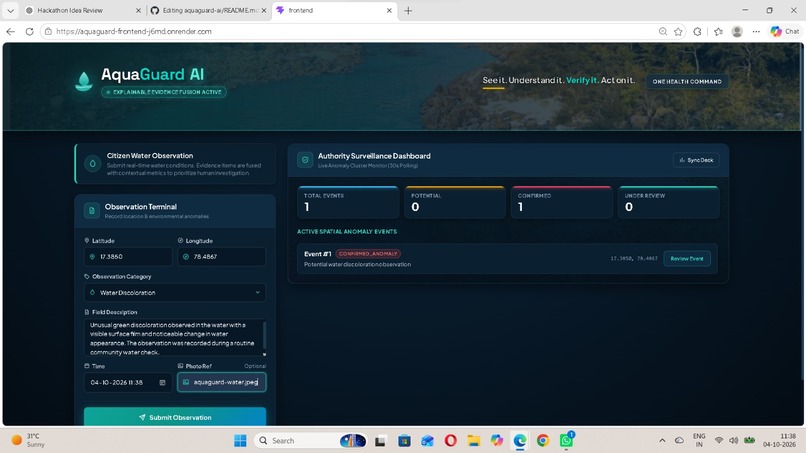
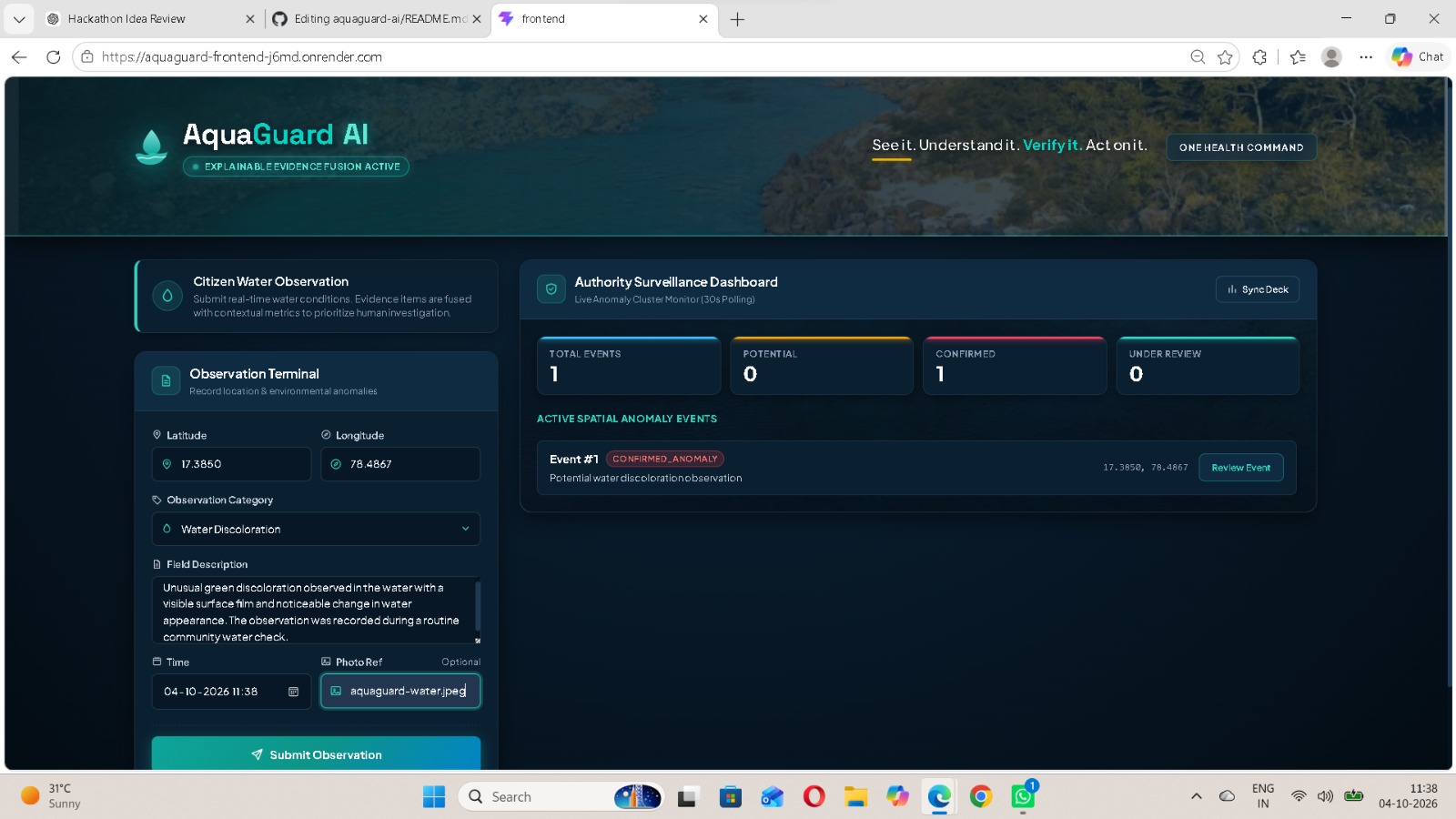
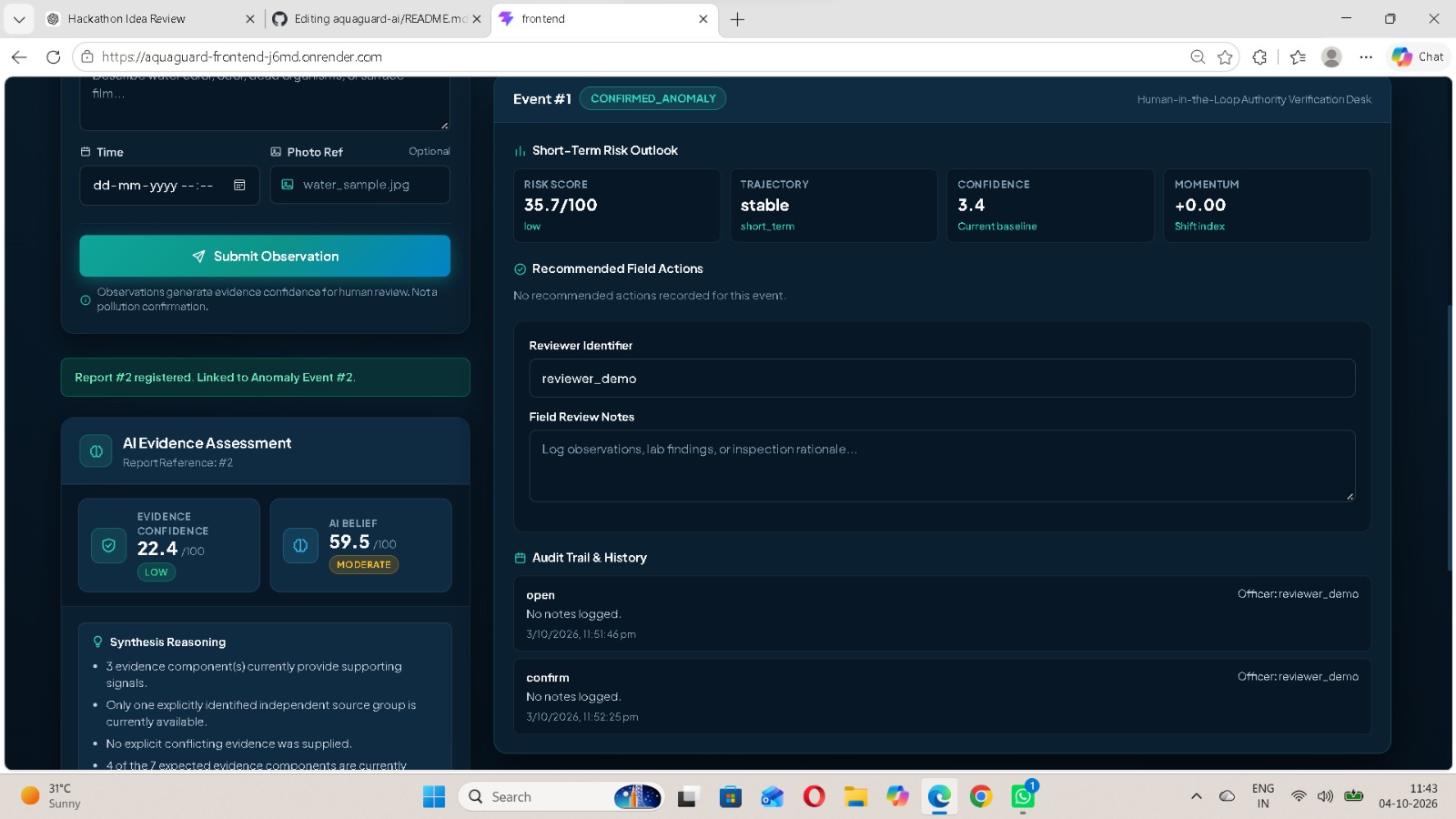
Image showing Citizen dashboard
-
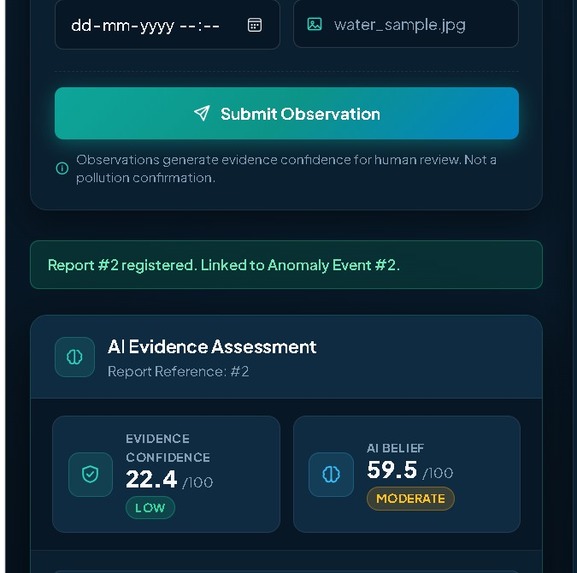
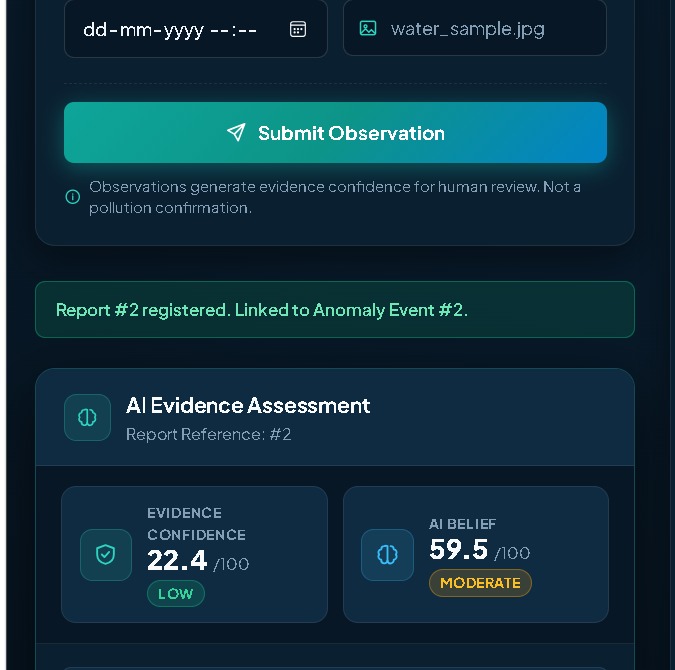
Evidence Assessment
-
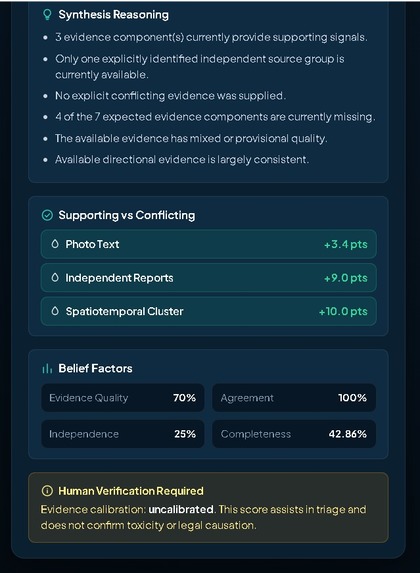
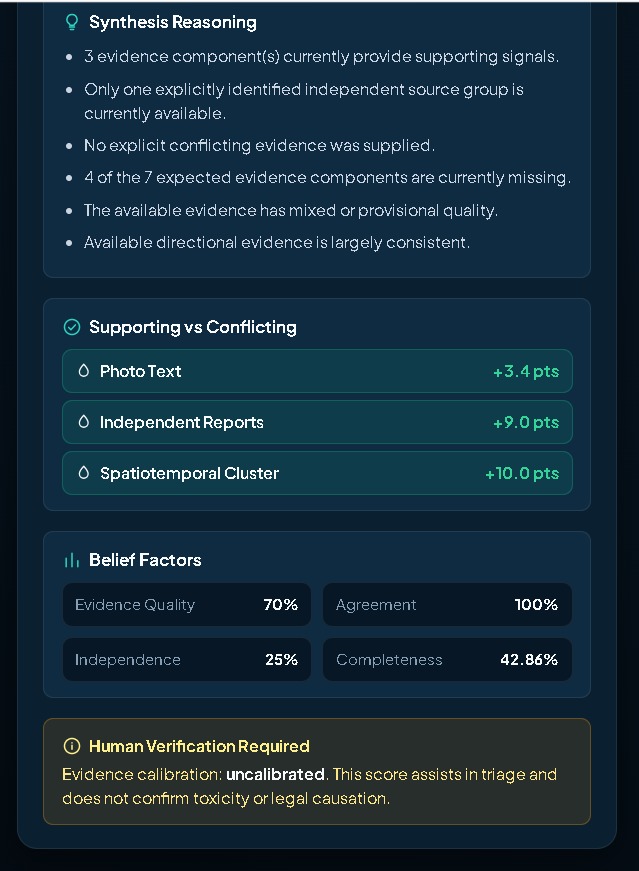
Evidence Contribution
-
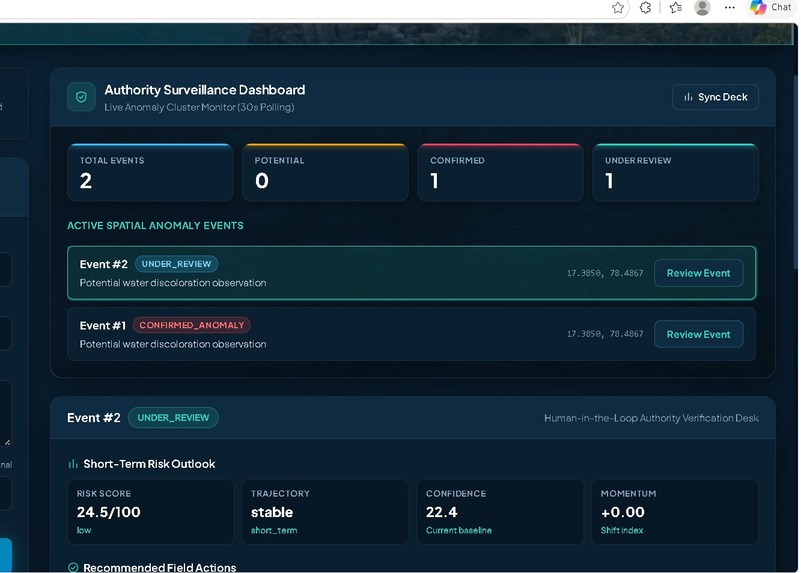
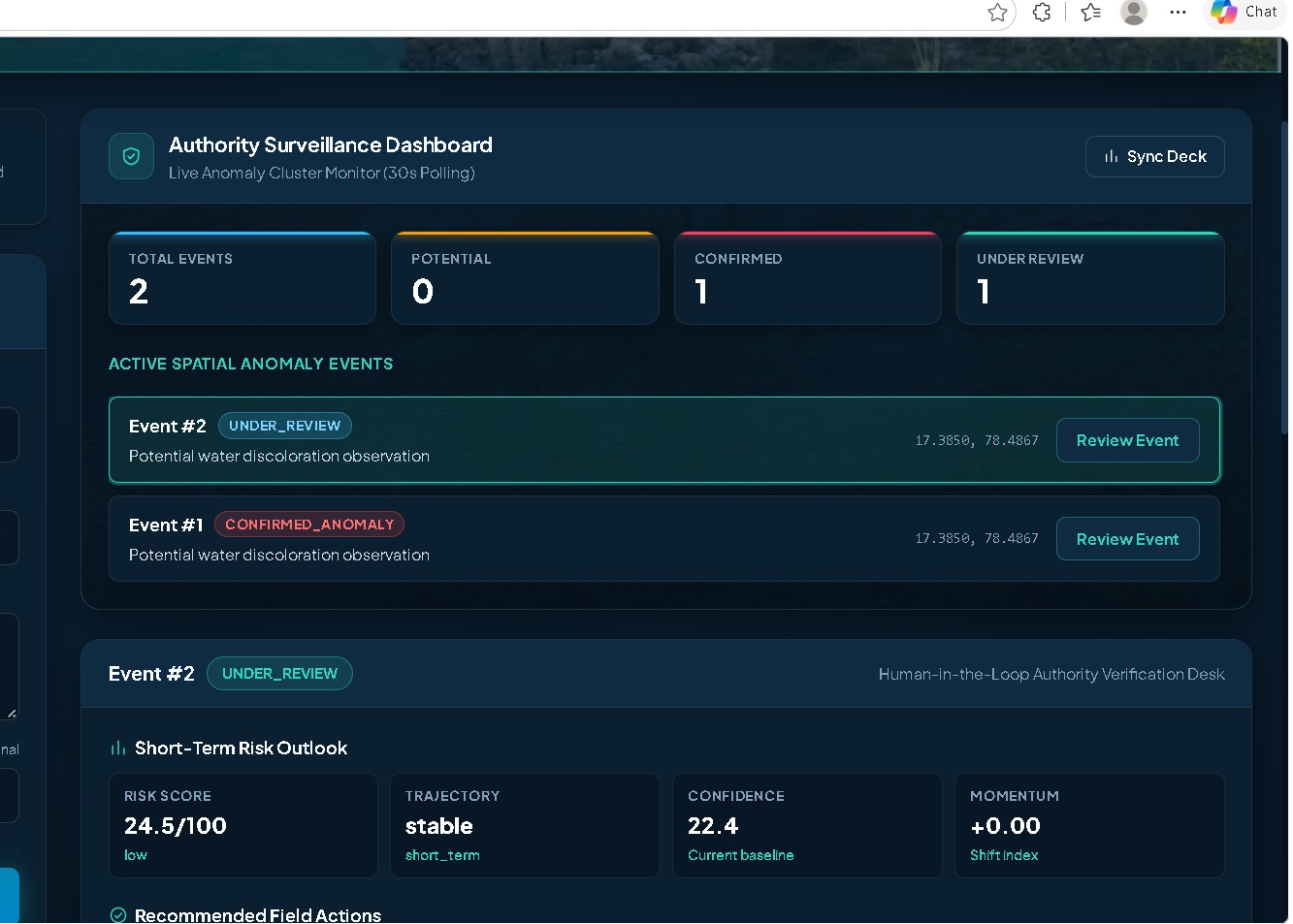
Authority Dashboard
-
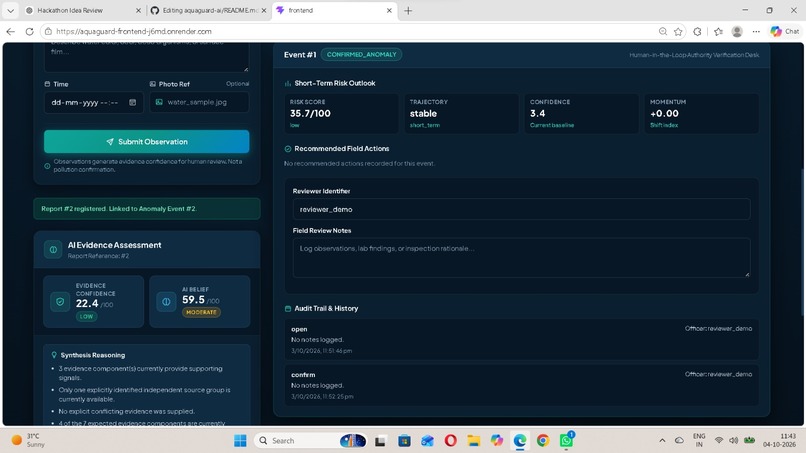
Recommended Actions
Inspiration
Water-health problems are often noticed by local communities before they are formally investigated. A citizen may notice unusual water discoloration, surface changes, or other abnormalities, but a single photograph or observation is rarely enough to determine what is actually happening.
I wanted to build something that could turn these observations into structured, explainable environmental intelligence instead of simply producing another black-box AI prediction.
This inspired AquaGuard AI.
My central idea is explainable evidence fusion: combine available citizen, AI, community, environmental, spatial, and temporal evidence, show how that evidence contributes to an assessment, and keep humans involved in the final decision. My guiding principle became:
See it. Understand it. Verify it. Act on it.
What it does
AquaGuard AI transforms citizen-reported water observations into an evidence-based workflow:
Observation → Evidence → Explanation → Verification → Prediction → Action
A citizen can submit an observation with a category, description, geographic coordinates, and photo reference. The system creates a potential anomaly event and performs an AI-assisted evidence assessment.
The platform provides:
Evidence Confidence — an ordinal prioritisation score representing how strongly the available evidence supports a potential anomaly. AI Belief — a separate assessment based on factors such as evidence quality, agreement, source independence, and completeness. Explainable Evidence Contributions — showing how available evidence contributes to the assessment. Authority Dashboard — providing an operational view of potential, confirmed, and under-review events. Human-in-the-Loop Verification — allowing authorised reviewers to review and confirm events. Audit Trail — recording verification actions and event-status changes. Contextual Risk Outlook — providing a risk score, risk band, and direction to help prioritize attention. Recommended Actions — suggesting human-reviewed next steps such as site inspection, water sample collection, environmental monitoring, evidence review, and authority review.
A key design principle is responsible communication. AquaGuard AI does not claim that a citizen photograph proves pollution or toxicity. It is a decision-support and prioritisation system.
How I built it
AquaGuard AI is a full-stack web application built with:
React + Vite for the frontend Python + FastAPI for the backend PostgreSQL/PostGIS for data persistence and geographic information AI-assisted text and vision analysis A deterministic evidence-fusion engine REST APIs connecting the application components GitHub + Render for deployment
The most important part of our implementation is the explainable scoring layer.
The system does not simply display fixed demonstration numbers. The architecture defines maximum contribution weights for different evidence components, while the actual contributions and final metrics are calculated from the evidence available for the current event.
For example, the photo-and-text component has a defined maximum contribution of 25 points and combines the available image and text signals using the defined mathematical formulation.
This means the assessment can be traced back to the evidence that produced it.
I also deliberately separated Evidence Confidence from AI Belief. Evidence Confidence asks how strongly the available evidence supports the potential anomaly, while AI Belief considers the reliability of the overall assessment.
The application was then connected to a human verification workflow, risk outlook, audit history, and recommended actions.
Finally, I deployed the working application to the cloud so that the complete workflow could be demonstrated through a live web application.
Challenges I ran into
One of my biggest challenges was designing an AI system that was explainable rather than simply predictive.
It was important to distinguish between a citizen observation, a potential anomaly, and a confirmed anomaly. We did not want the system to overclaim what the available evidence could prove.
Another challenge was ensuring that my displayed metrics were calculated from evidence rather than hard-coded for the demo. I therefore designed the fusion layer around deterministic mathematical contributions that can be inspected and explained.
I also had to design the system around the reality that environmental evidence is often incomplete. Different evidence sources may not always be available, so the platform needed to remain useful without pretending that unavailable information existed.
From the engineering side, I faced challenges integrating the frontend and backend, persisting AI results, implementing verification and audit workflows, configuring the production environment, and deploying the application successfully to the cloud.
These challenges pushed me to think not only about whether the AI worked, but also about how the AI should communicate its results responsibly.
Accomplishments that I'm proud of: I am proud that AquaGuard AI became a working, deployed end-to-end application, rather than remaining only a concept or model prototype.
My key accomplishments include:
Built a functional citizen reporting workflow. Connected citizen reports to potential anomaly events. Implemented AI-assisted evidence assessment. Implemented deterministic mathematical evidence scoring. Separated Evidence Confidence from AI Belief. Built an operational Authority Dashboard. Implemented human-in-the-loop verification. Added persistent verification history and audit trails. Implemented contextual Risk Outlook. Added Risk Outlook history. Implemented human-reviewed Recommended Actions. Connected the complete workflow through a live cloud deployment.
What I am most proud of is the combination of AI, explainability, environmental context, and human oversight in a single workflow.
Rather than simply asking:
“What does the AI predict?”
AquaGuard AI asks:
“What evidence do we have, how did it contribute, and what should a human review next?”
What I learned
I learned that building a responsible AI application involves much more than selecting an AI model.
I learned the importance of clearly distinguishing between evidence, confidence, prediction, and verification, particularly when working with environmental observations.
I also learned that explainability should be part of the system architecture from the beginning rather than something added after an AI model has already been built.
Technically, I gained practical experience with:
Full-stack application development React and FastAPI integration REST API design PostgreSQL/PostGIS AI-assisted analysis Mathematical evidence scoring Human-in-the-loop workflows Audit logging Cloud deployment
Most importantly, I learned that a useful AI system should communicate what it knows, how it reached an assessment, and where human judgment is still required.
What's next for AquaGuard AI
My next goal is to move AquaGuard AI from a working prototype toward stronger real-world environmental validation.
Future development includes:
Integrating real-time environmental and water-quality data Expanding community reporting datasets Improving calibration of AI image and text signals Conducting field validation with environmental experts Expanding spatial-temporal analysis Detecting changing environmental patterns over time Strengthening One Health contextual assessment Improving authority monitoring and investigation workflows Exploring integration with trusted environmental sensors Testing the evidence-fusion framework across a wider range of water-health scenarios
My long-term vision is to create a trustworthy bridge between citizen observations, environmental evidence, explainable AI, and informed human action.
AquaGuard AI — See it. Understand it. Verify it. Act on it.
Built With
- api
- css
- fastapi
- github
- javascript
- postgis
- postgresql
- pydantic
- python
- react
- render
- rest
- sqlalchemy
- uvicorn
- vite


Log in or sign up for Devpost to join the conversation.