Professional System Specification: Robust AI-Generated Content (AIGC) Detection Model
Target Application: Enterprise-grade AI-Generated Content Detection & Robustness Engine
Core Objective: High-precision, zero-leakage classification of authentic vs. AI-generated visual media under severe real-world redistribution degradations (e.g., social media re-compression, aggressive rescaling, and additive sensor noise).
Technical Performance & Empirical Benchmark
Primary Model Classification Metrics
Evaluated across internal validation (val_internal) and out-of-distribution transfer test splits (test_transfer). The deployed dual-tower ViT-L system delivers high operational accuracy and low False Positive Rates (FPR).
| Split | AUC | TPR@1%FPR | Dataset size (Real / Fake) | Model Families & Counts |
|---|---|---|---|---|
| train | — | — | 350,564 (175,670 / 174,894) | SD (5), Diffusion/Pixel (5), GAN (6), PixArt (3), SD-Adaptor (3), SD-Img2Img (3), Kandinsky (3), OmniGen (2), Infinity (2), FLUX (1), Z-Image (1), Open-Weight Singletons (5) |
| val | 0.9654 | 0.7348 | 53,600 (26,800 / 26,800) | VQ/Autoencoder (4), SD (2), FLUX (2), Klein (2), Open-Weight Singletons (3), Commercial Closed-Weight (2) |
| test | 0.9963 | 0.9825 | 37,295 (18,647 / 18,648) | Open-Weight Singletons (4), SD (1), FLUX (1), Z-Image (1), Commercial Closed-Weight (11) |
| demo | 0.9989 | 0.9758 | — | Coco val 2017 (1), Dall E Advanced |
Robustness & Stress-Test Degradation Matrix
Evaluated against a baseline reference performance ($\text{AUC} = 0.9551$). Operational invariance is sustained across typical degradation pipelines, with catastrophic degradation observed only at extreme compression thresholds ($\text{JPEG } q=10$).
| Applied Augmentation Pipeline | Metric (AUC) | Differential Score (Δ vs Clean Baseline) | Operational Impact |
|---|---|---|---|
| Clean Baseline Reference | 0.9551 | — | Baseline Nominal |
| JPEG Compression ($q = 90$) | 0.9645 | $+0.0094$ | High Stability |
| JPEG Compression ($q = 70$) | 0.9645 | $+0.0094$ | High Stability (Unseen Severity) |
| JPEG Compression ($q = 50$) | 0.9550 | $-0.0001$ | Negligible Shift |
| JPEG Compression ($q = 10$) | 0.8949 | $-0.0601$ | High Degradation |
| Gaussian Blur ($\sigma = 0.5$) | 0.9673 | $+0.0122$ | Performance Gain |
| Gaussian Blur ($\sigma = 1.0$) | 0.9585 | $+0.0035$ | High Stability (Unseen Severity) |
| Gaussian Blur ($\sigma = 2.0$) | 0.9500 | $-0.0051$ | Nominal Shift |
| Spatial Downscale ($0.5\times$) | 0.9600 | $+0.0049$ | High Stability |
| Spatial Downscale ($0.25\times$) | 0.9353 | $-0.0198$ | Moderate Shift |
| Additive Noise ($\sigma = 0.02$) | 0.9584 | $+0.0033$ | Nominal Shift |
| Additive Noise ($\sigma = 0.05$) | 0.9565 | $+0.0015$ | Nominal Shift |
| Additive Noise ($\sigma = 0.10$) | 0.9411 | $-0.0140$ | Moderate Shift |
| Color Jitter (Brightness $\pm 20\%$) | 0.9488 | $-0.0062$ | Nominal Shift |
| Color Jitter (Contrast $\pm 20\%$) | 0.9617 | $+0.0066$ | High Stability |
| Color Jitter (Saturation $\pm 20\%$) | 0.9572 | $+0.0021$ | Nominal Shift |
| Spatial Center Crop ($80\%$) | 0.9595 | $+0.0045$ | High Stability |
Corpus Curation & Out-of-Distribution Splitting
The training corpus leverages external benchmark distributions combined with targeted internal synthetic image generations. It strictly isolates zero-day commercial architectures and unseen autoencoder lineages to prevent data leakage.
- External Benchmarks: Baseline assets derived from NTIRE 2026 and WildFake datasets, capturing legacy GANs, foundational diffusion pipelines, and baseline organizer distributions.
- In-House Targeted Generations: Synthetic visual suites anchored to real portrait photographs from Open Images V7. Designed specifically to capture modern mobile visual trends (e.g., social media portrait layouts), spanning both Text-to-Image (T2I) and Image-to-Image (I2I) generation paradigms.
- Aspect Ratio Balancing: Open Images V7 portrait-oriented photographs ($18.0\%$ of sampled thumbnails $<0.8$ aspect ratio) are integrated to decouple aspect ratio structural shortcuts from the authentic class label.
- OOD Generalization Strategy: Held-out validation and testing splits strictly isolate unseen open-weight architectures (e.g., FLUX variants, SANA) and closed-weight commercial APIs (e.g., GPT Image 2, Seedream 4.5, Ideogram 4.0). Splits are enforced at the decoder/autoencoder lineage level rather than model checkpoint names (e.g., grouping all
flux2_vaelineages simultaneously).
                       Total Evaluated Corpus (N = 455,300)
                                        │
         ┌──────────────────────────────┼──────────────────────────────┐
         ▼                              ▼                              ▼
  Train Set (77.0%)             Val Set (11.8%)                Test Set (8.2%)
 Real: 175,670 | Fake: 174,894   Real: 26,800 | Fake: 26,800     Real: 18,647 | Fake: 18,648
 Total: 350,564                 Total: 53,600                  Total: 37,295
Quantitative Split Breakdown
| Dataset Partition | Authentic (Real) | Synthetic (Fake) | Aggregate Total | Generative Families & Architectural Diversity |
|---|---|---|---|---|
| Train | 175,670 | 174,894 | 350,564 | SD (5), Diffusion/Pixel (5), GAN (6), PixArt (3), SD-Adaptor (3), SD-Img2Img (3), Kandinsky (3), OmniGen (2), Infinity (2), FLUX (1), Z-Image (1), Singletons (5) |
| Validation | 26,800 | 26,800 | 53,600 | VQ/Autoencoder (4), SD (2), FLUX (2), Klein (2), Open-Weight Singletons (3), Commercial Closed-Weight (2) |
| Test | 18,647 | 18,648 | 37,295 | Commercial Closed-Weight (11), Open-Weight Singletons (4), SD (1), FLUX (1), Z-Image (1) |
| Total | 226,115 | 229,185 | 455,300 | Full Architectural Cross-Section |
Architectural Representation by Lineage
| Generator Lineage Family | Train Partition | Validation Partition (Internal) | Test Partition (Out-of-Distribution) |
|---|---|---|---|
| Stable Diffusion (SD) | SD 1.4, SD 1.5 T2I, SD 2.1, SDXL 1.0, SDXL T2I | SDXL Turbo, SD 3 Medium | SD 3.5 Large |
| SD-Adaptor | SD Adaptor ControlNet, SD Adaptor LoRA, SD Adaptor LyCORIS | — | — |
| SD-Img2Img | SD 1.5 Img2Img, SDXL Self-Cond, SDXL Img2Img | — | — |
| FLUX | FLUX.1 Kontext Dev | FLUX.1 Kontext Dev, FLUX.1 Dev | FLUX.1 Schnell |
| Generative Adversarial Nets | DF-GAN, GALIP, StarGAN, StyleGAN, GigaGAN, BigGAN | — | — |
| Diffusion / Pixel UNet | ADM, DDIM, DDPM, VQDM, Imagen | — | — |
| PixArt | PixArt-512, PixArt-$\alpha$, PixArt-$\Sigma$ | — | — |
| Kandinsky | Kandinsky 2, Kandinsky 3, Kandinsky 2.2 T2I | — | — |
| OmniGen | OmniGen, OmniGen 2 | — | — |
| Infinity | Infinity 2B, Infinity 8B | — | — |
| Klein | — | Klein 4B T2I, Klein 4B Ref Image | — |
| VQ / Autoencoder | — | VQ-VAE, VQ-GAN, MAGE, MAE | — |
| Z-Image | Z-Image T2I | — | Z-Image Turbo |
| Open-Weight Singletons | YOSO, Kolors, Janus Pro 7B, Ovis Image, DeepFloyd IF | Playground v2.5, Lumina Image 2.0, Qwen Image | Würstchen T2I, Sana 1600M T2I, HiDream, Ideogram 4.0 Turbo |
| Commercial Closed-Weight | — | Ideogram v3 Turbo†, ImageGen-4 Fast† | Nano Banana Pro†, FLUX-2 Max†, ImageGen-4 Ultra†, Seedream 5 Lite†, Groq Imagine Image†, Google Nano Banana 2 Lite, ByteDance Seedream 4.5, OpenAI GPT Image 2, Meta Muse Image |
Note: Models marked with (†) indicate preliminary proprietary evaluation suites.
Core System Architecture & Operational Pipeline
Dataset Ingest
     │
     ▼
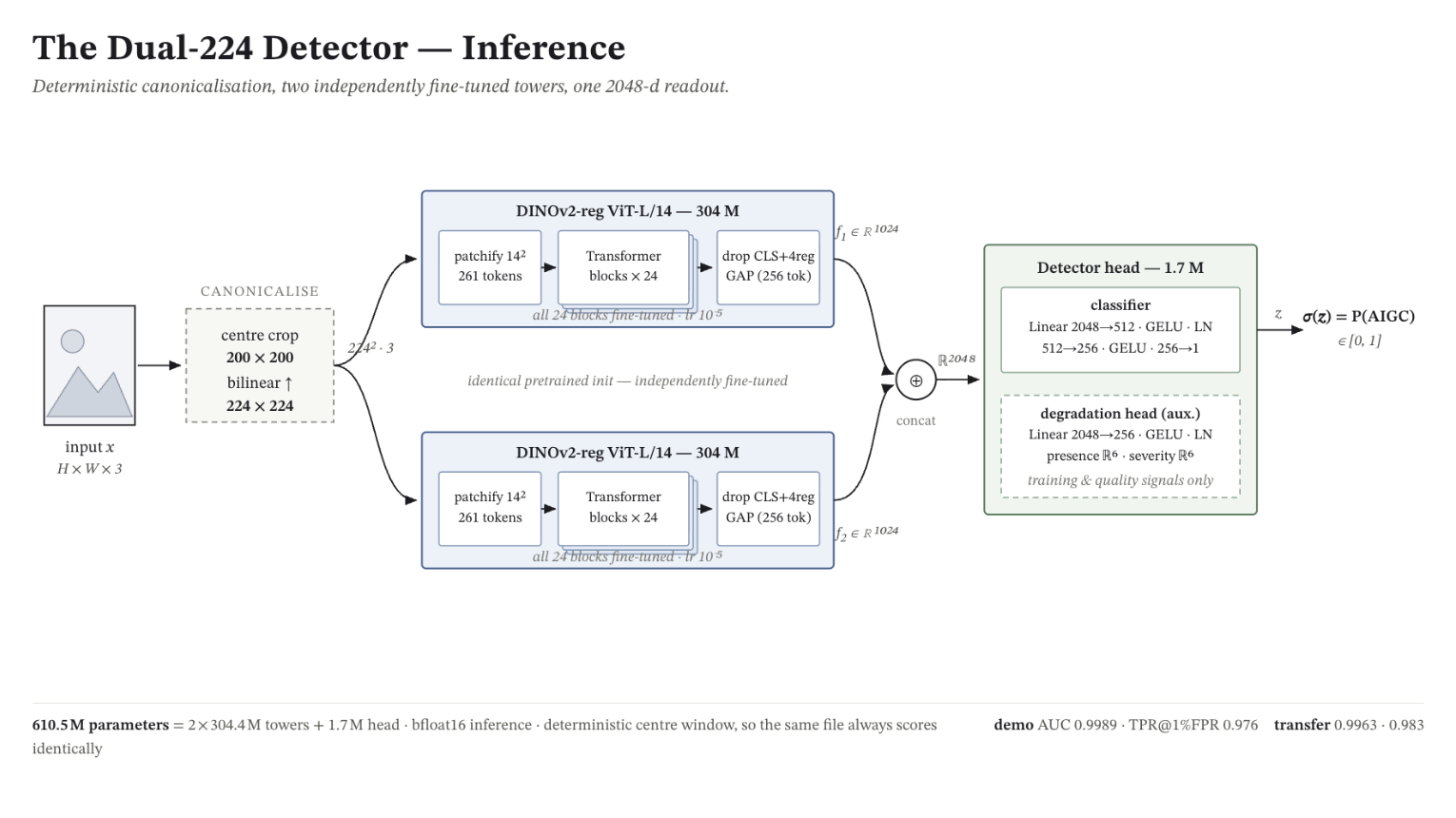
Canonicalisation (200px Crop, strip short-side shortcuts)
     │
     ▼
Augmentation (11 Stochastic View Pipelines, 1-3 operations chained)
     │
     ▼
Dual Parallel Towers (DINO ViT-L @ 224px, 608M combined parameters)
     │
     ▼
Concatenation Head (2048-d Feature Vector -> 512-d MLP)
     │
     ▼
Loss Regularization (Class BCE + Aux Degradation + TeleAI KL/MSE Consistency)
     │
     ▼
Calibrated Probability Output & EQI Dynamic Temperature Scaling
1. Canonicalisation & Resolution Shortcut Stripping
Short-side pixel dimensions leak class labels due to source dataset encoding biases (e.g., COCO real photographs exhibiting short-side dimensions of 200px versus high-resolution synthetic renders). Canonicalisation enforces strict input standardization prior to feature extraction.
- Window Dimensions:
CANON_CROP_SIDE = 200native pixel window, matching the bandwidth floor of authentic benchmark classes. Detail above 200px is omitted to prevent the network from learning high-frequency resolution artifacts as binary class indicators. - Crop vs. Band Resampling: Native cropping preserves high-frequency generator artifacts and pixel-grid structures. It provides measured gains for DINO-lineage ViTs (+0.079 on
dinov2l) without introducing resampling grid interference.
2. Stochastic Multi-View Augmentation Pipeline
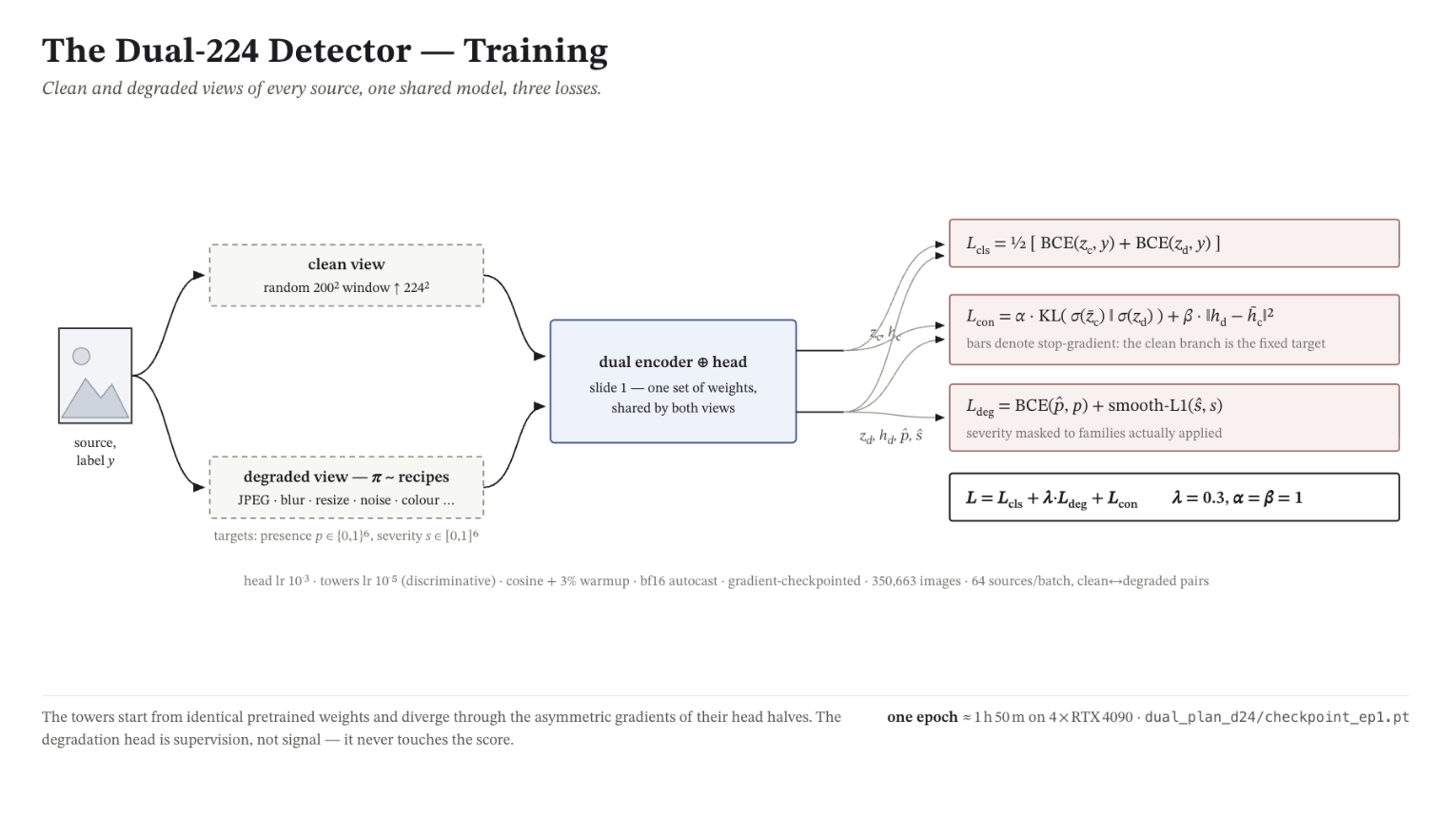
Training views ($N_{\text{views}} = 11$; 1 clean, 10 degraded) apply continuous, non-linear augmentation chains.
- Compound Recipes: Each degraded view applies 1 to 3 chained operations drawn from 6 distinct transform families (JPEG compression, Gaussian blur, spatial resizing, additive noise, color jitter, and center cropping).
- Withheld Severity Bands: To evaluate generalization against unseen degradation severities, specific operational parameters (e.g., JPEG quality $q \in [65, 75]$ and Gaussian blur $\sigma \in [0.85, 1.15]$) are strictly withheld during training.
3. Dual-Tower Vision Backbone
The primary extraction pipeline comprises two parallel 300M-parameter DINO-lineage Vision Transformer (ViT-L/14) towers operating at 224px native input resolution.
- Parameter Topology: Complete unfreezing across all 24 Transformer blocks (
--depth 24). Master weights are maintained in float32 precision with bfloat16 mixed-precision execution. - Optimization Differential: Tower learning rates are decoupled from downstream head parameters ($\text{LR}{\text{tower}} = 1\times 10^{-5}$ vs. $\text{LR}{\text{head}} = 1\times 10^{-3}$) to preserve foundational spatial representations.
4. Classification Head & Multi-Task Consistency Loss
Embeddings from both backbones are concatenated into a 2048-dimensional joint vector and fed into a 1M-parameter MLP head (Linear → GELU → LayerNorm(512) → Linear → GELU → Linear(1)). Training is regularized via a tri-part multi-task loss structure:
$$\mathcal{L}{\text{total}} = \mathcal{L}{\text{BCE}} + 0.3 \cdot \mathcal{L}{\text{degradation}} + 1.0 \cdot \text{KL}\left(P{\text{clean}} \parallel P_{\text{degraded}}\right) + 1.0 \cdot \text{MSE}\left(h_{\text{clean}}, h_{\text{degraded}}\right)$$
- Asymmetric Reference Target: The clean feature branch is detached during backpropagation, establishing a fixed reference state to pull degraded feature representations toward without risking representation collapse.
- Auxiliary Degradation Head: Predicts degradation presence and severity parameters to output a continuous degradation embedding vector ($d$).
5. Calibration & Abstention Policy
Inference delivers calibrated probability scores $P(\text{AI-generated}) \in [0, 1]$ mapped to a strict target operational threshold ($\text{FPR} = 0.01$).
- Dynamic Temperature Scaling: Incorporates predicted degradation vectors ($d$) and handcrafted proxy metrics ($h$) to dynamically adjust logit scaling:
$$T(d, h) = \text{softplus}\left(\text{Linear}([d; h])\right)$$
Under severe input corruption, confidence scores automatically soften toward $0.5$.
- Evidence Quality Index (EQI): Estimates residual forensic evidence within input images to support a three-way decision output: Clear (Authentic), Flag (Synthetic), or Review (High Uncertainty / Excessively Degraded).
Key Systemic Takeaways & Architectural Decisions
| System Metric / Component | Selection Rationale | Empirical Justification & Evidence |
|---|---|---|
| Lineage-Based Data Splitting | Grouped by generator family and VAE decoder lineage rather than model name. | Prevents model memorization of shared latent spaces; holding out klein4b_t2i alongside klein4b_ref_image measures actual structural generalizability (splits.py). |
| 200px Native Spatial Crop | Standardizes input resolution prior to transform execution. | Resolves resolution shortcuts where short-side dimensions yielded standard synthetic classification AUC of 1.0000 on baseline distributions (docs/resolution_shortcut.md). |
| Multi-Task Loss Regularization | Integrates KL prediction divergence and MSE hidden-state consistency. | Reduces calibration drift from 1.24 pts down to 0.37 pts (a 3.4× reduction), maintaining threshold stability across degraded deployment environments (docs/robustness_table.md). |
| Dynamic Temperature Scaling ($T$) | Rescales raw classification logits using auxiliary degradation vectors ($d$). | Mitigates overconfident false alarms on corrupted real images by softening probability outputs toward maximum uncertainty under high noise levels. |
| Dual ViT-L Parallel Architecture | Concatenates two 300M DINO ViT-L towers at 224px input resolution. | Provides high out-of-distribution transfer metrics (Transfer Test $\text{AUC} = 0.9961$; $\text{TPR @ 1\% FPR} = 0.9823$). Note: Evaluation warrants fine-tuned comparison against single-tower multi-policy baselines. |
Built With
- dinosv2
- huggingface


Log in or sign up for Devpost to join the conversation.