About the Project
Most projects in this hackathon will be purely software, and that's understandable because software has never been easier to build. What excites me most about ChatGPT 5.6 and Codex is that they don't just make software development faster. They make ambitious hardware projects accessible. They lower the barrier to building ideas that previously required significant engineering expertise, making the "impossible" feel genuinely achievable.
With that in mind, I wanted to build something at the intersection of AI, software, and physical computing. Rather than creating another web application, I wanted to explore how modern AI could bring traditional scientific demonstrations to life in an entirely new way.
The Education track felt like the perfect place to pursue this vision. My goal is to help students and educators reimagine scientific exploration for the AI era, where intelligent systems don't just explain concepts. They actively participate in demonstrating them.
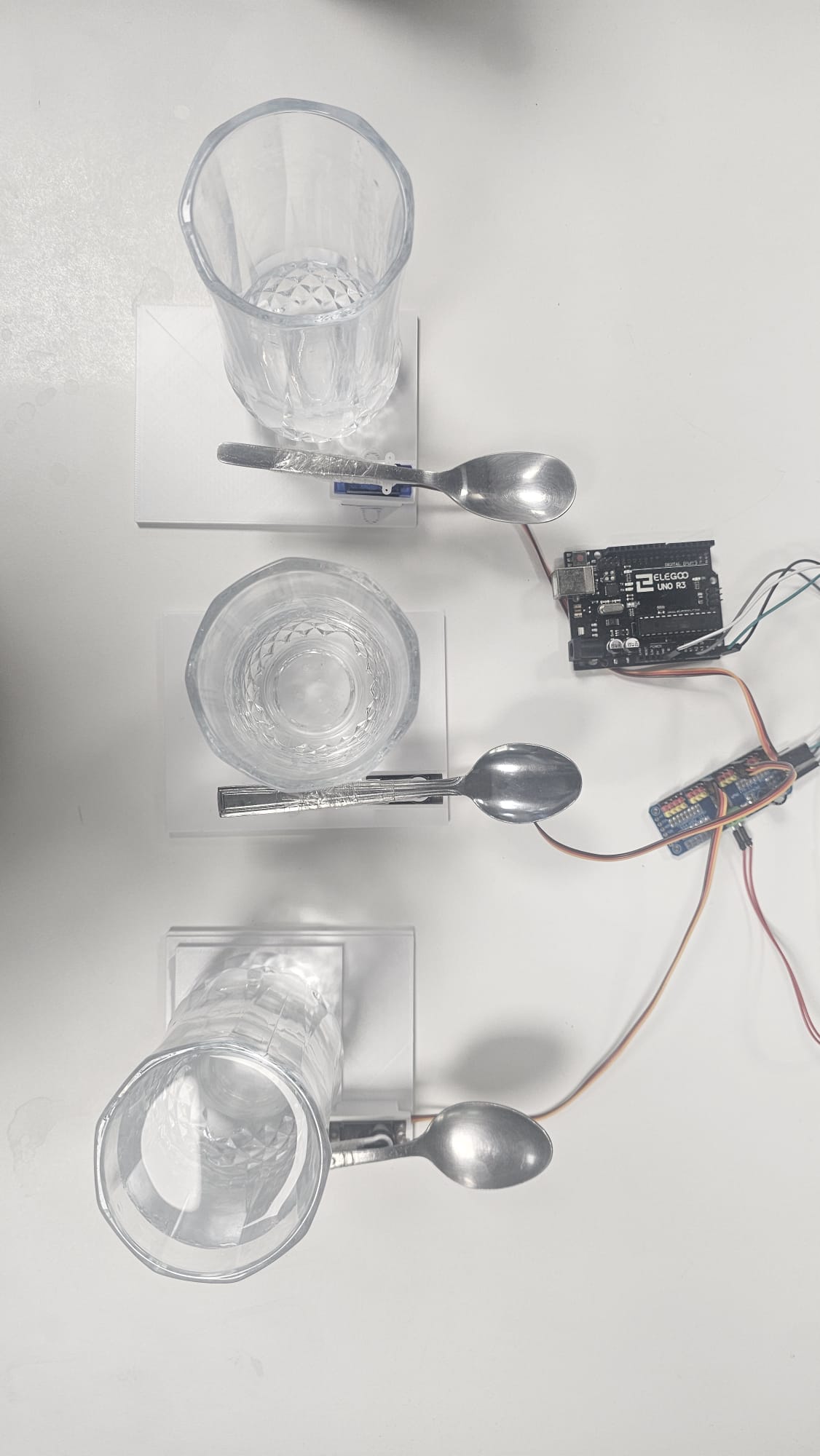
One of the earliest physics experiments many students encounter is the water xylophone. It's a simple but powerful demonstration of sound waves and vibration. When a glass is struck, the water inside vibrates and transmits sound through the air. Glasses with more water vibrate more slowly, producing lower-pitched notes, while glasses with less water vibrate more quickly, creating higher-pitched sounds. It's an elegant experiment that introduces the relationship between vibration and pitch.
This project reimagines that classic experiment using AI and robotics.
Instead of a person striking each glass, servo motors precisely play the water-filled glasses. The most exciting part, however, is the AI layer. ChatGPT 5.6 interprets natural language instructions, such as "play Twinkle, Twinkle Little Star" or "create a calm melody inspired by rainfall," and Codex helps translate those instructions into a sequence of notes that the hardware can perform.
The result is an interactive AI-powered scientific instrument that combines large language models, robotics, and physics education. It transforms a familiar classroom experiment into an engaging demonstration of how AI can bridge the digital and physical worlds, inspiring students to see both science and technology through a new lens.
How It Works
The interaction begins with something anyone can do: describe an idea in natural language.
A user enters a prompt such as "play something peaceful," "create a suspenseful melody," or "compose a happy tune." ChatGPT 5.6 interprets the intent behind that prompt and generates the sequence of notes and servo movements needed to perform it. Codex then helps produce the Arduino code that controls the hardware.
Once the code is uploaded to the Arduino, the servo motors execute the generated pattern, striking each water-filled glass in sequence to produce the melody. The varying water levels determine the pitch of each glass, allowing the AI-generated composition to be performed as a real, physical instrument.
Rather than simply generating music digitally, the system translates human creativity into movement, vibration, and sound in the real world. It creates a unique collaboration between natural language, AI, robotics, and physics.
What I Learned
One of the biggest takeaways from this project was how transformative the Codex CLI is for hardware development. Instead of spending most of my time writing boilerplate code, debugging microcontroller logic, or searching through documentation, I was able to focus on the creative aspects of the project, experimenting with ideas, refining the interaction, and building something genuinely novel.
I also discovered how valuable ChatGPT 5.6 is as a real-world engineering assistant. Beyond generating code, it helped me reason through hardware challenges, understand electronic components, verify wiring diagrams, troubleshoot issues with the Arduino and servo motors, and learn the robotics concepts needed to bring the project to life.
This experience changed the way I think about AI-assisted development. Modern AI isn't just a tool for writing software. It can guide the entire engineering process, making it much easier for developers to prototype and build intelligent physical systems. By reducing the friction of both programming and hardware integration, it lets you spend more time innovating and less time debugging.
Challenges
While AI-assisted hardware development is incredibly powerful, it isn't perfect. Building physical systems still requires hands-on problem solving, and there were many moments where I had to provide detailed guidance to the AI. Tasks involving spatial reasoning, hardware debugging, and diagnosing wiring issues were often the most challenging. In those situations, I still relied on traditional resources such as documentation, datasheets, and community forums. That said, with clear context and high-quality photos of my setup, ChatGPT 5.6 consistently got me around 80% of the way to a solution, dramatically reducing the time spent troubleshooting.
The biggest challenge, however, wasn't technical. It was creative.
Tools like Codex and ChatGPT 5.6 have fundamentally changed what's possible for an individual developer. As the cost of building ambitious ideas continues to fall, the real bottleneck becomes imagination. Throughout this hackathon, I found myself asking not "Can I build this?" but "What's the most interesting thing I could build?"
That mindset shift has been one of the most valuable lessons from this project. Rather than thinking within the boundaries of a single discipline, I want to explore ideas that combine fields that don't traditionally overlap, AI with robotics, education with creative technology, and software with physical computing. I believe that's where some of the most exciting innovations in education will emerge, and I hope this project encourages others to think just as boldly.
What's Next
This project is only the beginning of exploring what AI-powered physical computing can become.
One area I'd like to improve is the instrument itself. While the prototype successfully demonstrates the concept, there's plenty of room to refine the acoustics. I'd like to experiment with different striking materials and mechanisms to produce a clearer, louder, and more consistent sound. That could involve designing a custom striker that's more effective than a spoon without risking damage to the glass, or using motors with greater torque and more precise control.
Beyond improving the hardware, I'm excited by the possibility of scaling the idea far beyond the classroom.
Imagine transforming the water xylophone into a human-scale interactive installation. Instead of drinking glasses, the instrument could consist of towering glass vessels filled with water, each as tall as a person. Powerful robotic actuators would strike the glasses to create immersive soundscapes, while ChatGPT 5.6 interprets audience prompts in real time and generates musical performances. Visitors wouldn't just observe a science experiment. They would collaborate with AI to create a living, physical musical instrument.
More broadly, I want to continue exploring how AI can bridge the digital and physical worlds. As models like ChatGPT 5.6 and tools like Codex continue to evolve, I believe they'll empower creators to build experiences that combine robotics, education, art, and software in ways that were previously out of reach. This project is my first step in that direction, and I'm excited to see just how far that journey can go.
Built With
- arduino
- chatgpt
- codex

Log in or sign up for Devpost to join the conversation.