Inspiration
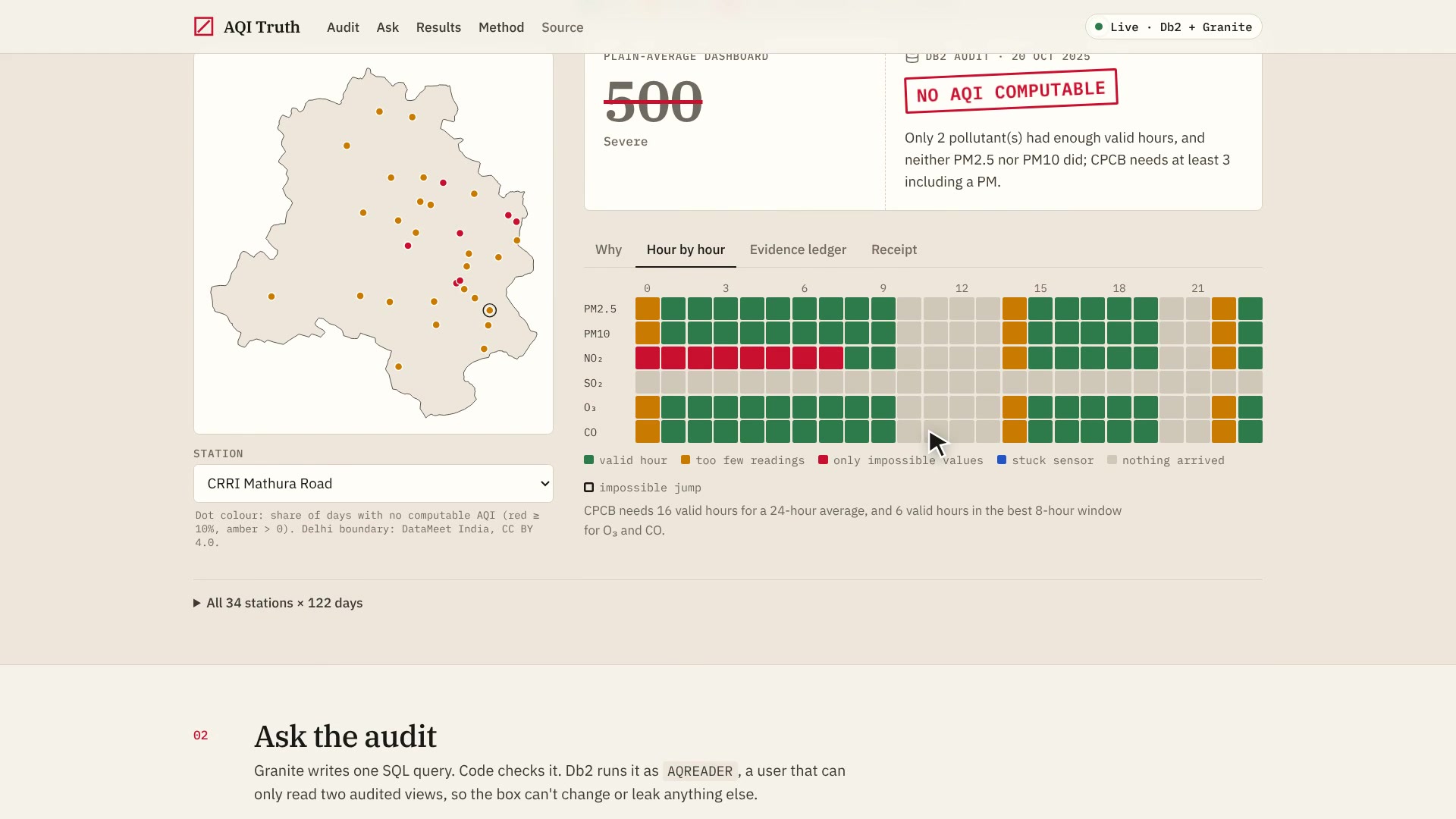
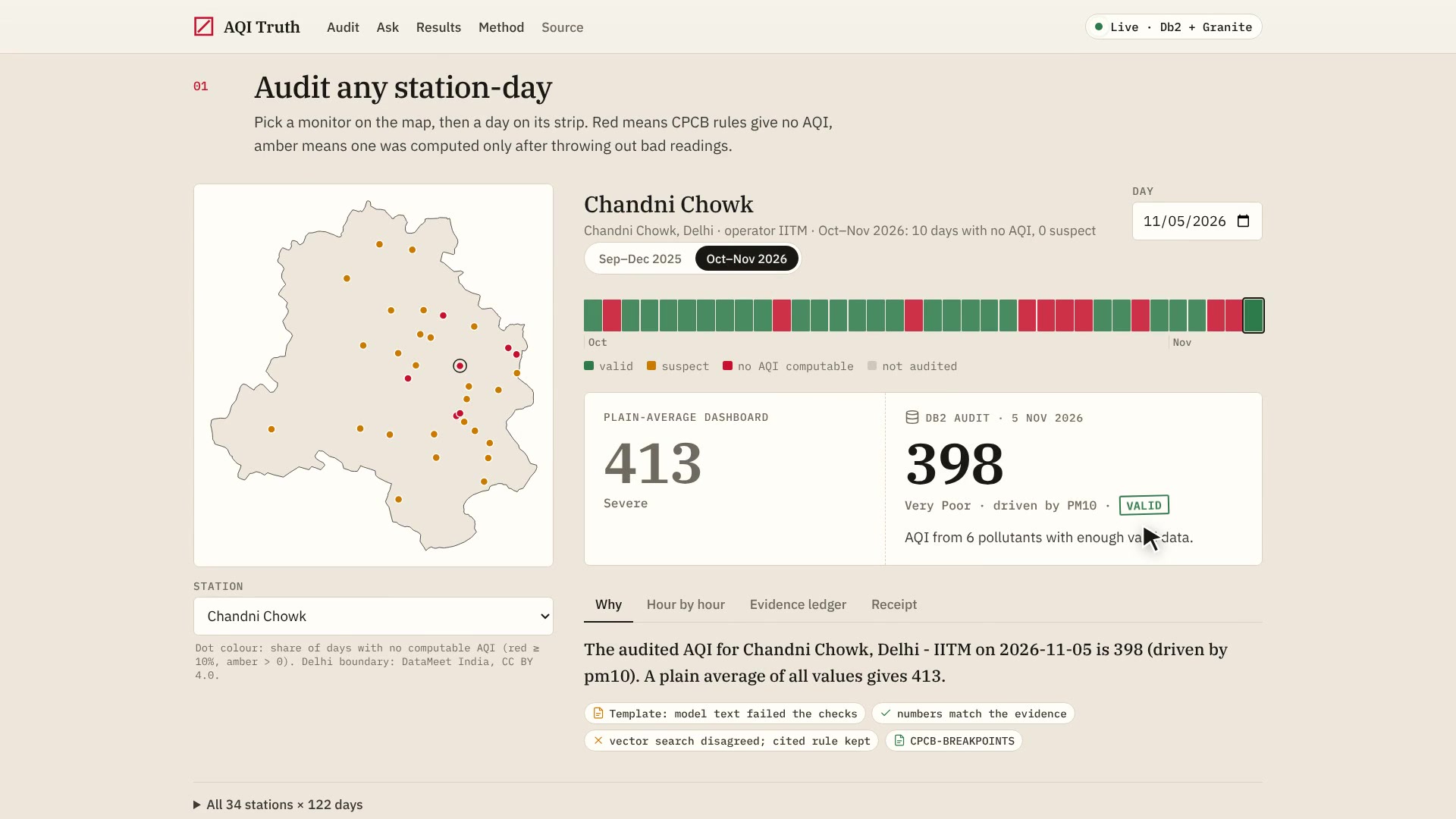
Delhi's air-quality dashboards always show a number, even when the monitors behind it were blank, frozen or reporting impossible values. India's official CPCB method says an AQI should not be published in those cases. I wanted to know how often a "Severe" headline is actually backed by data.
What it does
AQI Truth puts the official CPCB AQI method inside IBM Db2 and re-checks every monitor-hour of real Delhi data (OpenAQ public archive of CPCB monitors).
For each pollutant, Db2 computes the CPCB sub-index by linear interpolation within the breakpoint band that contains the concentration $C_p$:
$$ I_p = \frac{I_{HI} - I_{LO}}{B_{HI} - B_{LO}}\,\left(C_p - B_{LO}\right) + I_{LO} $$
$$ \text{AQI} = \max_{p}\; I_p $$
Under the CPCB rules, an AQI is valid only if at least 3 pollutants are available, one of them PM${2.5}$ or PM${10}$, and each 24-hour average has at least 16 valid hours. When the data cannot support a number, AQI Truth refuses to give one and explains why.
Results on 34 Delhi monitors (Sep–Dec 2025, 1.87 million readings, 4,148 station-days):
- On 395 station-days, the CPCB rules allow no AQI at all.
- A plain average still prints a number on 338 of them.
- 147 of those would read Very Poor or Severe.
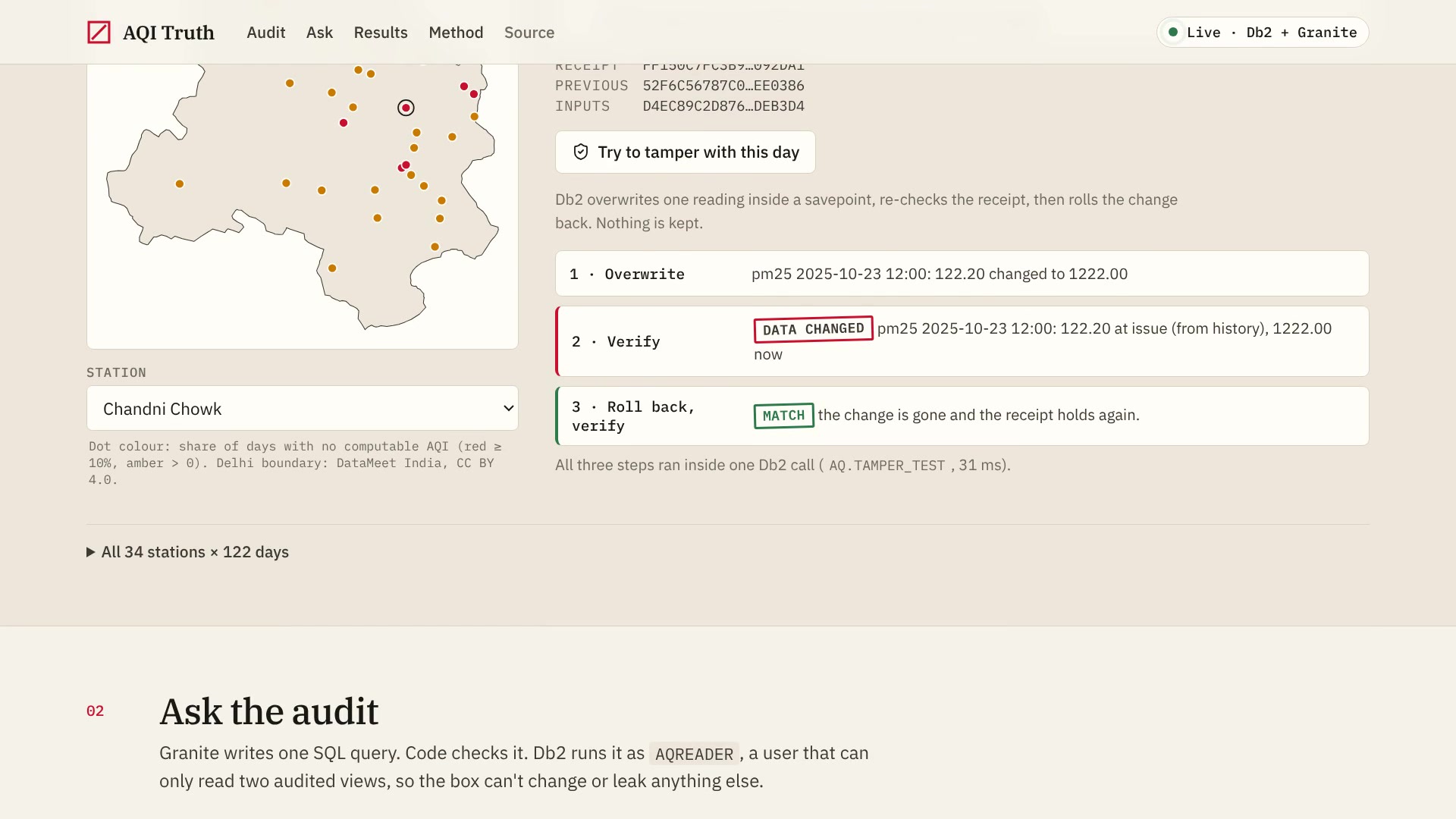
Every verdict comes with an append-only evidence entry and a hash-chained SHA-256 receipt that Db2 verifies against its own temporal history. If anyone edits a reading later, the receipt check fails.
How I built it
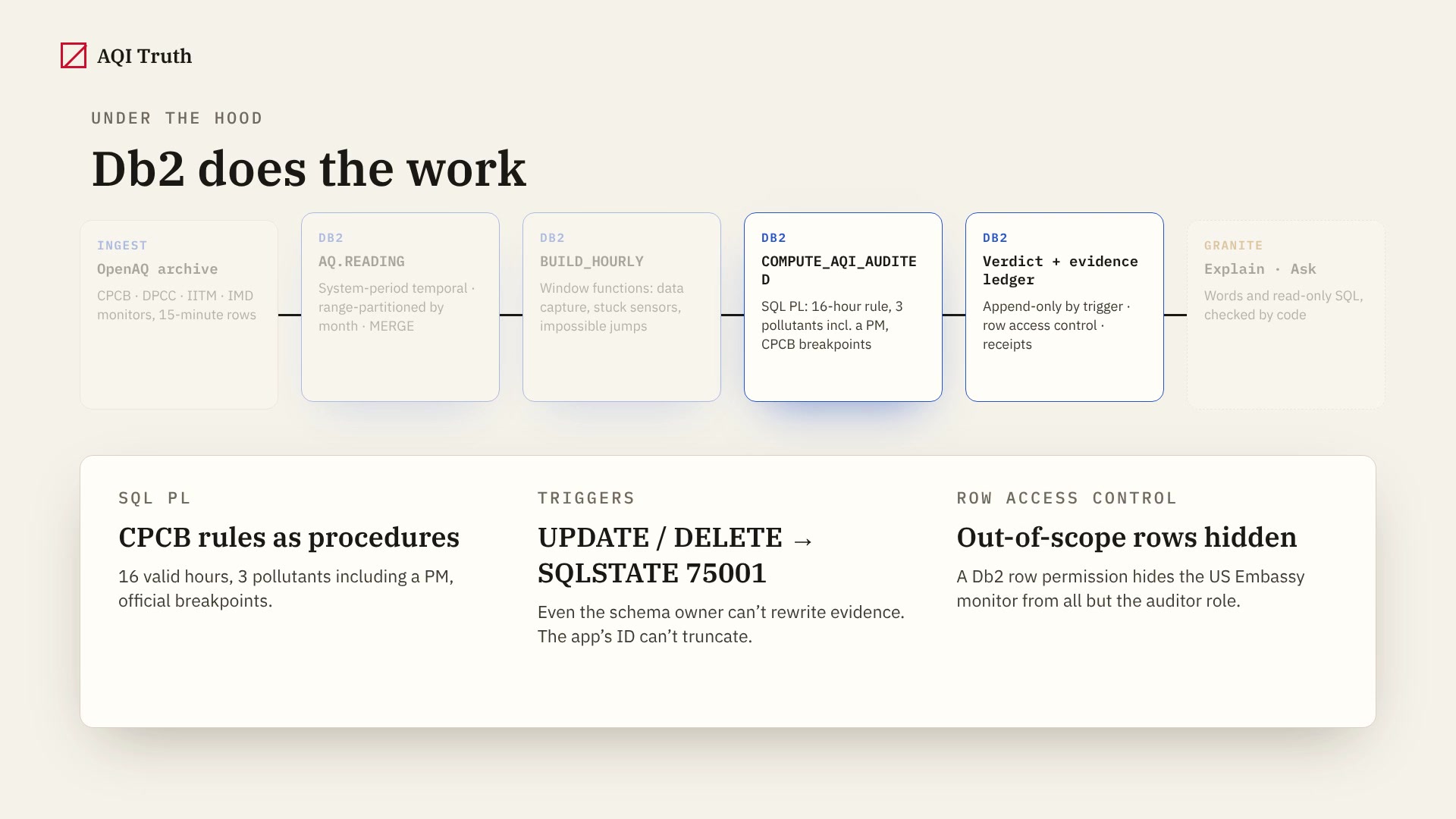
Db2 does the computing, not just the storage:
- System-period temporal table, range-partitioned by month and loaded with
MERGE, so any reading can be queriedAS OFthe time it was judged. - Window functions build the hourly layer and flag stuck sensors and impossible jumps.
- SQL PL procedures apply the CPCB rules and write the verdicts.
- Triggers make the evidence ledger append-only (SQLSTATE 75001 on update or delete).
- RCAC row permission and column mask, plus a materialized query table (MQT) that the optimizer uses automatically, shown with EXPLAIN.
- Hash-chained receipts:
AQ.VERIFY_RECEIPTreplays system-time history to detect tampering. VECTOR+VECTOR_DISTANCEretrieve the rule text that IBM Granite cites in its explanations.- Least privilege: the app can only
SELECT/INSERT; the question box runs as a read-only user that sees just two views.
Stack: Db2 Community Edition 12.1.5 (Docker), Python + FastAPI + ibm_db, IBM Granite on Ollama, a static web front end, pytest with CI on a fresh Db2 container.
Challenges I ran into
- Turning the CPCB rulebook into set-based SQL PL that handles gaps, stuck sensors and partial days correctly.
- Keeping the AI honest: Granite only explains what Db2 decided, and every number in its answer is checked against the database.
- Running a live Db2 demo on a zero budget.
Accomplishments that I'm proud of
- Real public data, not invented data.
- A live engine judges can query, plus a "Try to tamper" button that shows Db2 catching an edited reading.
scripts/db2_evidence.pyruns every Db2 claim as real SQL and records Db2's answers.
What I learned
Temporal tables, RCAC, MQTs and SQL PL together make Db2 a strong place for trust logic, because the database itself can prove what it knew and when.
What's next
- Extend coverage to more Indian cities.
- Run a scheduled job that checks for revisions to published data.
- Offer a public API for journalists and researchers.
Links: Repo · Live site · Demo video · Submission PR
