-
-
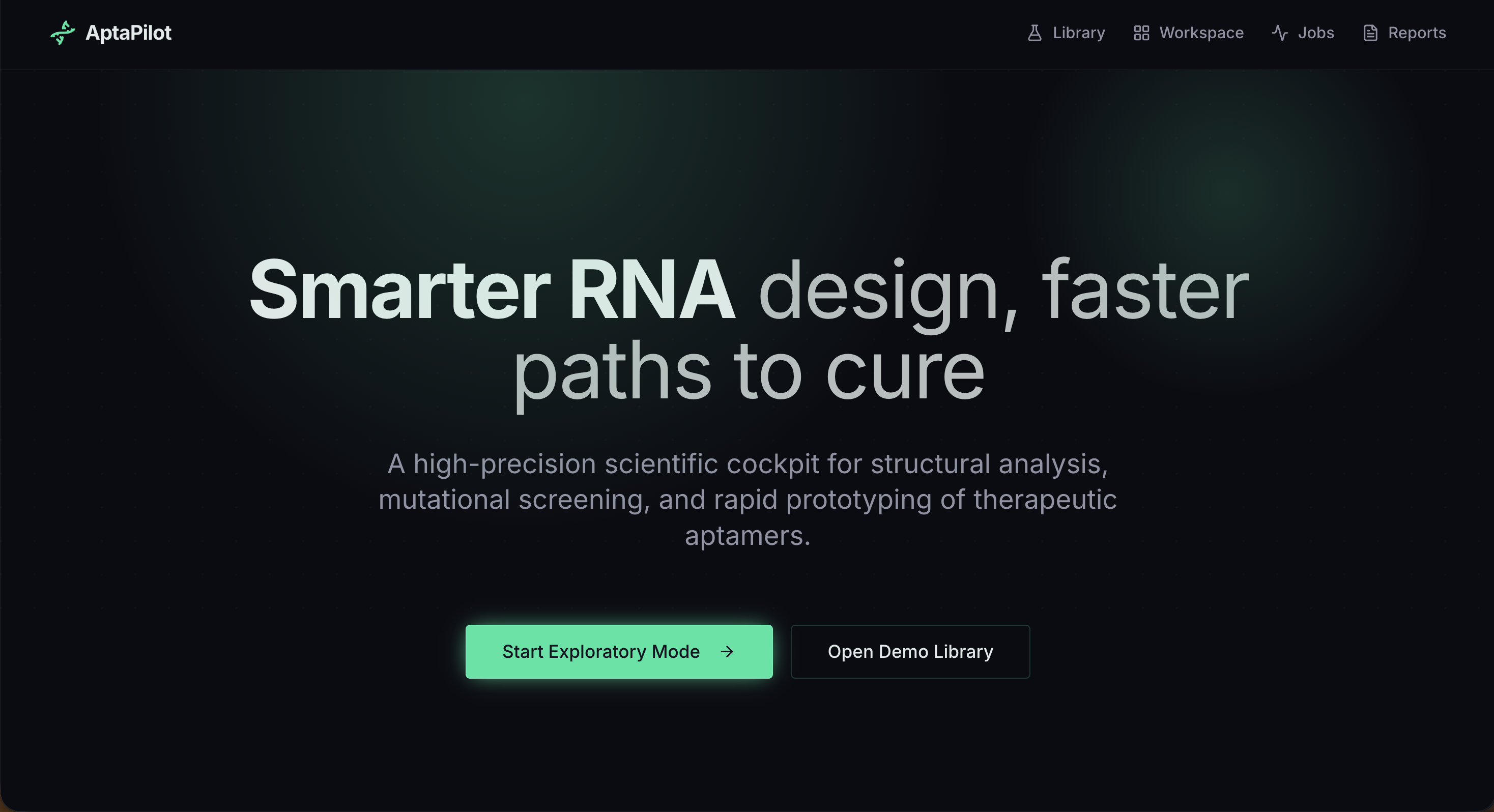
Splash Screen
-
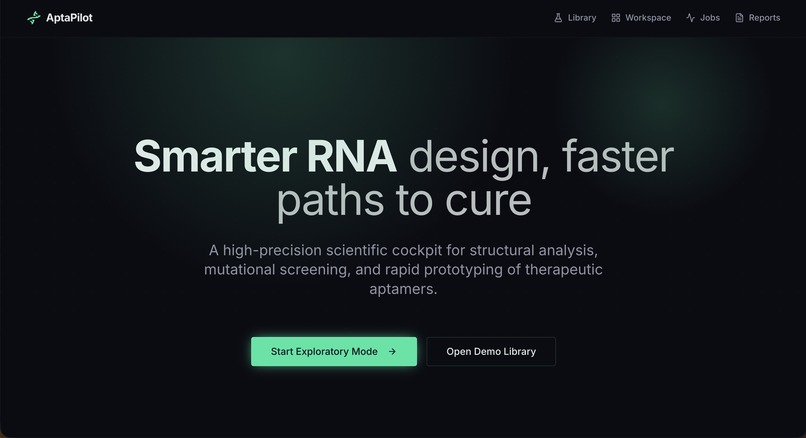
landing page
-
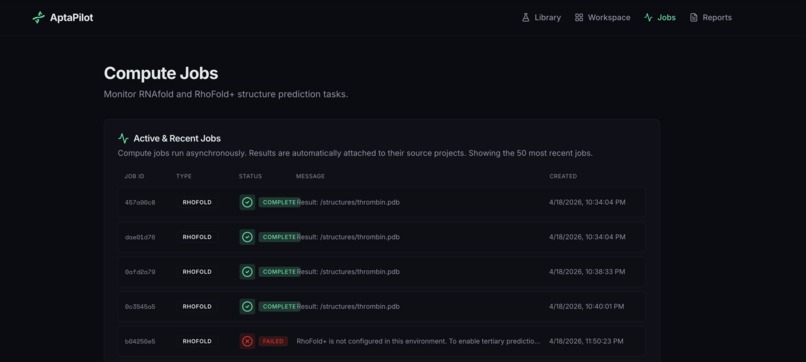
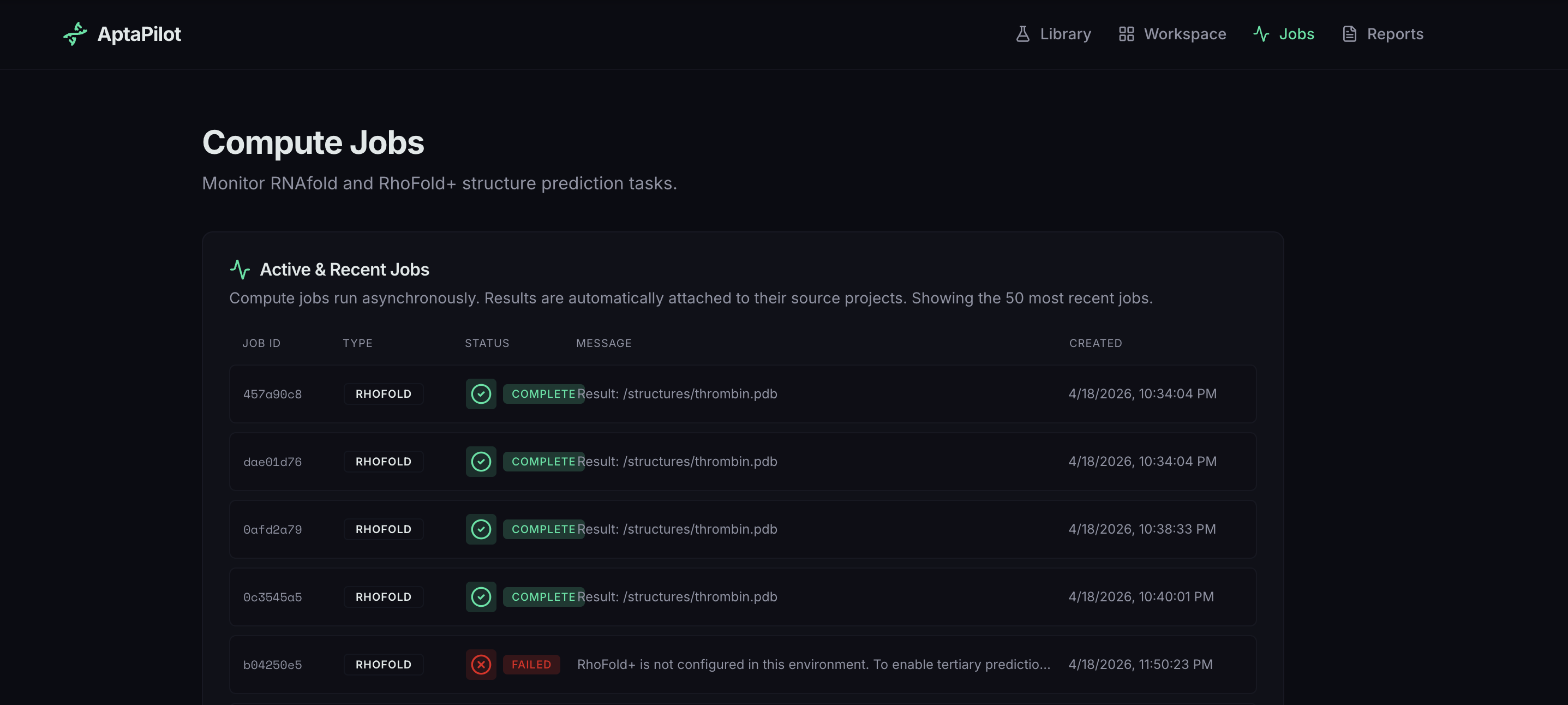
Job Reports Page
Inspiration
By accelerating how quickly better drug candidates reach preclinical testing, AptaPilot can help bring more precise therapies to patients sooner, when time can make the difference between progression and survival.
For diseases like triple-negative breast cancer, time is of the essence. As we looked into how these treatments are developed, what stood out was how much of it is still trial and error. We noticed researchers spend months meticulously tweaking tiny pieces of RNA, running experiment after experiment, hoping something sticks. It’s time-consuming, expensive, and frustrating given how crucial these therapies are. We kept asking, "Why is this still so manual?" AptaPilot came from that question. We wanted to build something that helps scientists move faster, cut down the guesswork, and focus on the work that directly affects patients.
What it does
AptaPilot is an RNA aptamer design copilot built to speed the creation of targeted therapeutics for hard-to-treat diseases. RNA aptamers are short strands of RNA that fold into precise 3D shapes, allowing them to latch onto protein targets and halt disease progression.
The promise of RNA aptamers is enormous, but turning an aptamer into a real drug requires repeated sequence engineering to improve stability in the body, strengthen target binding, and shorten the path to manufacturable leads.
Today, that optimization is slow, expensive, and heavily dependent on trial-and-error lab work. AptaPilot changes that by helping scientists test and rank promising mutations before they ever reach the bench, translating plain-English goals into structure-guided design plans, variant aptamer libraries, and clear next-step recommendations. Instead of spending months screening changes one by one in the lab, researchers can focus their experiments on the most credible candidates, dramatically reducing time, cost, and expertise barriers in RNA drug development
How we built it
•Built a full-stack RNA aptamer design copilot using FastAPI, React, TypeScript, and PostgreSQL, with two modes: a fast library-backed mode and an exploratory mode for raw sequence input
•Integrated real aptamer data from Ribocentre-Aptamer and RCSB PDB, serving actual PDB coordinate files and curated annotations for three therapeutic targets
•Built an interactive secondary structure viewer with color-coded residues mapped to biological annotation classes
•Integrated 3Dmol.js for real-time 3D molecular visualization and a RhoFold+ job simulation pipeline that polls for completion and auto-loads the predicted structure
•Implemented a deterministic mutation engine that generates and ranks candidate variants across four edit strategies while respecting protected binding regions, using dot-bracket secondary structure to apply biologically motivated scoring penalties
•Built a transparent scoring system with four weighted subscores, including fold preservation, binding risk, stability, and therapeutic readiness, with rationale bullets and warnings per candidate
•Designed a Claude-powered chat interface for design goal input, converting researcher intent into structured mutation plans
Challenges we ran into
One of the biggest challenges we faced was integrating the API for 3D RNA structure modeling and ensuring the visualizations were both accurate and responsive within the application.
Another major challenge was designing the scoring system for ranking RNA variants. Since “better” sequences involve trade-offs between stability, binding affinity, and structural feasibility, we had to carefully define a scoring approach that meaningfully reflects biological relevance rather than relying on a single metric.
Accomplishments that we're proud of
We’re proud that we were able to take a highly complex, research-heavy problem in RNA therapeutics and turn it into an interactive, usable system.
AptaPilot successfully bridges sequence-level design with structural and functional insights, allowing users to go from a raw RNA sequence to ranked, optimized variants in a single workflow.
One of our key accomplishments was building a system that doesn’t just generate outputs, but provides reasoning through structure visualization, mutation guidance, and ranking. This makes the results actionable rather than abstract.
We’re also proud of the usability of the interface, despite the underlying biological complexity, the workflow remains simple enough for researchers to quickly test ideas without needing deep computational expertise.
What we learned
We learned that the hardest part of building in computational biology isn’t generating results, it’s making those results meaningful and usable.
Translating vague biological goals into concrete computational actions required careful design of both prompts and system logic.
We also learned that ranking in scientific problems is rarely absolute. Instead of a single “correct” answer, we had to think in terms of trade-offs between stability, binding, and structural constraints.
Finally, we learned how important it is to design for interpretation. Outputs are only valuable if users can understand why a suggestion was made and how to act on it.
What's next for AptaMind
Next, we plan to expand AptaPilot into a more comprehensive RNA therapeutic design platform.
This includes integrating more advanced structure prediction models, improving scoring accuracy with additional biological validation signals, and expanding support to other RNA-based modalities beyond aptamers.
We also aim to introduce collaborative features so research teams can share designs, compare iterations, and build on each other’s work.
In the long term, we see AptaPilot becoming a core tool in early-stage therapeutic design, helping researchers move from idea to experimental candidate faster and with greater confidence.
Built With
- 3dmol
- anthropicapi
- fastapi
- node.js
- postgress
- pydantic
- python
- react
- rhofold
- rnafold
- typescript
- vite


Log in or sign up for Devpost to join the conversation.