Inspiration
Prior authorization is fundamentally broken. Currently, physicians waste approximately 16 hours a week on paperwork, and the average approval takes 1 to 5 business days. This friction delays critical care, with 34% of physicians reporting that prior authorization has led to a serious adverse event. We wanted to tackle this massive bottleneck that costs the US healthcare system $35 billion a year in administrative overhead.
What it does
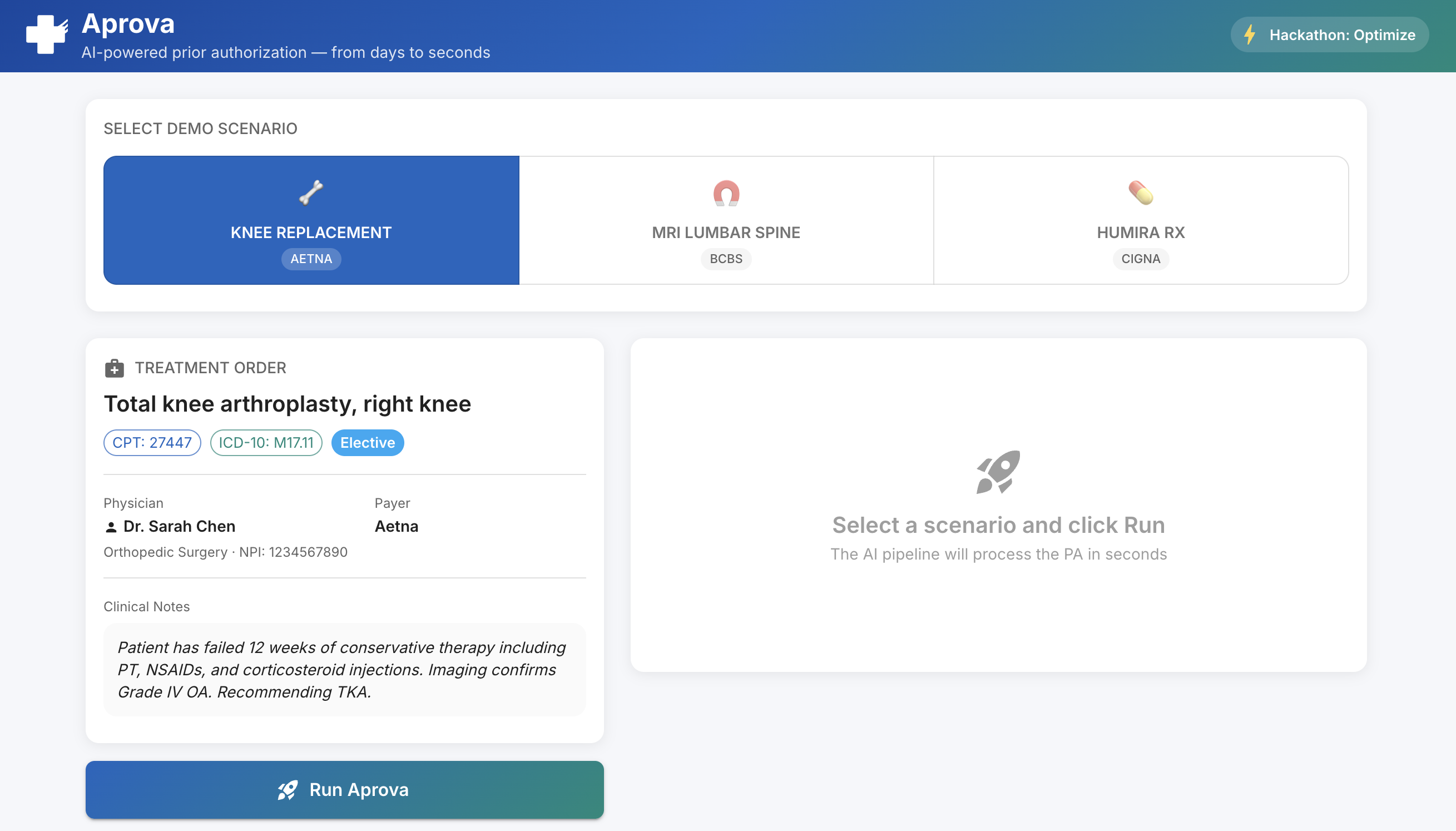
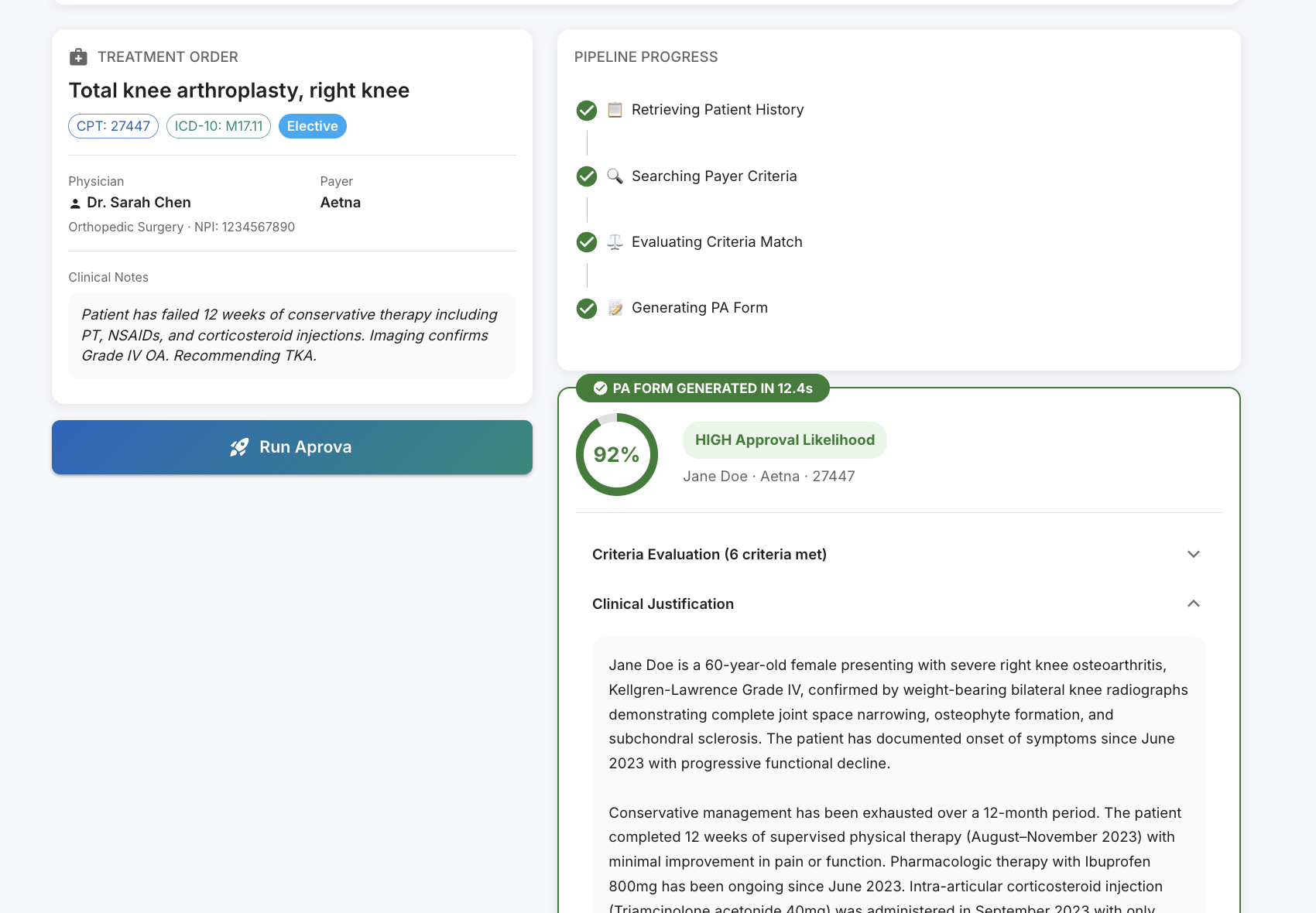
Aprova is an autonomous, end-to-end AI agent pipeline that completes prior authorizations in under 60 seconds.
- Ingests Data: Processes treatment orders and diagnosis codes submitted by physicians via a secure portal.
- Extracts History: Connects to a mock EHR to extract the patient's full medical history seamlessly.
- Cross-References Criteria: Executes a vector search lookup against dense payer policies and criteria.
- Evaluates Requirements: Utilizes chain-of-thought evaluation to accurately determine if individual criteria are met.
- Auto-Generates Submissions: Drafts a completed submission featuring a detailed clinical justification narrative.
- Calculates Probabilities: Generates a precise match score—such as 92%—and displays the approval likelihood instantly.
How we built it
We orchestrated the application's multi-agent system using LangChain and OpenAI GPT-4o.
- RAG Architecture: Built using ChromaDB and text-embedding-3-small to parse and understand complex insurance policies.
- Patient Data: Extracted utilizing standardized FHIR R4 JSON bundles from the Kaggle Synthea dataset.
- File Parsing: Processed complex medical files using LangChain TextLoader and PyPDFLoader.
- Frontend Experience: Developed a seamless user interface using Next.js and Material UI, deployed efficiently on Vercel.
- Containerization: Packaged the entire application environment using Docker Compose for portability and scale.
Challenges we ran into
Building an autonomous system that could flawlessly map complex medical facts deterministically to a payer's exact checklist required meticulous orchestration. Handling high-dimensional semantic search against dense insurance policy documents—while simultaneously executing chain-of-thought evaluations for individual criteria—meant we had to rigorously optimize our multi-agent system to track inference progress in real-time.
Accomplishments that we're proud of
- Massive Time Savings: Slashing processing time by 99.9%, taking the workflow from 2-5 days down to just 60 seconds.
- Cost Reduction: Driving the cost per authorization down by 99.8%, from $31.42 to roughly $0.05.
- Financial Impact: Creating a scalable solution that unlocks an extrapolated $47,000 in annual savings per physician.
- Validated Scenarios: Successfully pre-loading and validating highly complex medical scenarios, including Knee Replacements (Aetna), MRI Lumbar Spines (BCBS), and Humira prescriptions (Cigna).
What we learned
We learned how to effectively leverage advanced RAG architectures to parse highly dense payer policies. Furthermore, we gained deep insights into structuring standardized FHIR R4 payloads so that our AI could successfully pull—and accurately cite—specific dates, therapies, and biomarkers directly from patient records to definitively prove medical necessity.
What's next for Aprova
Our next step is scaling this architecture to optimize value-based care delivery across a wider range of medical specialties. We plan to expand our pipeline beyond our initial pre-loaded scenarios to handle increasingly complex treatment orders, with the ultimate goal to integrate directly with live EHR environments.


Log in or sign up for Devpost to join the conversation.