-
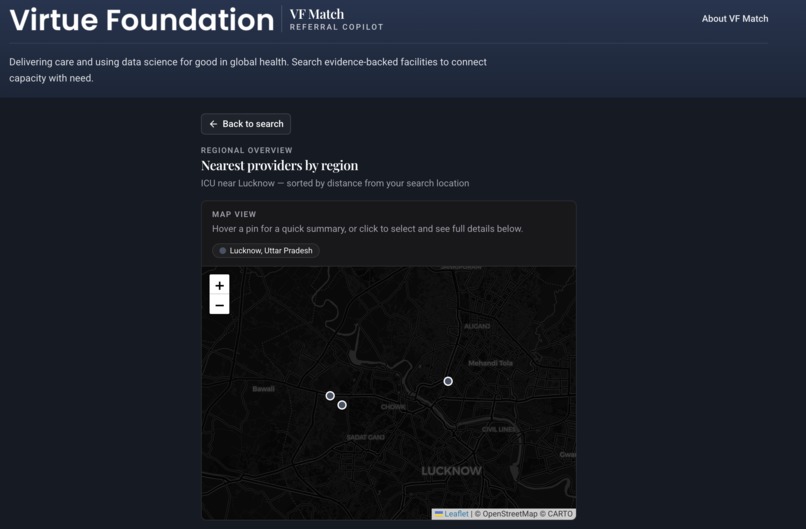
Referral Copilot Regional Search
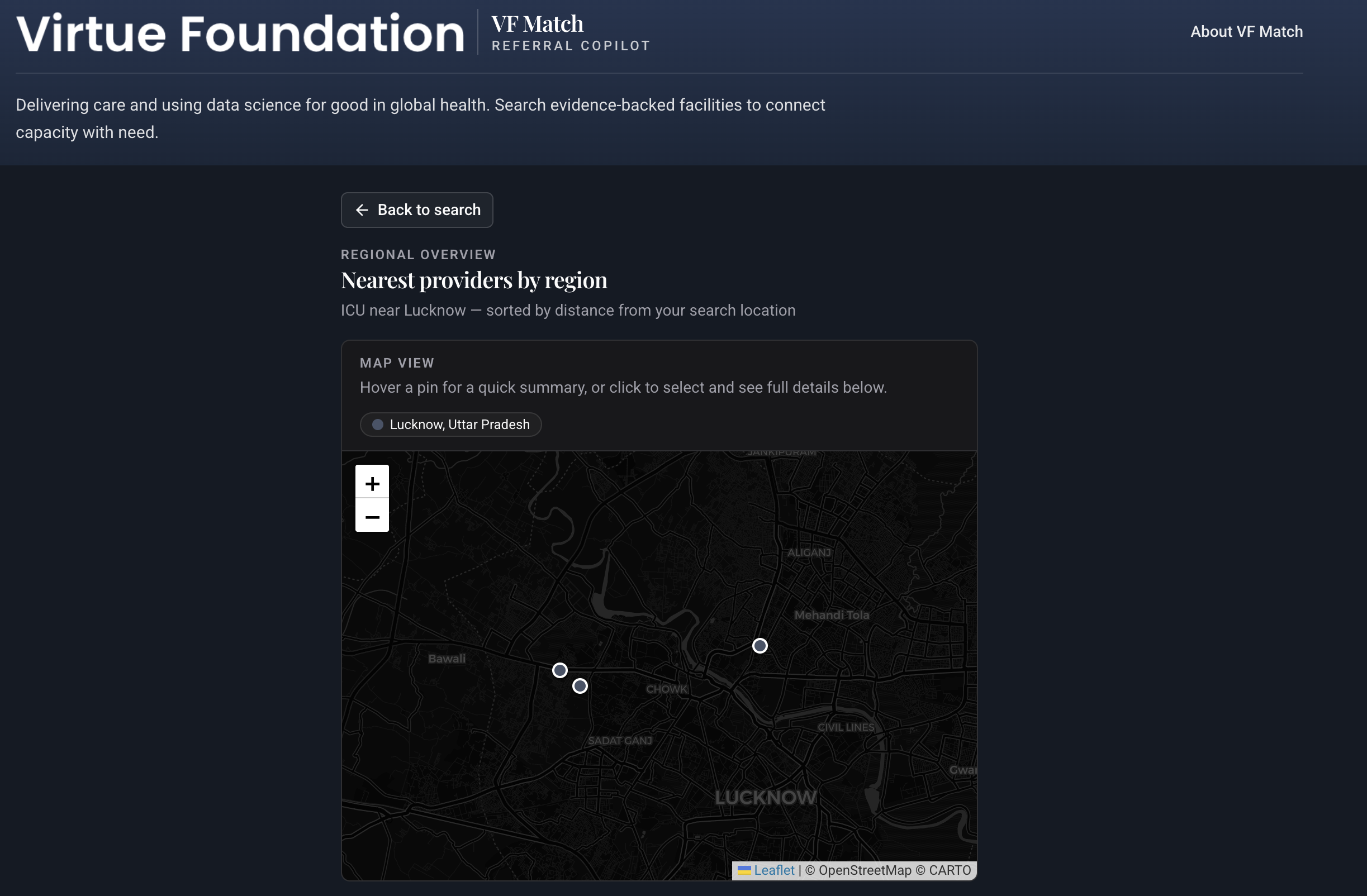
Inspiration Care coordinators often need to answer a hard question quickly: "Where might someone go for this care need near this location?" The available data is scattered, messy, and full of uncertainty. We wanted to build something useful for that moment without overclaiming. Referral Copilot is designed to reduce search time while keeping humans in control.
What it does Referral Copilot takes a query like ICU near Lucknow or dialysis in Jaipur and returns a shortlist of candidate healthcare facilities. Each result includes location context, evidence snippets, source signals, confidence labels, limitations, and contact or map actions. It does not make medical referrals or claim real-time availability. It shows evidence-backed candidates for coordinator review.
How we built it We built the system on Databricks. Unity Catalog stores the source and derived tables. Databricks SQL cleans facility, pincode, coordinate, and health-context data. Vector Search retrieves semantically relevant capability evidence from messy facility text. A backend orchestration layer merges semantic results with geo ranking, applies deterministic scoring, and uses a structured evidence judge to decide which candidates are strong enough to show. The frontend is a Databricks App built with React, TypeScript, and AppKit.
Challenges we ran into The biggest challenge was uncertainty in the data. Facility capabilities were often buried in free-form fields like description, specialties, procedures, equipment, and capability text. Location matching also needed care, since naive substring search can produce unsafe matches. We also had to avoid turning weak evidence into confident recommendations, especially because the dataset does not include real-time availability, clinical appropriateness, or ground-truth referral labels.
Accomplishments that we're proud of We are proud of the product stance: useful, but careful. The app only promotes candidates that pass a strong evidence filter, while lower-confidence results stay available for review. We built a real Databricks-native pipeline with cleaned tables, geo guardrails, hybrid Vector Search, a live API contract, structured judging, and a usable AppKit UI. We also created demo scenarios backed by measurable retrieval coverage rather than hand-picked examples.
What we learned We learned that good AI products in high-stakes domains are often less about making the model more assertive and more about designing the right constraints. Evidence, uncertainty, source visibility, and human review are not extra features here. They are the product. We also learned that Databricks is a strong environment for this pattern because data quality, retrieval, app hosting, and evaluation can live close together.
What's next for Apps & Agents for Good Hackathon Next, we would add Lakebase-backed session, feedback, review, and saved-shortlist state so coordinators can improve the system over time. We would add MLflow tracing and expert-labeled eval sets to measure false positives, weak evidence, and location mistakes. We would also expand the agent design with specialist components for retrieval, geo resolution, evidence review, and evaluation, turning Referral Copilot into a safer workflow for public-benefit healthcare navigation.
Built With
- codex
- databricks
- lakebase

Log in or sign up for Devpost to join the conversation.