-
-
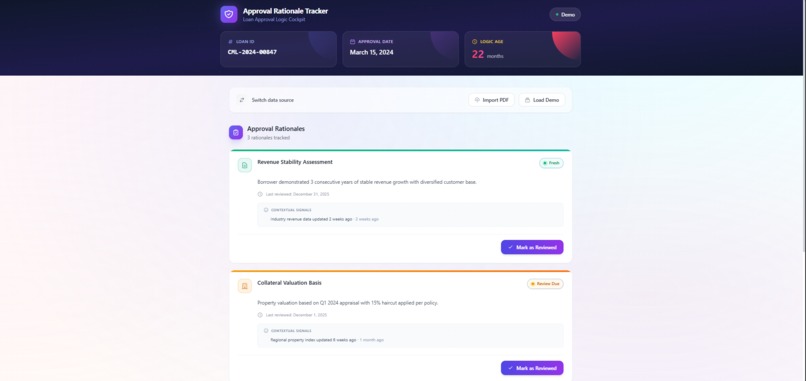
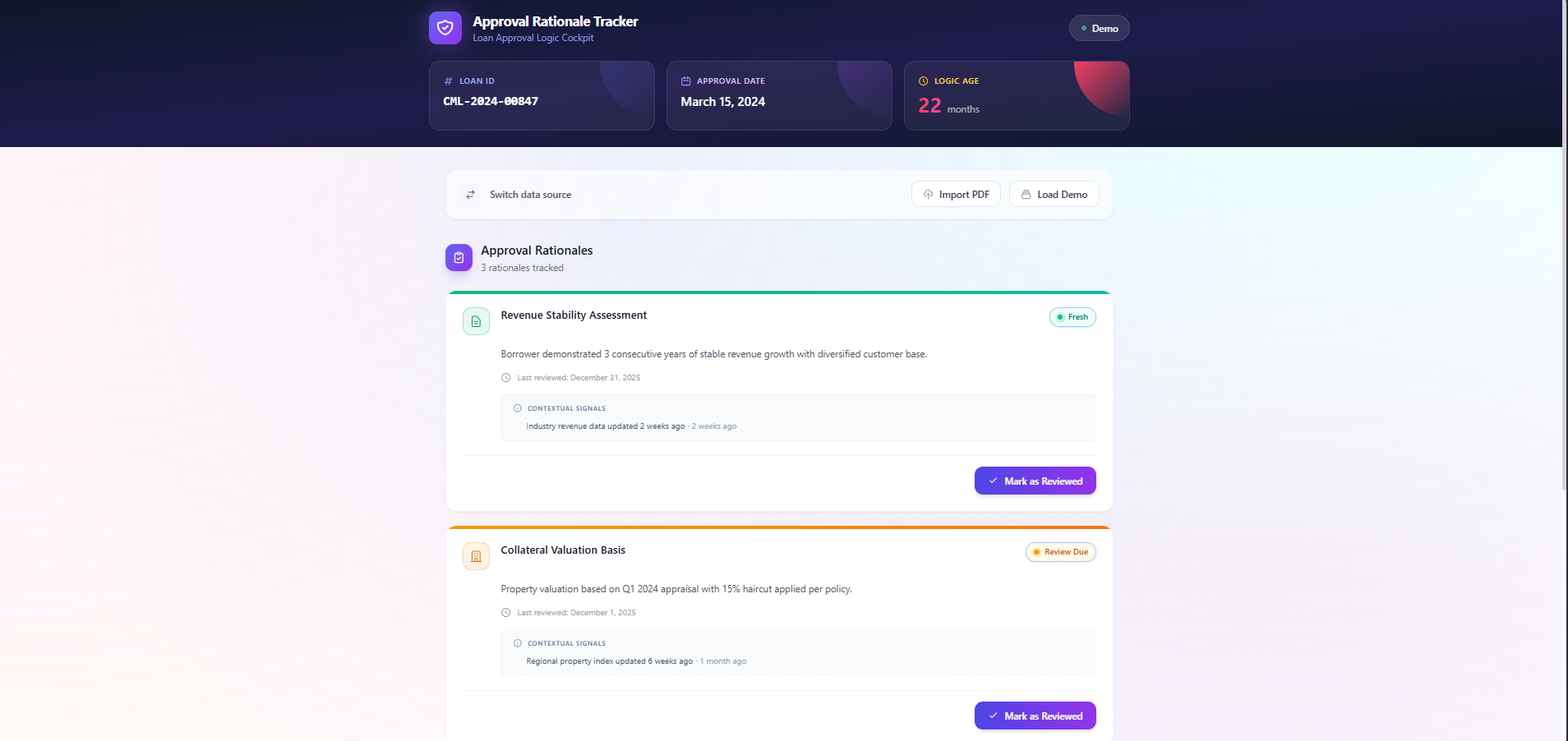
Approval Rationale Tracker — single-screen cockpit for governing loan approval logic
-
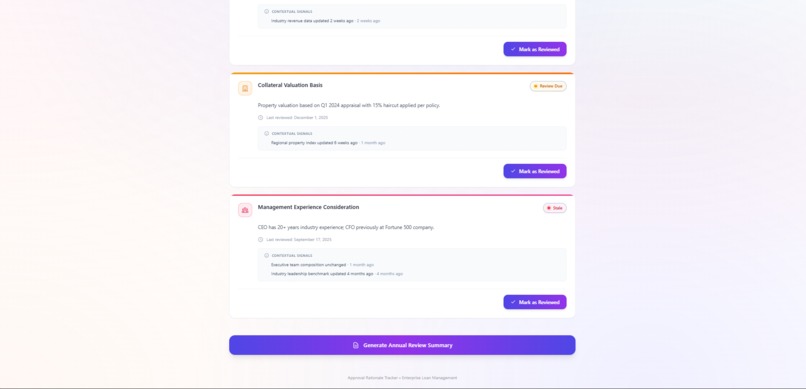
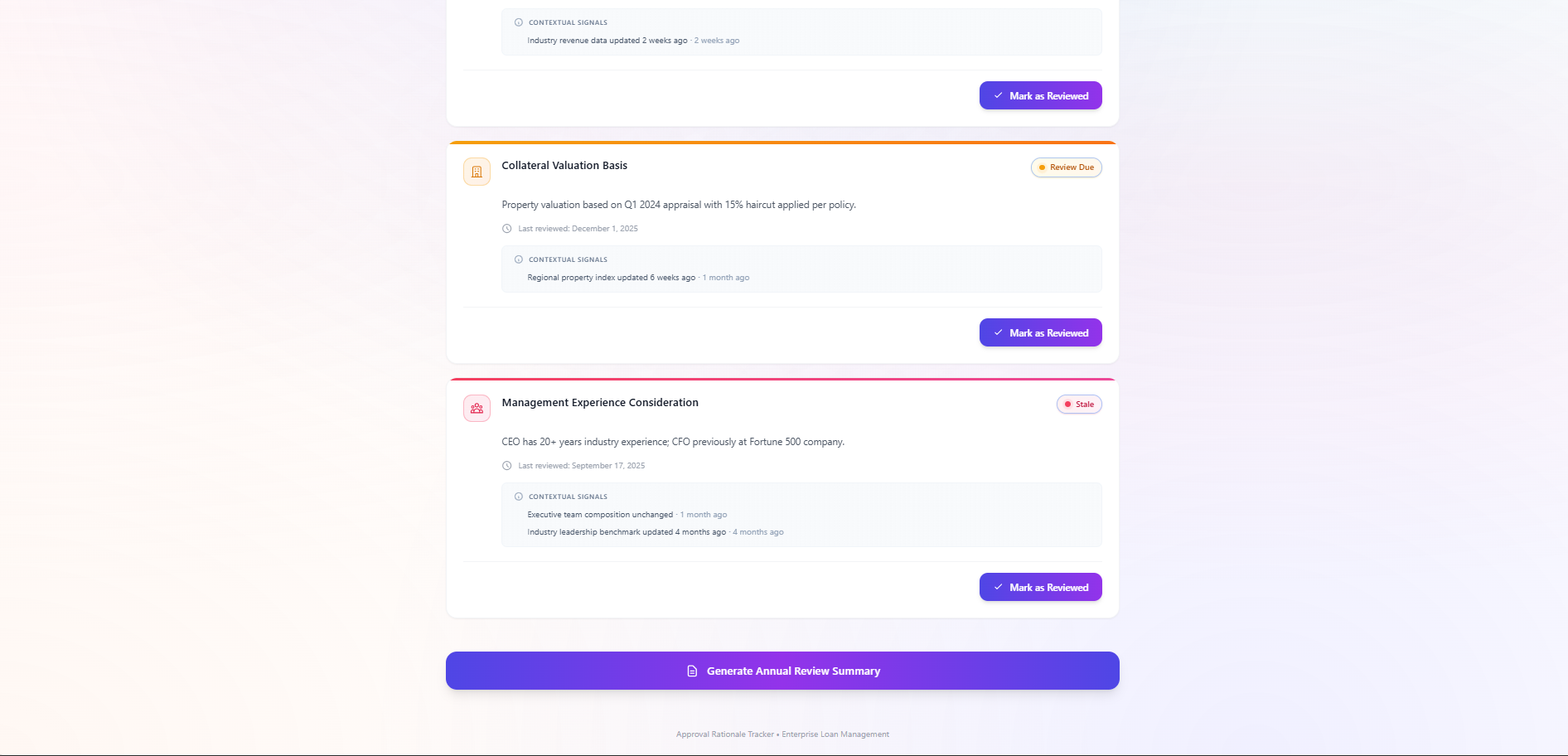
Approval rationales age over time, showing Fresh, Review Due, and Stale states within the same cockpit.
-
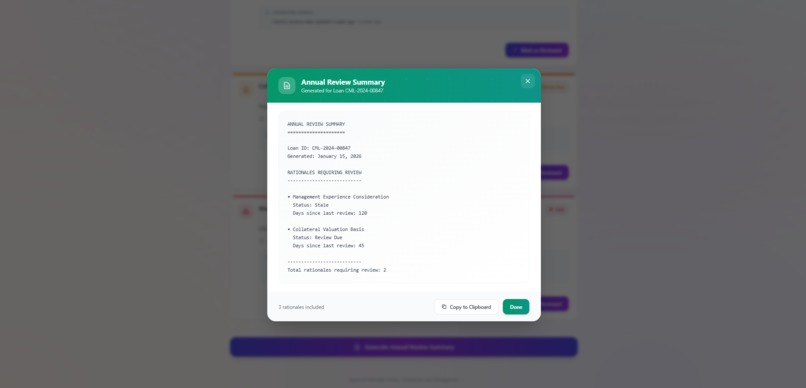
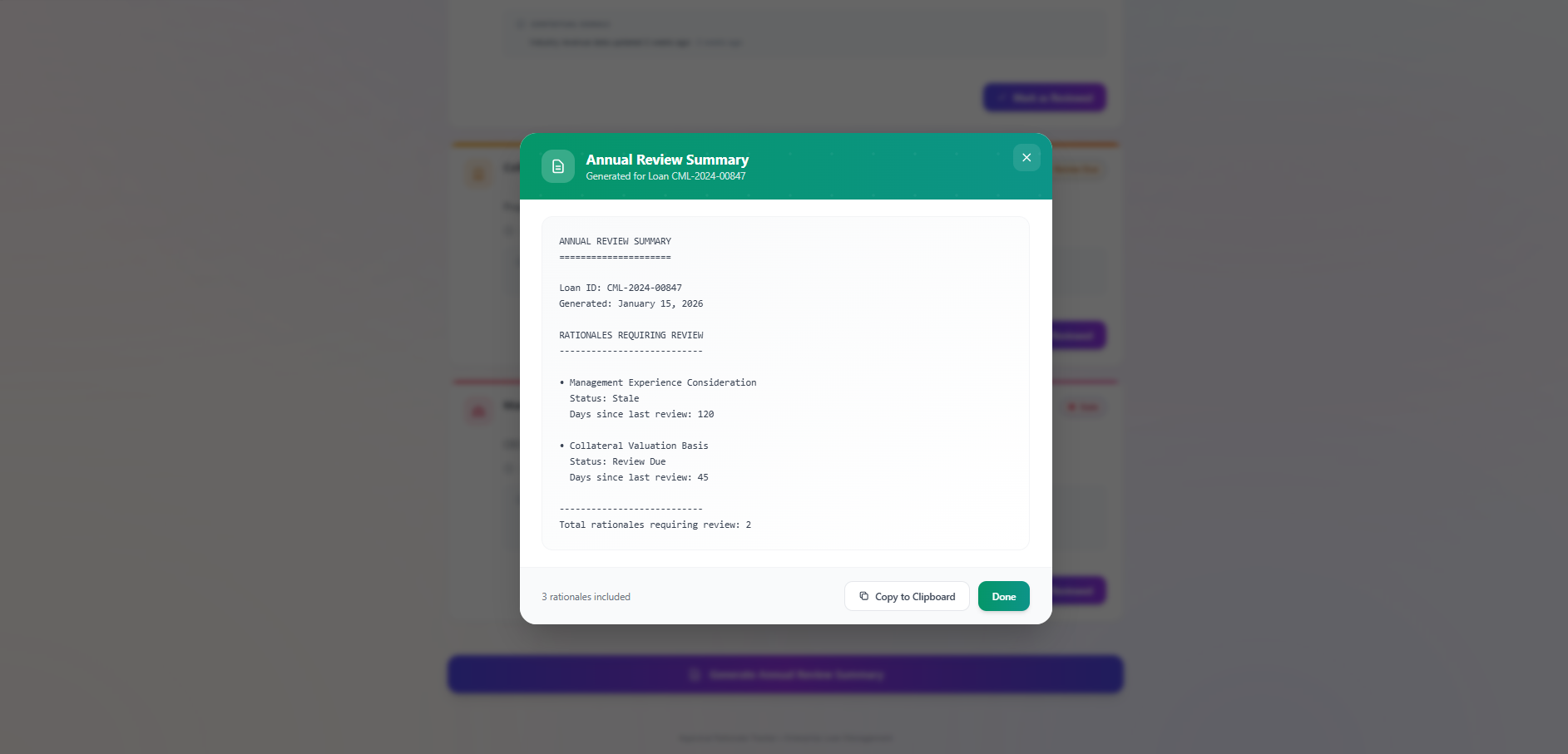
Plain-text annual review summary for governance, audit, and compliance workflows
-
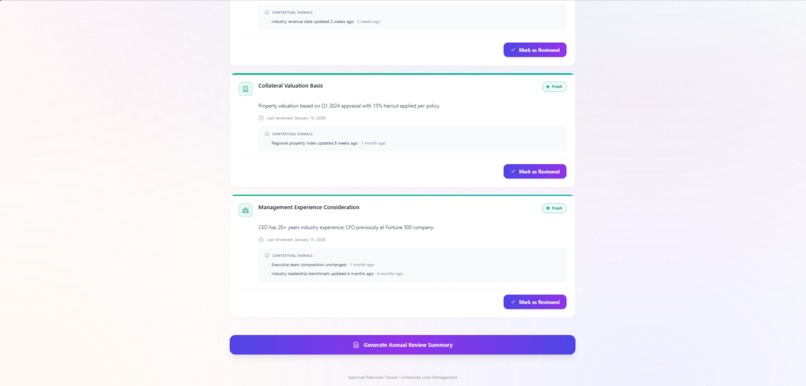
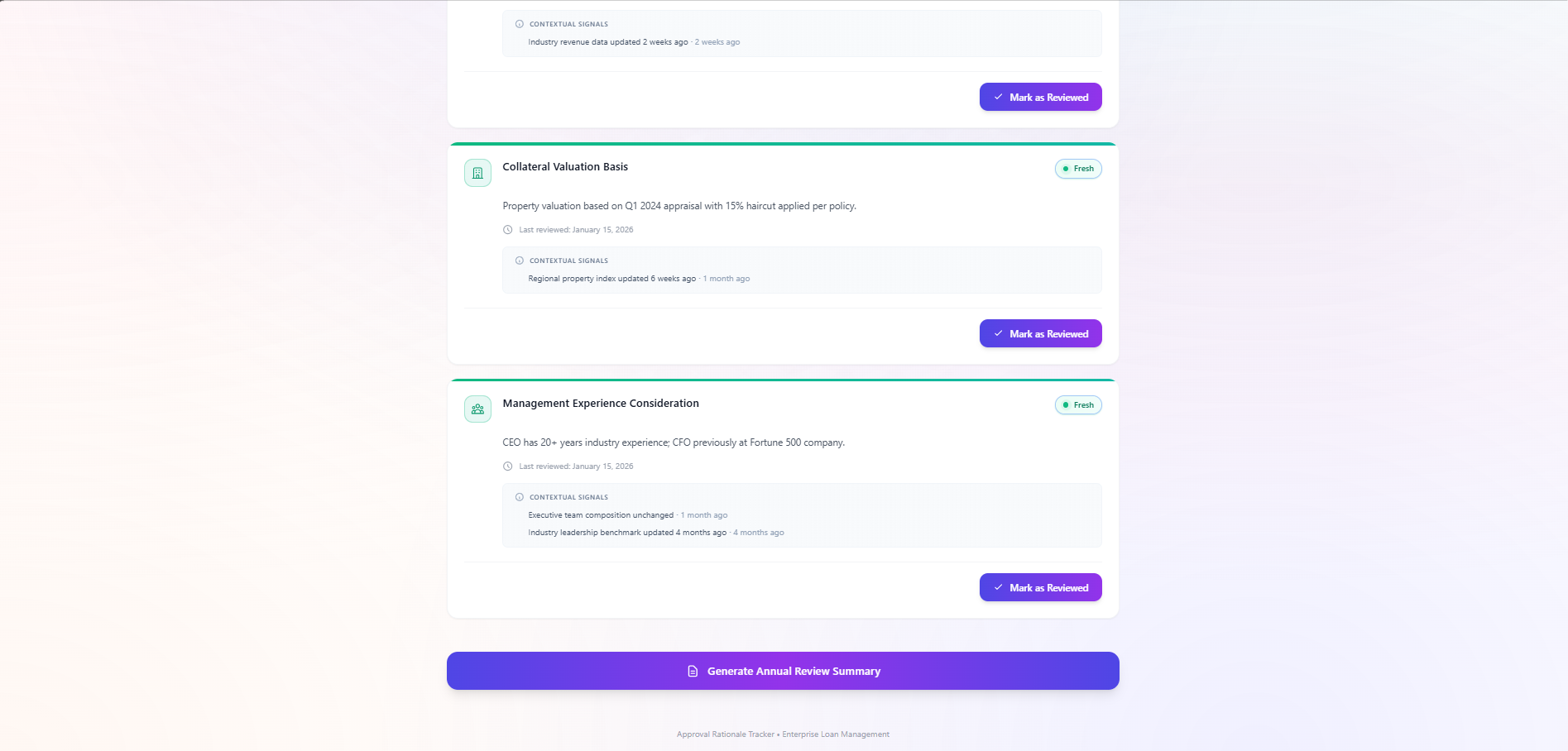
Human review is recorded with a single click, updating timestamps and status
Inspiration
In commercial lending, loan approvals rely heavily on qualitative reasoning — management quality, market conditions, collateral assumptions, and regulatory context. This reasoning is formally captured in Credit Memos at origination.
However, once a loan is approved, that approval logic typically remains embedded in static PDF documents. As time passes, markets evolve, borrower circumstances change, and assumptions age — yet the original reasoning is rarely revisited in a structured way.
Traditional lending systems focus on performance monitoring and risk metrics. They do not track whether the logic behind an approval has been re-verified over time.
This creates a quiet governance gap: institutions can often answer how a loan is performing, but struggle to demonstrate whether the assumptions that justified the approval are still valid.
Approval Rationale Tracker was built to address this gap — by keeping approval logic visible, time-aware, and reviewable throughout the loan lifecycle.
What it does
Approval Rationale Tracker (ART) is a decision-memory system for loan portfolios. It transforms static approval rationales from Credit Memos into structured, time-aware objects that remain visible and reviewable throughout the loan lifecycle.
Key capabilities:
- Import Credit Memos — Upload PDF documents and extract key approval rationales
- Human Confirmation — Every extracted rationale requires human review before entering the system (edit, confirm, or reject)
- Time-Based Staleness Tracking — Each rationale shows its review status: Fresh (≤30 days), Review Due (31-90 days), or Stale (>90 days)
- One-Click Review — Credit officers click "Mark as Reviewed" to update timestamps and recalculate status
- Annual Review Summary — Generate plain-text summaries listing rationales needing attention, ready for governance reports
ART is not a risk model. It doesn't score loans or predict defaults. It simply answers: "Has anyone revisited the logic behind this approval?"
How we built it
We built ART as a modern single-page application designed for desktop use in enterprise environments.
Architecture:
- React with TypeScript for type-safe component development
- Tailwind CSS for a clean, professional enterprise UI
- Context-based state management for the loan cockpit
- PDF.js for client-side document text extraction
- Local storage for data persistence (prototype phase)
- Vitest for comprehensive unit and property-based testing
Design Principles:
- Single-screen interface — no tabs, dashboards, or complex navigation
- Human-in-the-loop at every step — nothing automated without confirmation
- Audit-safe by design — every action is timestamped and traceable
- Conservative, enterprise-appropriate visual design
We followed a spec-driven development approach, defining requirements and acceptance criteria before implementation to ensure the product solves the actual governance problem.
Challenges we ran into
Scope discipline — The temptation to add "smart" features (risk scoring, automated alerts, predictive analytics) was constant. We had to repeatedly remind ourselves that ART's value is in its simplicity. It tracks time since human review. That's it. Keeping the product focused required saying no to features that would dilute the core value proposition.
PDF extraction reliability — Credit Memos vary wildly in format and structure. Building extraction that works across different document styles while gracefully handling edge cases took significant iteration.
Enterprise-appropriate design — Banking professionals expect conservative, professional interfaces. Finding the balance between modern UX and enterprise credibility required careful attention to typography, color, and interaction patterns.
Explaining what we're NOT — The hardest part of this project was communicating that ART is not another risk tool. It's a governance tool. That distinction matters enormously to the target users but requires careful framing.
Accomplishments that we're proud of
A working prototype that solves a real problem — ART isn't a concept. It's a functional application that demonstrates the complete workflow from PDF import to annual review summary.
Human-first design — Every feature requires human confirmation. In an industry rushing toward automation, we built something that keeps humans in control.
Time-based staleness as the core metric — We resisted the urge to add complexity. The status system (Fresh/Review Due/Stale) is simple, understandable, and directly actionable.
Audit-ready output — The annual review summary generates clean, plain-text documentation that integrates with existing governance workflows.
Enterprise-grade UI — The interface looks like it belongs in a bank, not a hackathon.
What we learned
Governance is underserved — The lending industry has invested heavily in origination and monitoring, but the space between — keeping approval logic alive — has been neglected. There's a real market gap here.
Simplicity requires discipline — Building a focused product is harder than building a feature-rich one. Every decision to NOT add something was a conscious choice.
Banking professionals value substance — Our target users don't want flashy demos or buzzwords. They want tools that solve real operational problems with minimal friction.
Time is a powerful organizing principle — Staleness based on days since review is intuitive, defensible, and requires no complex algorithms. Sometimes the simplest approach is the right one.
What's next for Approval Rationale Tracker
Near-term:
- Multi-loan portfolio view for tracking staleness across entire portfolios
- Batch import for onboarding existing loan documentation
- Enhanced PDF extraction for broader document format support
Medium-term:
- LOS (Loan Origination System) integration via API
- Role-based access control for credit teams
- Workflow routing for review assignments
Long-term:
- Enterprise deployment options (on-premise, private cloud)
- Integration with document management systems
- Portfolio-level analytics and reporting
ART is ready for pilot deployment with a lending institution that wants to close the governance gap in their approval documentation process.
Built With
- css3
- html5
- javascript
- pdf.js
- react
- tailwind-css
- typescript
- vite
- vitest

Log in or sign up for Devpost to join the conversation.