-
-

App Cover
-
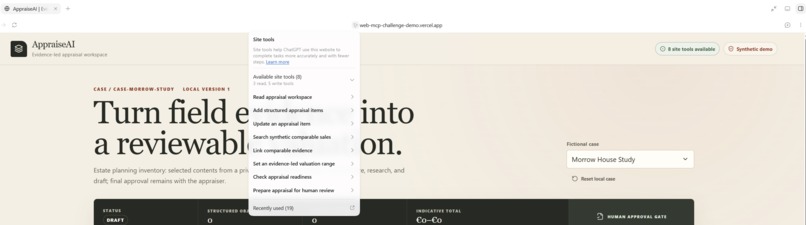
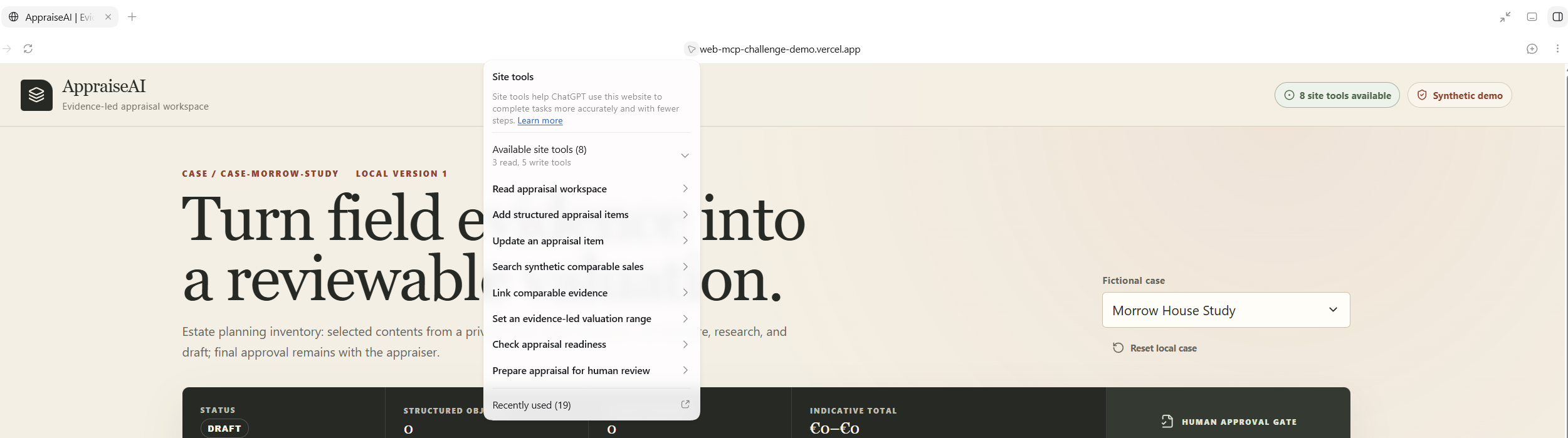
WebMCP tools

Inspiration
Appraisal work is meaningful, but the process around it can be frustrating and repetitive. Organizing field notes, saving evidence, researching comparable sales, checking completeness, and verifying that every conclusion is supported can take attention away from the work that matters most: professional judgment.
The idea for AppraiseAI started when I saw OpenAI’s tweet about WebMCP. I was curious, so I began reading more about it. The more I learned, the more I saw how well WebMCP could fit this problem.
Instead of making appraisers copy information between a website and a chatbot, I wanted to create one shared workspace where people and AI agents could work together while keeping the final decision firmly in human hands.
What it does
AppraiseAI turns unstructured field notes and object images into an organized, evidence-backed appraisal draft, saving professionals valuable time to focus on expert judgment and final decisions.
An AI agent can:
- Read the active appraisal context
- Turn field notes into structured appraisal items
- Search a catalog of synthetic comparable sales
- Link relevant evidence to each item
- Draft supported valuation ranges
- Check whether the appraisal is ready for review
- Hand the completed draft back to the appraiser
Every agent action immediately appears in the visible interface, updates the appraisal version, and is recorded in an activity ledger.
How I built it
AppraiseAI is built with React, Vite, and TypeScript.
The application uses a shared, typed state layer persisted in localStorage. The visible interface and WebMCP tools both use the same domain operations and validation rules, ensuring that an agent cannot bypass restrictions enforced by the application.
The page exposes eight focused WebMCP tools through document.modelContext.registerTool():
get_appraisal_contextadd_appraisal_itemsupdate_appraisal_itemsearch_comparable_saleslink_comparable_saleset_item_valuationget_appraisal_readinessmark_appraisal_ready_for_review
Every successful mutation returns a verification snapshot so the agent can confirm what changed.
The demo requires no backend, accounts, uploads, or external APIs. All cases, objects, images, comparable sales, people, organizations, dates, and values were created specifically for this challenge and are entirely fictional.
Challenges I ran into
Finding out in two days what WebMCP is and what WebMCP does.
Maintaining an agent and an interface that always work together. Each action on the tool would trigger a new state version, update the workspace at once, save the change locally, and generate a traceable activity entry. Another crucial point was ensuring the application would keep working in browsers without WebMCP support.
Lastly, making sure the demo video is less than three minutes long.
Accomplishments that i'm proud of
I am especially proud that AppraiseAI demonstrates a complete human-agent workflow rather than a collection of disconnected tool calls.
The agent can structure notes, research evidence, draft valuation ranges, identify missing work, and prepare the appraisal for review all inside the same interface the appraiser uses.
What I learned
WebMCP tools are surprisingly easy to build, yet they can save people enormous amounts of time. They can act as a second brain or personal assistant, taking care of repetitive work so people can focus on what actually requires their expertise.
What's next for AppraiseAI
The next step is to explore how AppraiseAI could support larger, more flexible appraisal workflows while preserving the same principles of human control. This could include additional components for customer communication, report generation, and further automation of repetitive tasks.
Built With
- css
- lucide
- react
- typescript
- vite
- webmcp

Log in or sign up for Devpost to join the conversation.