-
-
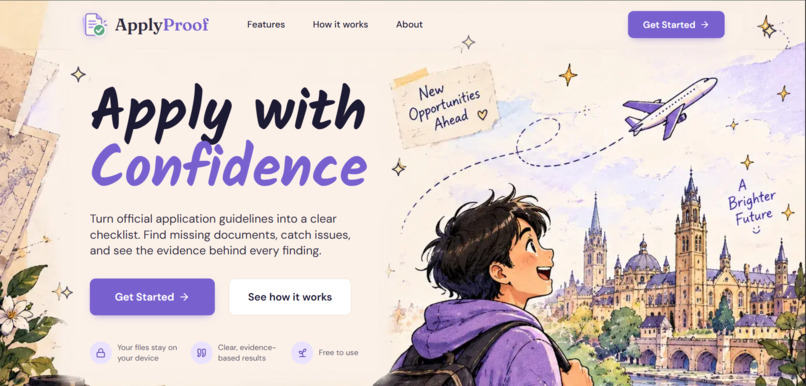
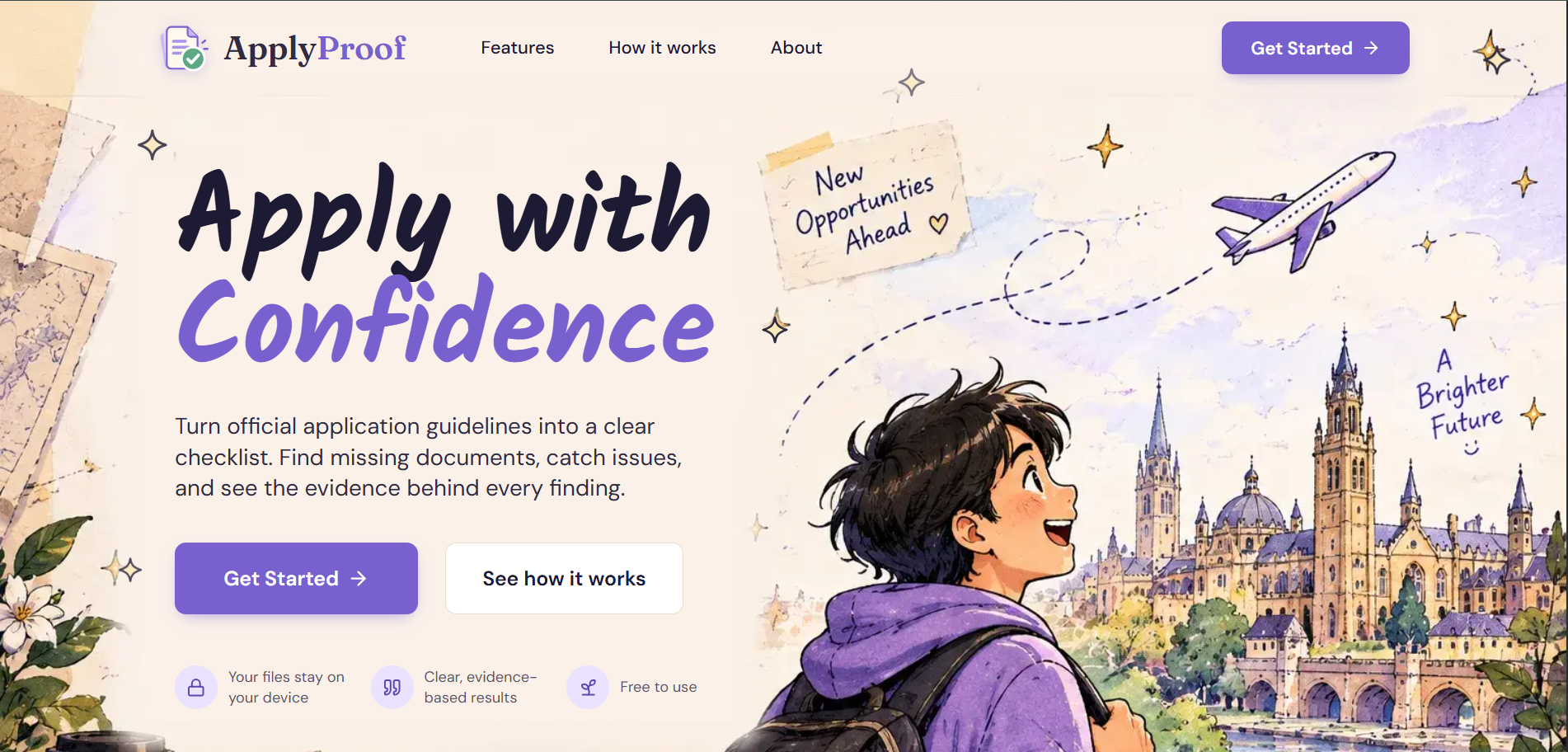
A welcoming, dream-journal-inspired landing page introduces ApplyProof and its evidence-based application readiness checks.
-
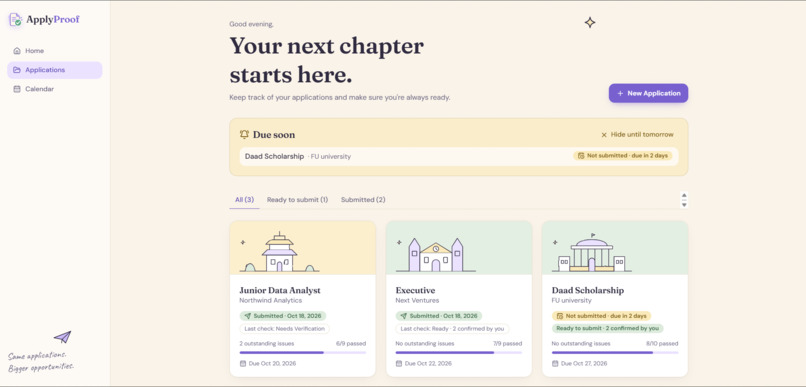
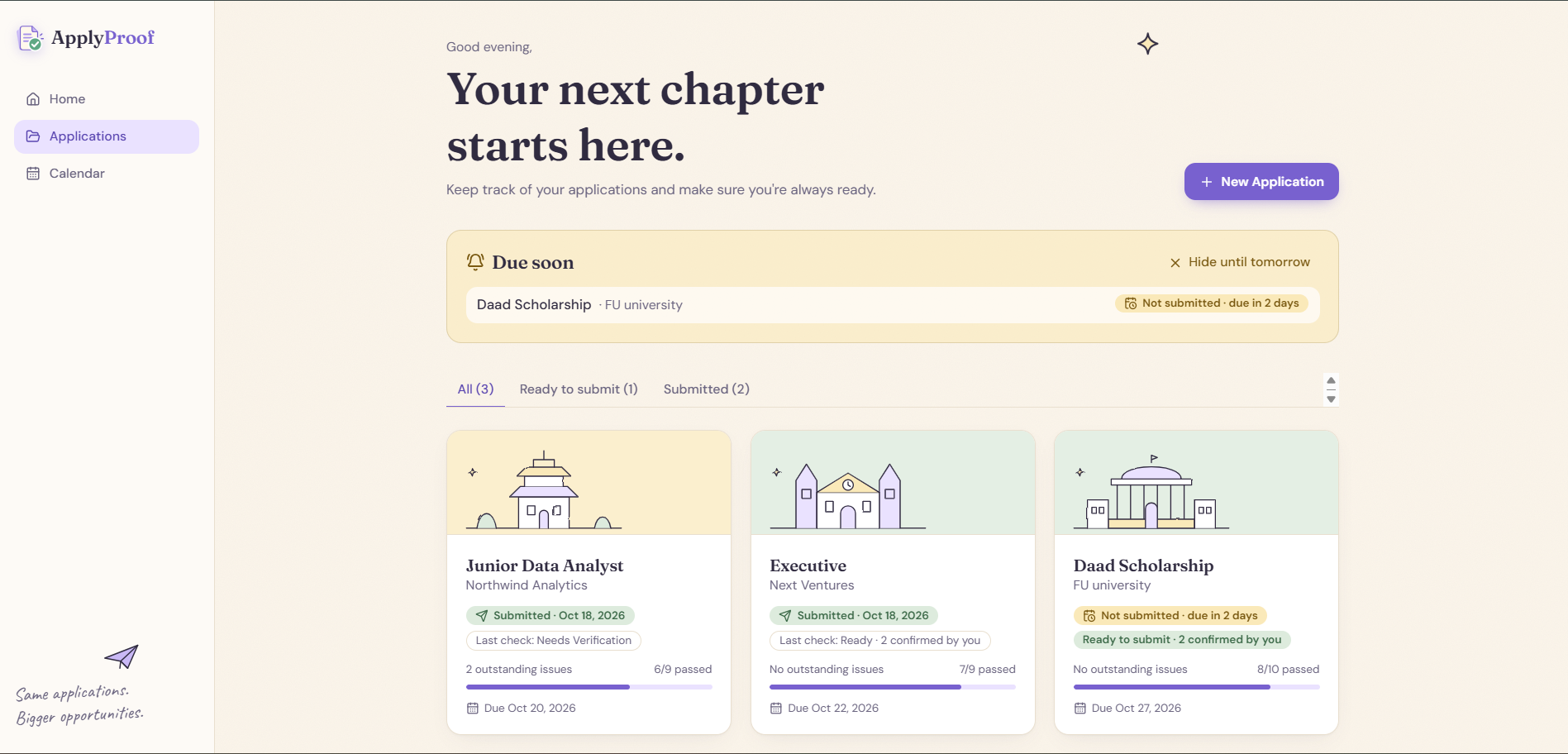
Manage applications in one place with submission statuses, readiness progress, outstanding issues, and upcoming deadline reminders.
-
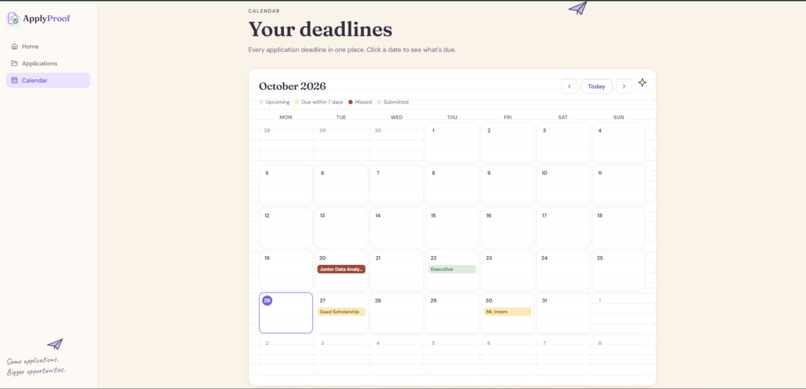
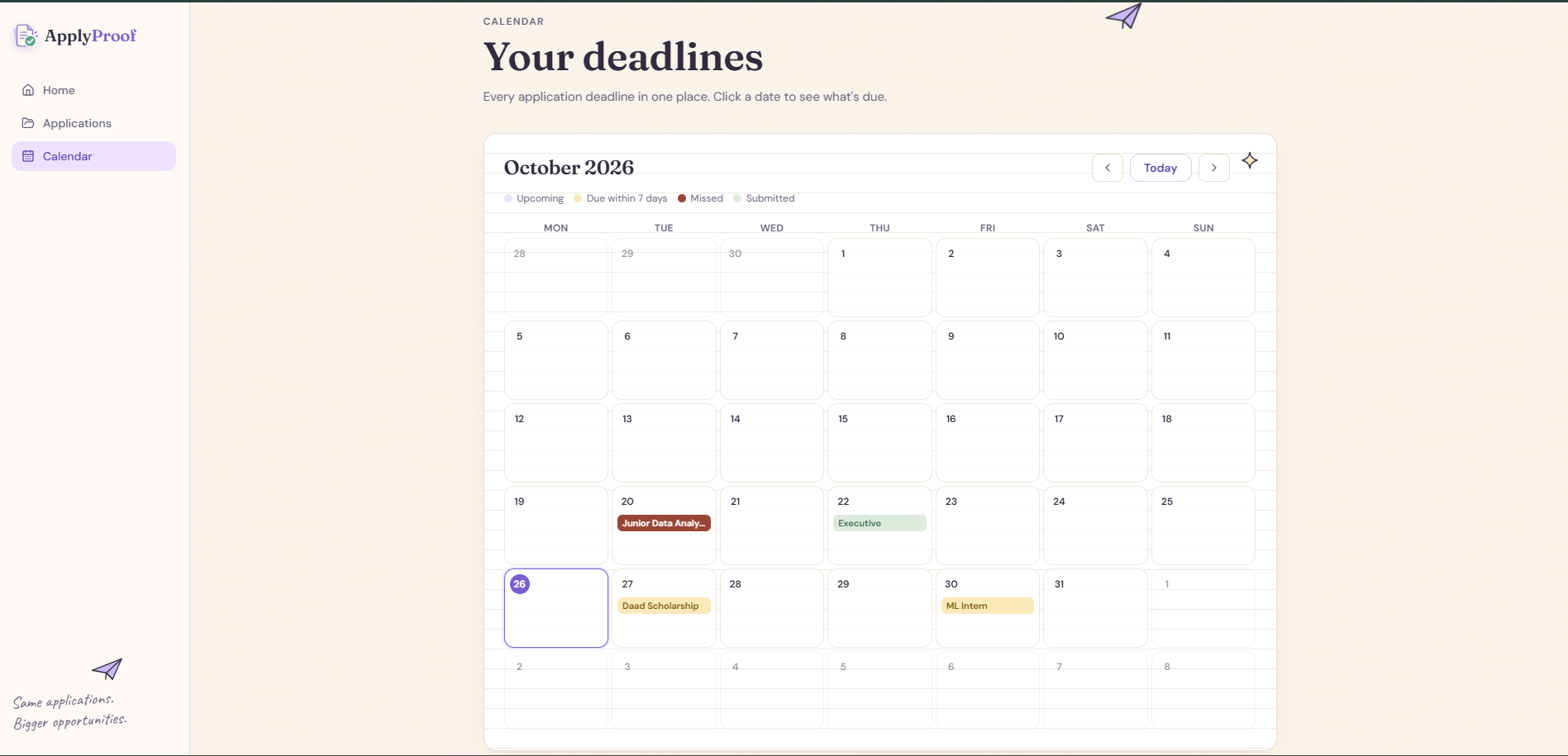
A monthly calendar organizes application deadlines and highlights upcoming, due-soon, missed, and submitted applications.
-
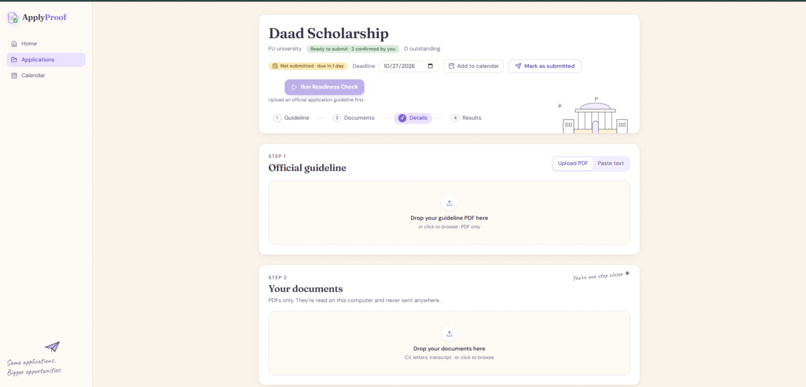
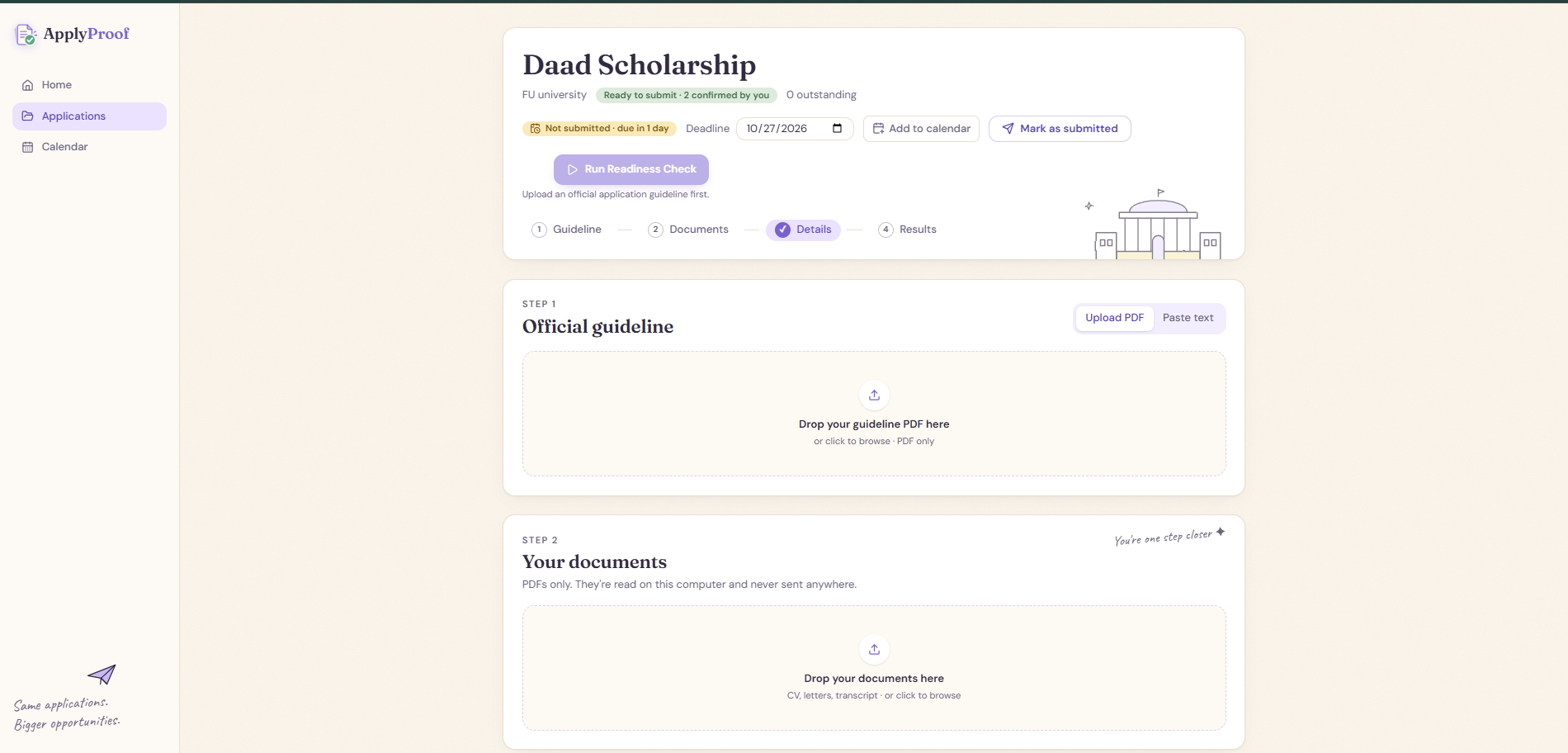
Create an application, upload or paste the official guideline, and add applicant PDFs through a guided, step-by-step workflow.
-
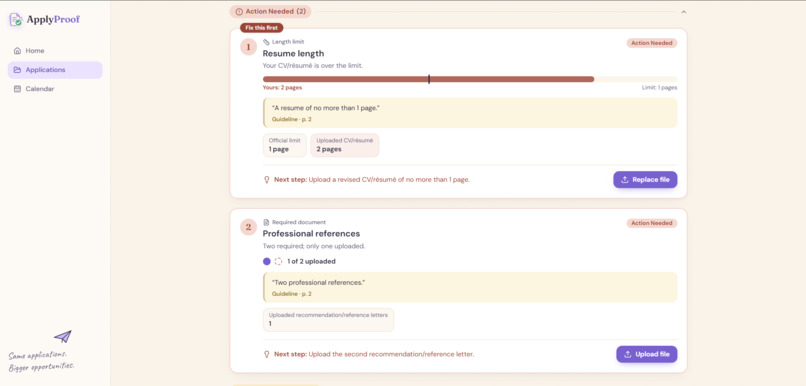
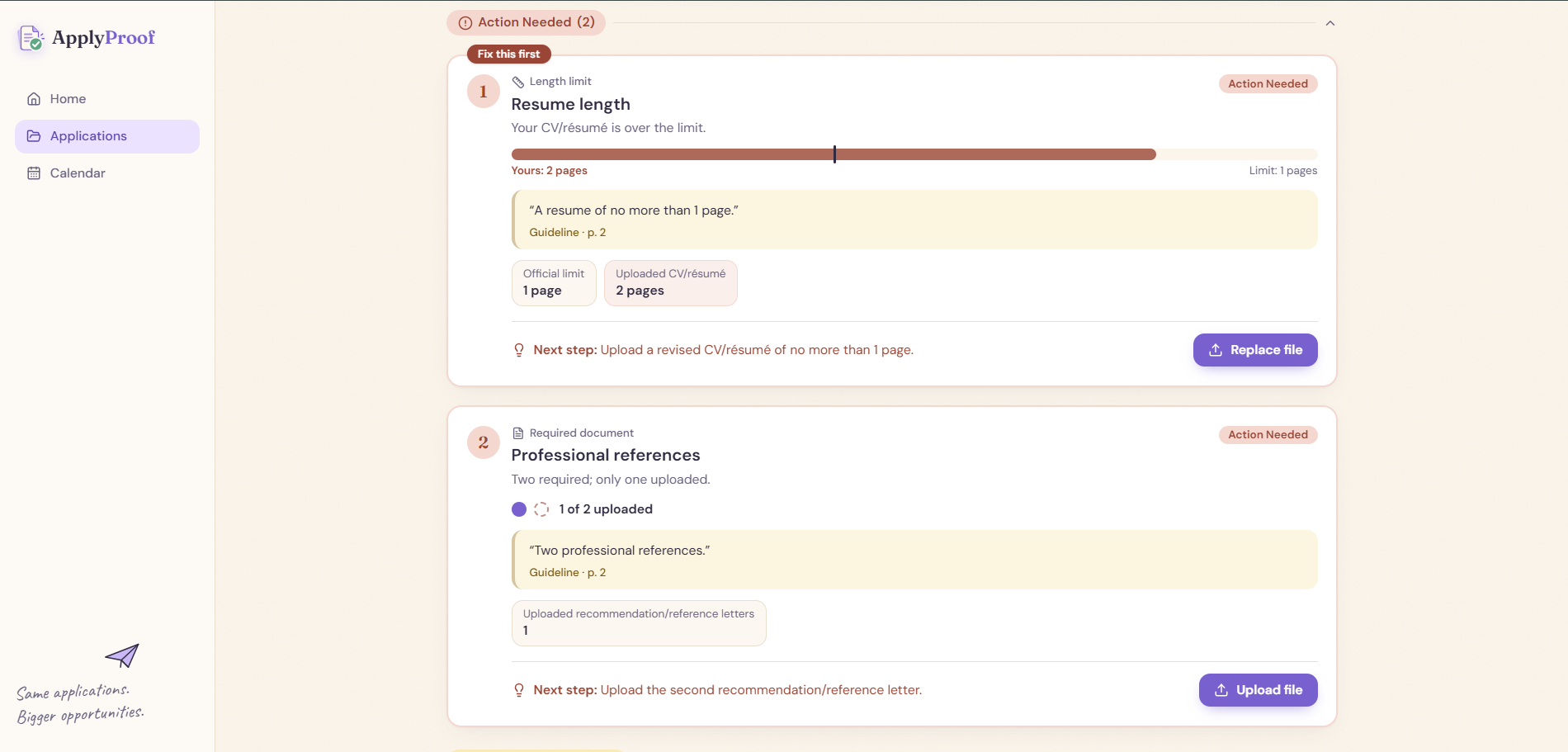
Action Needed highlights issues such as document length limits and missing files, with source quotes and clear next steps.
-
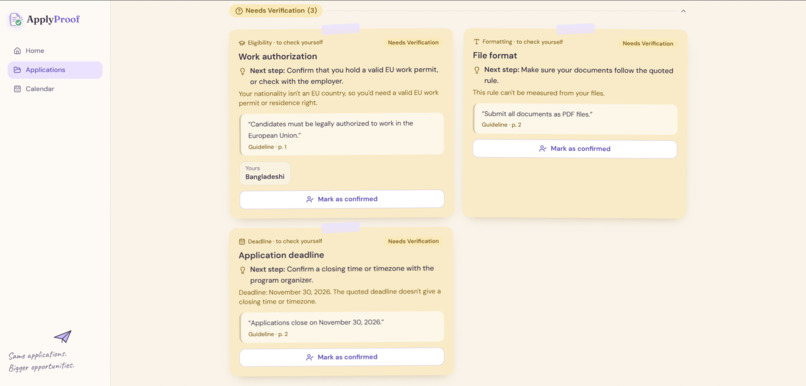
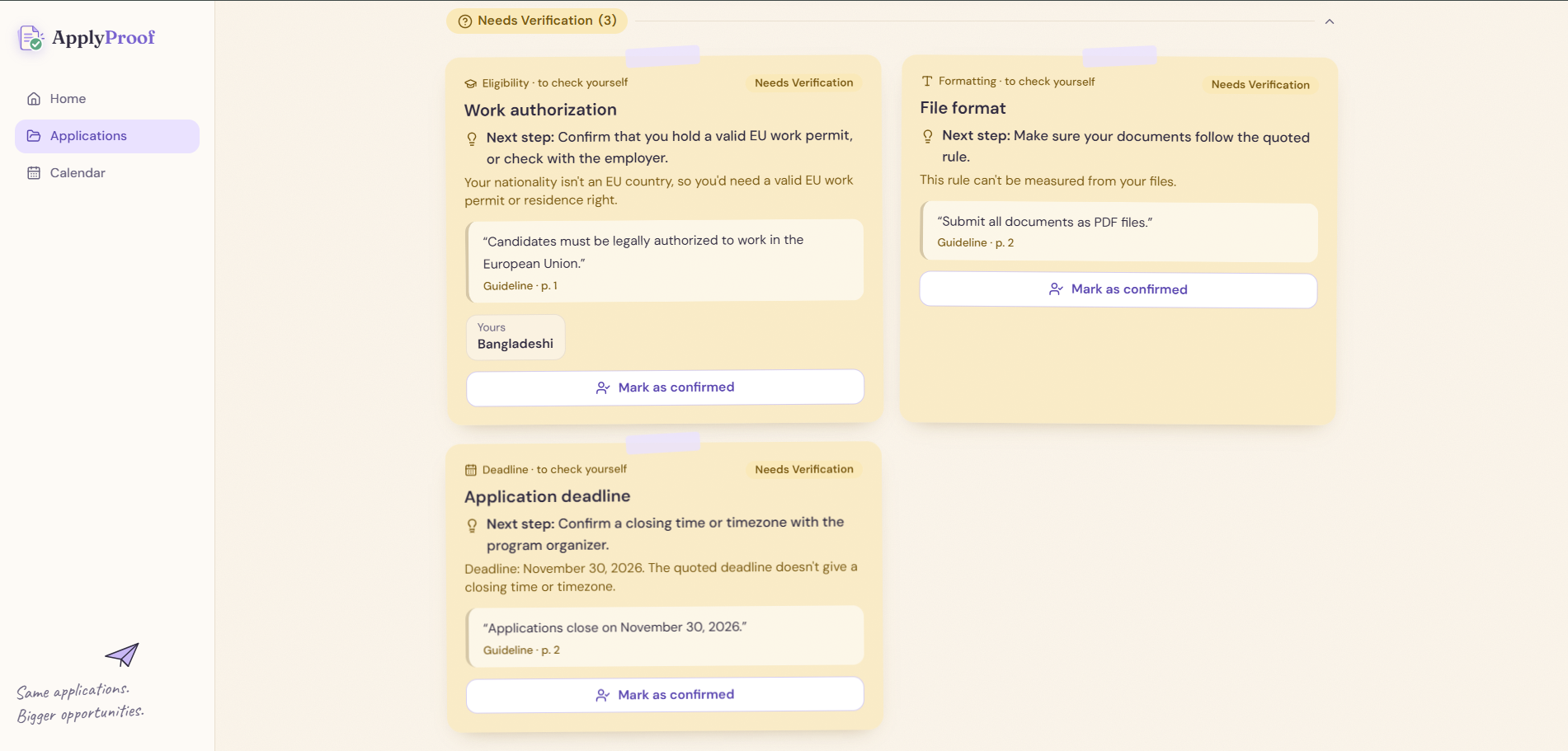
Flags uncertain requirements with source evidence and lets applicants record confirmations without treating them as independently verified.
-
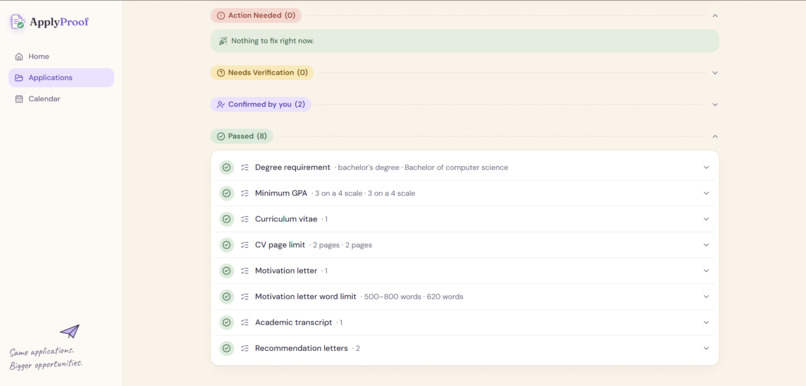
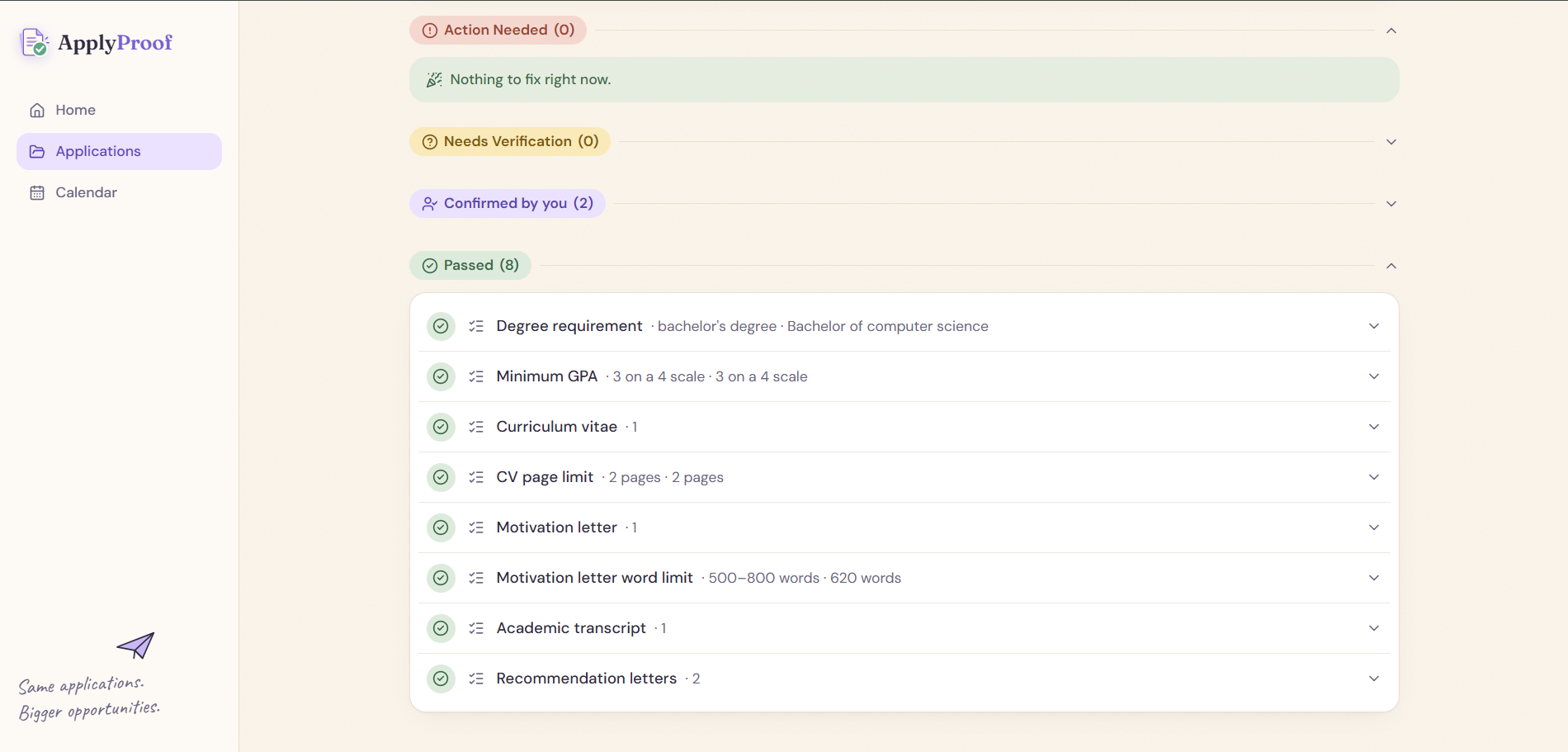
Shows requirements successfully checked against the guideline and applicant documents, with supporting evidence for each result.
Inspiration
Applying for a scholarship, university program, or internship often involves long guidelines, multiple documents, and strict deadlines. Even a small missed requirement can cause unnecessary stress or make an application incomplete.
We built ApplyProof to help applicants understand exactly what they need to fix before submitting. Rather than creating another generic AI chatbot, we wanted to build a tool that checks real application documents against official requirements and provides evidence for its findings.
What it does
ApplyProof is an AI-powered application readiness checker that helps applicants identify potential issues before submitting an application.
- Extracts requirements: Uses Google Gemini to turn official application guidelines into structured requirements.
- Checks documents: Validates applicant files against supported requirements, including document presence, page limits, word limits, and certain explicit eligibility criteria.
- Provides source evidence: Connects findings to verified quotes and source pages so applicants can understand why a requirement was flagged.
- Handles uncertainty honestly: Uses "Needs Verification" when the available evidence is insufficient instead of presenting an uncertain answer as fact.
- Tracks corrections: Lets applicants replace files, rerun checks, and compare previous and updated results through "What Changed."
- Organizes applications: Includes application status and deadline-tracking features to help users manage their progress.
How we built it
We built ApplyProof using Next.js and TypeScript. Google Gemini handles requirement extraction, while application code performs supported checks and validates extracted evidence against the original guideline text.
We use unpdf for PDF text extraction and IndexedDB with Dexie to store application data and applicant files locally in the browser. Our privacy-first design keeps applicant documents on the user's device; only guideline text is sent to Gemini after the first-use privacy disclosure.
We also created structured extraction tests using samples/expected-requirements.json and automated checks to evaluate the results. This gave us a repeatable way to test the AI's output and improve the system as we discovered new edge cases.
Challenges we ran into
Our biggest challenge was realizing that finding a requirement is not the same as interpreting it correctly.
Gemini achieved 10/10 on our initial sample-guideline extraction test, with all extracted quotes verified. However, further testing exposed issues that the original test did not catch. For example, the AI sometimes treated an explicit GPA requirement as unclear, omitted degree details, or confused work authorization with nationality.
We addressed these problems by making application code re-examine verified source quotes for supported eligibility rules and adding regression tests for the cases we discovered. We also preserved "Needs Verification" for cases that cannot be resolved reliably with the available evidence.
This taught us not to rely on a promising test score alone. We needed to test how requirements were classified and interpreted, not just whether they were extracted.
Accomplishments that we're proud of
- Built a complete application workflow, from creating an application and uploading guidelines to checking documents and correcting identified issues.
- Implemented evidence-linked findings so applicants can trace a result back to the original source instead of trusting an unsupported AI conclusion.
- Developed a verification approach that combines AI extraction with deterministic checks and regression tests.
- Built "What Changed" to help applicants understand whether replacing a document resolved an earlier issue.
- Tested the end-to-end experience on desktop and mobile devices while maintaining our local-first approach to applicant document privacy.
What we learned
We learned that building a useful AI product is not simply about choosing a capable model. Reliability comes from the system around it: source evidence, deterministic validation, careful handling of uncertainty, privacy boundaries, and tests that reflect real-world failures.
Our initial 10/10 result was useful, but it did not prove that the system would interpret every guideline correctly. Real testing revealed gaps, and each discovered failure helped us improve the logic and add a test to prevent the same mistake from returning.
Our guiding principle became:
Let AI propose, let code verify, and never hide uncertainty.
What's next for ApplyProof
We want to evaluate ApplyProof against a more diverse collection of real-world application guidelines to better understand its reliability across different institutions, formats, and eligibility rules.
We also plan to explore stronger recovery and persistence options, so applicants can preserve their work and access it across devices without compromising privacy. Additional improvements could include broader document-format support and better handling of scanned PDFs.
Our long-term goal is to make application preparation more transparent and less stressful by helping people identify issues, understand the evidence, and make informed corrections before submitting.
Built With
- dexie
- gemini-api
- indexeddb
- next.js
- tailwindcss
- typescript
- unpdf
