-
-
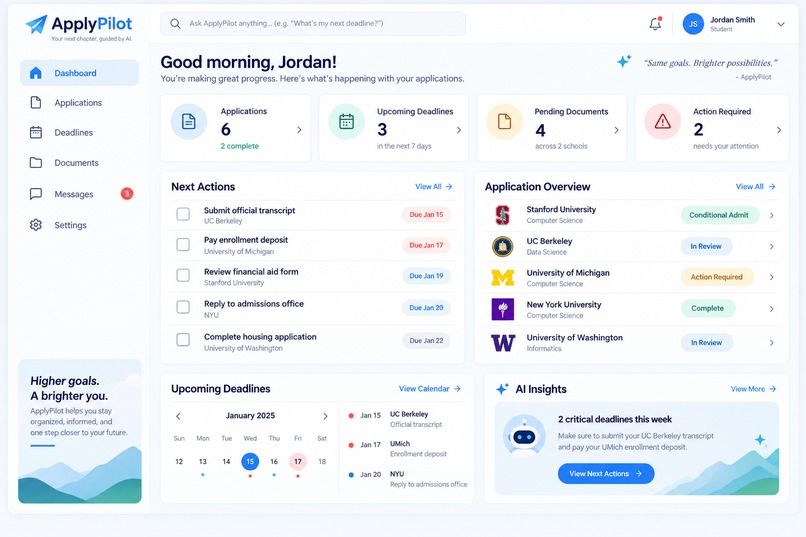
Main Screen
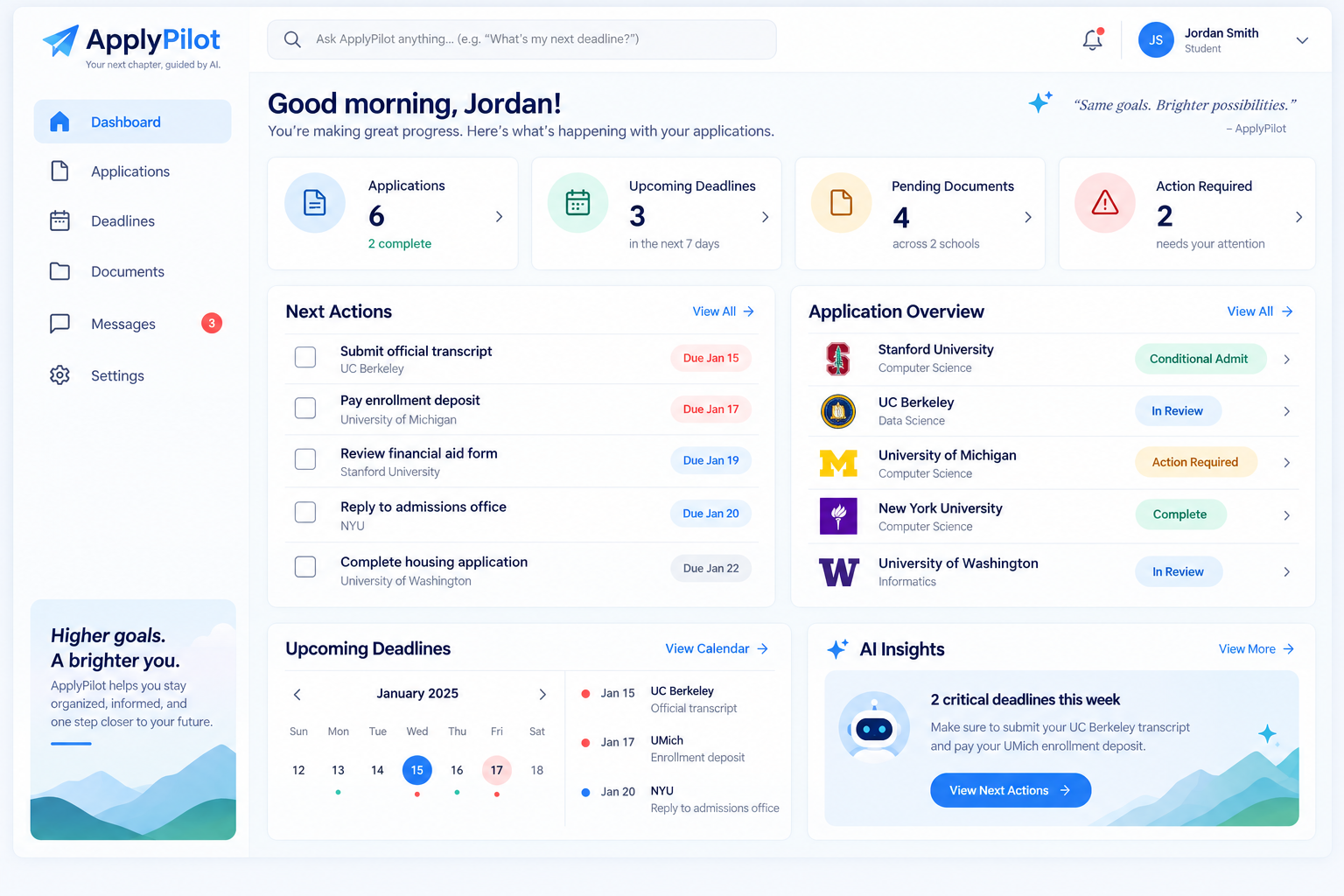
Inspiration
Applying to universities can quickly become overwhelming. Students receive emails from multiple institutions, upload documents through different portals, track transcript requirements, monitor deposits, respond to admissions offices, and remember dozens of deadlines.
The difficult part is not simply finding information. The real challenge is understanding what requires action, when it needs to happen, and what should be done next.
That inspired ApplyPilot.
ApplyPilot is an AI-powered student application agent designed to turn scattered admissions information into a clear, actionable plan. Instead of forcing students to repeatedly check emails, PDFs, portals, and personal notes, ApplyPilot analyzes application-related information and identifies the actions that actually matter.
Our goal is simple:
Never miss an important admission deadline or required action again.
What it does
ApplyPilot acts as an intelligent application assistant that can analyze admissions-related content and transform it into structured tasks.
A student can provide an admission email, application update, or document, and ApplyPilot can identify information such as:
University or institution Application status Required documents Missing documents Admission deadlines Enrollment deposit deadlines Financial aid actions Important dates Recommended next steps Whether the student needs to respond
Instead of only summarizing a message, ApplyPilot determines what the student should actually do.
For example, an admission email may contain several paragraphs of information. ApplyPilot can convert it into something much easier to act on:
University: Example University
Application Status: Conditional Admission
Actions:
- Submit official transcript
- Pay enrollment deposit
- Review financial aid requirements
Priority: High
Next Deadline: October 9
Human Decision Required: Yes — enrollment confirmation
This makes ApplyPilot more than a traditional chatbot. It is designed around an agentic workflow:
READ → UNDERSTAND → PLAN → TRACK → ACT → ESCALATE
Routine information can be processed automatically, while important decisions can be surfaced to the student.
How we built it
ApplyPilot is built around an agent architecture powered by Strands Agents and AWS services.
The AI agent receives application information and reasons about the content before producing structured actions.
The core workflow is:
Student Input ↓ Application / Document Analyzer ↓ Strands Agent ↓ Amazon Bedrock ↓ Action & Deadline Extraction ↓ Structured Application Record ↓ Task Tracking ↓ Student Dashboard Agent responsibilities
We separated the workflow into several logical responsibilities.
Document Analysis
The agent reads application-related information and determines what type of message or document it represents.
Deadline Extraction
Important dates are identified and associated with specific actions instead of being stored as isolated dates.
Action Planning
The agent determines whether the student needs to:
upload something, respond to someone, make a payment, confirm enrollment, complete a form, or simply wait.
Prioritization
Actions are ranked based on urgency and importance so students are not overwhelmed by unnecessary notifications.
Human escalation
ApplyPilot is designed to recognize when a decision should remain with the student.
For example, the system may automatically recognize an enrollment deadline, but the decision to accept an offer remains with the student.
This human-in-the-loop approach allows the agent to reduce repetitive work without taking control away from the user.
AWS architecture
The project uses AWS services to create a lightweight and scalable architecture.
The architecture can include:
Amazon Bedrock for foundation model inference Strands Agents SDK for agent orchestration and reasoning AWS Lambda for serverless processing Amazon API Gateway for backend API access Amazon DynamoDB for application and deadline records Amazon S3 for document storage Amazon Bedrock AgentCore for deploying and operating the agent workflow
A serverless architecture is especially useful for this type of project because students may use the system only when new application information arrives. Resources therefore do not need to run continuously.
What makes ApplyPilot different
Many AI assistants can summarize an admissions email.
ApplyPilot is designed to answer a more useful question:
What should I do because of this email?
The difference is the transition from information retrieval to action management.
Instead of:
"This email says your transcript is required."
ApplyPilot aims to produce:
ACTION REQUIRED
Submit official high school transcript
Deadline: October 9
Priority: High
Recommended next step: Request an official electronic transcript from your school.
This turns unstructured communication into an actionable workflow.
Challenges we faced
One of the biggest challenges was dealing with the way admissions information is written.
Important requirements are often buried inside long emails or documents. A single message might contain:
informational text, multiple deadlines, optional recommendations, mandatory actions, and conditional requirements.
The agent therefore needs to distinguish between information that is merely useful and information that requires immediate action.
Another challenge was deadline interpretation.
A date alone is not enough. The system also needs to understand:
what the deadline belongs to, whether it is mandatory, what happens if it is missed, and whether the student has already completed the associated action.
We also focused on preventing unnecessary automation.
For important decisions, such as accepting an admission offer or making a payment, ApplyPilot should assist the student rather than make the decision automatically.
What we learned
Building ApplyPilot helped us explore how AI agents can move beyond question answering.
One of the most important lessons was that useful agents require more than a powerful language model.
They need:
clear responsibilities, structured outputs, persistent state, reliable task tracking, prioritization, and well-defined boundaries between autonomous actions and human decisions.
We also learned how Strands Agents can be used to organize these responsibilities around a goal instead of treating every interaction as an isolated prompt.
AWS services make it possible to connect reasoning, storage, APIs, and serverless execution into a practical agent workflow.
What's next for ApplyPilot
The next stage is to make ApplyPilot increasingly proactive.
Future capabilities could include:
Email integration
Automatically detect application-related emails and extract new requirements.
Document understanding
Analyze admission letters, financial aid documents, and transcript requests directly from PDFs.
Multi-school application tracking
Give students one dashboard for every university they applied to.
Smart reminders
Notify students only when an important deadline is approaching or when an application requires attention.
Response drafting
Generate appropriate email drafts when an admissions office requests additional information.
Application timeline
Automatically create a chronological view of each student's admissions journey.
Multi-agent workflows
Specialized agents could independently handle document analysis, deadline management, communication drafting, and application status tracking.
Ultimately, ApplyPilot could become an autonomous coordination layer between students and the complex systems involved in education applications.
Our vision
Students should spend their time deciding where they want to study, not worrying about whether they forgot a deadline hidden inside an email.
ApplyPilot demonstrates how AI agents can quietly handle repetitive administrative work while bringing humans back into the loop when an important decision actually needs their attention.
ApplyPilot — Never miss the next step.

Log in or sign up for Devpost to join the conversation.