Inspiration
What it does## Inspiration
Applying to internships is repetitive and frustrating. Candidates repeatedly enter the same experience, education, and personal information into application systems that all look slightly different.
Traditional automation scripts are cheap but break whenever a form changes. Fully AI-driven browser agents can understand unfamiliar pages, but using AI for every click is expensive and unpredictable. We wanted to combine the intelligence of AI with the reliability of deterministic software.
What it does
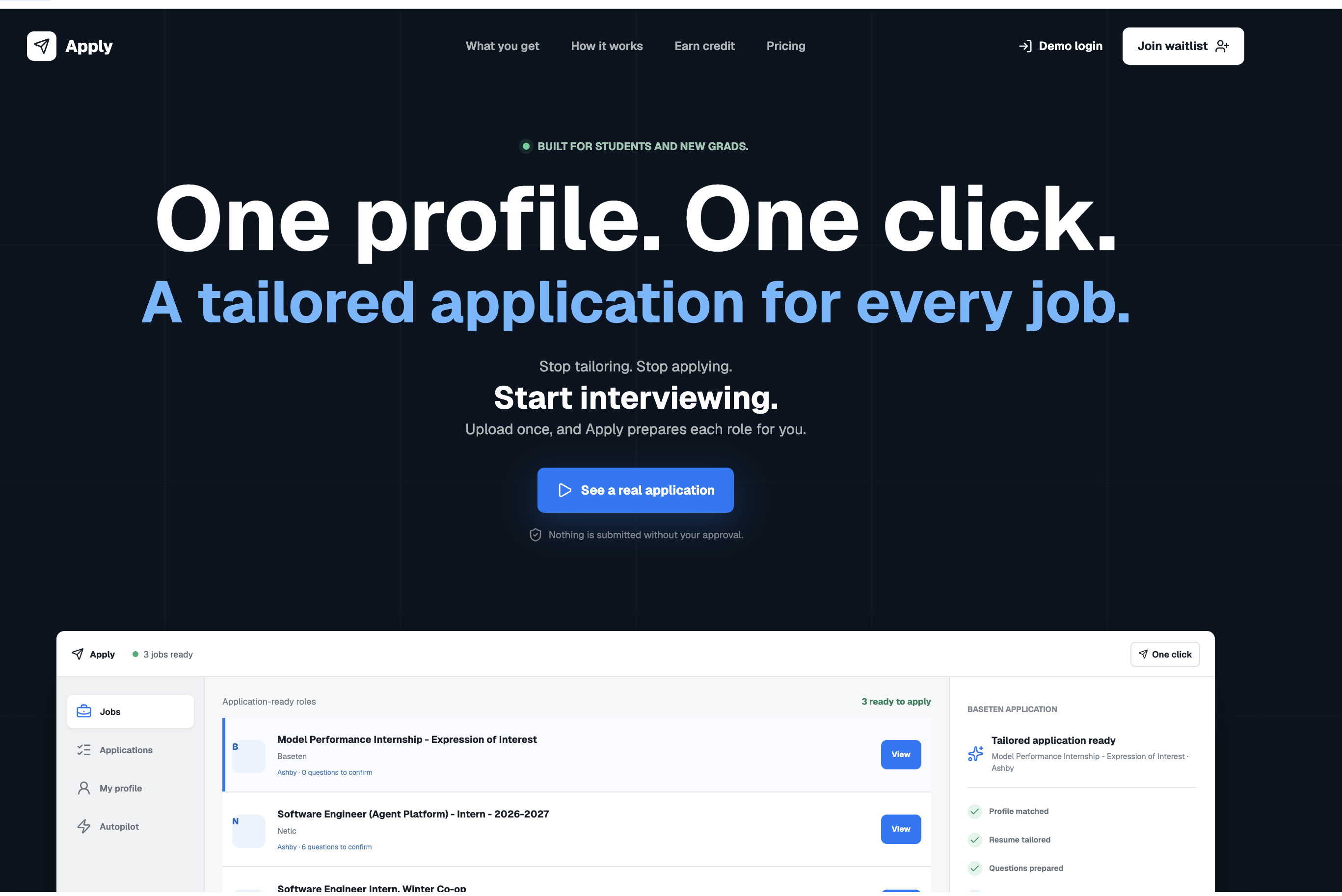
ApplyFree is an AI-powered job application service. Users provide their profile and a job URL, and ApplyFree completes the application for them.
It automatically navigates the application, fills known information, uploads the correct resume, handles validation, and reaches the final Review page. It only asks the user to return when human involvement is necessary—such as logging in, completing MFA or CAPTCHA, answering an unknown personal question, or approving the final submission.
Our intended business model is simple: users pay per successfully completed application.
How we built it
ApplyFree uses a three-stage architecture.
First, a human or AI explores an unfamiliar application. During AI exploration, the model reads the current screenshot and decides the next browser action. A passive watcher records visible text, controls, dropdown options, validation errors, screenshots, and page transitions.
Second, ApplyFree converts this evidence into a standalone, job-specific runner. The generated runner uses stable questions, labels, roles, and section boundaries instead of fragile temporary DOM identifiers.
Finally, the deterministic runner completes future applications through Chrome DevTools Protocol without requiring an AI model to reason through every click again. Before stopping, it verifies that the expected information is present on the Review page.
We built the interface with Next.js and implemented the browser and runner infrastructure with Python, Node.js, Playwright, and CDP.
Challenges we ran into
The largest challenge was the diversity of application platforms. Ashby generates temporary control identifiers, while Workday contains multi-step forms, authentication transitions, repeatable sections, and complex validation behavior.
Our first AI architecture also became extremely expensive because every browser action carried previous screenshots, DOM logs, and tool output into the next model turn. We redesigned it so that every decision uses a fresh AI context containing only the current screenshot and compact page information.
Built With
- chatgpt
- chatgpt5.6
- codex


Log in or sign up for Devpost to join the conversation.