-
-
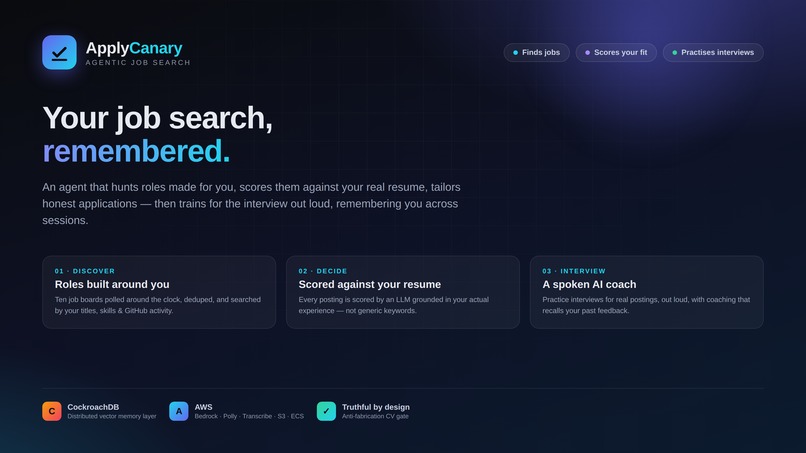
Branded hero banner — tagline "Your job search, remembered.", feature cards (Discover / Decide / Interview), CockroachDB
-
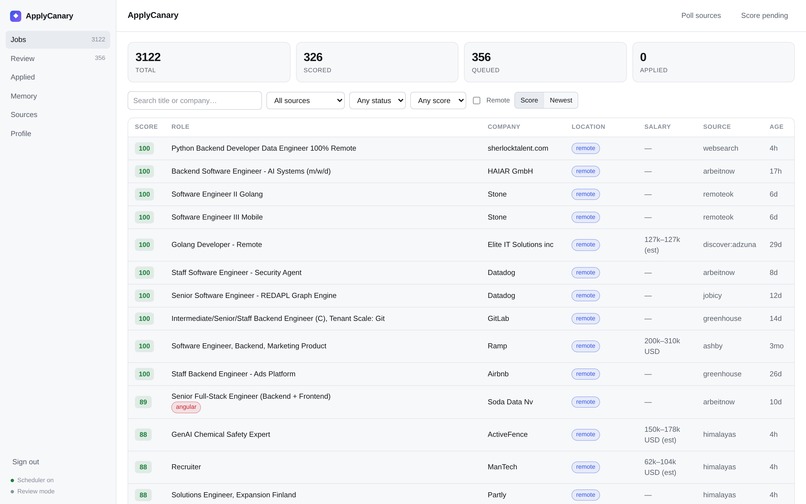
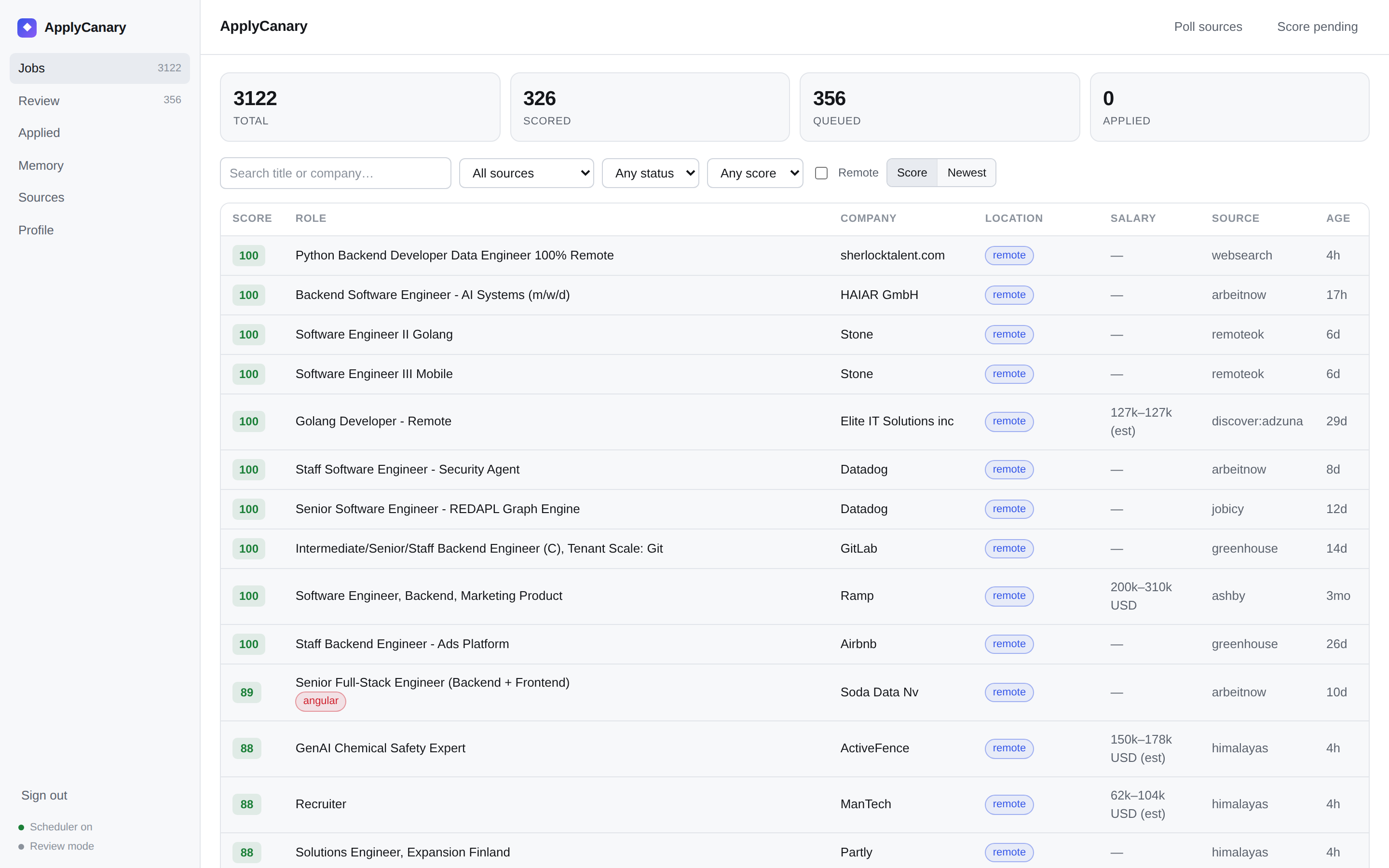
Jobs dashboard — scored job feed with filters, match percentages, alert threshold banner
-
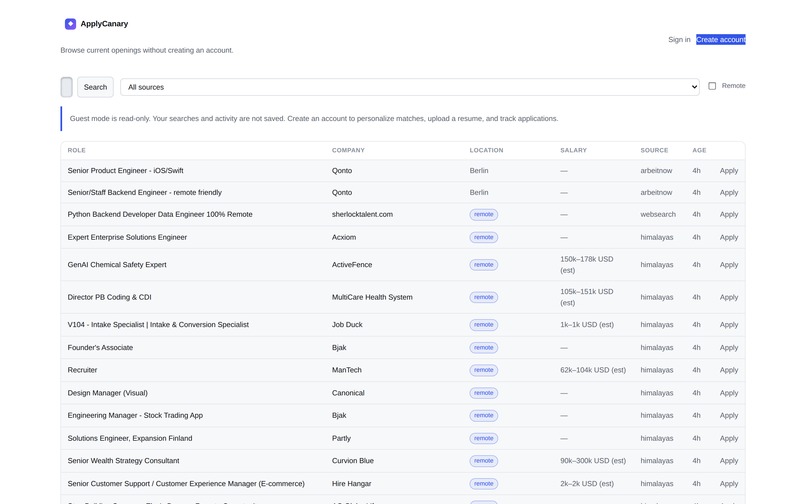
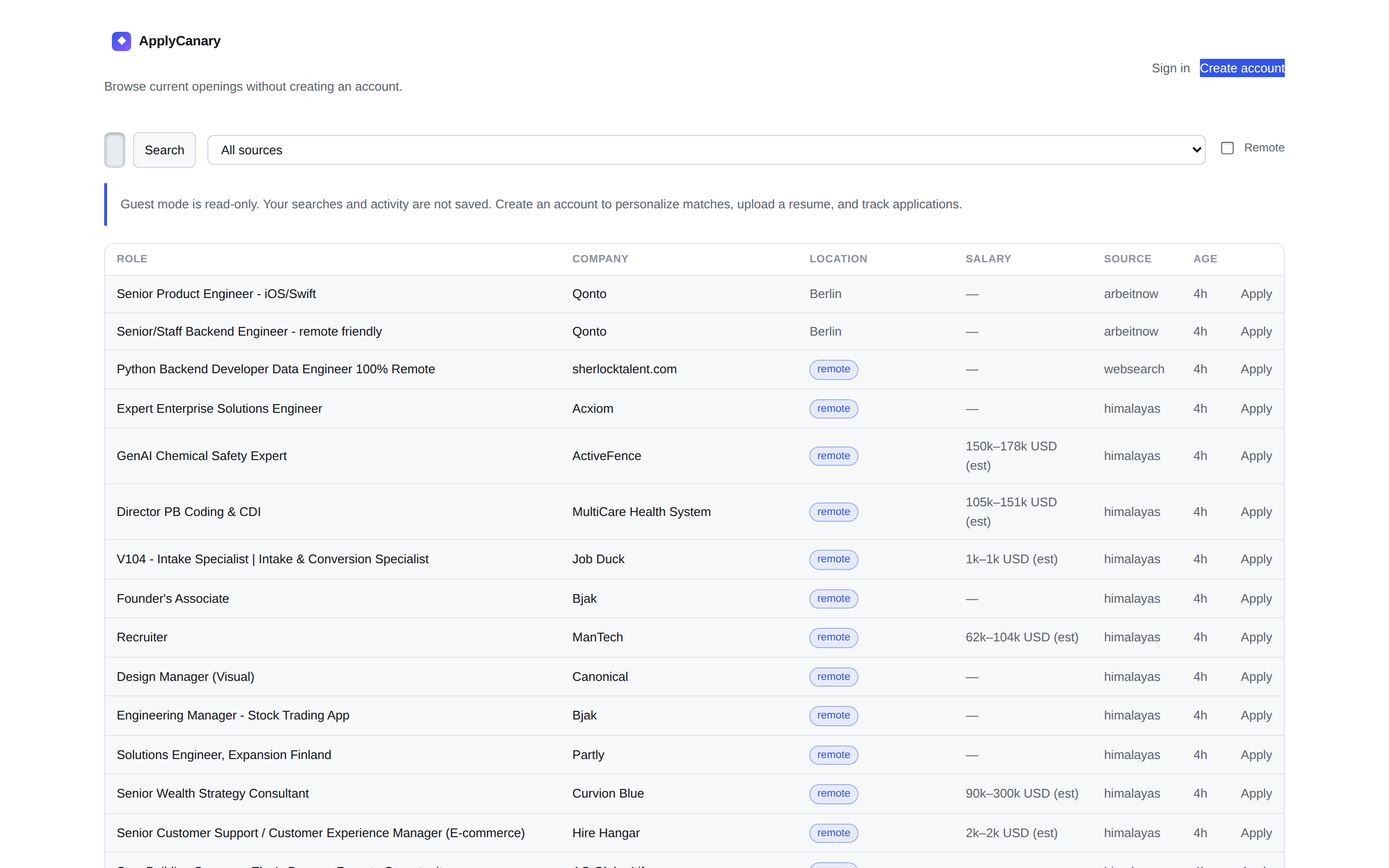
guest mode — browse and search jobs with no account
-
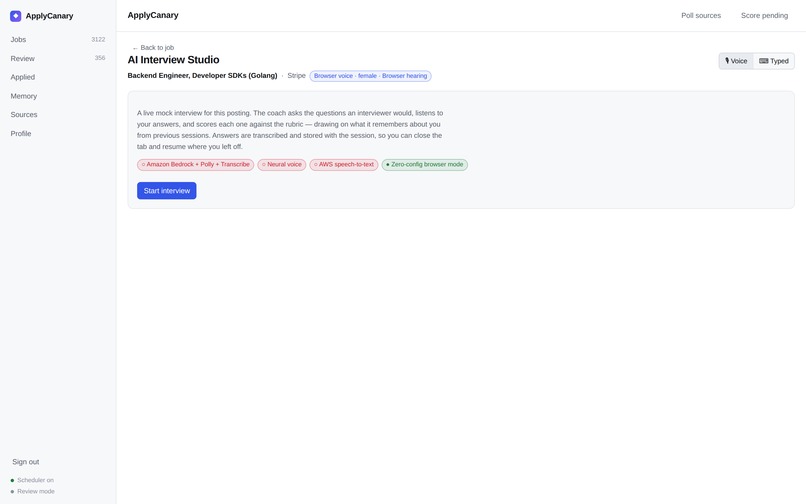
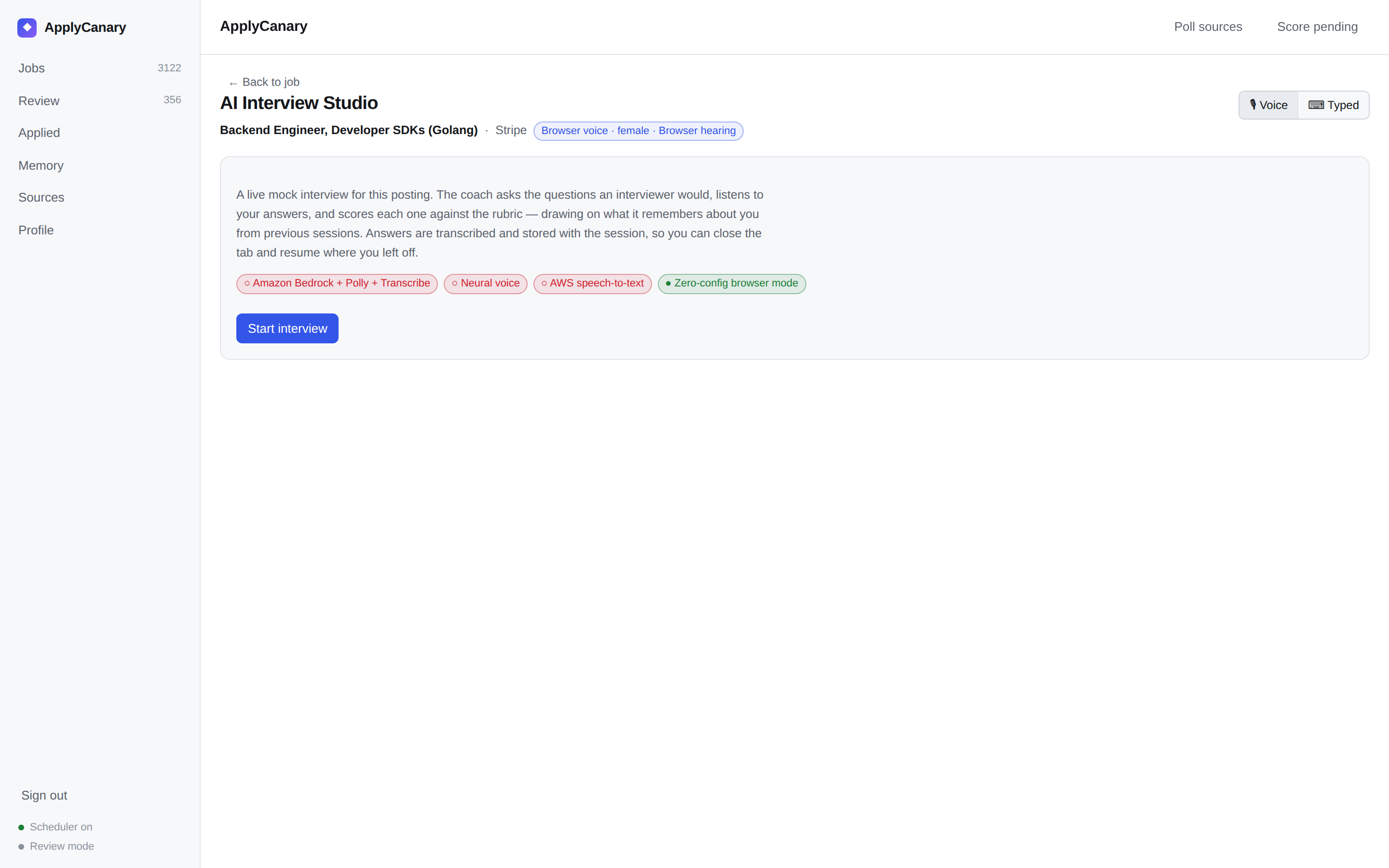
AI Interview Studio — spoken mock interview for a real posting, coach panel, start controls
-
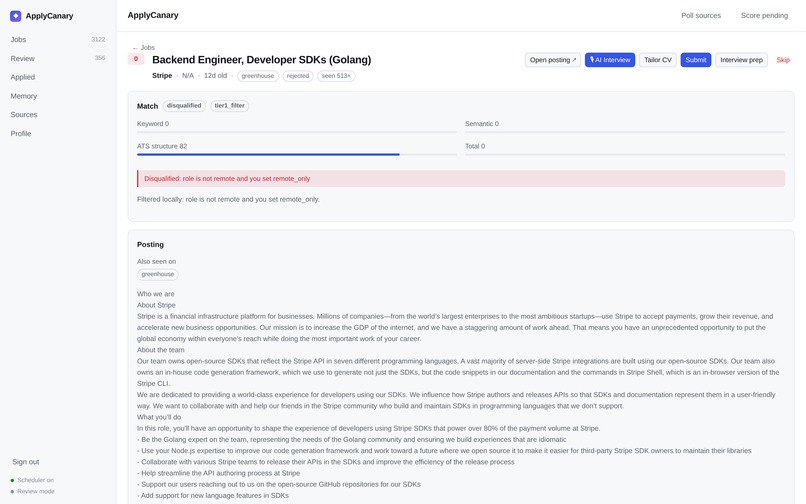
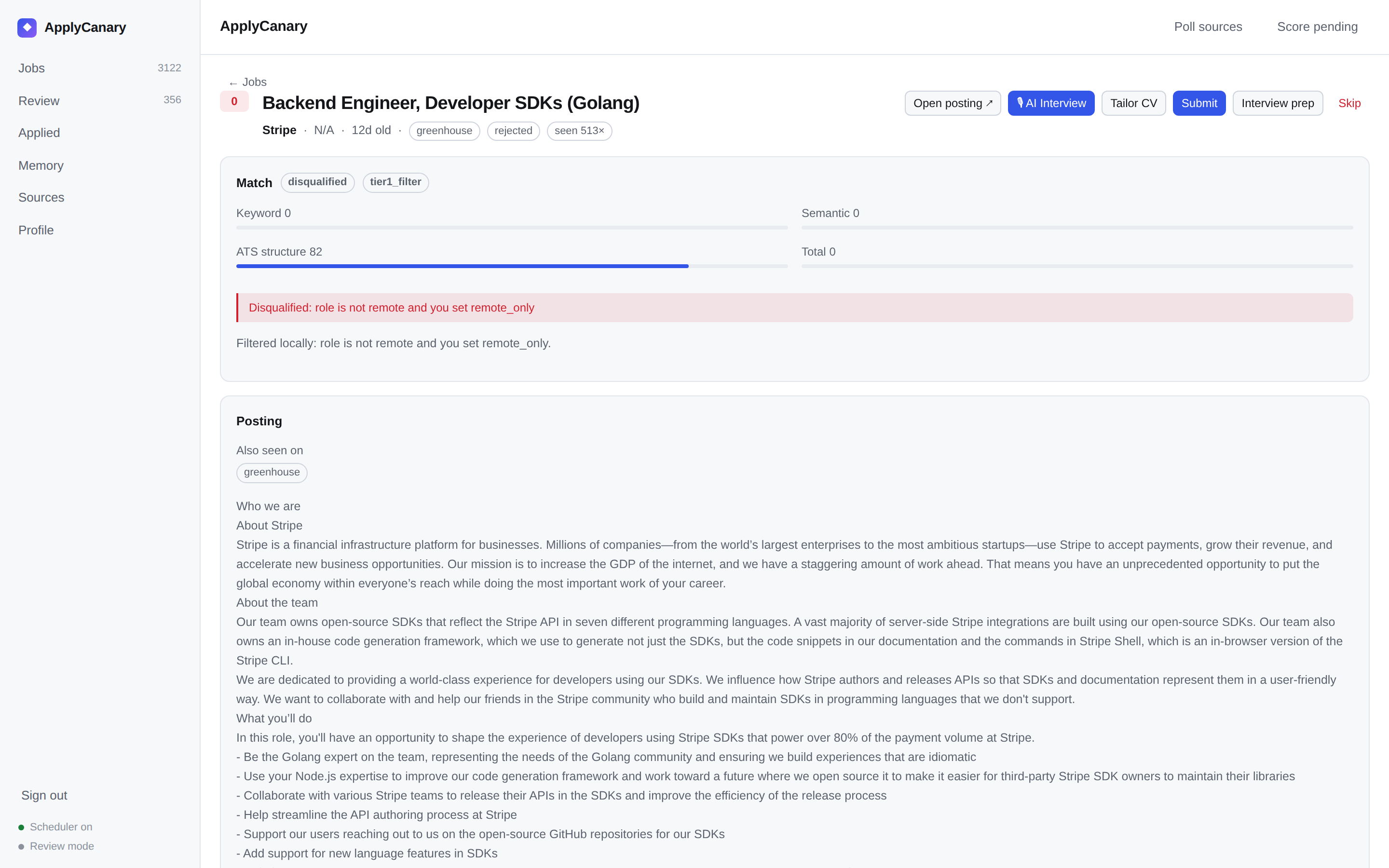
job detail -Backend Engineer, Developer SDKs (Golang)" at Stripe, match card, similar roles from the vector index, AI Interview entry point
-
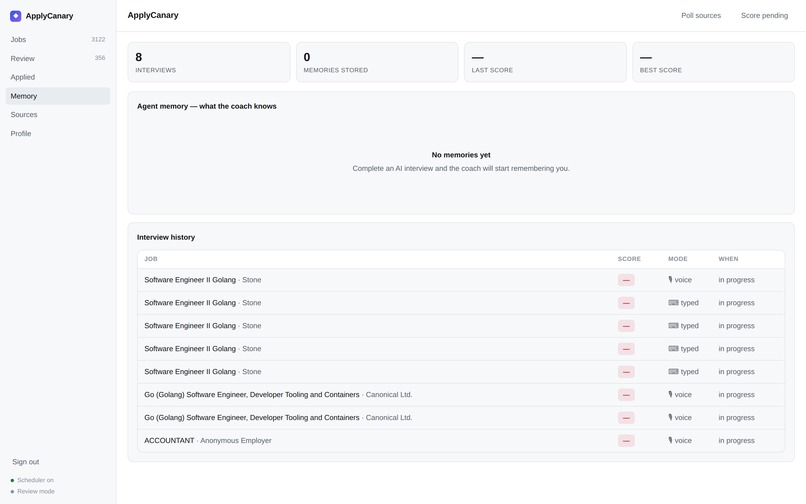
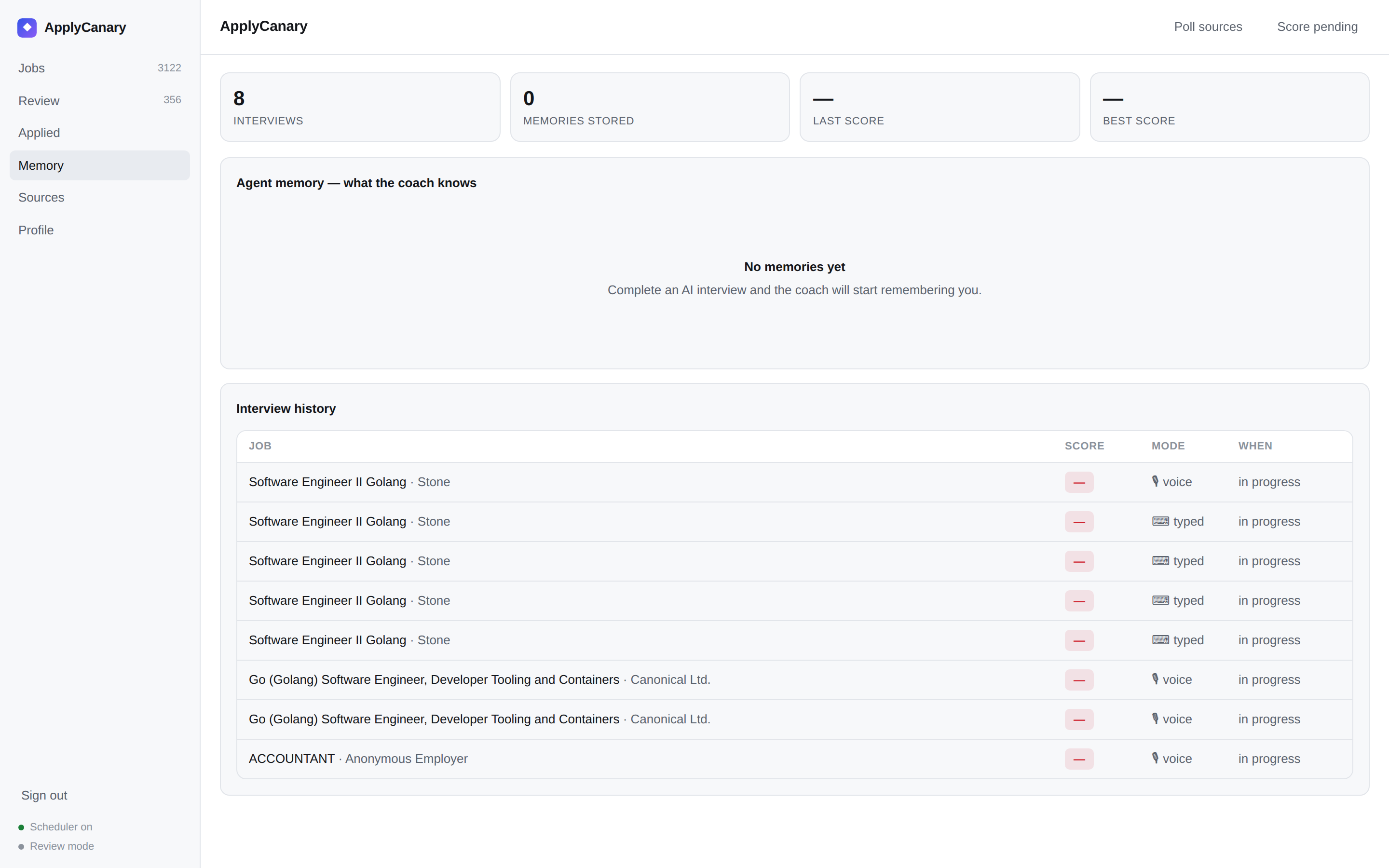
Memory page — interview stats, improvement trend,
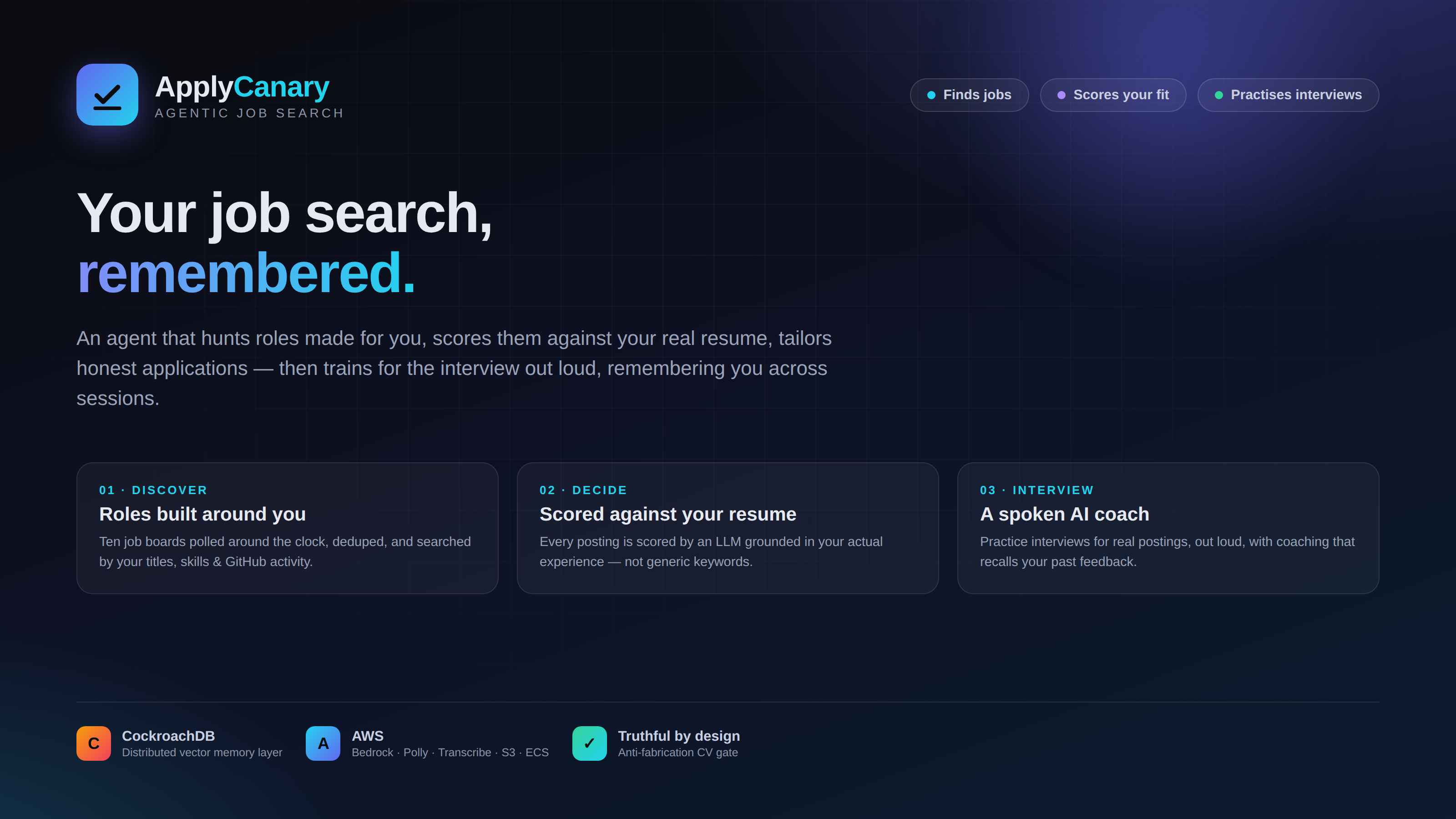
ApplyCanary — Your job search, remembered.
Inspiration
Job search is broken in a very specific way: candidates scatter across a dozen job boards, guess which roles actually fit them, send generic applications into a void — and then walk into interviews cold. Practice tools exist, but they're chatbots: they grade a canned answer against a canned rubric and forget you the moment the tab closes.
We wanted to build the opposite: an agent that runs the whole pipeline — find, score, tailor, interview — and that remembers you between sessions. And the hackathon's premise clicked: memory isn't a feature you bolt on, it's the thing that makes an agent useful in production. So we built the memory layer first, in CockroachDB, and designed every feature around it.
What it does
ApplyCanary is an agentic job-search assistant that:
- Finds jobs. Ten connectors — company ATS boards (Greenhouse, Lever, Ashby, SmartRecruiters, Workable) polled every 5 minutes for the apply-early edge, plus five aggregators — with cross-posted roles collapsed by semantic dedup.
- Hunts your roles specifically. Role discovery builds queries from your target titles, skills, and GitHub activity, and actively searches Adzuna and the web — so a Go developer actually sees Go roles, not just whatever the configured boards carry.
- Scores against your resume. Two tiers: hard knockouts and keyword overlap, then an LLM that reasons about fit using the actual job description and your actual experience. Hit your alert threshold and the job is emailed to you the moment it's found.
- Tailors CVs — truthfully. Rewrites your resume against each posting with your GitHub repos as evidence, then a separate truthcheck pass blocks any claim not backed by your real history. An unverified draft can never be submitted.
- Practises the interview — out loud. The AI Interview Studio is a live, spoken mock interview for a real posting: a coach asks the questions an interviewer would, hears your answers, scores each against the posting's rubric, and coaches you — remembering your past feedback before every new question.
And the through-line: it remembers. Sessions are transactional state in CockroachDB; every answer and memory is stored with an embedding; the coach semantically recalls your past feedback ("you rushed the last behavioural answer") before each new session. The Memory page shows your improvement trend. Memory isn't a feature here — it's the point.
How we built it
Stack: React + TypeScript dashboard, FastAPI agent (web + scheduler in one task), and a CockroachDB Serverless cluster as the single memory layer.
CockroachDB is load-bearing, not decorative:
- Distributed Vector Indexing — native
VECTOR(1024)columns onjob_embeddingandagent_memorywith a distributedvec_cosine_opsindex. "Similar roles", semantic job search, and agent-memory recall are all SQL:1 - vec_cosine_distance(embedding, :q::vector). No separate vector store, no reindexing, no consistency gap. - CockroachDB Cloud Managed MCP Server — read-only, fully audited agent
access: schema inspection,
SHOW INDEXto verify the vector index, andEXPLAIN (VECTOR)to confirm the planner uses it. - ccloud CLI — the agent provisions the cluster, enables backups, checks memory-layer row counts, and tails the audit log, all with JSON output and service-account RBAC.
- Agent Skills —
cockroachlabs/cockroachdb-skillswired in viaAGENTS.mdso any agent working in the repo operates the memory layer correctly.
AWS runs it: Amazon Bedrock (Claude inference + Titan embeddings), Amazon Polly (the spoken interviewer — neural female voice), Amazon Transcribe (streaming STT for spoken answers), Amazon S3 (private, versioned interview audio), and Amazon ECS/Fargate behind an ALB with CloudWatch observability. Every AWS feature degrades gracefully: with no credentials the app still runs on Gemini/OpenRouter/Groq/local Ollama, browser speech, local embeddings, and local disk.
Resilience by design: a multi-provider LLM chain with circuit breakers (a dead key cools down instead of retrying into a storm), a SQLite fallback for the vector layer so all 215+ tests run hermetically offline, and a truthcheck gate that prevents fabrication in both LLM and rule-based tailoring.
Challenges we ran into
- One memory layer, two engines. The vector search had to work identically
on CockroachDB (
vec_cosine_distancein SQL) and SQLite (Python distance) so the test suite stayed hermetic. We abstracted the distance computation behind one function and made the fallback deterministic — the feature set is identical on both. - Free-tier LLM quotas burn fast. Scoring, tailoring, and interviews are token-hungry, and free tiers rate-limit hard. We built a provider chain with circuit breakers, tuned thinking-budget settings so short JSON answers weren't truncated, and added local Ollama as the genuinely never-exhausted option.
- "Go developer" found one role. Early on, role discovery only mirrored whatever boards were configured. We rebuilt it to derive queries from the user's actual profile — target titles, skills, and GitHub evidence — so the search is about you, and "go developer" finds "Senior Golang Engineer".
- Deployment friction. The frontend and backend live in one repo, and the first Vercel deploy failed because the build ran at the repo root. Tracking down a root-directory setting, an SSO-locked deployment, and a proxy round trip to a backend with a separate database taught us a lot about real multi-service deploys.
- Memory that isn't a gimmick. Storing sessions is easy; making the coach genuinely better with you is hard. We had to design what gets embedded, when it's recalled, and how the UI proves it's working ("🧠 Coach remembers").
Accomplishments that we're proud of
- The spoken interview loop, end to end: question → you answer aloud → transcribed → scored against the posting's rubric → coached — with the coach recalling your past feedback via semantic search before each new question.
- A vector layer that's real, not a demo prop: actual
VECTOR(1024)columns, a realvec_cosine_opsindex, nearest-neighbour search executed in the database — and an honest fallback that keeps 215+ tests green offline. - Truthful tailoring: an anti-fabrication gate means the agent will refuse to send a CV claim it can't verify against your history. That's the kind of safety judges and real users should expect from agentic systems.
- Three of the four CockroachDB tools used meaningfully (vector indexing, MCP Server, ccloud CLI, Agent Skills) and six AWS services, each with a concrete role and a graceful degradation path.
- It works with zero credentials. No API keys? No problem — browser speech, local embeddings, keyword scoring, and heuristic coaching still run the full loop. With AWS configured, it lights up the entire stack.
What we learned
- Memory is what separates an agent from a chatbot. The moment the coach recalls your past feedback instead of giving generic advice, the product stops being a wrapper around an LLM and starts being a system that learns.
- Vector search belongs next to the data it describes. Keeping embeddings and transactional rows in one database eliminated a whole class of consistency problems — no separate vector store to sync, no reindexing pain.
- Agentic systems need explicit safety rails. Truthcheck, per-user scoping, invite-gated registration, secrets in SSM, auto-submit off by default — these are what make an agent usable in production, not just impressive in a demo.
- Resilience is a feature judges can feel. Circuit breakers on LLM providers, a scheduler that survives a dead key, and a health endpoint that reports scheduler state — the system behaves well when things go wrong.
What's next for applycanary
- Auto-apply with approval: ranked shortlist → human review → one-click submission per job, with the truthcheck gate as the last line of defense.
- Smarter discovery: integrate more regional boards and LinkedIn profile signals, and let the agent learn from which jobs you actually engage with.
- Deeper memory: cross-session narrative — the coach builds a running profile of your strengths and gaps across all interviews, not just the current posting.
- CockroachDB at real scale: multi-region deployment, change-data-capture for analytics, and backup/restore drills on the live cluster.
- Mobile: push alerts when a strong match appears, and a pocket mode for interview practice anywhere.
Built With
- fastapi
- httpx
- react
- sqlalchemy
- sqlmodel
- typescript
- vite


Log in or sign up for Devpost to join the conversation.