Applied Learning AI Notebooks (ALAIN)
AI manuals for AI models.
Turn developer docs into active learning, powered by OpenAI gpt‑oss 20B. Paste any Hugging Face model link or ID → get an interactive training notebook. Run locally or in the cloud.
About The Project
Inspiration: AI models progress daily, but practical adoption lags. Documentation is scattered, inconsistent, and often not runnable. Organizations need repeatable onboarding, not one‑off demos. ALAIN turns any model reference into a guided, runnable lesson with clear steps, guardrails, and transparent costs, so teams can ship faster on any stack, online or offline.
What It Does
- The Problem: AI models advance daily; human onboarding lags. Current materials favor passive consumption over interactive practice, limiting effective learning.
- The Solution: ALAIN uses gpt‑oss‑20b to automatically generate interactive tutorials for any model. Input a model reference, receive a complete lesson with setup instructions, runnable code, and assessments, export to Jupyter or Colab, and run anywhere.
How We Built It
Architecture Overview
├── Teacher Model: gpt-oss-20b with schema validation
├── Backend: Encore (TypeScript) + PostgreSQL (Neon)
│   ├── Execution service (provider routing/fallbacks)
│   ├── Tutorial service (CRUD)
│   └── Export service (Jupyter/Colab notebook generation)
├── Frontend: Next.js + React
│   ├── Model picker with instant preview
│   ├── Real‑time streaming output
│   └── Directory with search/filters
└── Deployment: Vercel (web) + Encore Cloud (backend)
- Teacher model: gpt‑oss‑20b (teacher). Strong instruction‑following and JSON reliability.
- Local or hosted: identical UX with Poe and OpenAI‑compatible endpoints (Ollama, LM Studio, vLLM).
- ALAIN‑Kit (schema‑first):
- Research: ingest model card or text; normalize specs
- Design: draft Lesson JSON (Setup / Example / Verify / Guardrails)
- Develop: add runnable examples and assessments; parameterized API calls
- Validate: JSON schema validate; auto‑repair; preflight; export (nbformat Jupyter/Colab)
- Prompting formats:
- OpenAI‑compatible (Ollama / LM Studio / vLLM): Harmony roles (system + developer)
- Poe: OpenAI Chat Completions; developer content folded into system
- Reliability guarantees: parameterized backend execution only (no server‑side arbitrary code), reproducible prompts (hosted or local), and export to Jupyter/Colab.
Challenges We Overcame
- Unstructured Inputs: Model cards vary widely; solved with schema‑first generation + repair loop
- Provider Differences: Normalized on OpenAI‑compatible requests with intelligent routing/fallbacks
- Safety vs. Interactivity: Kept server execution strictly parameterized while preserving hands‑on learning (client‑side runners use browser sandboxes)
- Cost Transparency: Added rough token/cost estimates and provider smoke tests so users understand trade‑offs before they run
What We Learned
- AI Teaching AI Works: gpt‑oss can synthesize high‑quality tutorials from heterogeneous sources
- Schema‑First Wins: JSON schemas with validation/repair deliver reliability under messy real‑world inputs
- Abstraction Matters: A clean provider layer unlocks seamless hosted <-> local switching
- Offline Is Empowering: True local capability enables classrooms, air‑gapped labs, and low‑connectivity regions
- Community Effects: Standardized, shareable "blueprints" compound learning and reduce onboarding from hours to minutes
Why Now
- Models ship daily; documentation lags. ALAIN turns model cards into runnable lessons.
- OpenAI-compatible APIs unify Poe, vLLM, Ollama, and LM Studio. ALAIN runs hosted and local with one instruction layer.
- Consumer NVIDIA GPUs and mature runtimes make local learning practical. ALAIN keeps the UX identical offline.
- gpt-oss-20b follows instructions and outputs reliable JSON. ALAIN uses it to synthesize lessons online or offline.
- Teams need privacy and cost control. ALAIN uses parameterized execution, preflight checks, and notebooks for compliance and budgeting.
- Educators need reusable content. ALAIN standardizes lessons from Hugging Face and exports to Jupyter and Colab.
Category Alignment
🎯 Wildcard - Most Unexpected Use: ALAIN uses OpenAI gpt‑oss 20B to generate interactive lessons for any model — AI teaching AI.
🌍 For Humanity: Democratizes AI education by transforming passive model documentation into active, hands‑on learning experiences. Reduces learning barriers, enabling global access through offline capability and removing cost barriers via open‑source platform.
🏠 Best Local Agent: Identical UX offline via OpenAI‑compatible endpoints (e.g., Ollama, LM Studio/vLLM).
Technology Stack
- Languages & Frameworks: TypeScript, React, Next.js, Tailwind CSS
- Backend & Runtime: Encore (TypeScript), Node.js
- AI & Providers: gpt‑oss‑20b (teacher), Poe API (hosted), OpenAI‑compatible endpoints (Ollama; LM Studio/vLLM where configured)
- Data & Auth: PostgreSQL (Neon), Clerk; optional Upstash KV; GitHub export
- Notebooks & Tools: nbformat/Jupyter, ipywidgets, Vitest
- Dev & Ops: Vercel (web), Encore Cloud (backend)
Try It Out
Live Demo: https://alain-ruddy.vercel.app GitHub: https://github.com/daniel-p-green/alain-ai-learning-platform
No-login core flow:
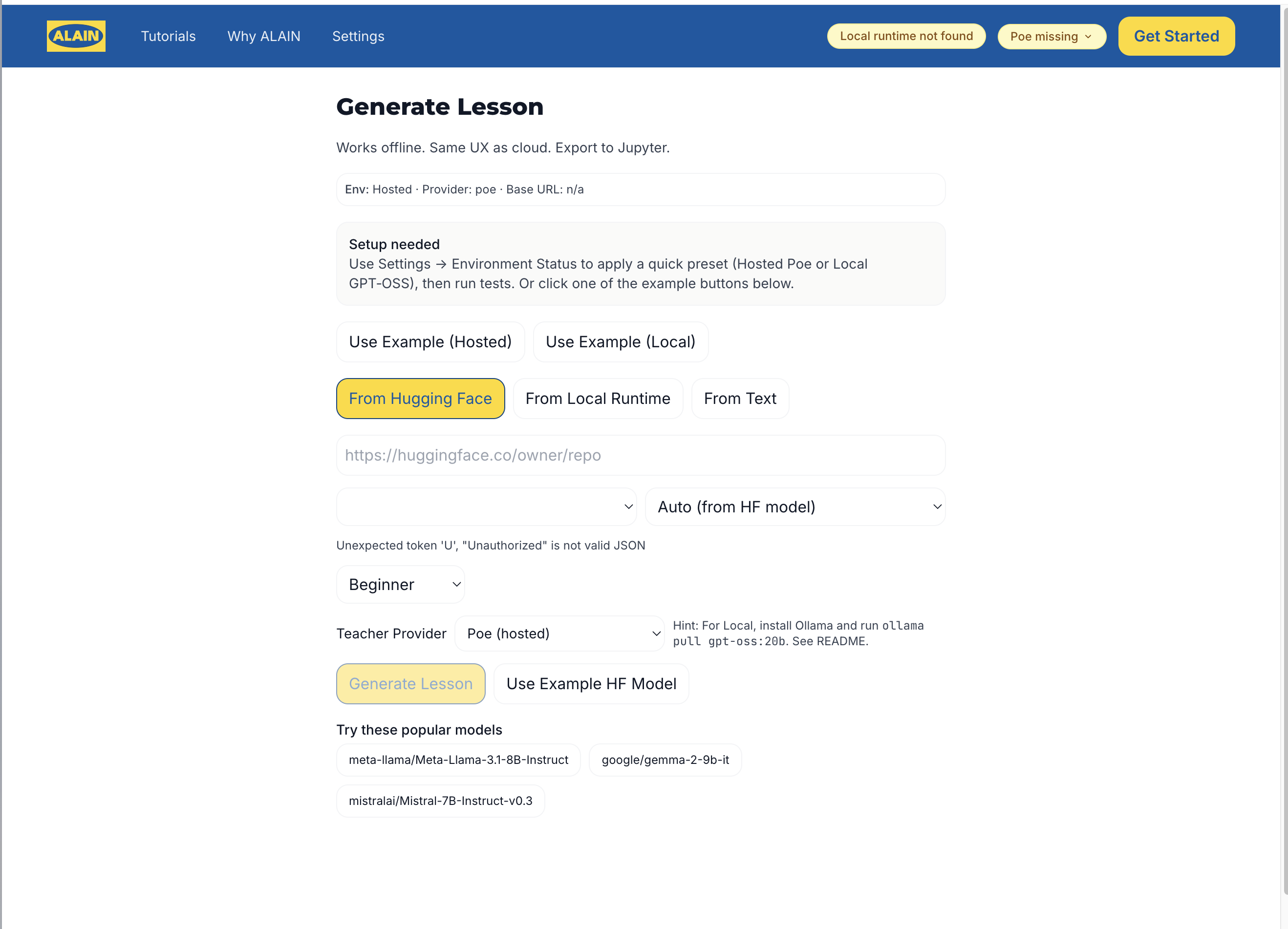
- Open https://alain-ruddy.vercel.app/generate
- Toggle "Force fallback mode (no backend)" to run web-only
- Paste a model reference (e.g.,
openai/gpt-oss-20b) - Click Generate → open the tutorial → Render to Colab (web) to download a
.ipynb
Quick local start:
- Run
npm install - Run
ollama pull gpt-oss:20b - Run
npm run dev:offline - Open http://localhost:3000 → Generate → Run a step → Export to Colab
- Run
Additional Highlights
Key Features:
- Adapt Experience (Beginner/Intermediate/Advanced)
- Public Gallery with filters
- "Show Request" + cURL copy
- Schema validation with auto‑repair
- Secure Colab export with preflight
Safety:
- No server‑side arbitrary code execution; only parameterized API calls
- Client‑side code executes in browser sandboxes (Pyodide/Worker); exported notebooks run in the user’s environment
- Secrets handled via Encore/Clerk
- Notebooks do not embed secrets; users set keys in their environment
- Preflight connectivity and smoke tests included
Why gpt-oss-20b
- Open model fit: runs locally (Ollama/LM Studio/vLLM) with the same API shape as hosted
- Instruction following: produces stepwise, teachable content with minimal prompt overhead
- JSON reliability: strong schema adherence; fewer repair passes than smaller models
- Cost and latency: fast enough for iterative generation and repair with real‑time previews
- Community impact: open weights and local‑first unlock classrooms and air‑gapped labs
Testing Instructions (Judges)
No login required for core flow.
- Open https://alain-ruddy.vercel.app/generate
- Toggle "Force fallback mode (no backend)" to run web-only
- Paste a model reference
- Hugging Face: openai/gpt-oss-20b
- Local (Open Models): select Local, set model to
gpt-oss:20b
- Click Generate → open the tutorial → “Render to Colab (web)” to download a
.ipynb
Optional auth-only features:
- Sign in with
[email protected]/Ikea4AI! - Visit
/uploador/my/notebooks(admin pages are not required)
Local testing (optional):
npm installinweb/, thennpm run dev- Open http://localhost:3000 → Generate → enable fallback → generate → open tutorial → Render to Colab
How We Apply gpt-oss (Judging Criteria)
- Application of gpt‑oss: gpt‑oss‑20b acts as the teacher that synthesizes structured, runnable lessons from model cards/repos; supports local/offline generation with identical API shape (Ollama/LM Studio/vLLM).
- Design (incl. safety): Schema‑first with validation + auto‑repair; parameterized backend execution; preflight checks; accessible UI; clear fallback without backend.
- Potential Impact: Makes any model “learnable” in minutes; useful for classrooms, low‑connectivity regions, and small labs with limited DevRel.
- Novelty: “AI teaching AI” to produce instructional content across arbitrary models with exportable notebooks and uniform hosted <-> local UX.
Licensing and Rights
License: MIT (see LICENSE in repository root)
Categories: Wildcard, For Humanity, Best Local Agent
Built With
- codex
- encore.ts
- lm-studio
- next.js
- node.js
- ollama
- openai
- postgresql
- react
- tailwind-css
- typescript
- vercel


Log in or sign up for Devpost to join the conversation.