Inspiration
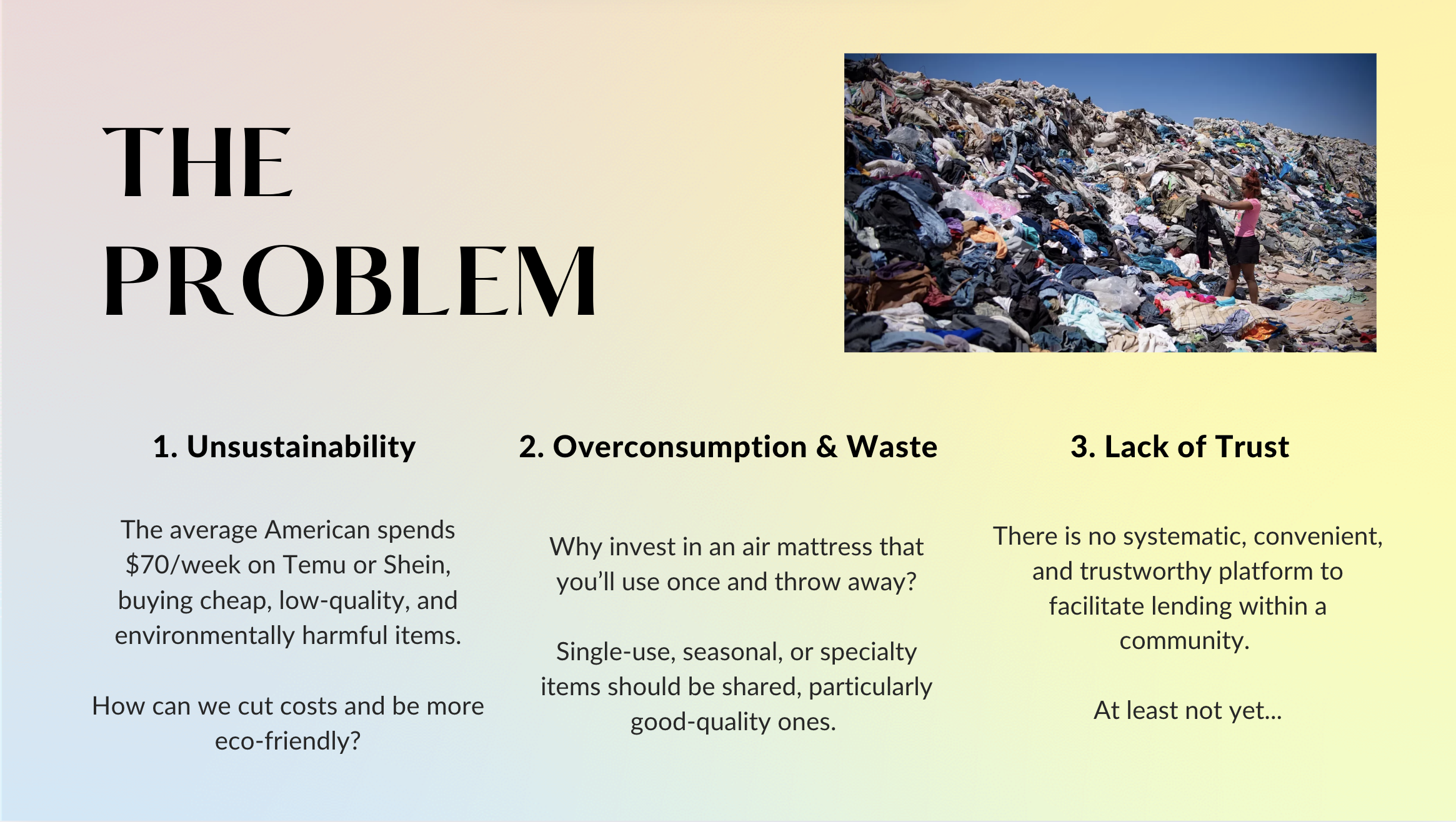
Let’s face it: being broke college students isn’t easy. We want to impress our dates with fancy dinners, but we just don’t have the money for an air fryer. Or we need an iClicker for that last-minute Gen Chem class, but spending $50 on something we’ll use once is just not in the budget. As a result, we turn to unsustainable and ethically questionable companies like Temu and Shein. Americans spend $70/week on these disposable items—we buy cheap, low-quality items, use them once, and throw them out. Being inspired by the need for easy, sustainable access to everyday items for demographics such as college students and part-time workers, our goal was to create an AI-powered web application where users could lend and borrow items for free. We sought to create a unique points system based on a model of “sharing is caring”: the more items one lends, the more they can borrow.
What it does
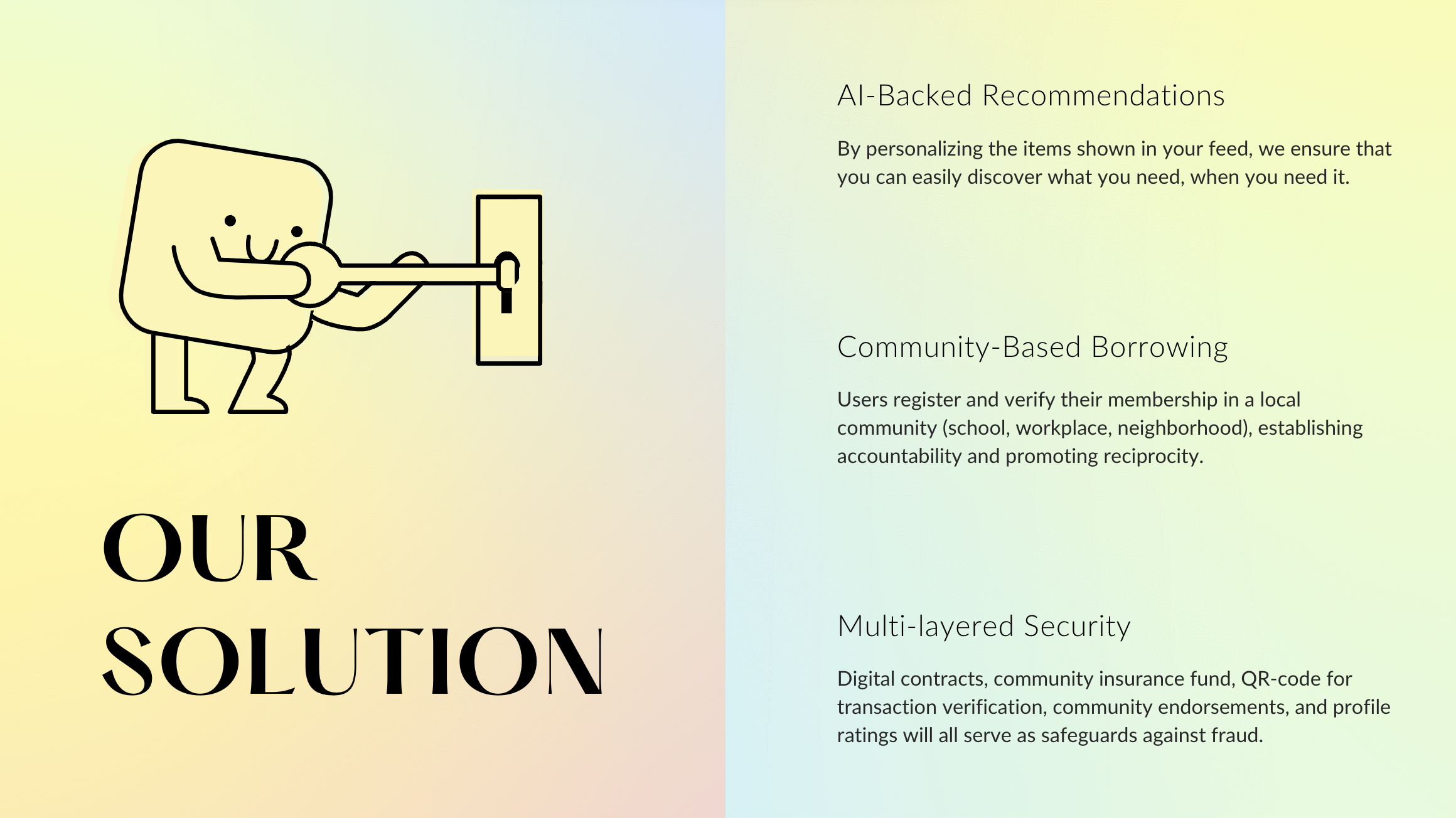
Our application not only facilitates the sharing of resources, but its AI-backed explore page allow them to get what they truly need. Upon opening the app, users see a for-you page with items generated based on what is currently available. They can scroll through this page to find items they are looking to borrow and add the items they are seeking to lend out. Moreover, the other pages of the application allow them to potentially search, view possible messages with venders and buyers, and check their profile with their number of points.
How we built it
We used React-Native for the frontend due to its design capabilities and Firebase for the database because of its real-time data handling. To retrieve information from Firebase, we used an intermediary backend platform, Flask, to receive this retrieval request to the API through HTTP and send information back to the client--a process that involves both the backend and frontend. The information we then gathered was fed to the AI models we used (Groq and LLaMA) and used to generate tags and recommendations for image items in the backend. On the frontend side, we implemented various methods in React-Native to allow for scrolling in the app and aesthetic color themes.
Challenges we ran into
Having three of four members never participated in hackathons previously and little experience in integrating the various parts of a tech stack, particularly frontend, backend, and databases, one of the hurdles we had to overcome was the learning curve for the platforms React-Native, Firebase, and Flask. In particular, we had trouble communicating between React-Native and Firebase and vice versa. However, we ultimately discovered a fix through the intermediary Flask, which we used for the backend, and Ngrok, which allowed us to directly communicate between the backend and frontend. This process enabled us to do direct testing on multiple devices and mimic how a real application would act in communicating with a remote server.
What we learned
We went through multiple trial-and-error debugging sessions, from trying to synchronize the state between client and server to discovering when to use POST vs. GET. Some of the errors we found in debugging led us to learn that sometimes the largest impacts are caused by the smallest and least expected mistakes. By the end of the hackathon, we were therefore not just able to learn more about the skills used in developing a web application but also gain a deep understanding of problem-solving beyond the classroom and in industry—where teams work together to meet their goals.
Accomplishments that we're proud of
This was our first time programming an application, and we are proud of how much we learned and the progress we were able to make to implement our plans. Our submission serves as the draft for a web application that can help both society and our environment.
What's next for Appli
What we developed for this hackathon—Appli—isn't just a one-time project. As individuals interested in making our planet more sustainable and creating a start-up, we hope to deploy this app by the end of the school year, initially just to college campuses and later expanding our customer base to other local communities. As our next steps, we hope to fully implement and expand on the search function. We will also work on the messaging and point accumulation functions. We also want to start beta-testing.


Log in or sign up for Devpost to join the conversation.