-
-
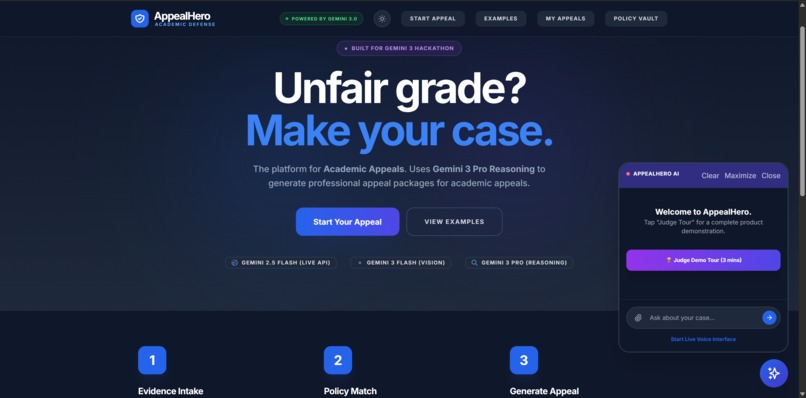
Home
-
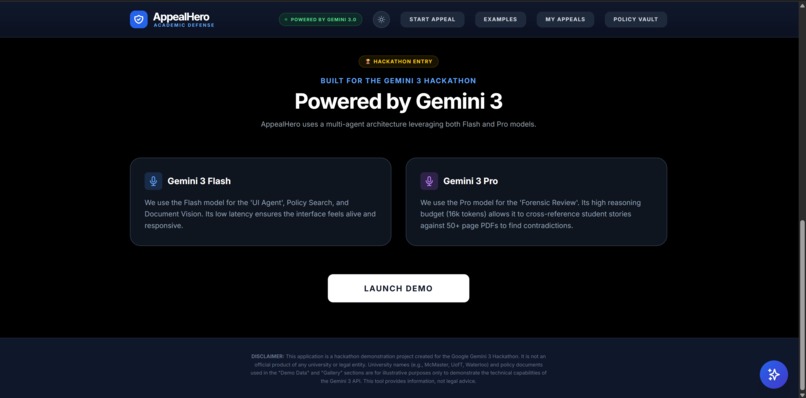
Home 2
-
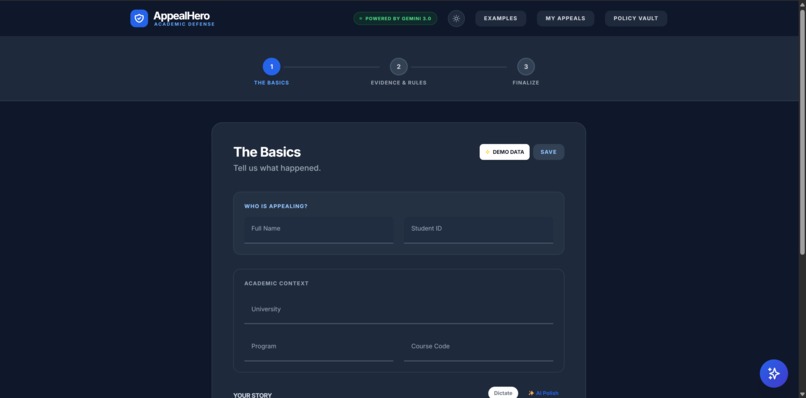
Intake 1
-
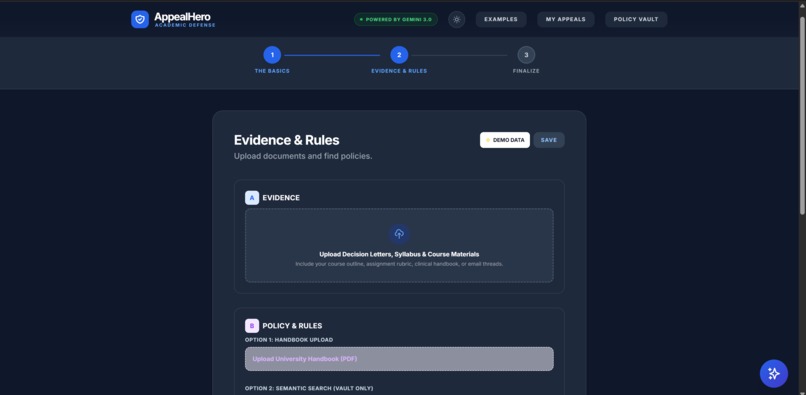
Intake 2
-
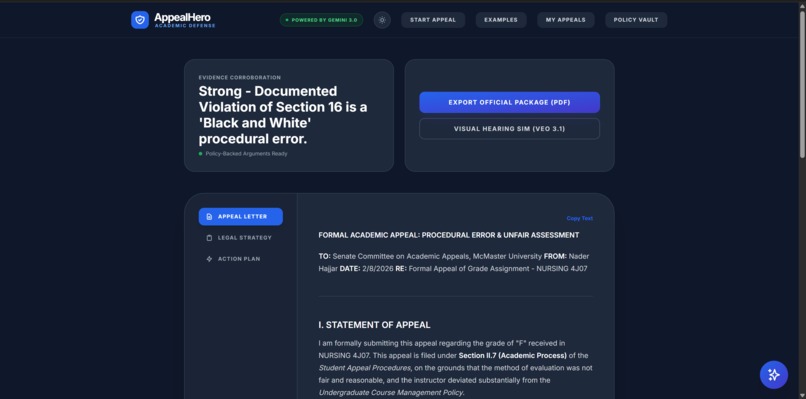
Final Product
-
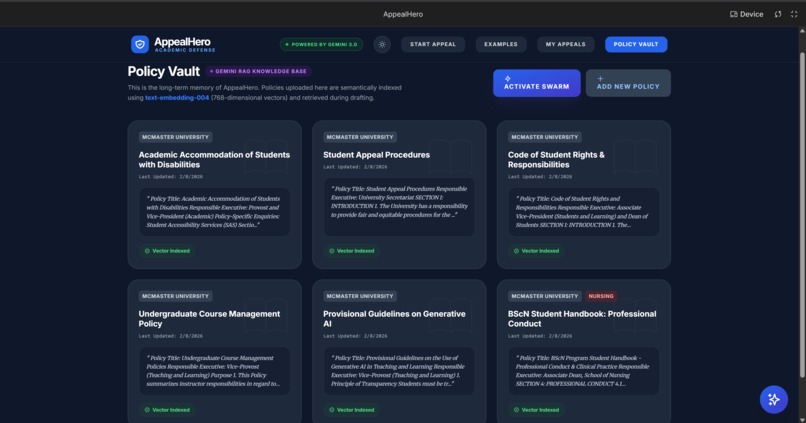
Policy Vault With Swarm Fetch Button
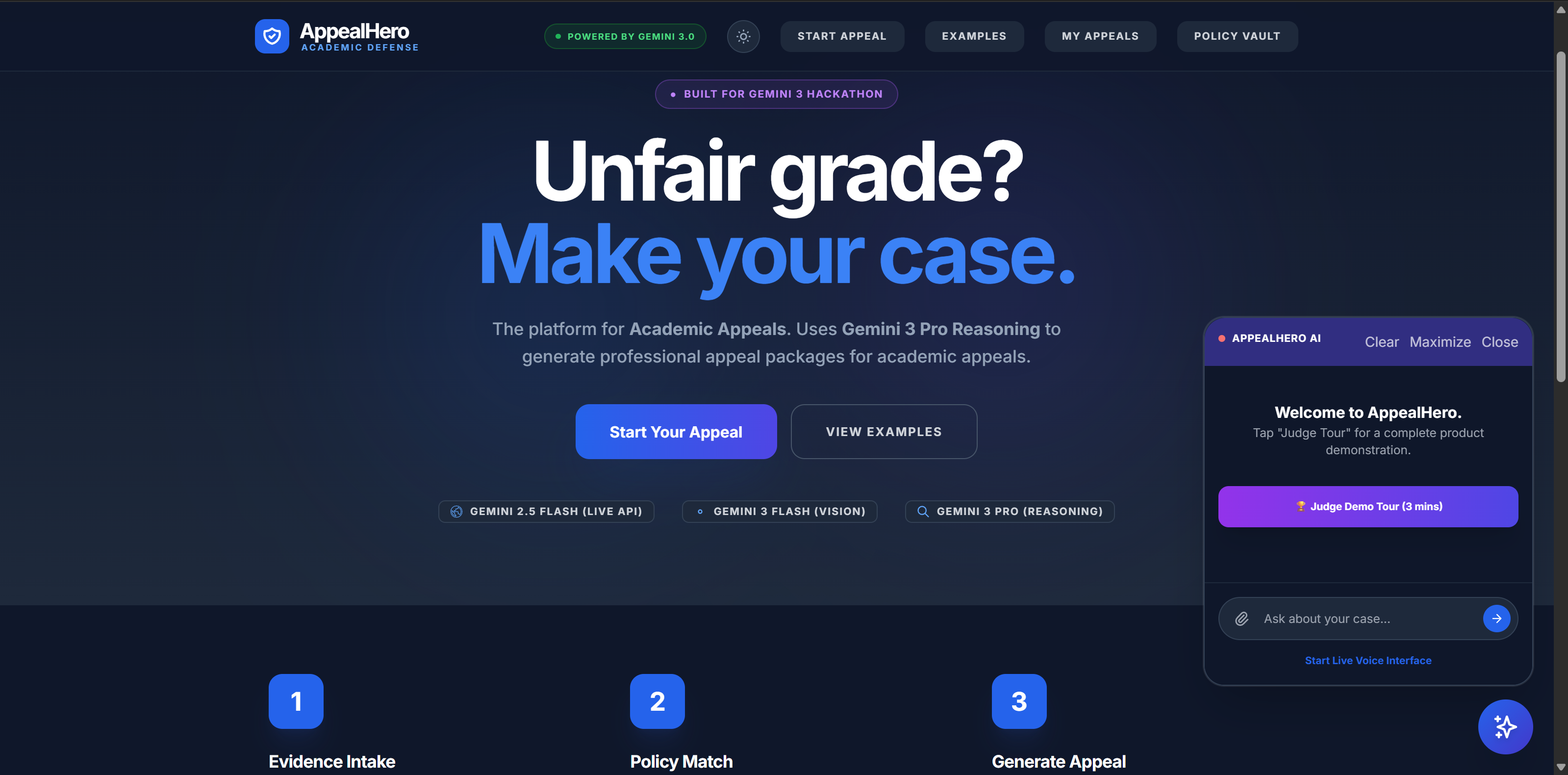
AppealHero: Leveling the Academic Playing Field
Inspiration
AppealHero was forged in the fire of a grueling year long academic battle. As a nursing graduate preparing for my licensing exam, I understand the immense pressure of high-stakes healthcare programs. When faced with an unfair academic decision of my own, I found myself in a labyrinth that nearly cost me my career.
I was forced to take four months away from my studies just to focus on my defense. I met with university ombudsmen, student services, and faculty—only to find that while they could point to policies, they couldn't act as the advocate I desperately needed. Professional legal help was financially out of reach. This revealed a systemic gap: universities have teams of administrators and complex handbooks, while students often run on stress, low income/student loans, and a ticking clock. AppealHero is the tool I needed—a platform that turns "Administrative Overload" into a fair, evidence-based process.
What it does
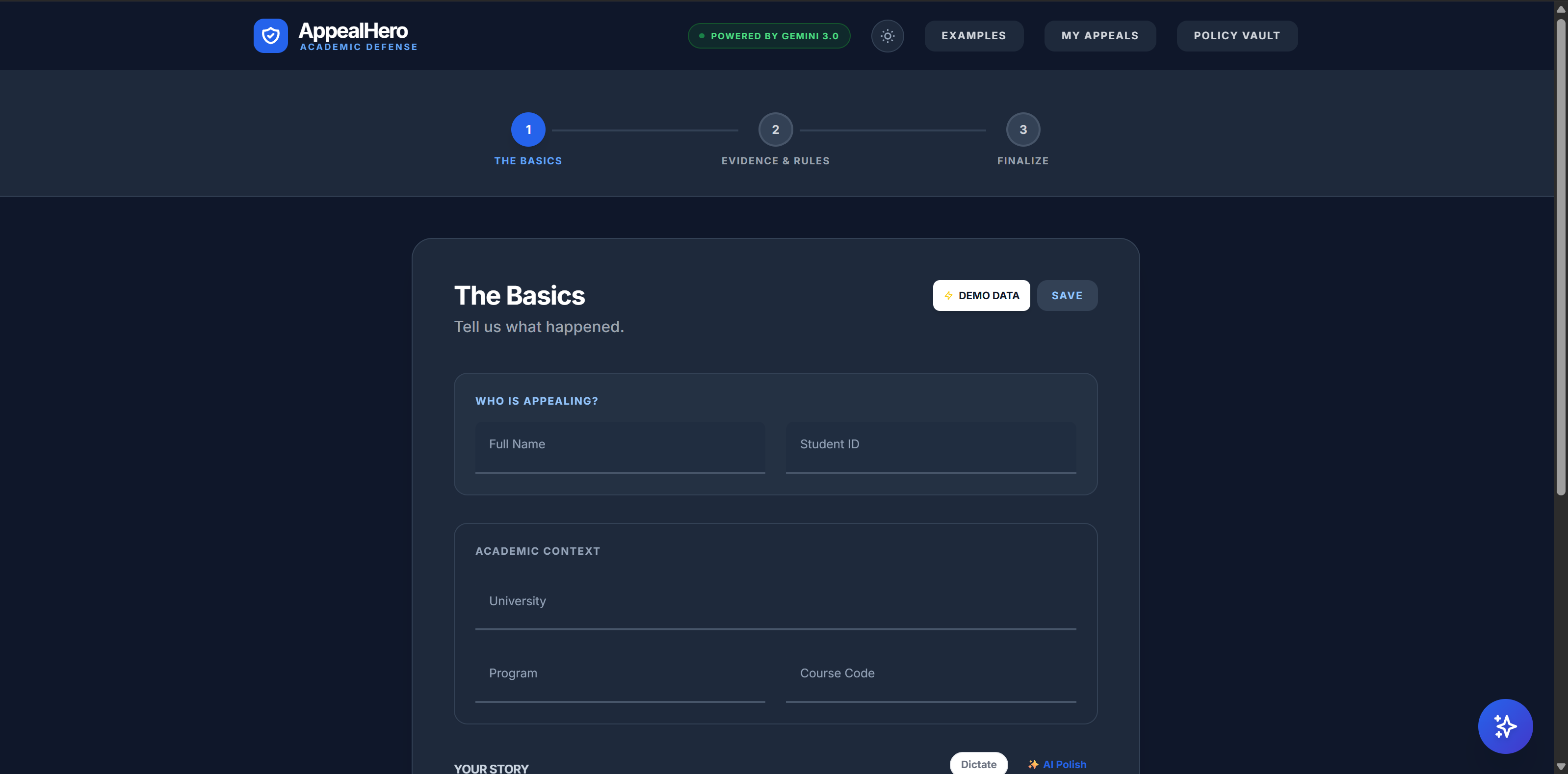
AppealHero bridges the gap between a student’s narrative and the technical "grounds" required to win a case. What once took months of manual policy cross-referencing now takes less than 10 minutes.
- Empathetic Intake (Gemini Live): Users talk to AppealHero via voice or chat. The AI acts as a compassionate interviewer, guiding the student through their story to extract facts without the stress of typing a legal brief.
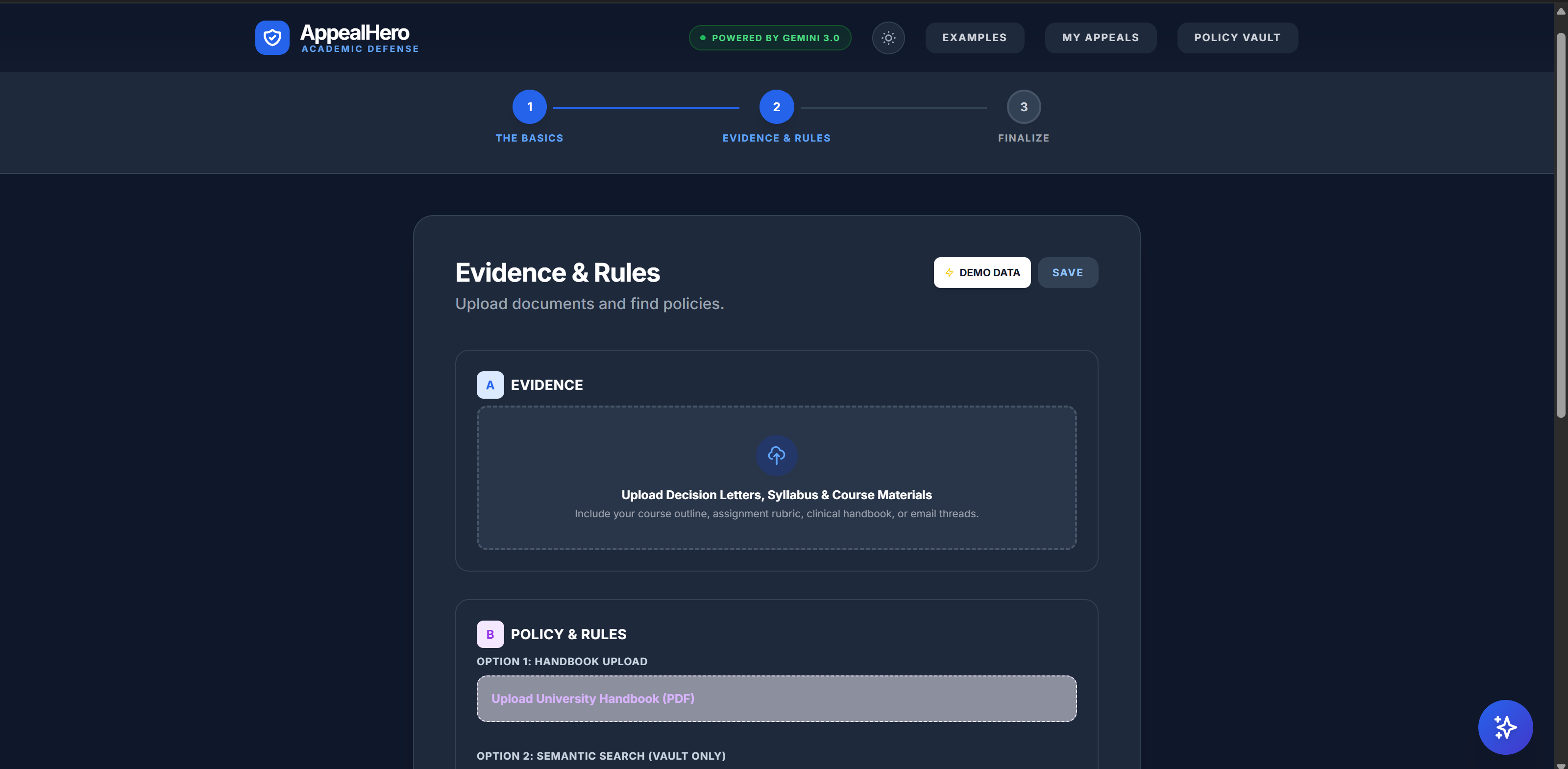
- Forensic Policy Matching (RAG Agent): It doesn't just guess; it actively parses specific university PDF handbooks and syllabi to find the exact clause violated (e.g., "Violation of Senate Policy 134, Section 4.2").
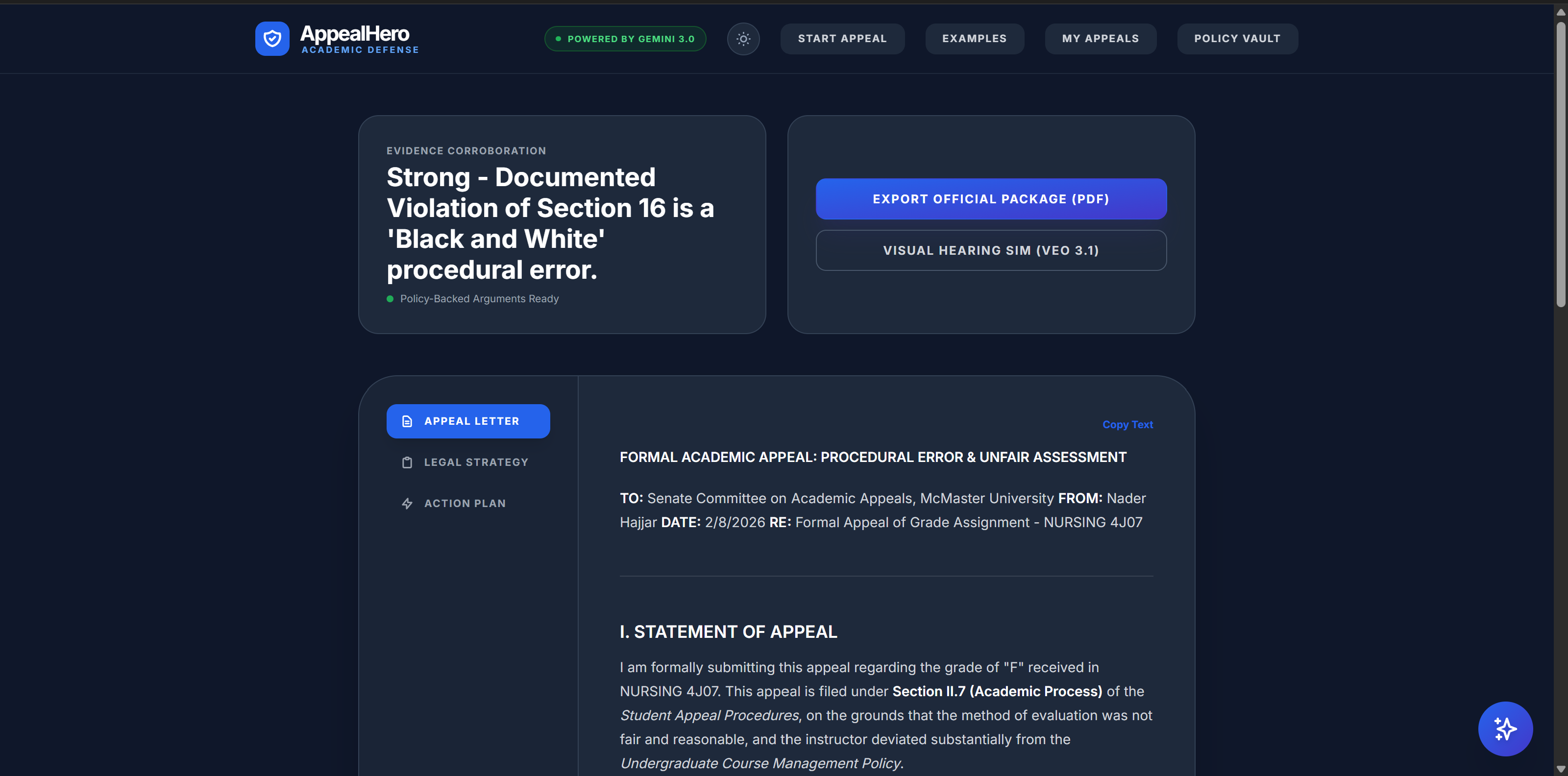
- Actionable Output: It produces a submission-ready formal appeal letter, maintaining all necessary professional formatting and identifying details.
How we built it
We designed a Local-First, Multi-Agent Architecture to prioritize student privacy while leveraging the reasoning depth of Google's latest models.
1. The Brain: Gemini 3.0 Agent Swarm
We utilize a swarm of specialized agents:
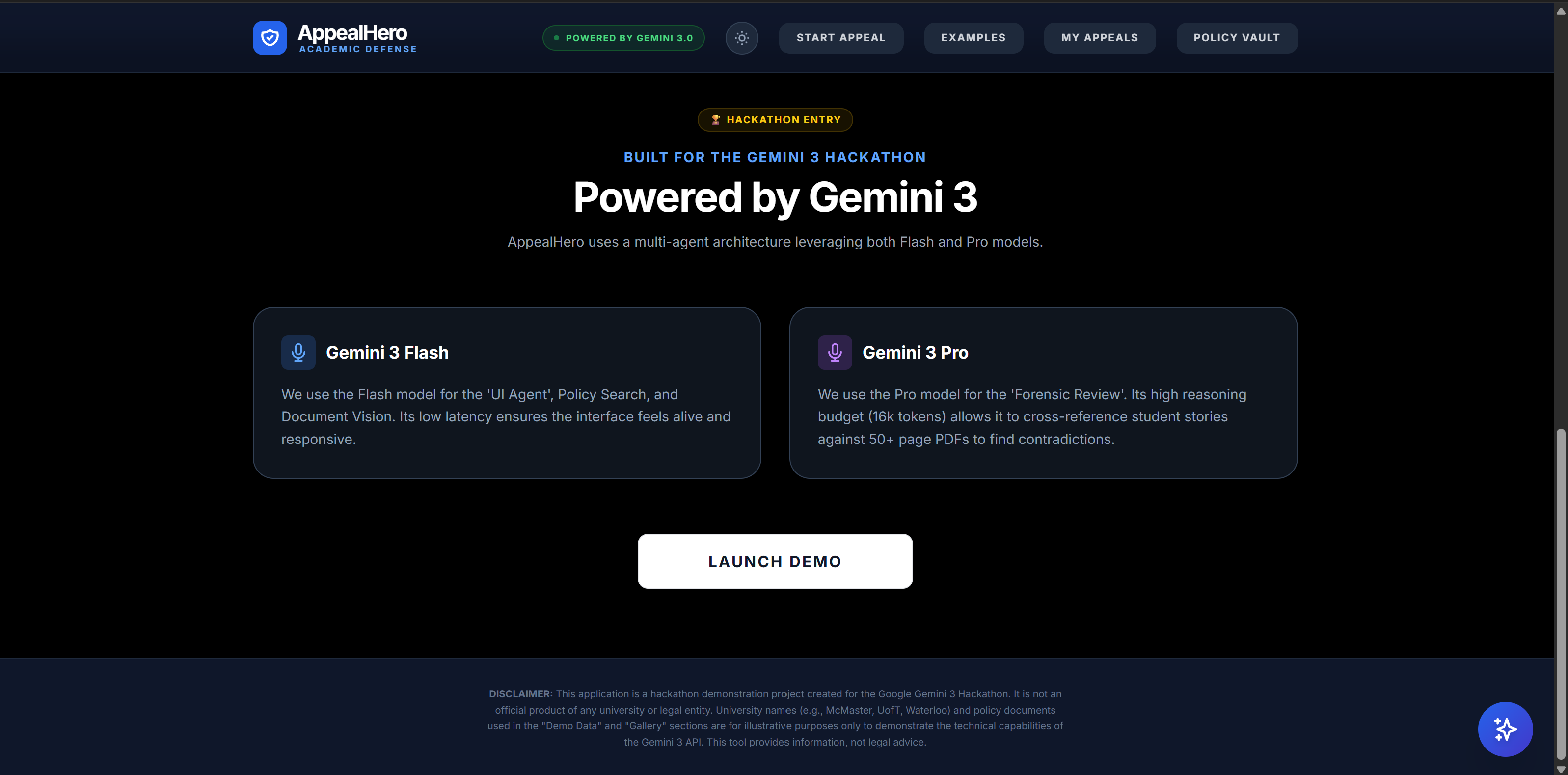
- The Strategist (Gemini 3.0 Pro): Performs deep reasoning, cross-referencing stories against policy clauses.
- Flash Vision (Gemini 3.0 Flash): OCRs and extracts metadata from uploaded PDF evidence and handbooks.
- The Interface (Gemini Live API): Integrated via WebSockets for real-time, low-latency voice intake.
- The Simulator (Google Veo 3.1): Generates video simulations of potential committee hearings to help students prepare emotionally.
2. The Engine: Client-Side RAG
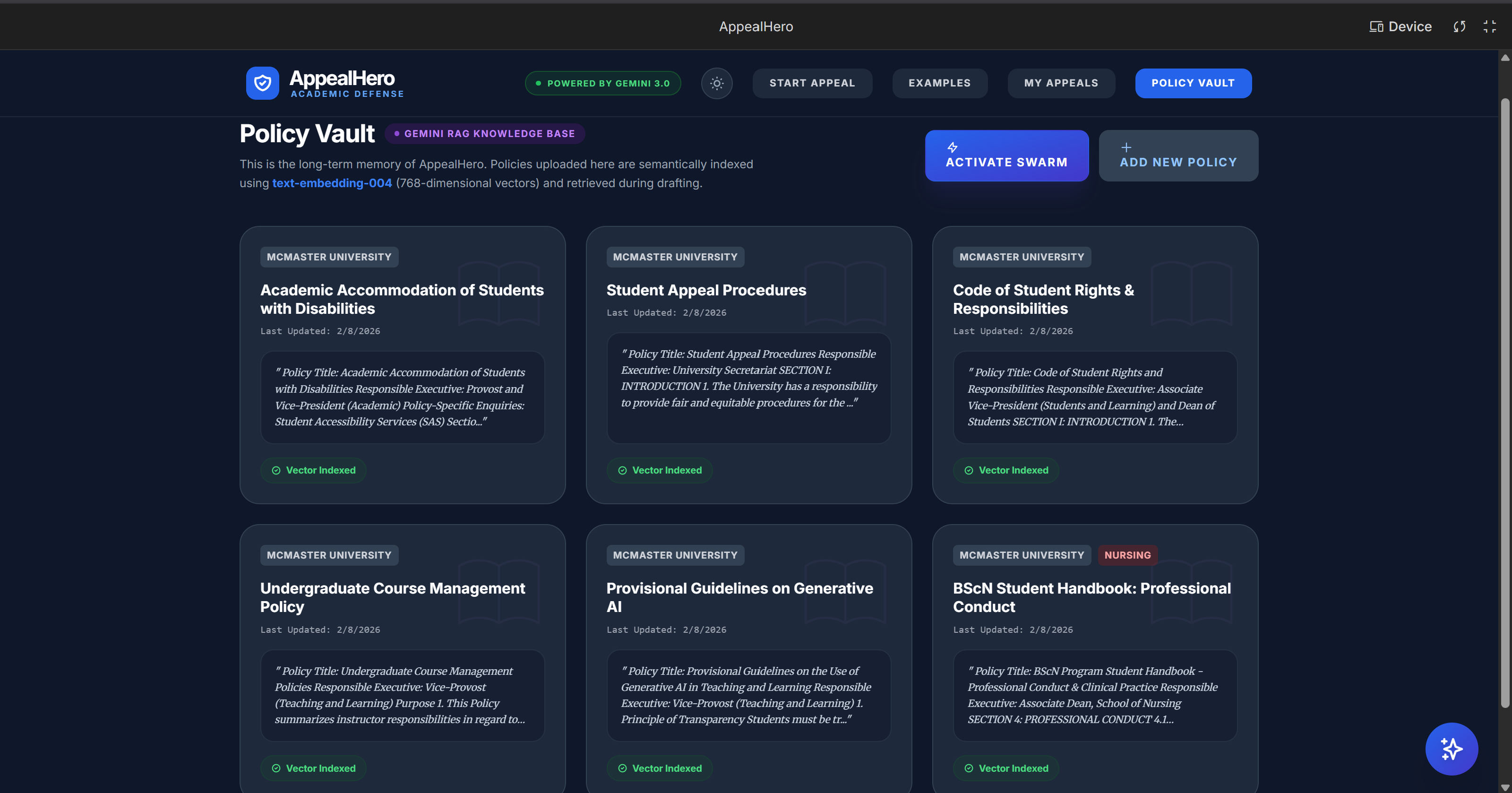
We implemented a Hybrid RAG pipeline. To ensure maximum privacy, sensitive student data and personal narratives are vectorized and stored locally in IndexedDB. Meanwhile, massive university policy databases are managed via a cloud-based vector store to allow for global scaling and real-time policy updates.
3. The Frontend: Polymorphic React UI
Built with React and TypeScript, we implemented a Polymorphic UI Agent. This agent can rewrite the app's CSS in real-time based on the user's reported physical state. For example, if a student reports a migraine, the agent modifies the UI state $S$ to a low-strain state $S_{alt}$:
$$S_{alt} = f(S_{initial}, \text{Accessibility_Constraints})$$
Challenges we ran into
- The Hallucination Hazard: In academic law, citing a non-existent policy is fatal. We solved this with a Librarian Agent that performs a final verification pass. It checks every citation against the vector store; if the groundedness score $G < 0.95$, the link is flagged for review.
- PDF Parsing at Scale: University handbooks can be 200+ pages. We implemented a Semantic Chunking strategy that splits documents based on policy headers rather than arbitrary character counts, ensuring context is never lost.
- Balancing Empathy and Authority: The AI needed to be supportive during intake but clinically precise during drafting. We solved this by maintaining separate system prompts: high temperature for "Intake" and low temperature for "Drafting."
Accomplishments that we're proud of
- The "Dean" Simulation: We built an adversarial loop where the AI calculates a Rejection Probability $P(R)$ for the draft and self-corrects to close loopholes before the student ever hits "send."
- The Polymorphic Interface: Creating a UI that redesigns itself to comfort the user—such as auto-switching to a "Migraine Mode"—feels like the future of compassionate software.
- Privacy by Design: Our Hybrid Privacy Model demonstrates that we don't need to trade user privacy for AI power. By keeping the student's 'Private Context' on-device while leveraging 'Public Knowledge' from the cloud, we’ve created a secure, forensic-grade advocate.
What we learned
- Prompt Engineering is Legal Engineering: Teaching an LLM to write an appeal requires defining the Standard of Proof and the Burden of Evidence.
- The Power of Multimodality: For students with anxiety or physical barriers, typing is a hurdle. Gemini's native audio and vision capabilities turned AppealHero from a form-filler into a true listener.
- Latency as UX: We learned that users trust the AI more when they see it "thinking." We built a visualization of the agent swarm so the user understands the depth of work happening.
What's next for AppealHero
- Global Scaling: Expanding beyond Ontario to every educational institution worldwide with multilingual support.
- Institutional Intelligence: An Enterprise use case allowing universities to benchmark their policies against global standards to ensure fair standards.
- New Bureaucratic Frontiers: Applying this "Forensic Advocate" logic to other high-stakes situations, such as Landlord-Tenant Board disputes, to protect the rights of those who cannot afford representation.
Built With
- gemini-3-flash
- gemini-3-pro
- gemini-live-api
- google-ai-studio
- google-gemini
- google-veo
- indexeddb
- rag
- react
- tailwind-css
- text-embedding-005
- typescript


Log in or sign up for Devpost to join the conversation.