Inspiration
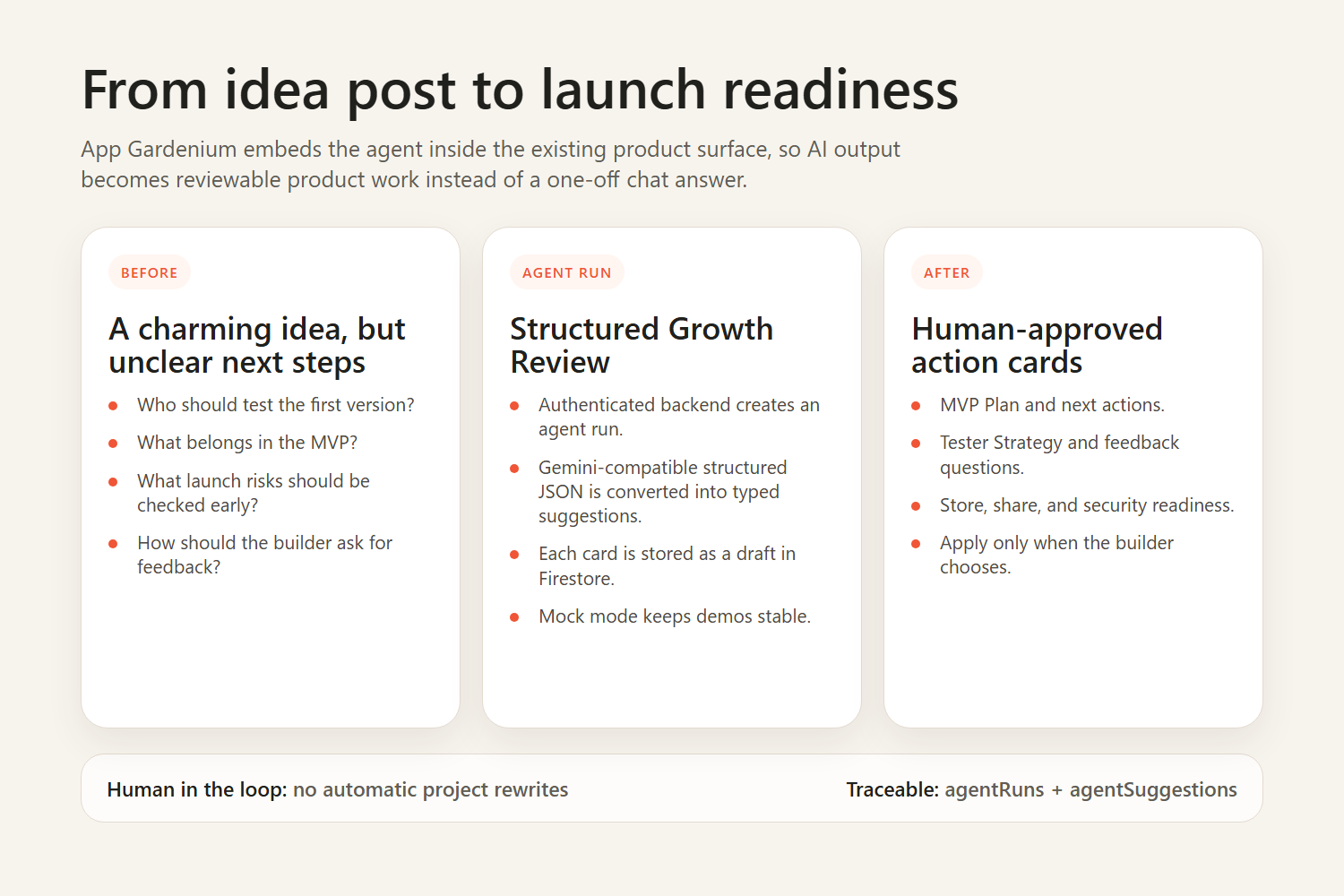
Solo builders often have promising app ideas, but many projects get stuck before validation. The hard part is not only writing code. Builders also need to decide what to build first, who to test with, how to prepare for launch, how to share the project, and what risks to check before publishing.
App Gardenium was created as a gentle place to grow small app ideas. For this hackathon, I added a Growth Agent that turns an early idea into a practical launch-readiness path.
What it does
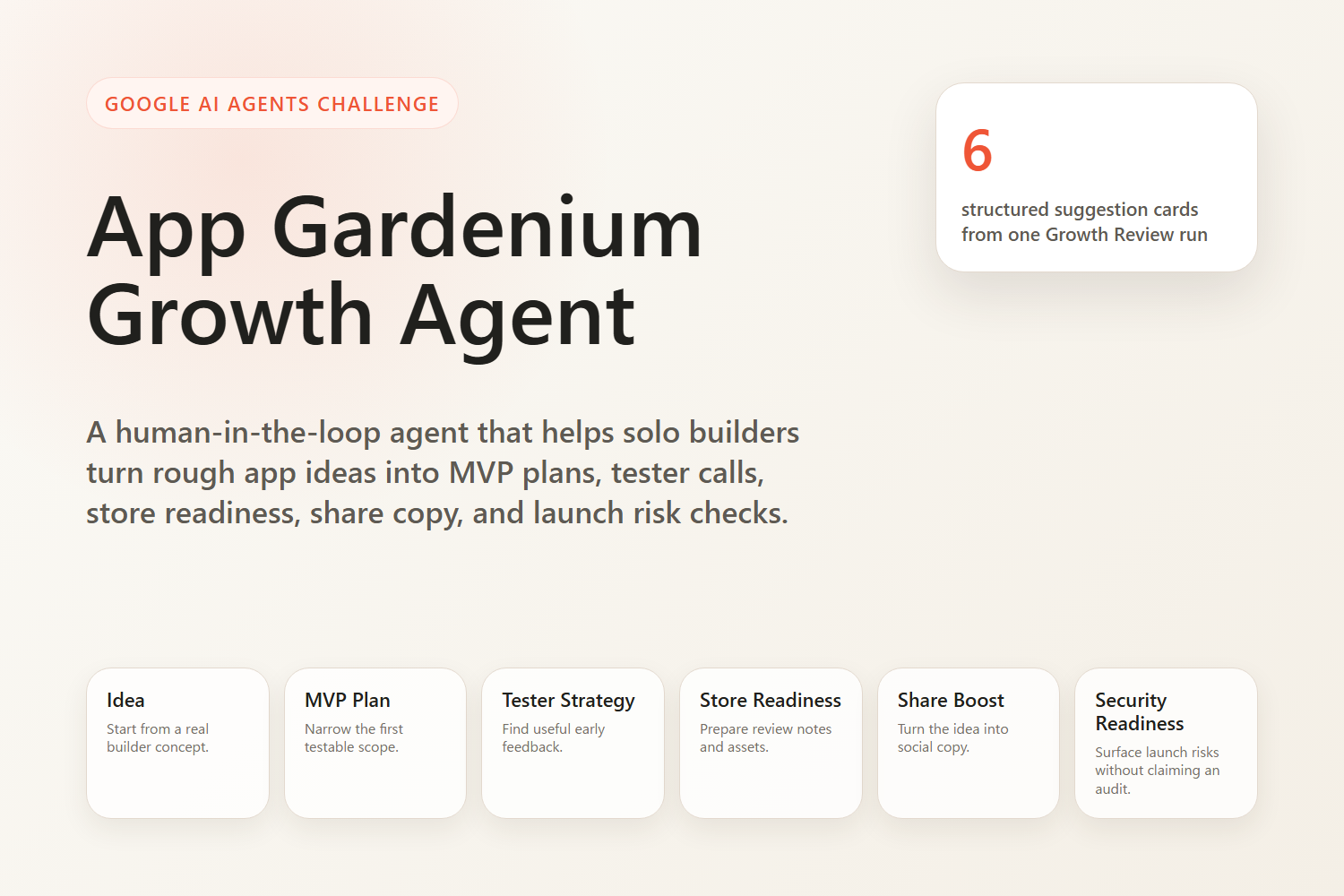
App Gardenium Growth Agent helps solo builders turn rough app ideas into tested, launch-ready products.
When a builder opens an idea and runs the Growth Agent, it creates structured draft suggestions:
- Idea Diagnosis
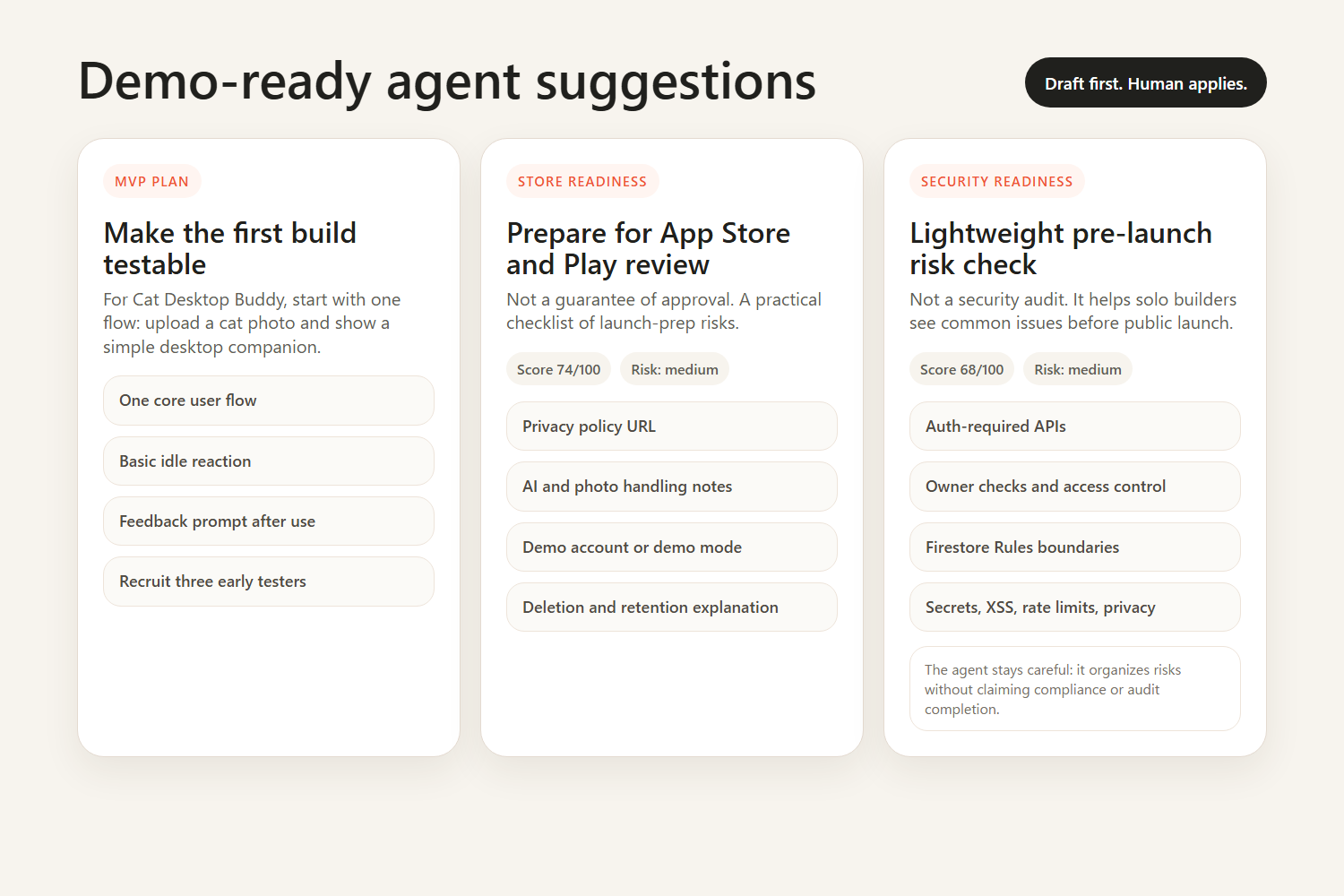
- MVP Plan
- Tester Strategy
- Store Review Readiness
- Share Boost
- Security Readiness
- Next Actions
The agent is human-in-the-loop. It does not automatically rewrite or publish the project. Every suggestion is saved as a draft, and the builder decides what to apply, dismiss, or copy.
The goal is to help builders move from “I have an idea” to “I know what to test next.”
How we built it
App Gardenium is built with React, Vite, TypeScript, Express, Firebase, Firestore, Firebase Auth, Google Cloud Run, Gemini API, and Stripe.
The Growth Agent runs through an authenticated backend workflow. The backend snapshots the current idea, creates an agent run record, generates structured suggestions, and stores each suggestion as a draft. The frontend renders those suggestions as actionable cards inside the idea detail page.
The demo also includes mock mode for stable recordings and testing:
AGENT_MOCK_MODE=true
This lets the Growth Agent show consistent structured output even when live model access is not required.
Challenges we ran into
One challenge was designing the right level of autonomy. I did not want the AI to silently change project data. The solution was a human-in-the-loop workflow where the agent proposes and the builder decides.
Another challenge was making the output useful beyond brainstorming. The agent needed to support a real builder journey: MVP planning, tester recruitment, store review preparation, social sharing, and lightweight security readiness.
I also spent time stabilizing Cloud Run, Firebase Admin, Stripe pricing, and checkout configuration so the project could behave like a real product rather than only a prototype.
Accomplishments that we're proud of
I am proud that App Gardenium now feels like more than an idea board. It acts as a launch-readiness layer for indie builders.
The Growth Agent can turn a rough app idea into a structured path: Idea Diagnosis -> MVP Plan -> Tester Strategy -> Store Review Readiness -> Share Boost -> Security Readiness.
I am also proud of the human-in-the-loop design. The AI suggestions are traceable, reviewable, and safe to apply only when the builder chooses.
What we learned
I learned that useful AI agents are not just chat interfaces. The most valuable part is embedding the agent into a real workflow with clear state, draft suggestions, user approval, and traceability.
I also learned that small builders need help not only with code, but with decisions: what to test, who to ask, what to prepare before launch, and how to explain the project to real people.
What's next for App Gardenium Growth Agent
Next, I want to improve the end-to-end launch flow: deeper tester recruitment support, better public project pages, stronger progress coaching, and more reliable store-review and security-readiness checks.
I also want to keep App Gardenium lightweight and friendly, so solo builders can use it without feeling overwhelmed.
Built With
- express.js
- firebase
- firebase-auth
- firestore
- gemini-api
- google-cloud
- google-cloud-run
- react
- typescript
- vite

Log in or sign up for Devpost to join the conversation.