-
-
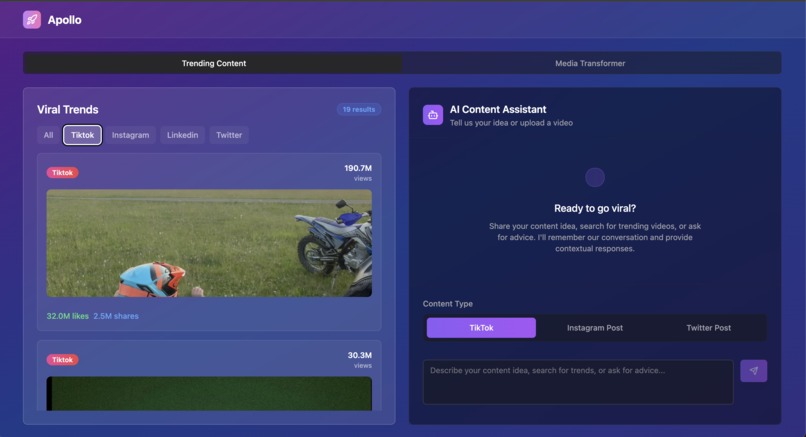
Apollo: AI Content Consultant
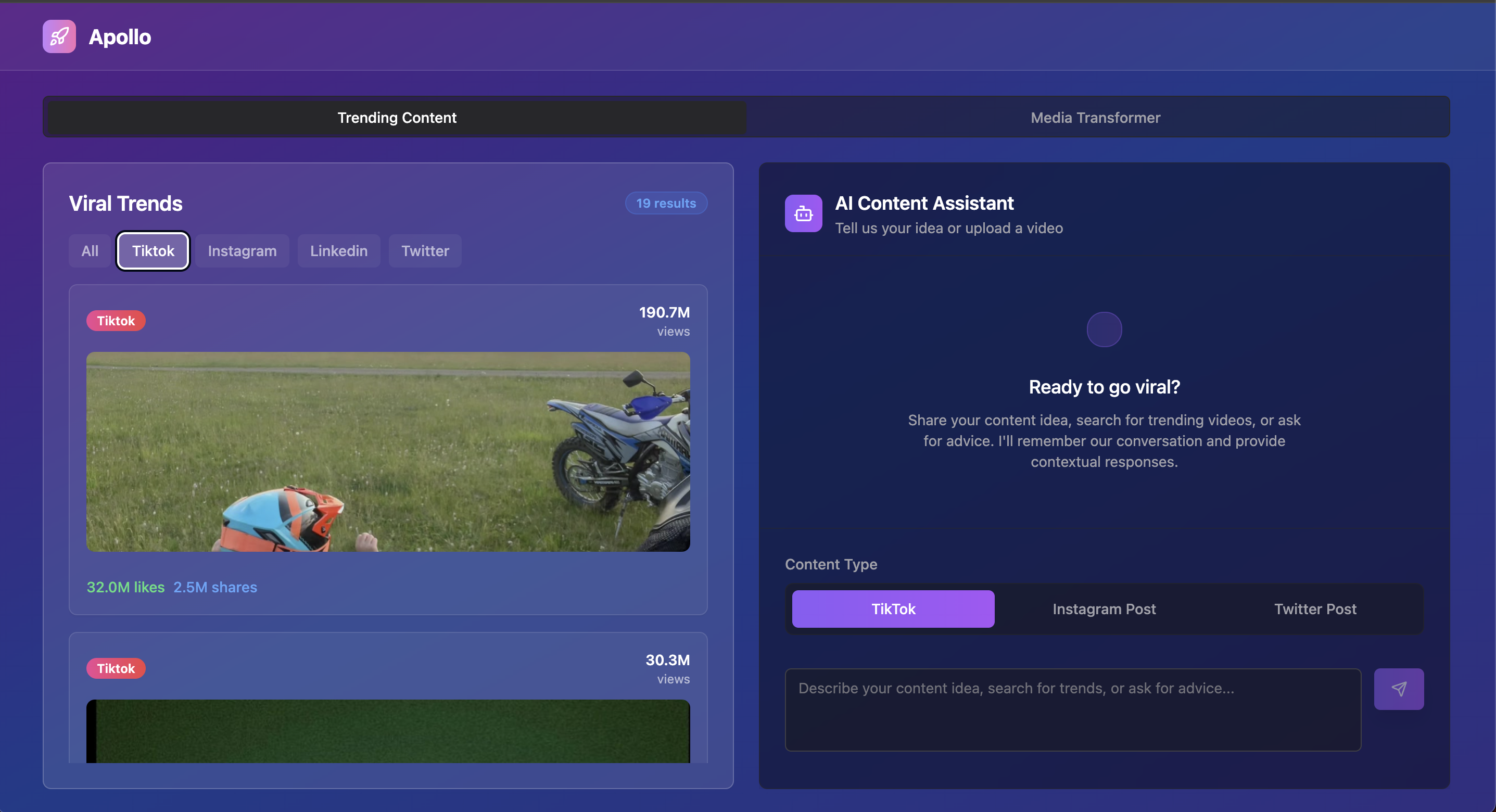
Inspiration
- We wanted to empower content creators who face constant pressure to produce fresh, engaging, and viral content across multiple platforms.
- Our goal was to build an AI co-pilot that acts as a personal content strategist, helping creators keep up with trends and brainstorm platform-optimized ideas.
What it does
- Features an AI assistant that generates content ideas, video structures, captions, and hashtags through a simple chat interface.
- Includes a "Viral Trends" feed that updates in real-time based on the user's conversation, providing relevant video inspiration on the fly.
How we built it
- A full-stack application using a React/TypeScript frontend and a Python/FastAPI backend.
- The AI core is powered by Google's Gemini 2.5 Pro and a LangGraph state machine, with a Qdrant/Cohere RAG pipeline for retrieving real-time content.
Challenges we ran into
- Our biggest challenge was designing a robust multimodal RAG system that could effectively embed and query both video transcripts and visual content. We had to integrate multiple embedding models (SentenceTransformer for text, CLIP for visual content) with Qdrant vector database, while ensuring semantic search worked across different content modalities. The complexity increased when implementing Cohere reranking to improve retrieval quality and handling edge cases where embedding generation failed.
- Architecting a stateful conversation agent using LangGraph presented significant complexity in managing conversation context, intent detection, and dynamic response generation. The challenge was creating a graph-based workflow that could handle multi-turn conversations, extract search queries from natural language, and seamlessly integrate RAG retrieval with content generation.
- Smart Media Transforms – We needed to extract key moments from long videos. We solved this by running speech-to-text, then using an LLM to identify the most relevant clip timestamps and generate a caption optimized for social posts.
Accomplishments that we're proud of
- Creating a cohesive user experience where the Viral Trends panel intelligently updates based on the user's natural conversation with the AI.
- Building a sophisticated backend with a stateful conversation graph and a real-time RAG pipeline to ensure generated content is both creative and relevant.
What we learned
Designing for Ambiguity:
This project was a lesson in designing complex systems where user interactions are fluid. Our initial component-level state management proved brittle. We learned that abstracting this into a centralized service hook provided the architectural flexibility needed to handle ambiguous user inputs that affect multiple UI components at once.
Agentic RAG Control:
We explored how to move beyond simple retrieval by using LangGraph to create an agent. This agent decides when to query our multimodal RAG pipeline based on conversational context. This layer of agentic control was crucial for delivering timely, relevant video trends that enhanced the AI's creative suggestions, making the tool feel truly consultative.
What's next for Apollo: AI Content Consultant
- We plan to expand to more platforms like YouTube Shorts and LinkedIn, and introduce multimodal chat capabilities (e.g., uploading images for feedback).
- Our roadmap includes adding performance analytics to predict engagement and a dashboard for users to track the success of their generated content ideas.
Built With
- assemblyai
- cohere
- docker
- fastapi
- google-artifact-registry
- google-cloud-run
- google-gemini
- langgraph
- moviepy
- opencv
- pydantic
- python
- qdrant
- radix-ui
- react
- react-router
- shadcn-ui
- tailwind-css
- tanstack-react-query
- terraform
- typescript
- uvicorn
- vite

Log in or sign up for Devpost to join the conversation.