ApnaRaasta — Community Discovery
Inspiration
Moving to a new city can be exciting, but finding people who share your interests is not always easy. You might enjoy indie music, Bollywood films, photography, books, board games, or exploring new food places, but knowing where to start can be difficult.
Most people can search for events and places online. The harder part is finding activities that genuinely match their interests, fit their budget and schedule, and give them a comfortable way to meet people with similar hobbies.
We wanted to work on this problem through ApnaRaasta.
The idea is simple: your interests can be a starting point for discovering communities around you. Instead of making people search through endless lists of activities, ApnaRaasta aims to help them find a practical path from what they enjoy to places and activities they can take part in.
We chose Pune as our initial focus because a city-based prototype allows us to work with a more specific set of local activities and test whether our recommendations are useful in a real setting.
What it does
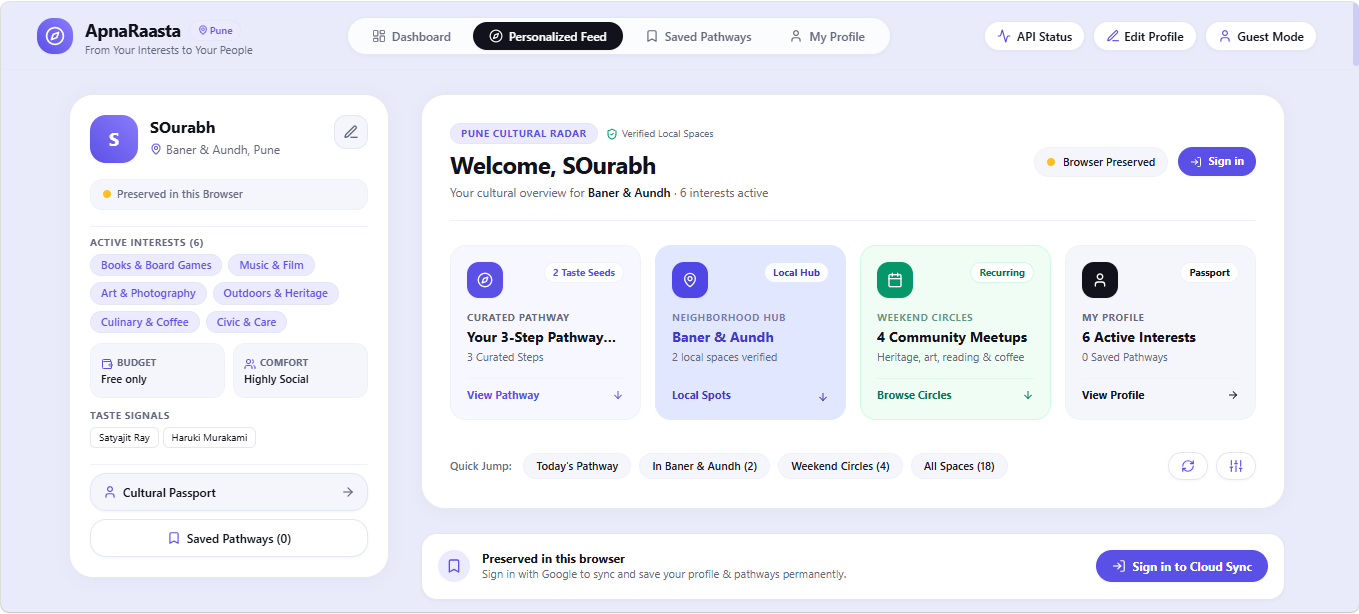
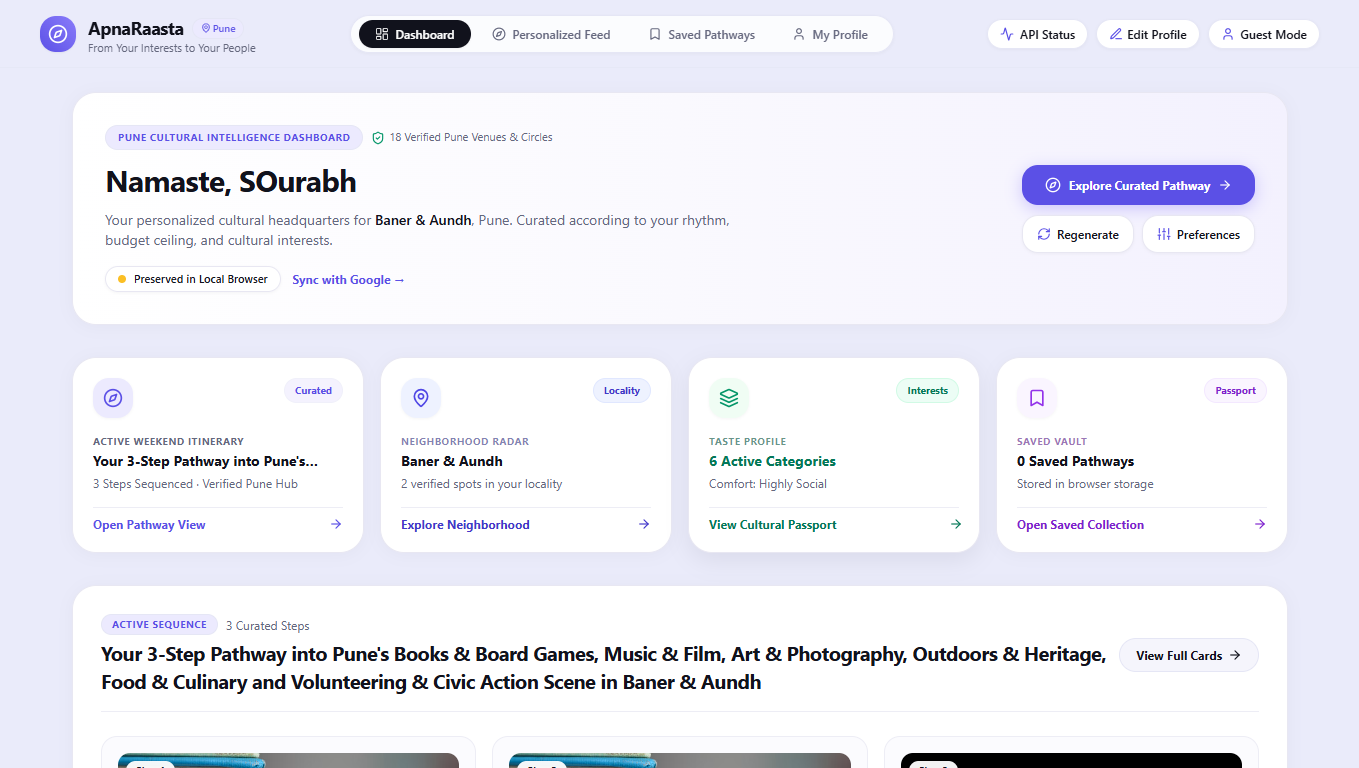
ApnaRaasta is a cultural discovery platform that helps people find local activities and recurring communities based on their interests.
The experience starts with a short onboarding process. Users select the things they enjoy and set practical preferences such as their budget, preferred area or distance, available days and times, and social comfort level.
ApnaRaasta then uses Qloo's cultural intelligence to understand relationships between the user's interests and other relevant cultural entities. Gemini helps turn these signals, along with the user's preferences and available activity information, into a personalized pathway.
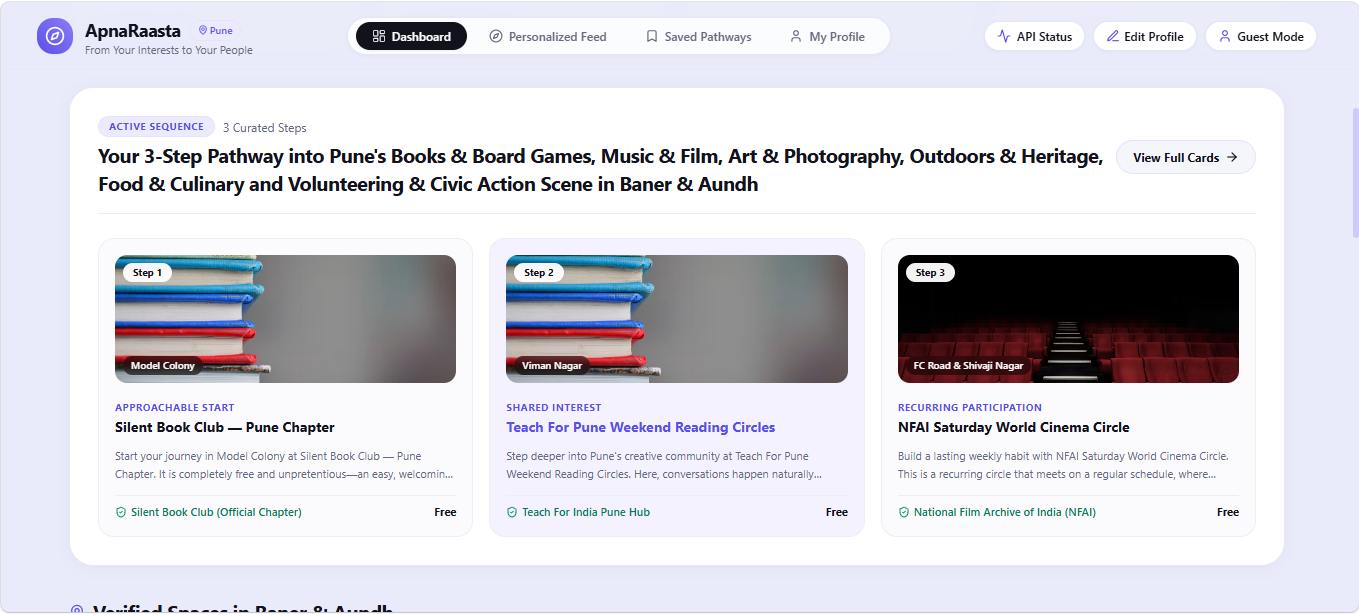
The main result is a three-step pathway rather than just a list of recommendations.
For example, someone interested in photography and indie music might receive a progression from exploring a suitable creative space, to trying a photography-related activity, to finding a recurring creative group. The exact suggestions depend on available data and must not be presented as confirmed activities unless their details can be verified.
Users can review alternatives and regenerate the pathway when their preferences change. They can also compare the Qloo-assisted approach with a basic AI approach to understand how cultural information affects the recommendations.
ApnaRaasta focuses on discovery and participation. It does not promise friendships, guarantee social outcomes, or act as a booking, payment, or messaging platform.
How we built it
We designed ApnaRaasta as a mobile-first, responsive web application. The aim is to make it comfortable to use on a phone while remaining accessible through a normal browser on a laptop or desktop.
Technology stack
- Next.js and TypeScript: For the web application, server-side API routes, and type-safe application logic.
- Tailwind CSS: For consistent styling and responsive layouts.
- Qloo API: For cultural intelligence, including supported entity search, cultural signals, and insights.
- Gemini: For reasoning over the available signals and activity records, generating a structured pathway, and explaining why activities may fit a user's interests.
- Firebase Authentication: For Google sign-in.
- Cloud Firestore: For saving users' pathways and retrieving their previous pathways.
- Vercel: For hosting the web application and its server-side functionality.
How the recommendation process works
The planned recommendation flow has several stages.
1. Understanding the user
We collect selected interests and practical preferences through guided onboarding. These preferences become structured input rather than a vague request to an AI chatbot.
2. Retrieving cultural signals
The server communicates with Qloo through its supported API. It searches for relevant cultural entities and uses supported insights operations to retrieve useful relationships or affinities.
Qloo is responsible for supplying cultural signals, not for inventing local activities. Its results may include entities related to a user's interests, but the system must verify which signals are actually returned and useful for the task.
3. Connecting cultural signals to local activities
Cultural signals alone are not enough to recommend something a person can actually do. ApnaRaasta therefore uses a separate activity dataset containing relevant Pune locations, activities, recurring groups, and other suitable opportunities.
The dataset combines manually curated information with live data where a reliable source is available. Records should include their source links, verification dates, and whatever details are actually known. Unknown prices, timings, or availability must remain unknown rather than being guessed.
4. Generating the pathway
Gemini receives the relevant cultural signals, eligible activity records, and the user's constraints. It helps organize the candidates into a coherent three-step pathway, with alternatives and explanations.
The application validates the generated response before displaying it. The model should not invent venues, events, prices, dates, or registration links.
5. Saving and revisiting
Users can explore the experience without creating an account. Google sign-in is required for the planned saving and history features. Firestore stores the user's saved pathways, with access restricted to their owner.
6. Comparing the approaches
ApnaRaasta includes a comparison between the Qloo-assisted approach and a generic AI baseline. Both should use the same user preferences, verified activity candidates, and hard constraints. The baseline must not receive the Qloo signals being evaluated.
This comparison is intended to help us understand whether cultural context changes the relevance and variety of recommendations, rather than assuming that adding another API automatically improves the result.
Visual design
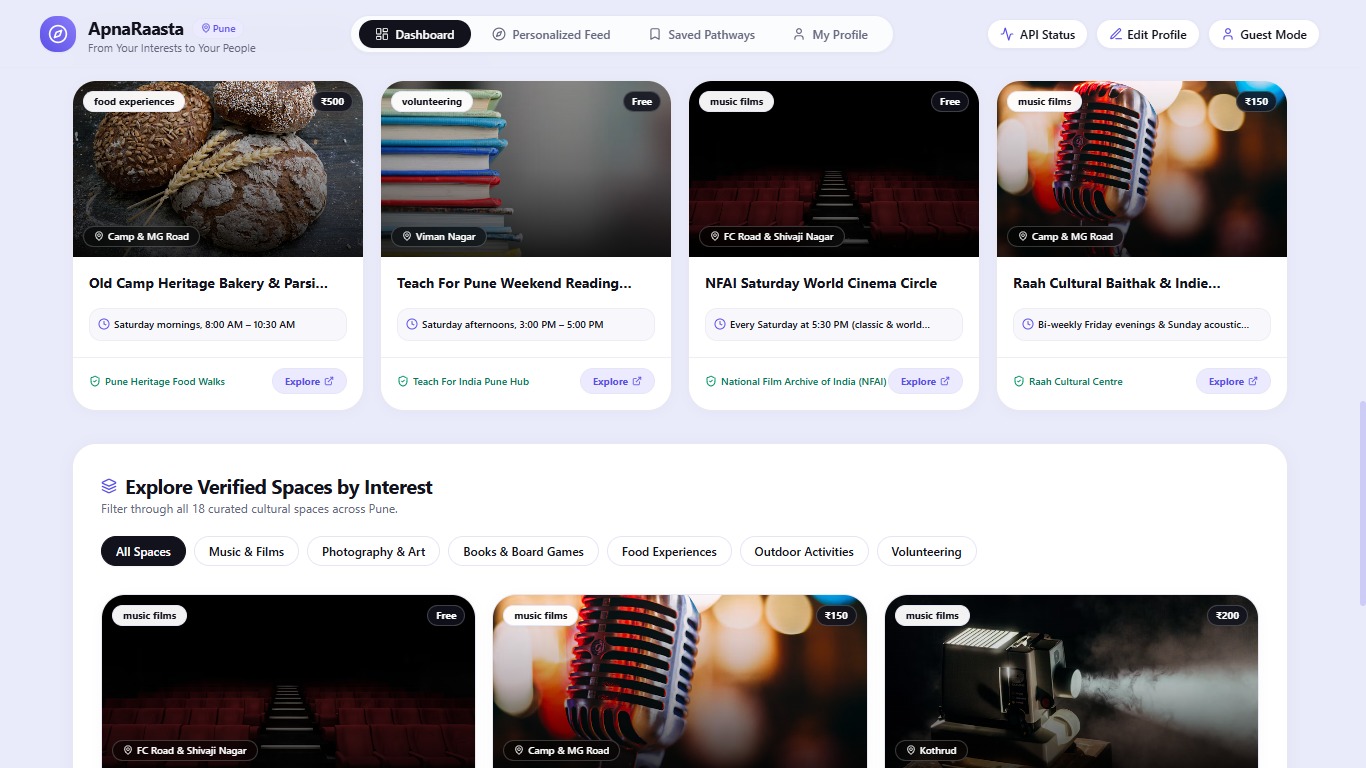
The UI references we selected use a clean, light interface with lavender and periwinkle accents, rounded activity cards, clear typography, generous spacing, and images that help users understand an activity at a glance.
We want ApnaRaasta to follow that general visual direction without copying unrelated features from the reference applications.
Activity images can make it easier for users to understand the kind of experience being suggested. Where possible, they should come from the relevant activity or a properly sourced image. A general illustrative image must not be presented as proof that a particular venue or event exists.
The goal is a polished interface that feels simple to explore, not a crowded dashboard full of unnecessary features.
Challenges we ran into
One of the main challenges is connecting cultural preferences to real activities.
Knowing that someone enjoys a particular music genre or type of film does not automatically identify an appropriate local group. We need a meaningful connection between Qloo's cultural signals and the activity data available to the application.
Another challenge is data reliability. An activity may sound like a perfect fit but have an outdated listing, an unknown price, or no reliable information about when it takes place. We need to distinguish verified information from incomplete records and avoid misleading users.
We also need to ensure that Gemini does not simply produce convincing-sounding suggestions. The model must work with eligible activity records, respect the user's budget and location preferences, and explain its choices without making unsupported claims.
The comparison with generic AI presents another challenge. It would be easy to make Qloo look better by giving it more information or better activity candidates. A fair comparison requires keeping the underlying candidates and user constraints consistent.
Finally, building a polished experience within a hackathon timeline means being careful about scope. It is tempting to add maps, social feeds, messaging, event bookings, and other features, but those would distract from the main question we want to explore: can cultural intelligence help people discover more relevant ways to participate in their local communities?
Accomplishments that we're proud of
We are proud that ApnaRaasta is built around a specific problem rather than simply adding AI to a generic discovery app.
The project gives Qloo a meaningful role in the recommendation process. Its cultural signals are intended to influence which activities are considered relevant, while Gemini helps turn the available information into an understandable pathway.
We have also defined a focused user journey, from selecting interests to discovering activities and saving a pathway for later. This gives us a practical way to demonstrate the idea without needing to build a complete social network.
Another part we value is the emphasis on data quality. Recommendations should be connected to available evidence, and the application should make uncertainty clear instead of inventing details.
We are also keeping the comparison with a generic AI baseline as part of the prototype. It gives us a way to examine the actual contribution of cultural intelligence instead of relying only on how impressive a generated answer sounds.
What we learned
Working on ApnaRaasta has helped us understand that personalization involves more than collecting a user's favourite things.
The difficult part is connecting those preferences to relevant choices in the real world. Cultural signals, reliable local information, practical constraints, and clear explanations all need to work together.
We also learned that different AI systems have different roles. Qloo provides cultural intelligence, while Gemini helps reason over the information available to the application. Neither replaces the need for reliable local activity data.
Another important lesson is that an AI recommendation should be explainable and testable. We need to understand which signals and constraints affected a result, whether the recommended activity is actually supported by the dataset, and how the result changes when the user's interests change.
Finally, we learned the importance of setting boundaries. A focused product with one complete, well-tested user journey can demonstrate its value more clearly than an application with many unfinished features.
Potential impact and real-world use cases
ApnaRaasta is intended for people who want to explore activities and find communities connected to their interests, particularly those who have recently moved to a new city.
A college student could use it to find creative activities beyond their campus. Someone interested in books or board games could discover suitable local groups. A photography enthusiast could use it to explore relevant activities and look for recurring opportunities to participate.
The same idea could eventually be useful to people relocating for work, newcomers looking for local cultural experiences, or anyone who wants to explore a city through their interests.
The potential impact is making community discovery more approachable. Rather than expecting people to know the right search terms, websites, or local groups beforehand, ApnaRaasta aims to provide a useful starting point.
We do not claim that a recommendation will automatically lead to a friendship or solve loneliness. Our first goal is more practical: help people find relevant opportunities and make it easier to take the first step.
We can evaluate the prototype by checking whether its suggestions respect the user's constraints, whether activity details are supported by reliable sources, whether the pathway changes meaningfully when preferences change, and whether Qloo contributes useful cultural context compared with the baseline.
These checks will help us assess the product before making broader claims about its impact.
What's next for ApnaRaasta - Community Discovery
Our immediate goal is to complete and test the working web prototype using real Qloo API responses, Gemini, Firebase, and a carefully curated set of Pune activities.
We want to verify that the complete experience works: a user selects interests, receives a personalized three-step pathway, explores alternatives, and saves the result after signing in. We also want to make the Qloo-versus-baseline comparison reproducible and useful for judging the results.
After that, we plan to improve the quality and coverage of the activity dataset, refine the recommendation logic, and test the experience with people who are unfamiliar with the city or looking for new communities.
If the approach proves useful, we would like to expand coverage to more cities and eventually develop a native mobile application.
Longer term, ApnaRaasta could become a practical way to explore a city through the things people care about. For now, we are keeping the focus on one city, reliable information, and a simple path from personal interests to local activities.

Log in or sign up for Devpost to join the conversation.