Inspiration
The inspiration for APISense came from our own frustrations as developers. We've all been there, starting a new project and spending hours, sometimes days, researching which APIs to use. The process of manually browsing through multiple API directories, reading documentation, comparing features, and evaluating pricing models was exhausting and time-consuming.
We realized that in an age where AI can help us design systems, and solve complex problems, API discovery was still stuck in the manual research era. Developers were losing valuable time that could be spent actually building their projects. This realization sparked the idea: what if we could leverage the power of AI to understand a developer's project context and instantly recommend the perfect APIs with intelligent explanations?
With the rise of powerful AI models like Google Gemini and robust search technologies like Elasticsearch, we saw an opportunity to transform API discovery from a tedious research task into an intelligent, conversational experience. APISense was born from this vision, to help developers make informed decisions faster and start building sooner.
What it does
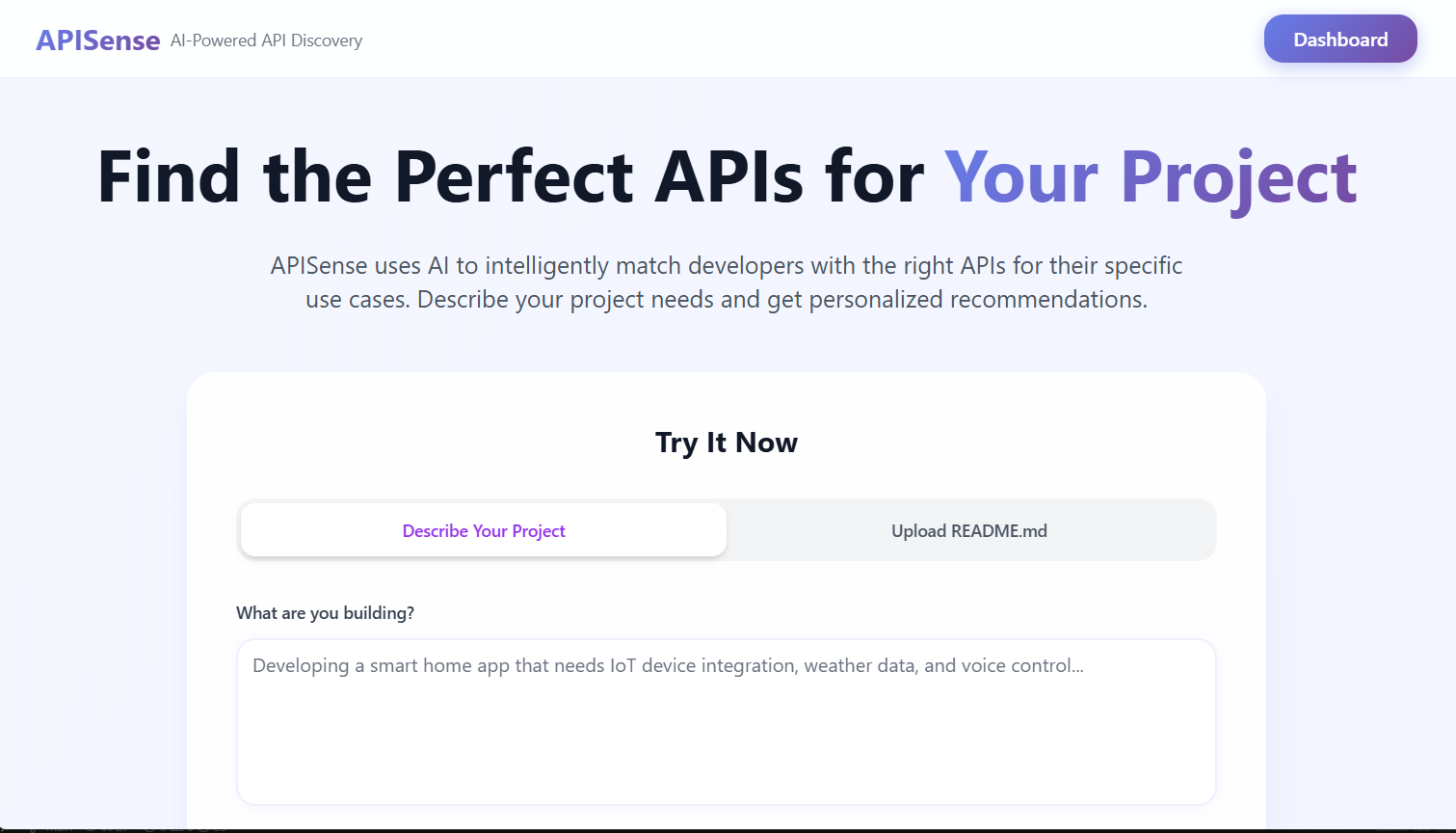
APISense is an intelligent API recommendation platform that uses AI to match developers with the perfect APIs for their specific projects. Here's what makes it unique:
Natural Language Understanding: Developers can describe their project in plain English, "I'm building a travel booking app with real-time pricing and weather forecasts" and APISense's AI engine, powered by Google Gemini, understands the context and identifies the exact APIs needed.
File Upload Analysis: Users can upload their README.md or project description files, and the platform automatically extracts requirements, technical preferences, and integration needs to generate tailored recommendations.
Context-Aware Recommendations: Unlike simple keyword-based search engines, APISense understands project context. It doesn't just list APIs; it explains why each API fits your use case, compares alternatives, and considers factors like pricing models, documentation quality, community support, and scalability.
Comprehensive API Repository: The platform maintains a curated database of popular APIs across various categories, payments, authentication, communications, weather, maps, databases, and more, all indexed in Elasticsearch for lightning-fast search and retrieval.
Smart Analytics: Visual comparisons help developers evaluate APIs based on features, pricing, documentation quality, and community ratings, making informed decision-making effortless.
How we built it
APISense is built on a modern, robust tech stack that combines the power of Laravel's backend capabilities with cutting-edge AI and search technologies:
Backend Framework: We chose Laravel 12 with PHP 8.3 as our foundation, leveraging its elegant syntax, built-in authentication (Laravel Breeze), and powerful ORM for rapid development.
AI Integration: Google Gemini API (gemini-2.5-flash model) powers our intelligent recommendation engine. We integrated the Gemini API to analyze natural language queries, extract project requirements from uploaded files, and generate context-aware API recommendations with detailed explanations.
Search Engine: Elasticsearch Cloud provides lightning-fast full-text search capabilities. We created custom index mappings for our API repository, enabling semantic search that goes beyond simple keyword matching to understand developer intent.
Database: MySQL serves as our primary database, storing API metadata, user conversations, project uploads, preferences, and saved recommendations. We designed a normalized schema with efficient indexing for optimal query performance.
Frontend: We built a responsive, modern UI using Laravel Blade templates, TailwindCSS for utility-first styling, and Alpine.js for reactive components—creating an intuitive chat-like interface that feels natural and engaging.
Architecture Highlights:
- ElasticsearchService: A custom service class handles all Elasticsearch operations—index creation, document indexing, and complex search queries with boosting and filtering.
- GeminiService: Encapsulates all AI interactions, managing API calls, prompt engineering, and response parsing to extract structured recommendations from Gemini's responses.
- Seeder System: We created comprehensive database seeders with curated API data (Stripe, Twilio, Firebase, AWS, Google Maps, etc.) to provide immediate value to users.
- File Upload Processing: Secure file handling with validation, storage, and content extraction for README analysis.
Challenges we ran into
Building APISense presented several significant technical challenges:
1. Prompt Engineering for Consistent AI Responses
Getting Gemini to return consistently was challenging. We solved this by carefully crafting system prompts. We also implemented robust parsing logic to handle edge cases.
2. Elasticsearch Schema Design
Designing an Elasticsearch index that could handle diverse API attributes while maintaining fast search performance required extensive testing. We experimented with different analyzers, field mappings, and boosting strategies.
3. Balancing AI Creativity with Accuracy
Gemini's creative responses sometimes included speculative information about APIs. We had to tune the temperature parameters and implement validation checks to ensure recommendations were based on actual API data in our database.
Accomplishments that we're proud of
1. Seamless AI Integration
We successfully integrated Google Gemini AI to provide genuinely intelligent, context-aware recommendations. The AI doesn't just match keywords, it truly understands project requirements and explains its reasoning, creating a conversational experience that feels natural and helpful.
2. Sub-Second Search Performance
Our Elasticsearch implementation delivers fast results. Even with complex queries across large datasets, users get relevant API recommendations in under a second, creating a smooth, responsive experience.
3. Comprehensive API Repository
We built a well-structured database with detailed information about popular APIs across multiple categories. Each entry includes rich metadata that powers intelligent matching.
4. Intuitive User Experience
We created a clean, modern interface that makes API discovery feel effortless. The conversational UI feels natural, file upload works seamlessly, and the dashboard provides clear, actionable insights. User testing showed developers could find suitable APIs in minutes rather than hours.
5. Production-Ready Architecture
Despite being built for a hackathon, APISense has a production-grade architecture with proper separation of concerns, service abstraction, error handling, and security best practices. The codebase is clean, well-documented, and scalable.
6. End-to-End Feature Completeness
We didn't just build a proof-of-concept—APISense is a fully functional platform with authentication, conversation history, file uploads, search, API management, and analytics. Users can register, explore APIs, get recommendations, save favorites, and track their discovery journey.
What we learned
1. The Power of AI in Developer Tools
This project reinforced that AI isn't just about chatbots, it can fundamentally transform how developers work. By understanding context and providing intelligent recommendations, AI can eliminate hours of research and decision-making.
2. Prompt Engineering is an Art
Crafting effective prompts for consistent, structured AI responses requires iteration and experimentation. Small changes in wording can dramatically affect output quality. We learned to be explicit about expected formats, provide examples, and validate outputs programmatically.
3. Search is More Complex Than It Seems
Implementing semantic search with Elasticsearch taught us about analyzers, tokenizers, boosting, and relevance tuning. Creating a search experience that "just works" requires deep understanding of how search engines interpret and rank results.
4. Data Quality Determines AI Quality
The recommendations are only as good as the underlying API data. Accurate, comprehensive API metadata is crucial for generating useful recommendations.
What's next for APISense
We're excited about APISense's potential and have ambitious plans for future development:
1. Gemini Function Calling for Code Generation
Integrate Gemini's function calling capabilities to generate actual integration code. Users won't just get API recommendations, they'll get working code snippets in their preferred language (Python, JavaScript, PHP, etc.) with proper authentication and error handling.
2. IDE Integration
Build VS Code and JetBrains extensions that bring APISense directly into developers' workflows. Imagine describing your needs in a comment and having APISense suggest relevant APIs and generate integration code right in your editor.
3. Real-Time API Monitoring
Track API uptime, response times, and status changes. Notify users if a recommended API experiences downtime or announces deprecations, helping them make proactive decisions.
4. Community-Driven Ratings and Reviews
Allow developers to rate APIs they've used, share integration experiences, and provide real-world insights. This crowdsourced data will enhance AI recommendations with authentic developer feedback.
5. API Comparison Tool
Build a side-by-side comparison feature where users can evaluate multiple APIs across dimensions like pricing, features, performance, documentation quality, and community support, all in one view.
6. Enterprise Features
Develop role-based access control for development teams, API vendor partnerships for verified listings, usage analytics, and integration with project management tools.
7. Multi-Language Support
Expand beyond English to support developers worldwide, making API discovery accessible to the global developer community.
APISense started as a solution to a common developer pain point, and we believe it has the potential to become an essential tool in every developer's workflow. The future of API discovery is intelligent, contextual, and conversational, and we're building it.

Log in or sign up for Devpost to join the conversation.