Inspiration
As a solo developer with a passion for clean architecture and reproducible results, I’ve often faced the challenge of integrating multiple APIs into a single workflow—especially when working with CRM, billing, and support systems. Most solutions require custom glue code, brittle logic, and hours of debugging. I wanted to build something that simplifies this process for others like me: a tool that lets developers and small businesses compose APIs like building blocks, without diving deep into backend orchestration.
What it does
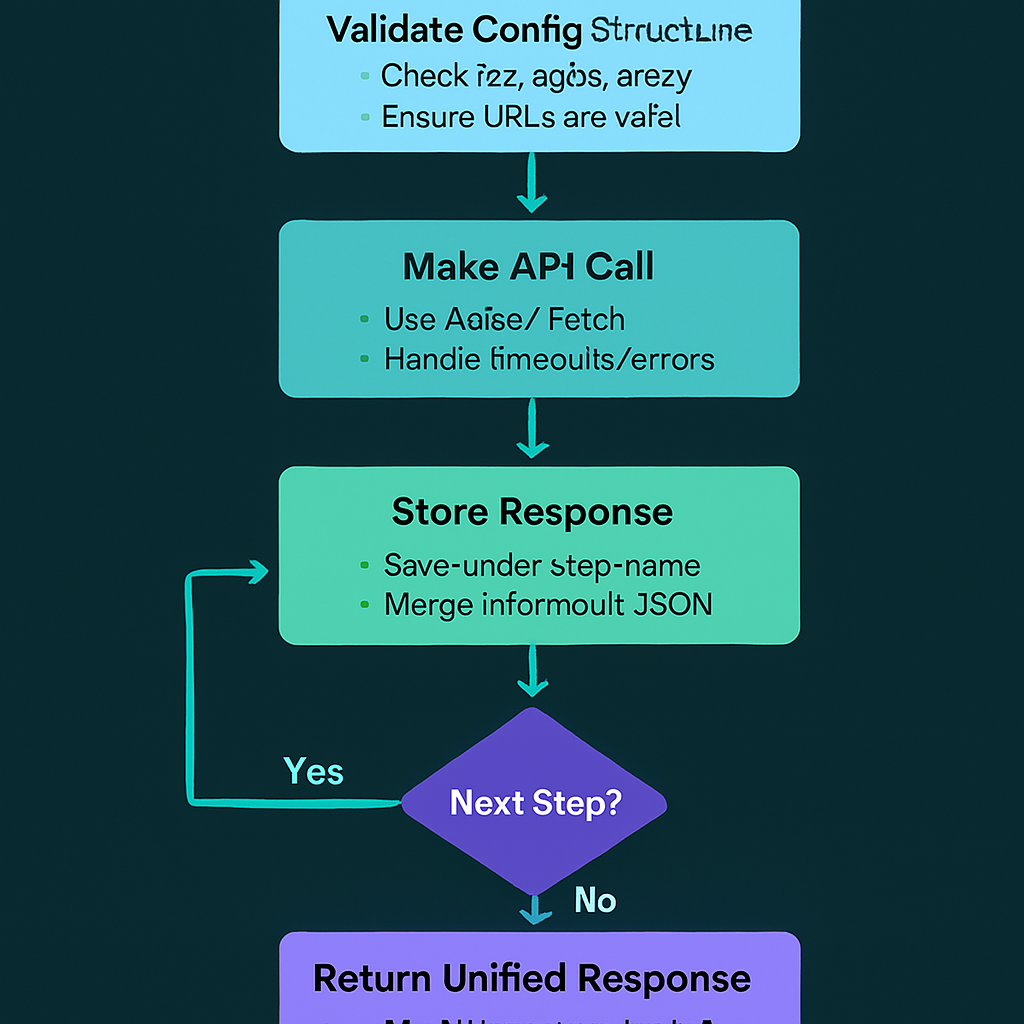
API Composer is a lightweight web platform that allows users to define composite APIs by chaining multiple third-party services into a single endpoint. Users can:
- Create a config file or use a visual builder to define API steps
- Automatically orchestrate calls to services like HubSpot, Stripe, and Zendesk
- Receive a unified JSON response with merged data
- Handle errors, retries, and rate limits gracefully
It’s like Zapier for developers—focused on API response composition rather than automation triggers.
How we built it
The project was built solo over the course of the hackathon using the following stack:
- Frontend: React + TailwindCSS for a clean, responsive UI
- Backend: Node.js + Express for routing and orchestration
- API Layer: Axios for external API calls, with support for chaining and error handling
- Config Parser: A custom parser that reads JSON/YAML configs and executes steps sequentially
- Hosting: Vercel for frontend, Render for backend
The orchestration logic uses a recursive pattern to process each API step and merge results:
async function executeSteps(steps) {
  const results = {};
  for (const step of steps) {
    const response = await axios.get(step.url);
    results[step.name] = response.data;
  }
  return results;
}
Challenges we ran into
- Rate limiting and retries: Some APIs had strict limits, so I had to implement exponential backoff and caching.
- Error handling across chained calls: Ensuring one failed call didn’t break the entire response required careful logic.
- Time constraints: As a solo dev, balancing frontend polish with backend robustness was tough.
- Sponsor alignment: Making sure the project met Celigo’s challenge requirements while staying feasible for demo.
Accomplishments that we're proud of
- Built a fully functional composite API builder from scratch in under 2 weeks
- Created a clean, intuitive UI that non-devs could understand
- Designed a modular backend that can be extended with new connectors easily
- Successfully aligned with Celigo’s challenge and hackathon judging criteria
What we learned
- API orchestration is deceptively complex—handling latency, failures, and data merging requires thoughtful design
- A well-scoped solo project can still deliver startup-level impact
- Sponsor challenges offer great direction, but staying true to user needs is key
- Building for clarity and reproducibility pays off in both demo and documentation
What's next for API Composer: Composite API Builder for SMBs
- Add OAuth support and connector templates for popular services
- Build a drag-and-drop visual flow editor for non-technical users
- Offer exportable OpenAPI specs for generated endpoints
- Launch a freemium model for SMBs to create and host their own composite APIs
- Explore integrations with Celigo’s platform for deeper automation

Log in or sign up for Devpost to join the conversation.