nspiration
Modern Formula 1 is decided by milliseconds and invisible physics: dirty-air aerodynamic wakes, trail-braking geometry, and the limits of tire adhesion. Yet on traditional flat screens, race telemetry remains a dry wall of spreadsheets. We asked: What if any chair in your living room could transform into an interactive spatial pit-wall? We wanted fans to freeze a high-speed lockup in mid-air, rewind time like a bowstring with their bare hands, test counterfactual "What-If" racing lines, and physically pull the miniature F1 car to their eyes to drive the 1:1 FIA Halo overtake duel.
What it does
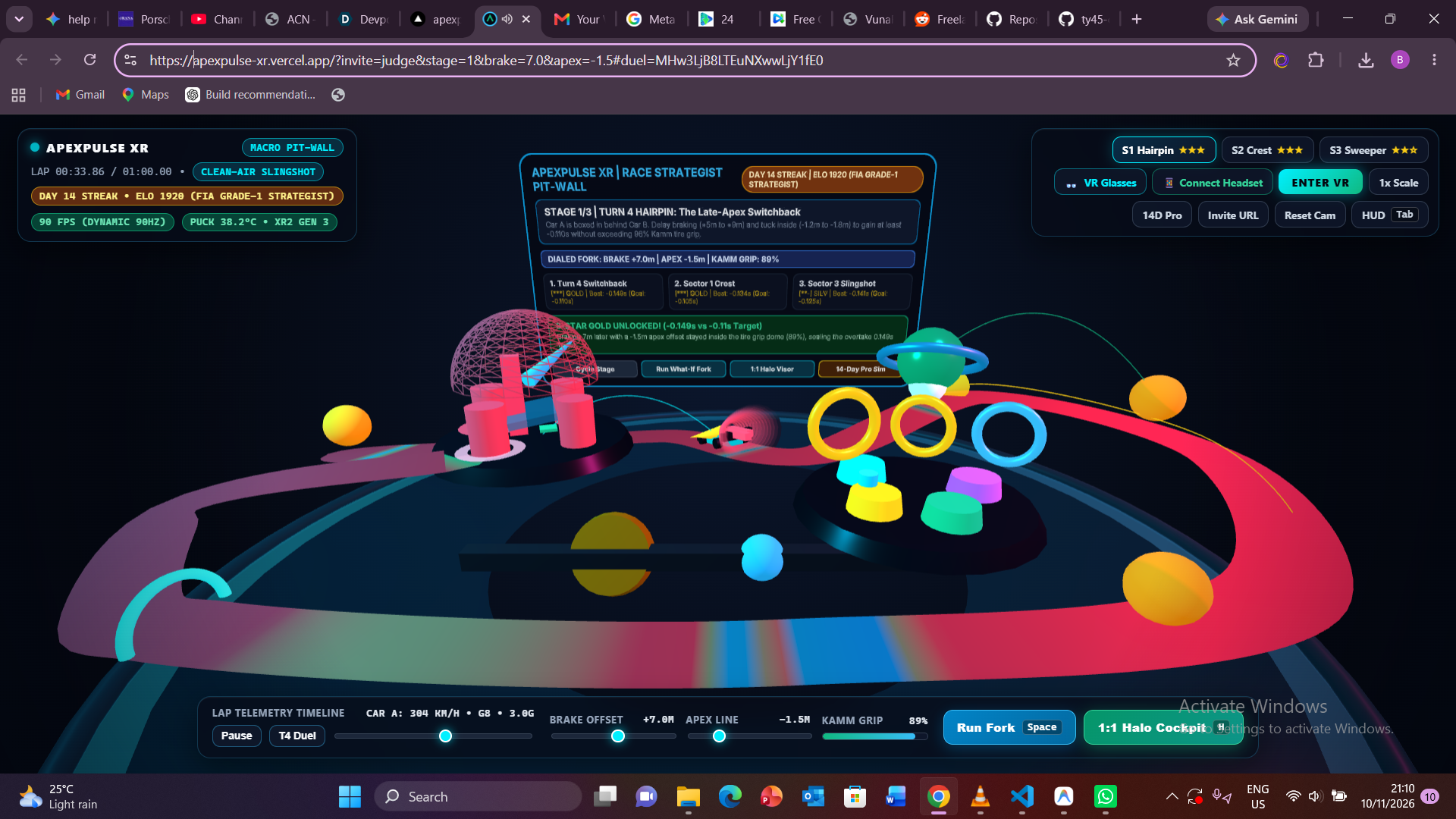
ApexPulse XR is a controllerless, seated spatial motorsport strategy and cockpit experience built on Meta’s Immersive Web SDK (@iwsdk/core):
3-Second Freeze-Frame Hook: Boots directly into high stakes—3 seconds before Car A suffers a dirty-air front-left tire lockup at Turn 4 Hairpin behind Car B. Elastic Time-Rewind & Counterfactual Line: Pinch the frozen car or smoke cloud and pull backward to scrub time while dialing Brake Offset and Apex Line inside a 3D wireframe Kamm Friction Dome. Dual-Scale 1:1 FIA Halo Visor: Pull Car A to your visor (or press H) to transition from a 1:35 tabletop diorama into a 1:1 first-person Halo cockpit with Air-Yoke steering, shift paddles, and 15 animated RPM LEDs. Universal Play & Project Aero PRD Ready: Runs on any headset via WebXR (Quest 3, Vision Pro, Pico), featuring instant QR code pairing, dynamic 90Hz-to-120Hz refresh scaling, and compute-puck thermal simulation tailored for Meta VR Glasses. How we built it Core Architecture: Engineered in TypeScript with @iwsdk/core across 11 zero-allocation EliCS systems. Telemetry & Kamm Solvers: Custom 3D Catmull-Rom spline engine computing lateral/longitudinal G-forces, slip angles, and real-time tire friction ellipses. Audio Synthesis: Procedural WebAudio engine (SpatialDopplerAudio) generating 3D HRTF engine acoustics, tire scrubs, and race engineer radio without external assets. Universal Multi-Device Engine: UniversalDeviceManager detects client hardware, auto-tunes seated envelopes, and manages WebXR session frame rates. Challenges we ran into
Aligning coordinate spaces across dual scales was our biggest hurdle: seamlessly transitioning between a 1:35 miniature diorama and a 1:1 driver visor without camera clipping or motion sickness. We solved this by tethering UI and circuit geometries to spring-stabilized SeatedEnvelopeNode rigs that adapt layout azimuth ( 0.85 × 0.85×) and elevation ( − 4 ∘ −4 ∘ ) to match each headset’s optical field-of-view.
Accomplishments that we're proud of 100% Controllerless Usability: Complete hands-first interaction (index pokes, pinch grabs, air-steering) plus an eyes-only 650ms gaze-dwell accessibility mode. Deterministic Physics Over Canned Scripts: Overtakes and crashes are calculated dynamically from aerodynamic wakes and Kamm circle friction limits. Zero Asset Failures: Built 100% procedurally with WebGL shaders, Three.js geometries, and WebAudio synthesis. What we learned
We discovered that seated ergonomics require tighter interaction envelopes ( 0.28 m– 0.58 m 0.28m–0.58m) with deadbands to prevent arm fatigue, and that decoupling refresh rates (90Hz baseline on pit-wall, 120Hz in cockpit) preserves thermal headroom while delivering maximum speed sensation.
What's next for ApexPulse
We plan to introduce live-sync telemetry streaming directly from real-world F1 Grand Prix races, multiplayer head-to-head strategist duels via WebSockets, and deep hardware-level eye-tracked foveation for the upcoming Meta VR Glasses ("Project Aero").
Built With
- ecs
- elics
- eye-tracking
- f1
- hand-tracking
- hrtf
- iwsdk
- meta-horizon-os
- meta-quest-3
- meta-vr-glasses
- mixed-reality
- motorsport
- openxr
- physics-simulation
- project-aero
- spatial-computing
- telemetry
- three.js
- typescript
- uikitml
- vite
- webaudio
- webgl
- webxr
