-
-
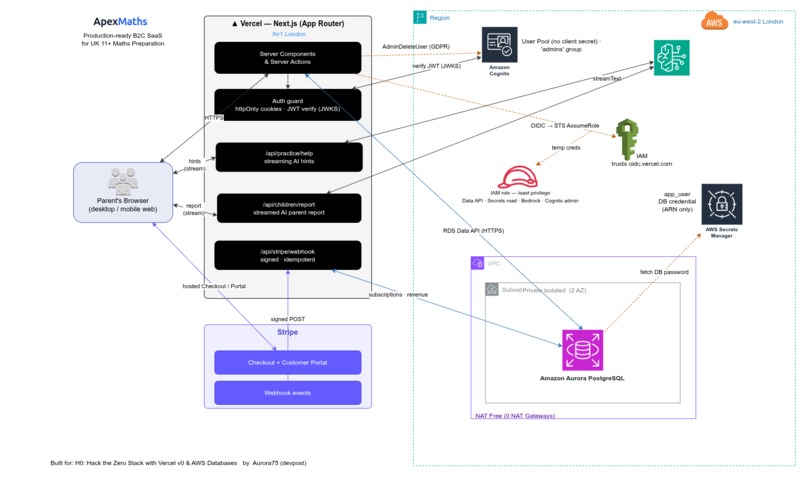
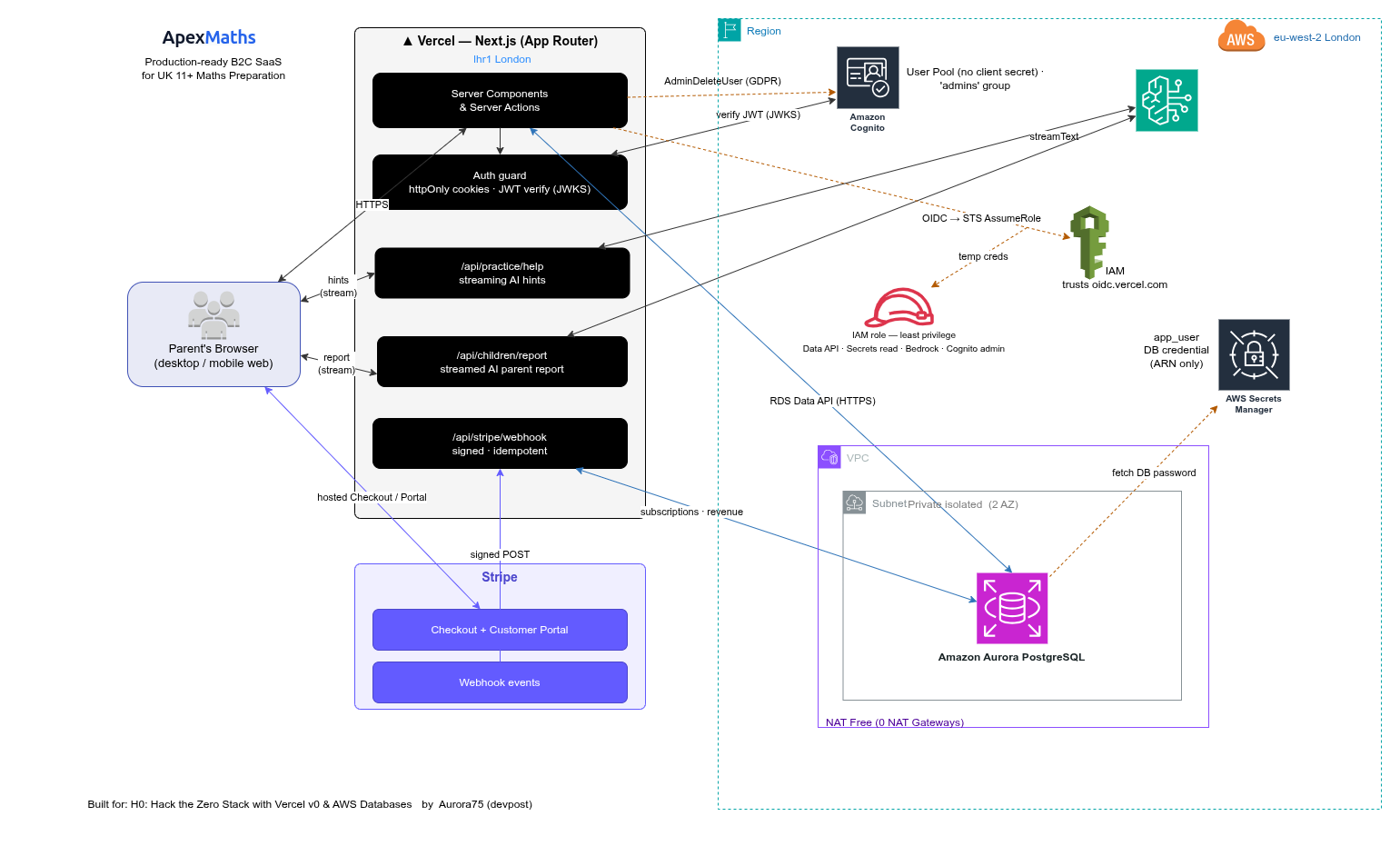
App architecture diagram
-
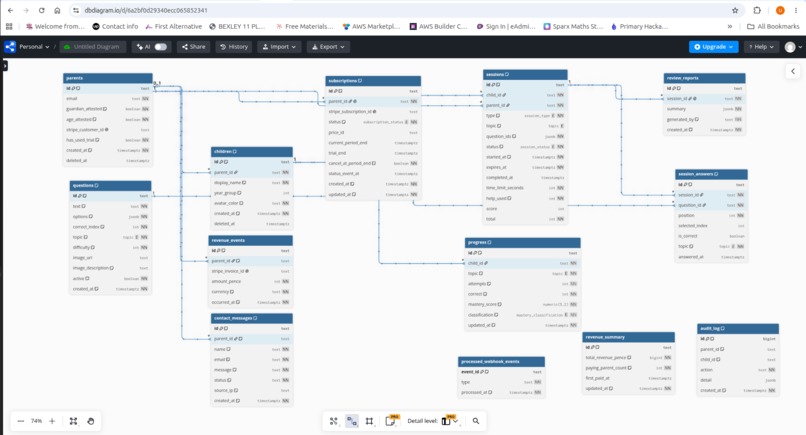
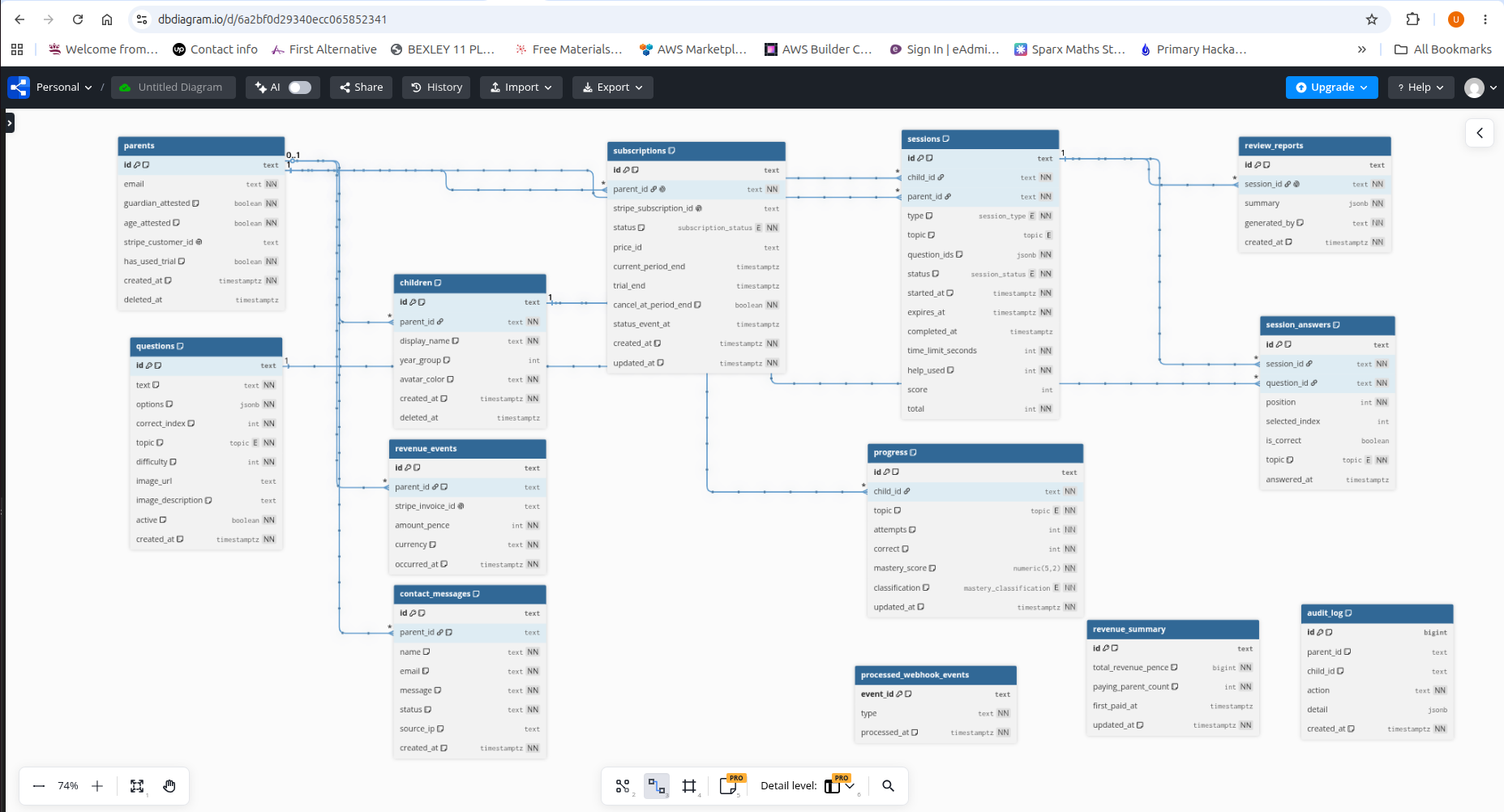
Aurora PostgreSQL diagram
-
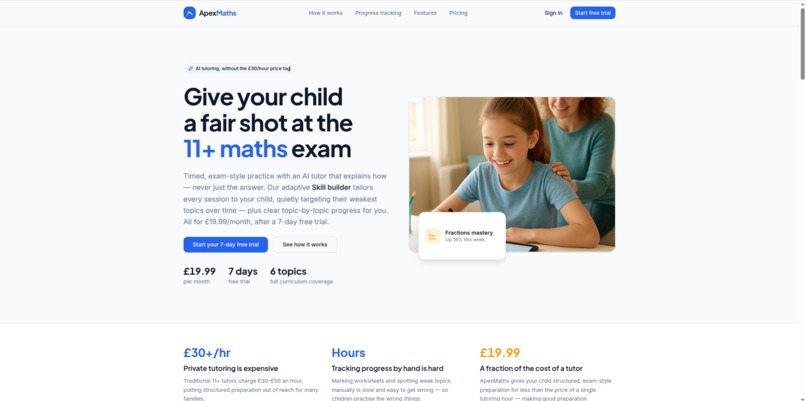
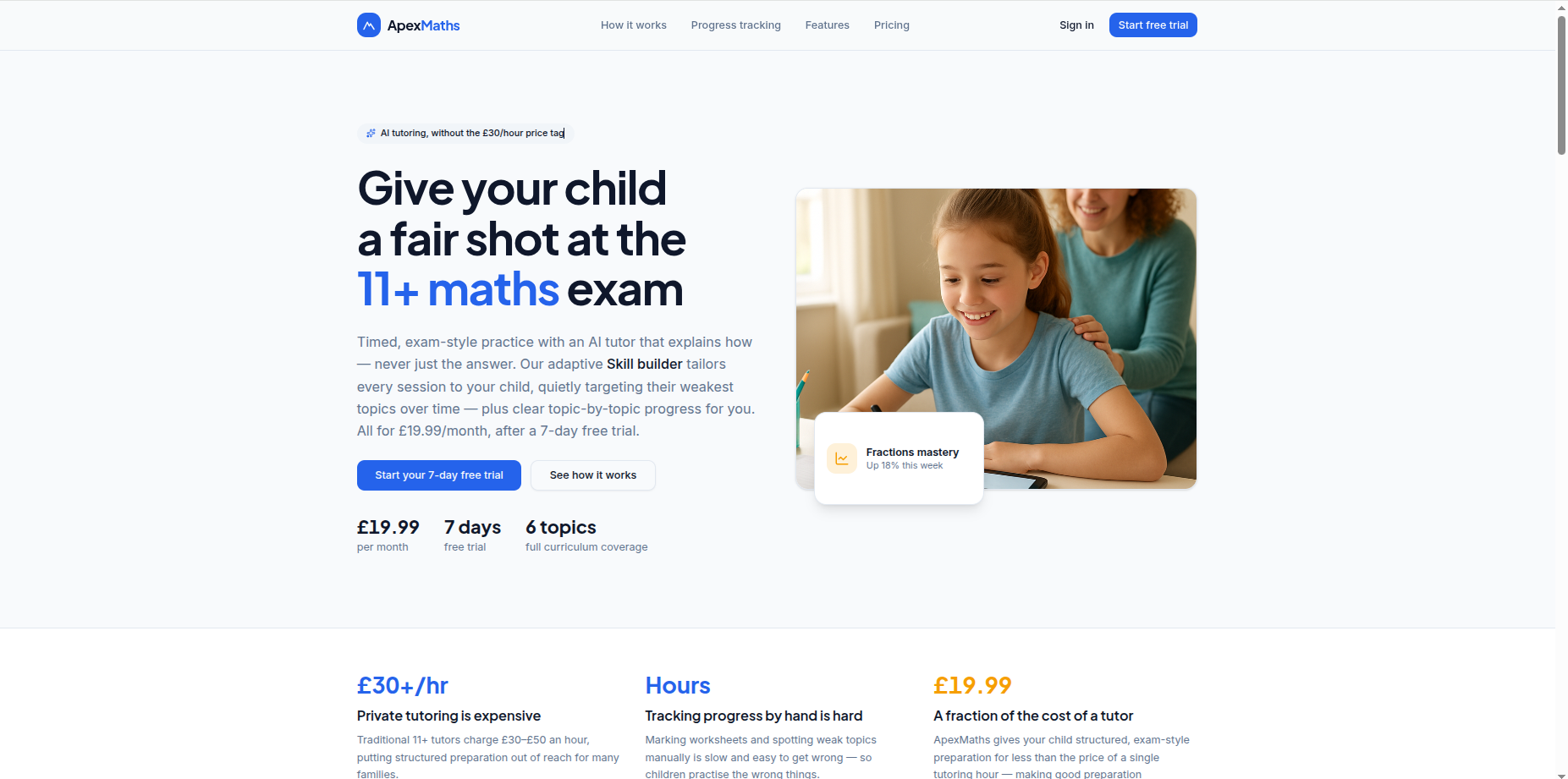
Hero
-
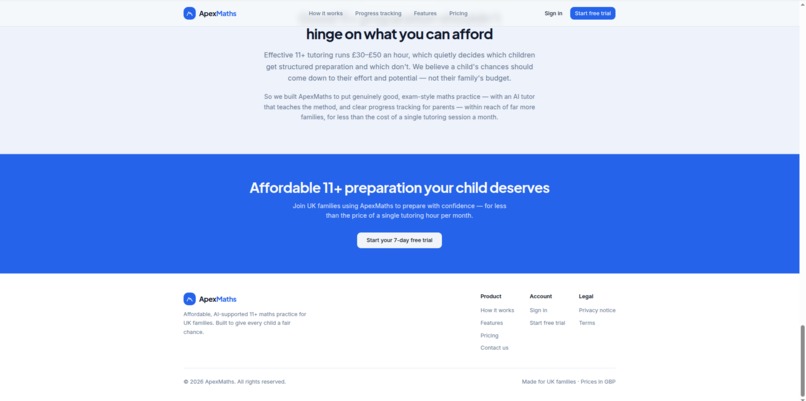
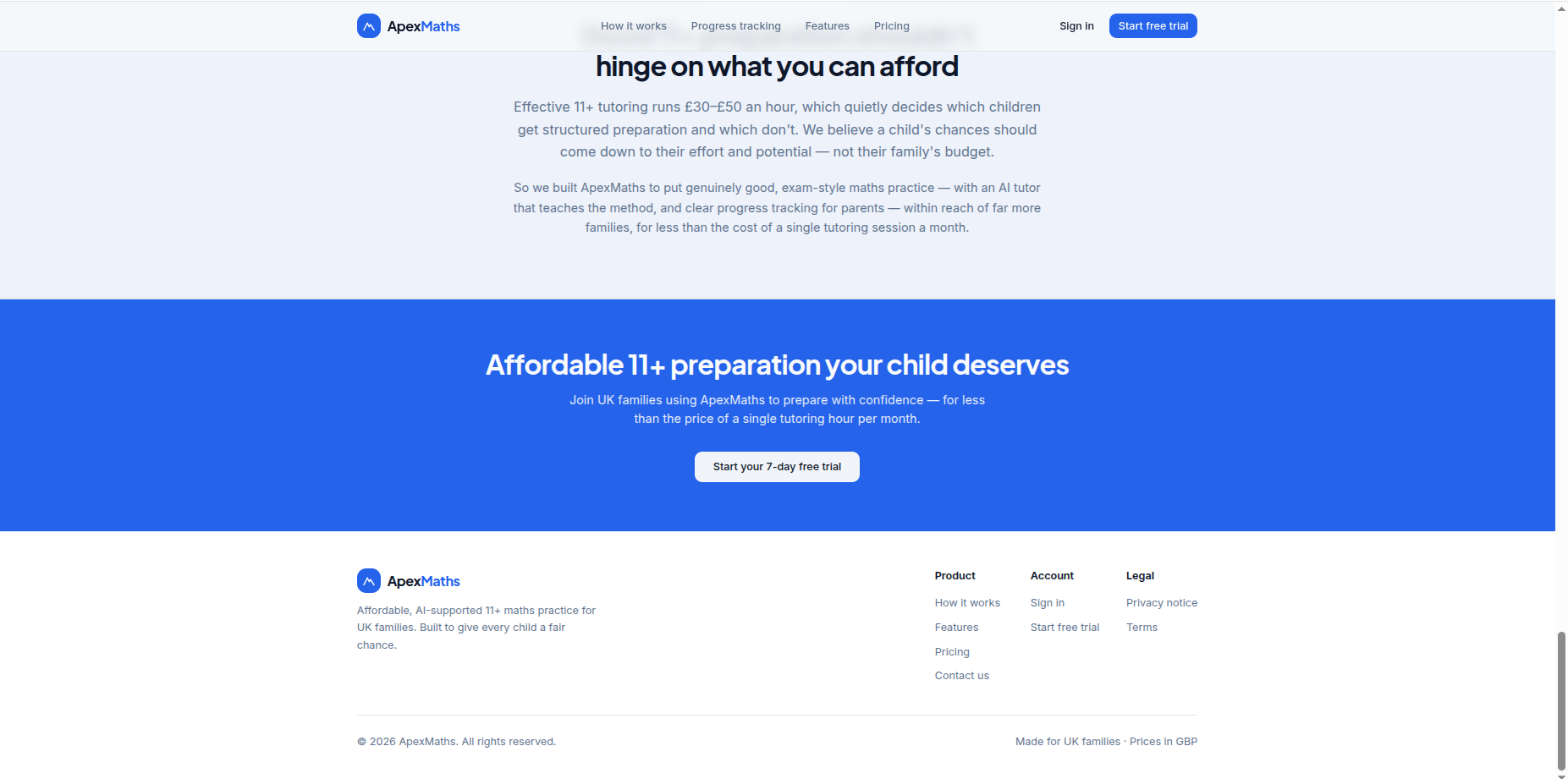
Why I build it ?
-
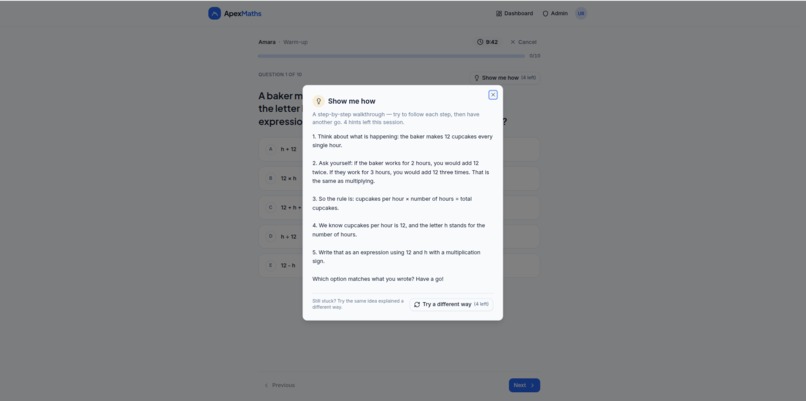
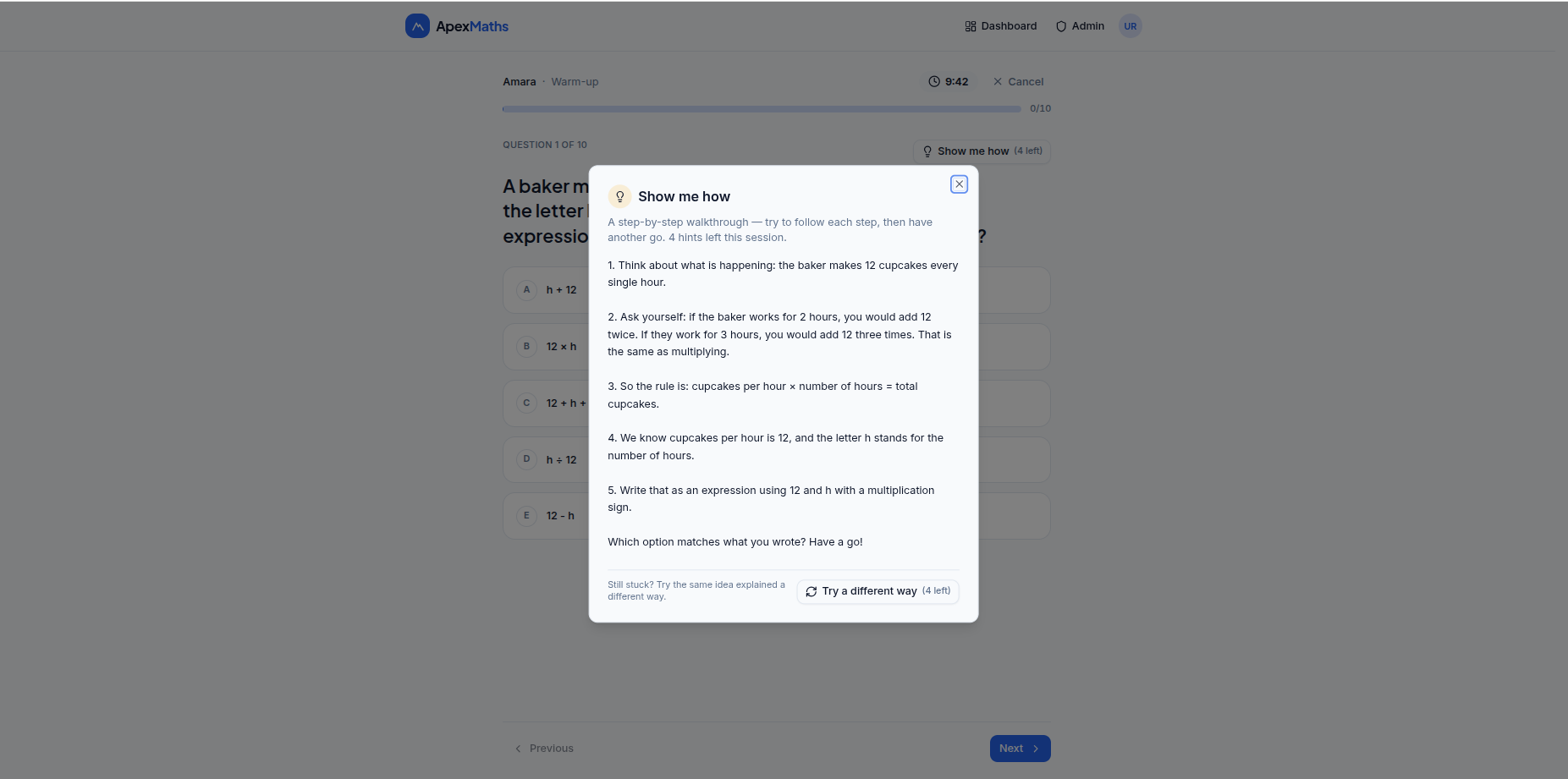
AI - show me how
-
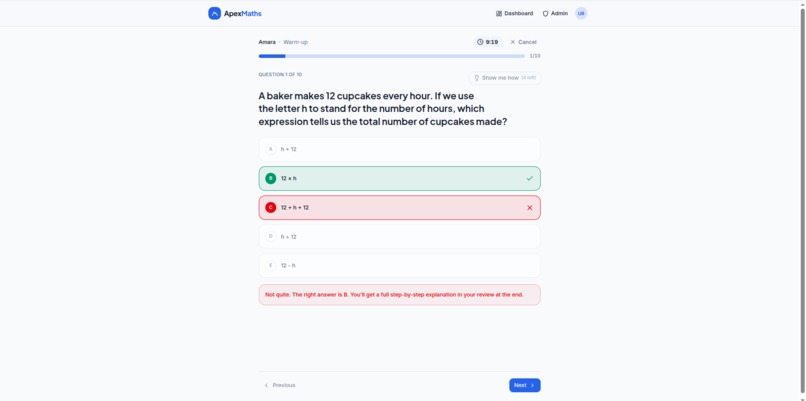
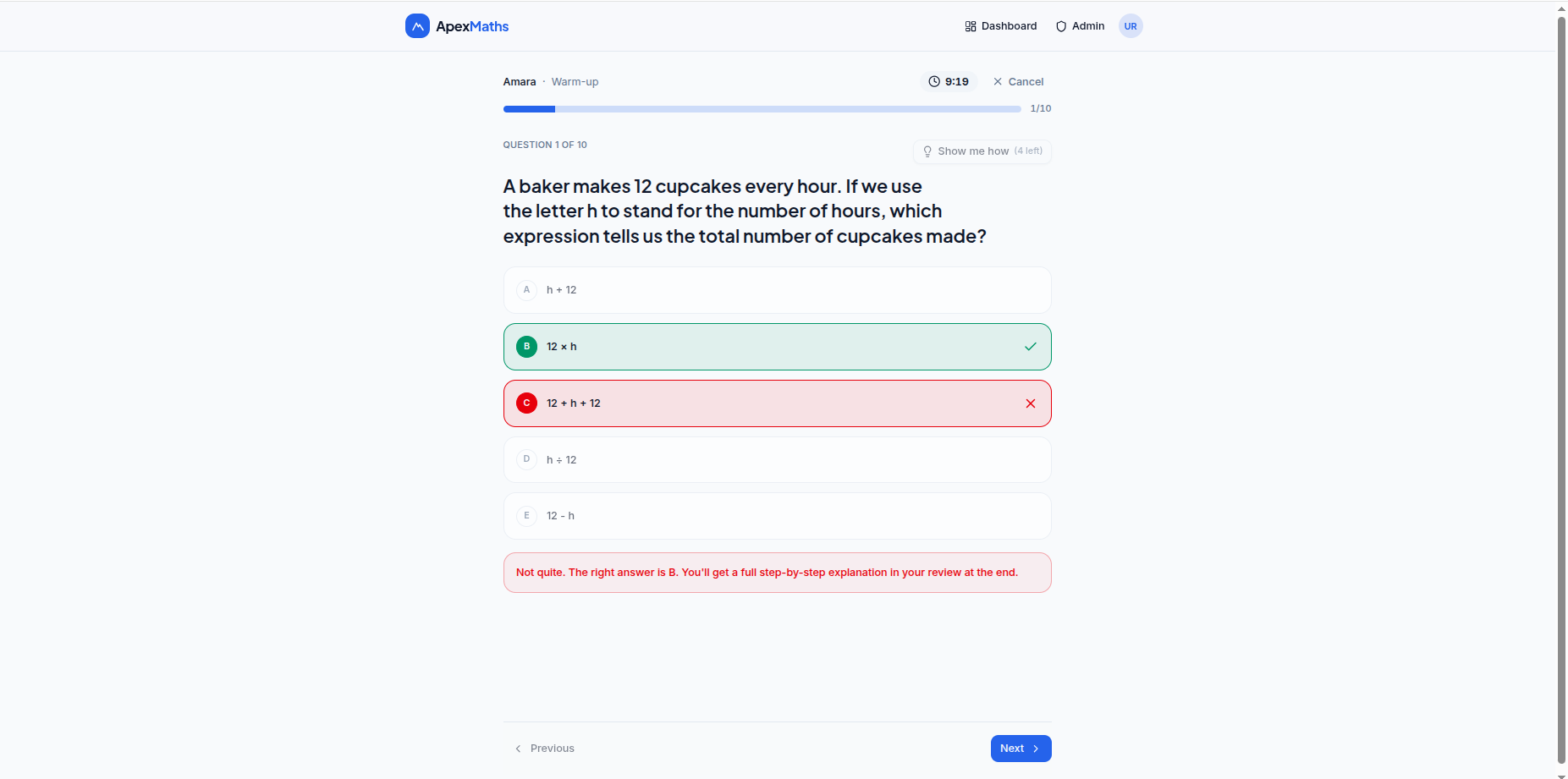
Question
-
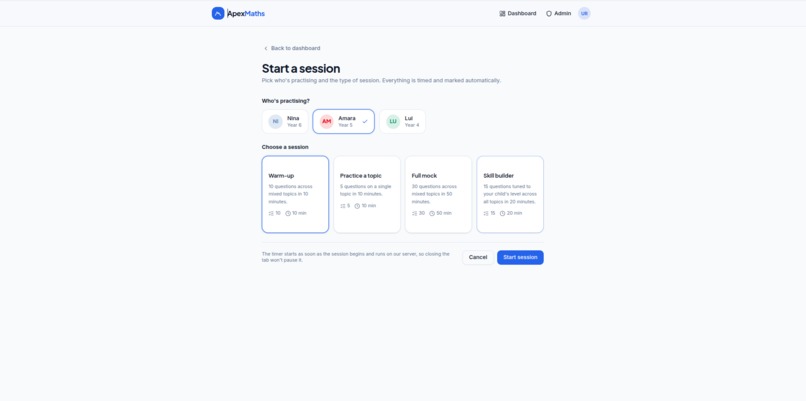
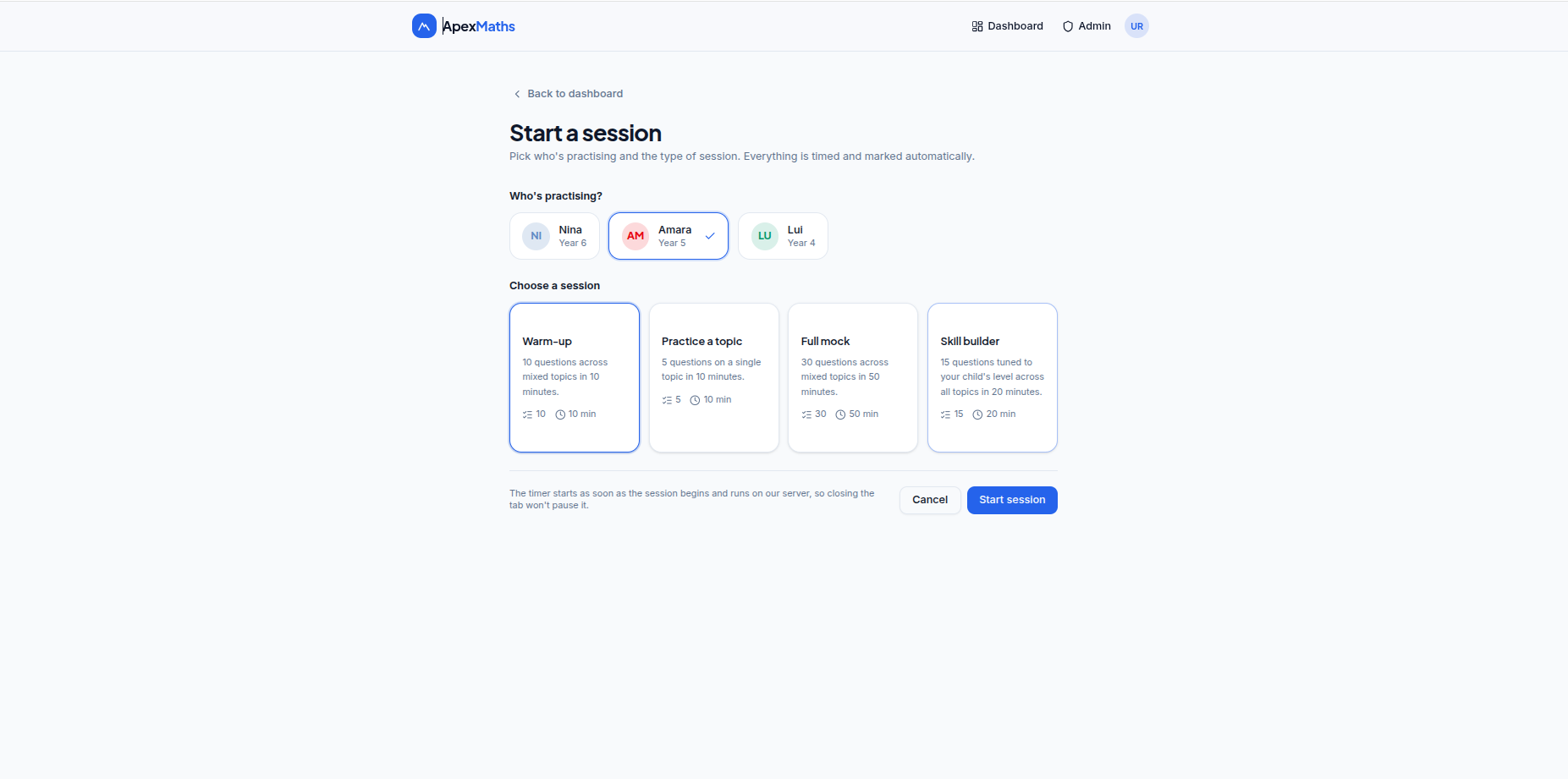
Learning sessions
-
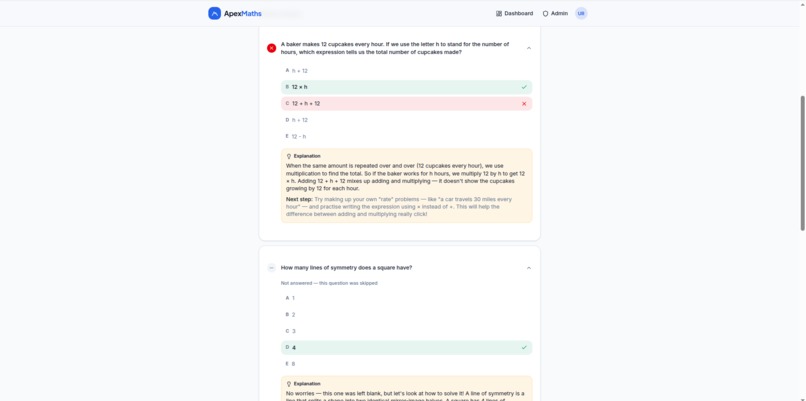
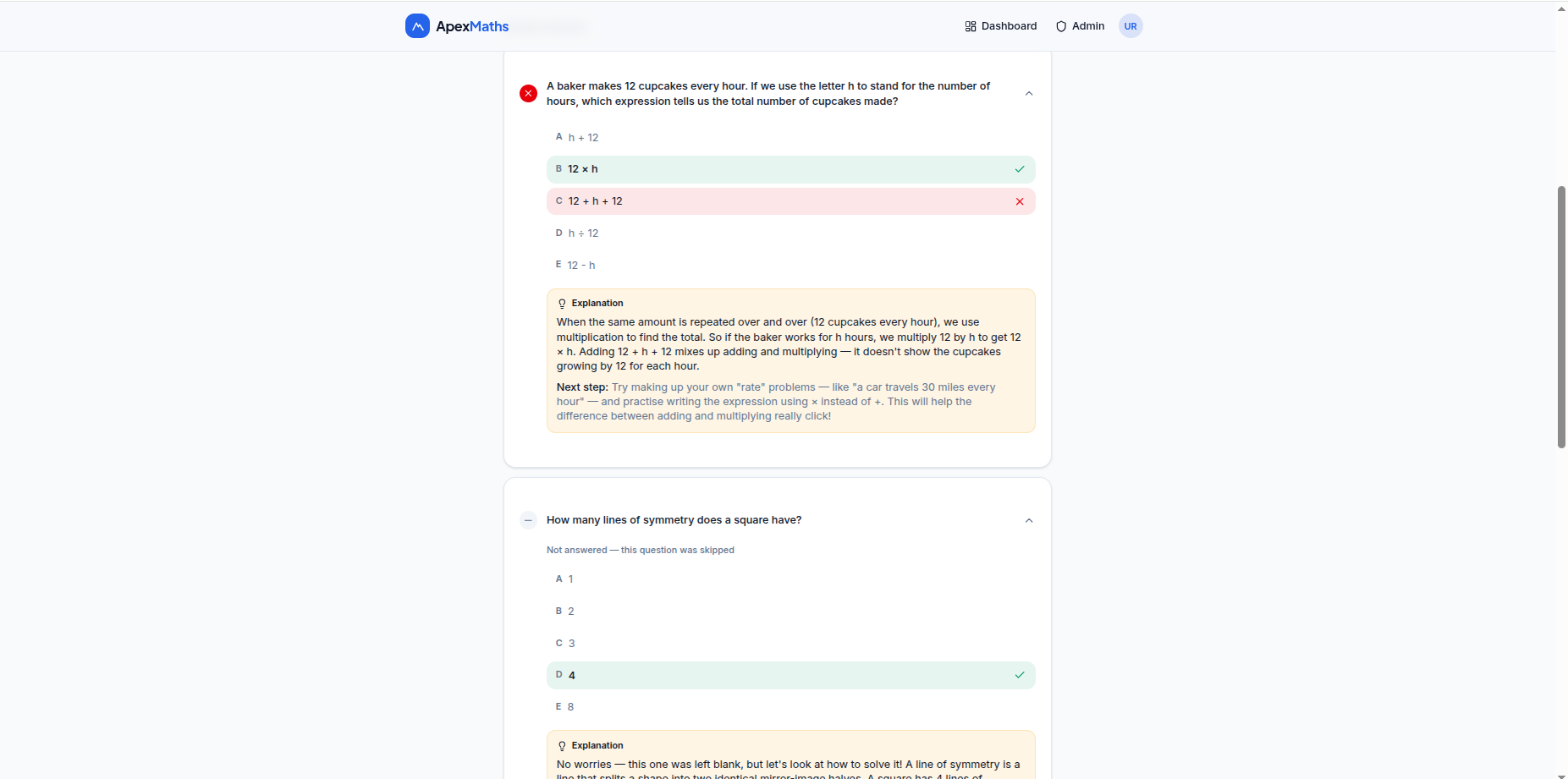
Post session review
-
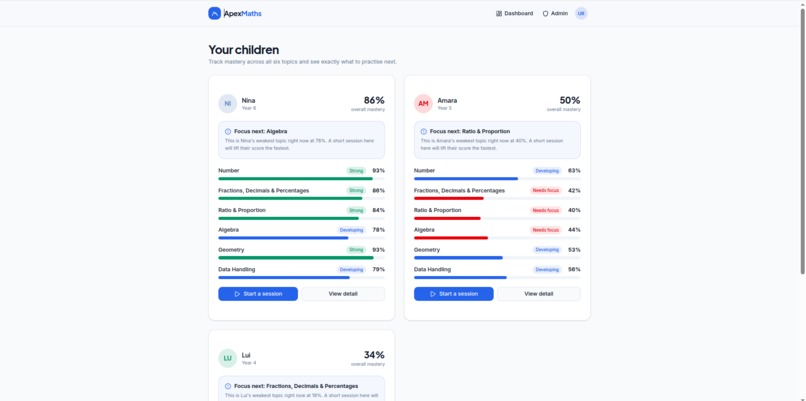
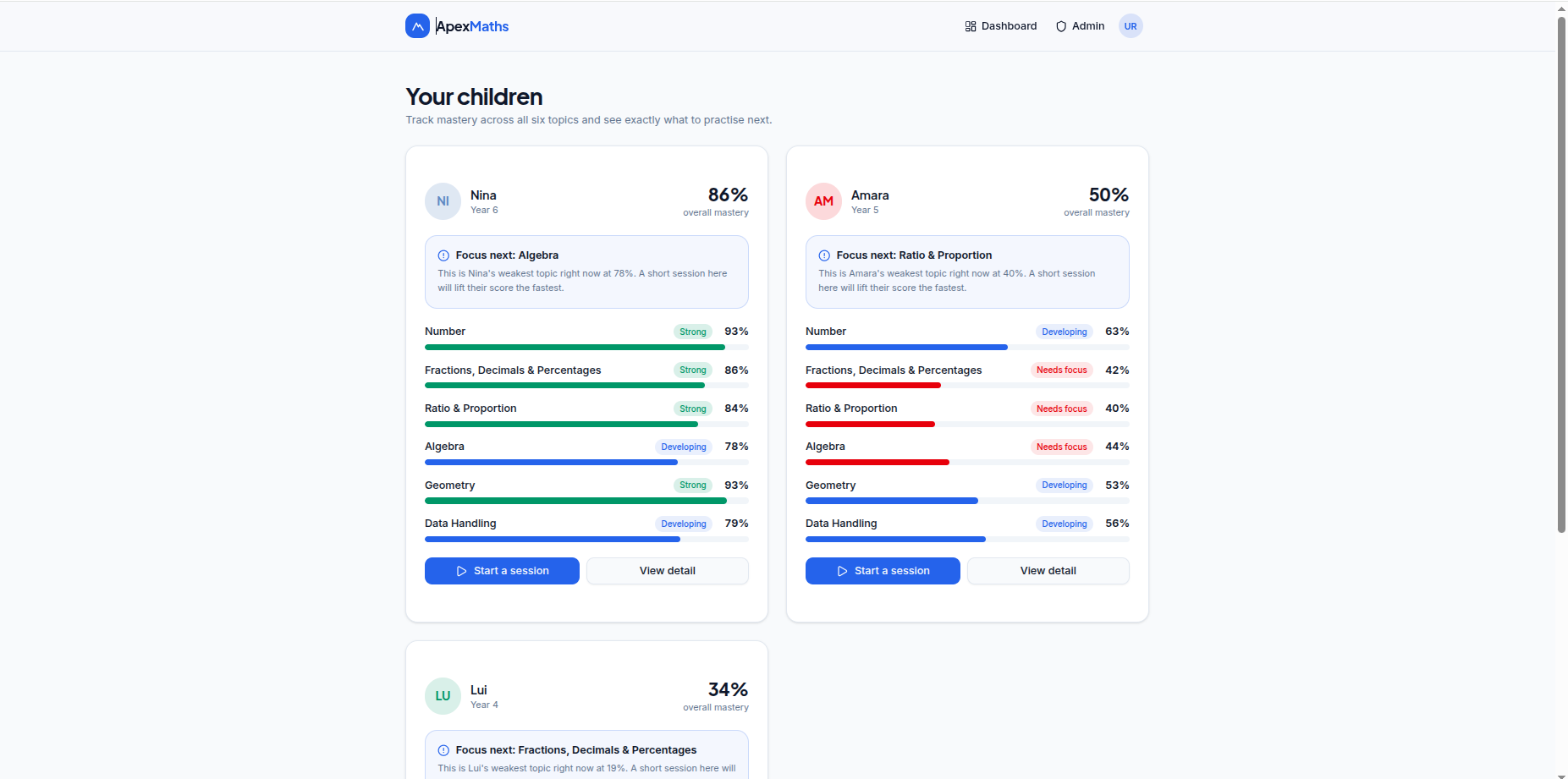
Parent Dashboard
-
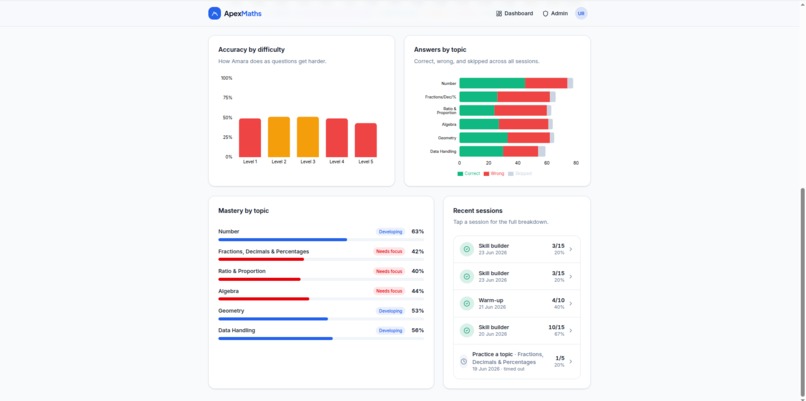
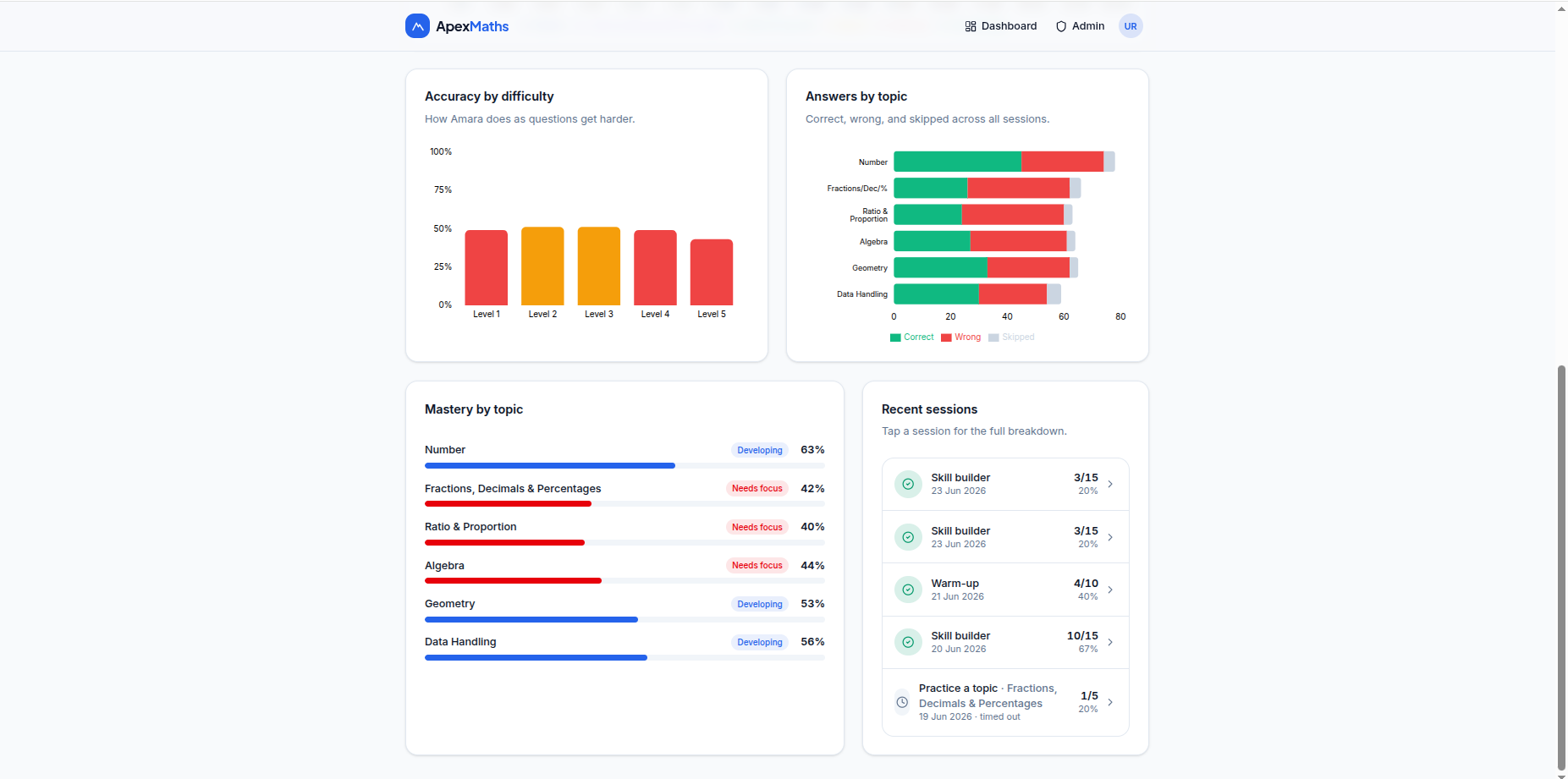
Progress trucking analytics
-
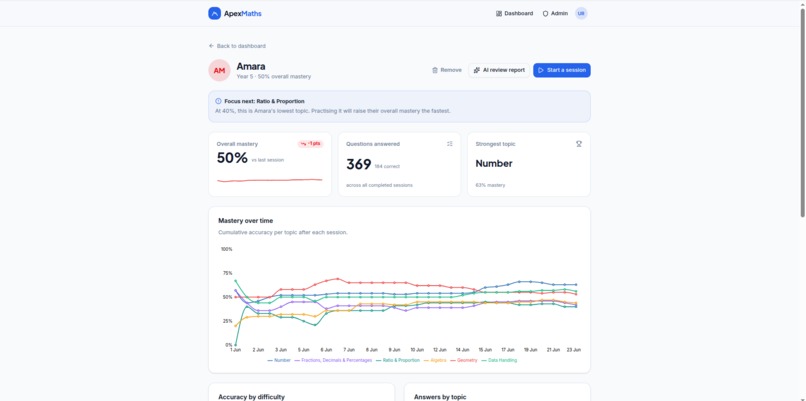
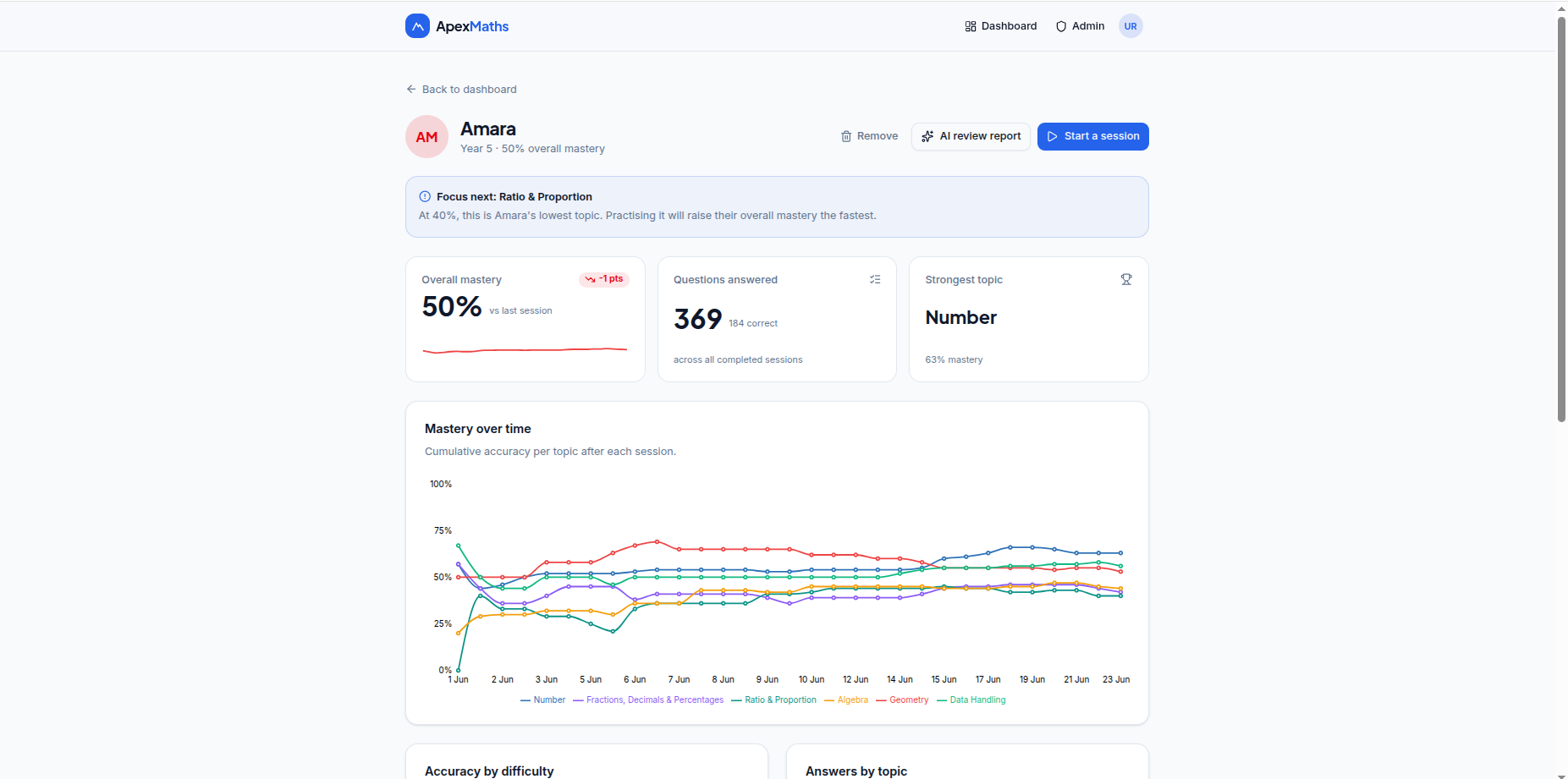
Progress trucking analytics 1
-
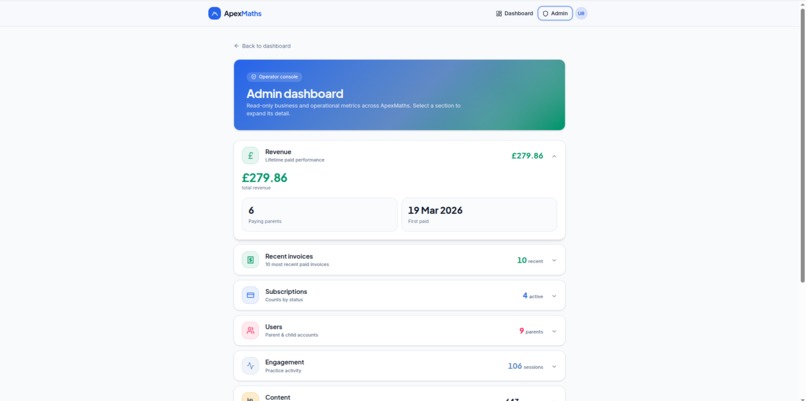
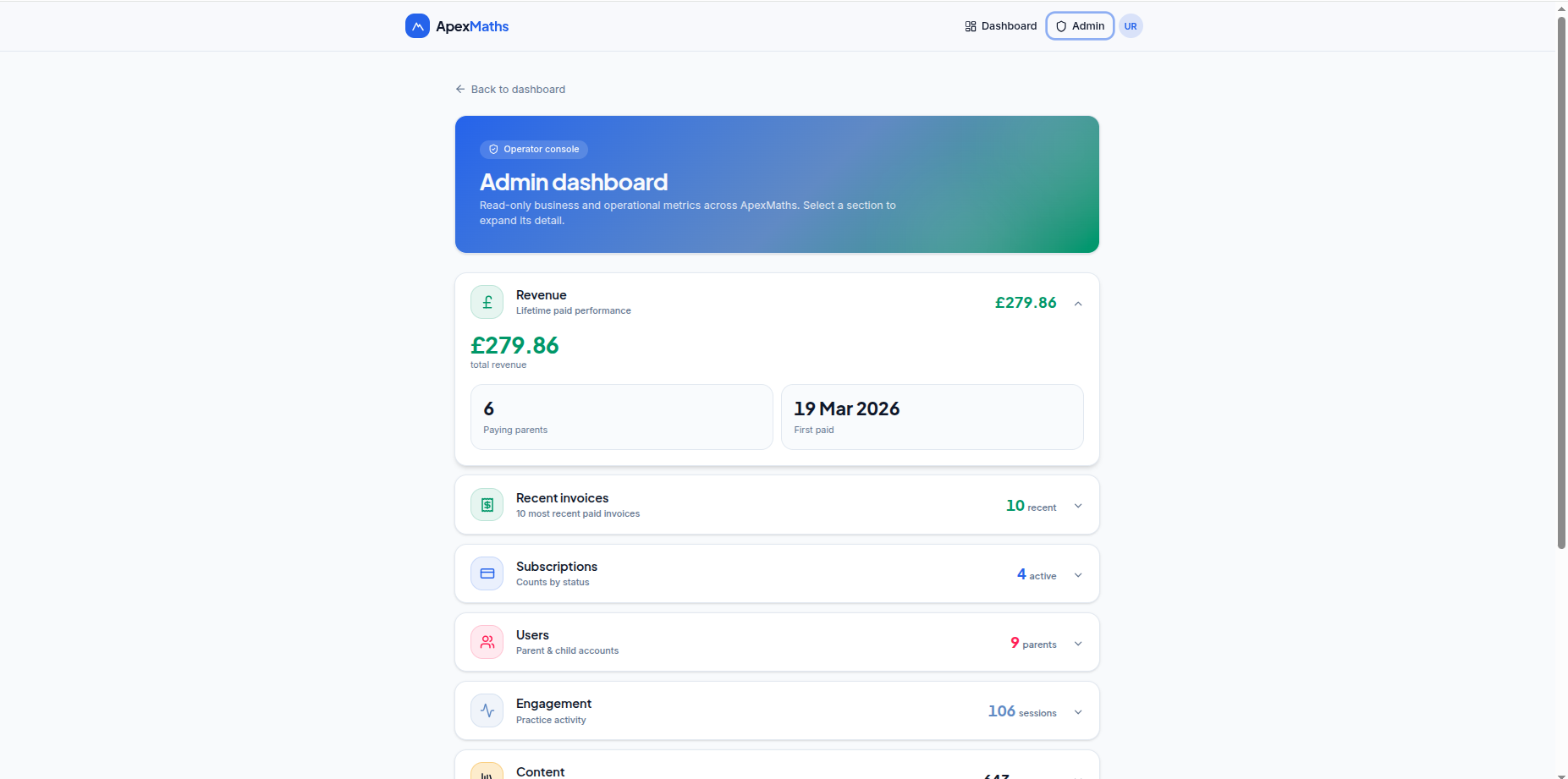
Admin Dashboard
-
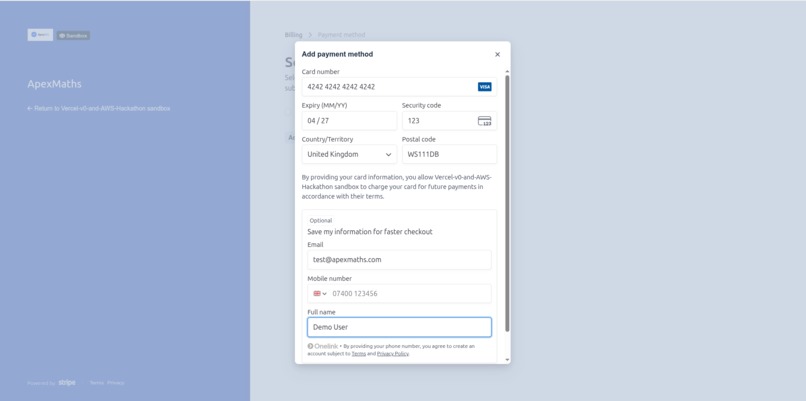
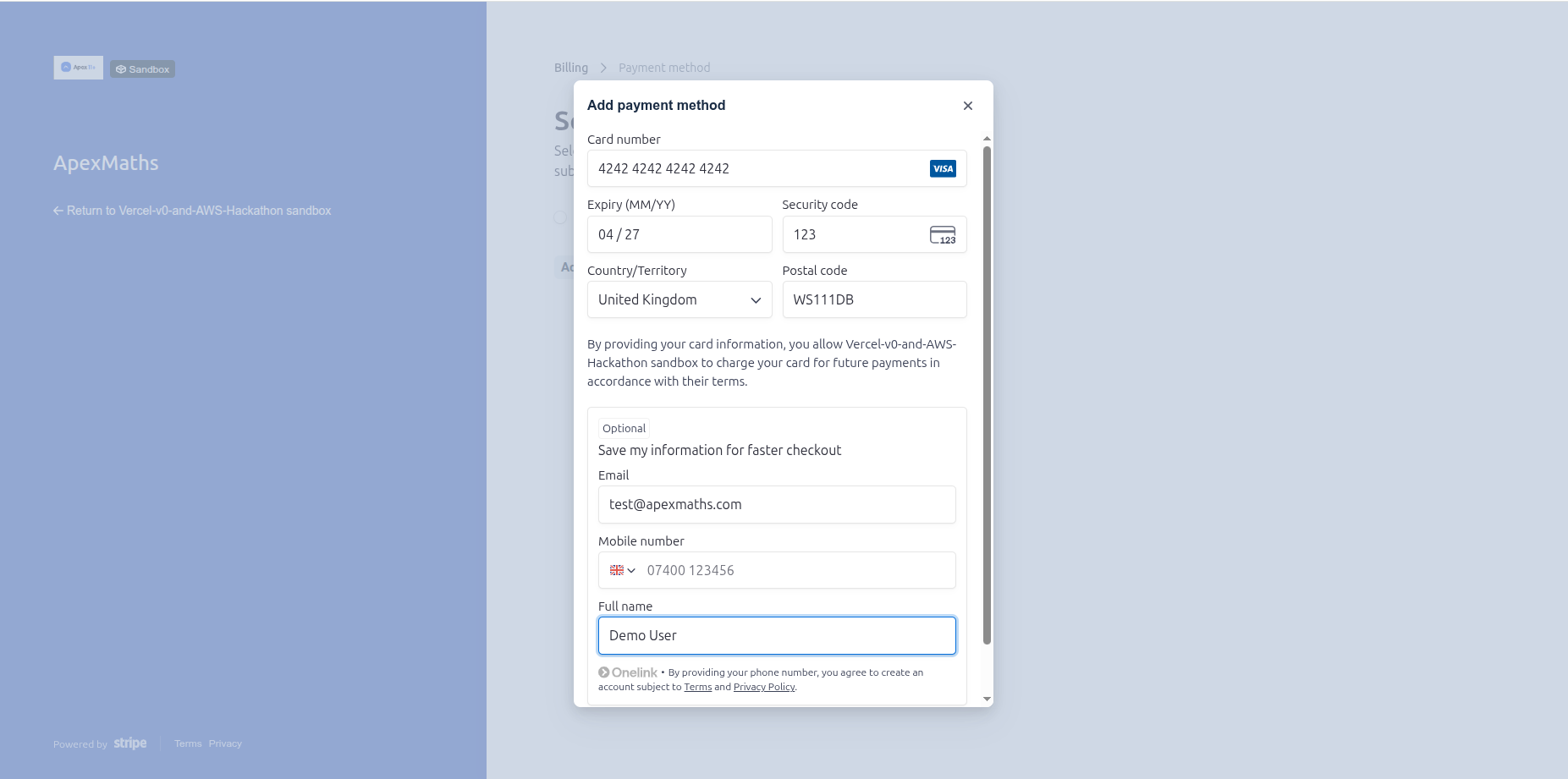
stripe sandbox mode 1
-
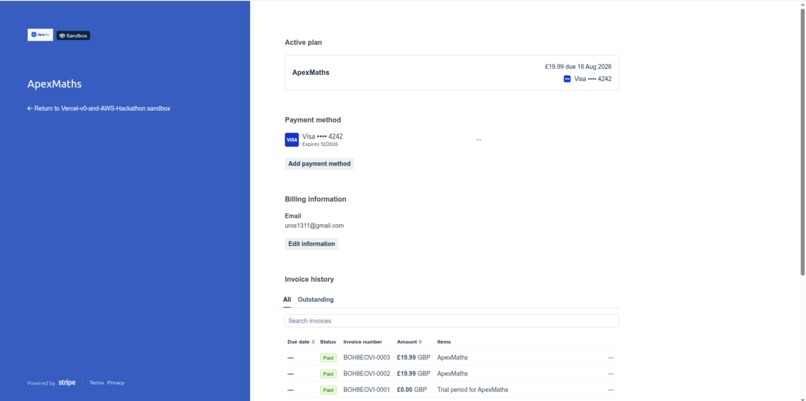
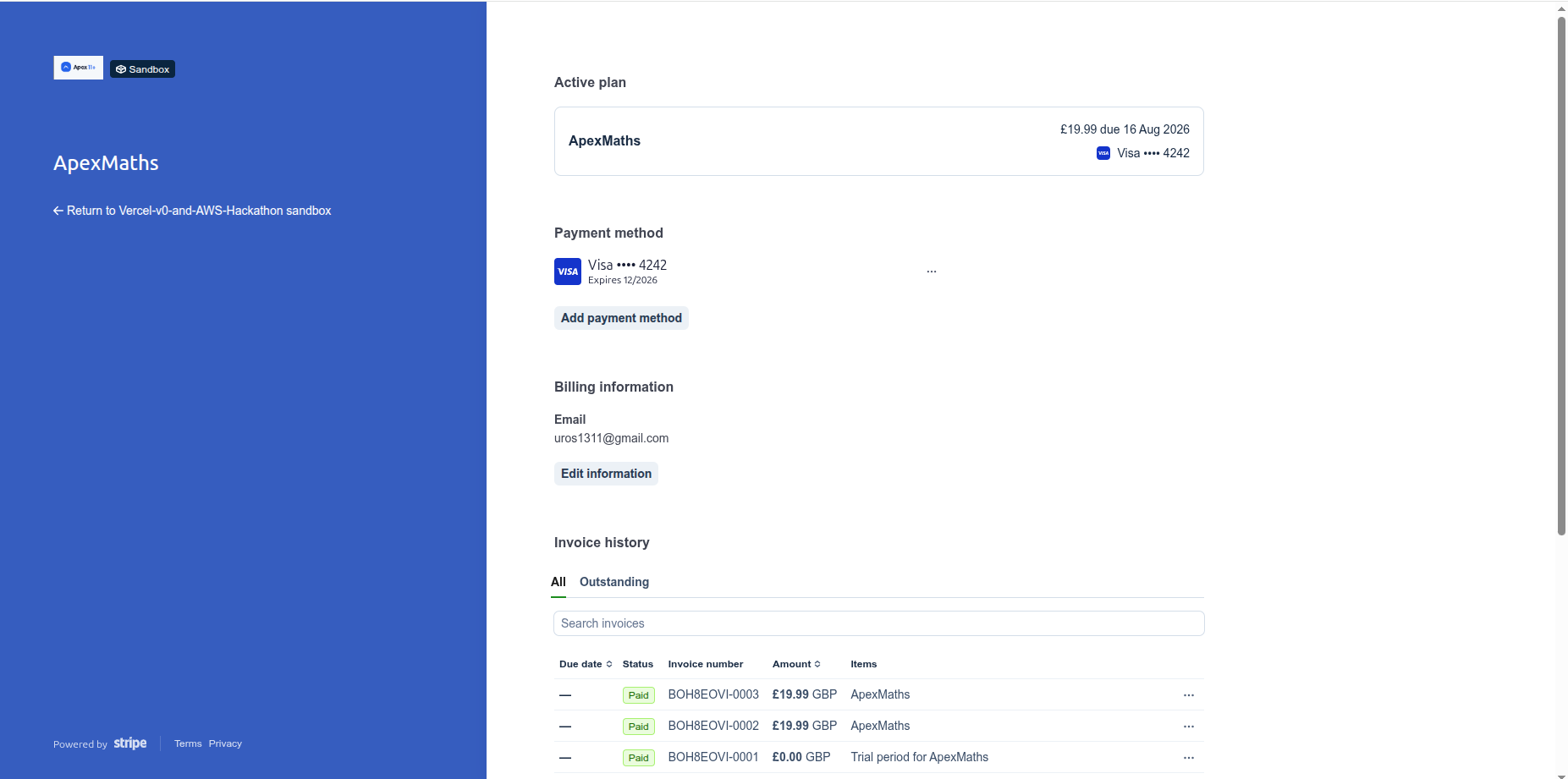
stripe customer portal
ApexMaths — About the project
Why I build it
I have 3 kids, and I prepared both of them for the 11+ exam for Grammar schools. I didn't do it with a tutor. Good 11+ tutoring runs into the thousands of pounds, and I couldn't justify that, so I did it myself: printed papers, blue and red pen, and a lot of late evenings.
The teaching wasn't the hard part. Marking and tracking progress was.
Three things were the hardest, and all three are software problems hiding as parenting problems:
- Silly mistakes destroy your data. 11+ multiple-choice options are deliberately close. Sometimes my child would clearly understand a problem but tick the wrong box. As a parent you know they "really" got it — so do you give the mark or not? Either way, one judgement call at a time, your record of how they're doing quietly becomes fiction.
- You can't see the shape of the weakness. Is she weaker at algebra or at geometry? Across twenty mixed papers, by hand, that's unanswerable. You end up guessing.
- You can't see movement. "Is he actually improving since last month?" is, at best, an educated guess when your evidence is a stack of paper.
And the thing I wanted most was impossible on paper entirely: a practice session that adapts to what the child knows right now — questions on the child's weakest topics, pitched at a difficulty that helps them build skills and make steady progress without hitting a wall.
I'm a software engineer. The whole time I kept thinking there has to be a better way to do this. ApexMaths is that better way. Everything I learned doing it the hard way is built into the product.
The belief underneath it: a child's chances should come down to their effort and potential — not whether their parents can afford a tutor.
What it does
A parent adds up to three children and picks a practice mode — a quick warm-up, a single-topic drill, a full timed mock, or the adaptive Skill Builder. The child answers; when they're stuck, an AI tutor streams a step-by-step method without ever giving the answer away. At the end the score is instant, every wrong answer gets an AI explanation, and the parent gets a dashboard — mastery over time, accuracy by difficulty, strengths and gaps — topped with an AI-written summary in plain English, because parents need answers, not more charts.
It's a real, monetizable product: Cognito accounts, Stripe subscriptions, an operator/admin console, and UK GDPR compliance are all built and running — not mocked.
How I built it
Vercel is the entire backend. There's no separate API server. Every
privileged operation — auth, database, billing, AI — runs server-side in Next.js
Server Components, Server Actions, and Route Handlers on Vercel. The browser is a
thin client that never holds a secret and never sees an answer key: a question
is sent to the client with its correctIndex stripped out, grading is
server-authoritative and idempotent, and the timer is enforced on the server. You
can't cheat the UI because the UI doesn't know anything worth cheating.
The data layer is the heart of it: Amazon Aurora Postgres (Serverless v2), reached over the RDS Data API. This was a deliberate choice, and it's the one I'd defend hardest. My workload is relational to its core — choosing questions, rolling answers into per-topic mastery, reporting across a child's whole history, and erasing an account as a single cascading delete across ten foreign keys. Those are joins, aggregates, and transactions, not a single partition key, so DynamoDB was the wrong tool. And because I serve one UK-only market, I had no need for Aurora DSQL's multi-region distributed writes — Multi-AZ failover is the right durability. The key advantage is the: RDS Data API: it lets a serverless Vercel function reach a private Postgres database over HTTPS with no connection pool to exhaust, no VPC to enter, and no database password in my code — it kills the classic "serverless + relational" failure mode outright.
The schema does the work the engine is good at: window functions and LAG() for
mastery-over-time and improvement velocity, FILTER aggregates for
correct/wrong/skipped, a partial unique index that guarantees one active session
per child even under a concurrent double-submit, and foreign keys with three
different ON DELETE rules so GDPR erasure is one DELETE FROM parents.
Security with no standing secrets. Vercel reaches AWS through OIDC
federation — it presents a short-lived token that's exchanged for temporary IAM
credentials. There are no static AWS keys anywhere. The app holds only the
Secrets Manager ARN, never the password; and the role can only reach a dedicated
app_user database role with DML-only grants — never the schema owner. Least
privilege at both the AWS layer and the database layer.
AI: one model, three jobs. Everything — the streaming tutor hints, the per-question review, and the parent report — runs on Claude Sonnet 4.6 via Amazon Bedrock, resolved through a single accessor so the call sites can't drift, and invoked through the EU regional inference profile co-located with the functions in London. A strict PII firewall means prompts carry maths content and a year group only — never a name, email, or id.
Identity & billing. Cognito owns sign-up, verification, and JWTs (no client secret); admin access is gated solely by a Cognito group claim and fails closed (non-admins get a 404, so the admin area is invisible). Stripe runs Checkout and the Customer Portal; the webhook is signature-verified and idempotent, with subscription status driven only by subscription events and revenue only by paid invoices.
All of it is defined in AWS CDK, and the correctness-critical logic is covered
by property-based tests with fast-check.
The adaptive engine
The Skill Builder is a pure, deterministic, I/O-free function with an injected seeded RNG, behind a thin data service — which is exactly why I could property-test it instead of hoping it worked.
It concentrates practice where the child is weakest. For each attempted topic with mastery $$m_t \in [0, 100]$$ the weight is inverse-mastery:
$$w_t = \big(\max(100 - m_t,\ \varepsilon)\big)^{\gamma}, \qquad \gamma = 1.5$$
Those weights are turned into whole-question counts per topic with the Hamilton largest-remainder method plus a coverage floor, so every topic stays warm and the counts sum exactly to the session length.
Difficulty targets the child's zone of proximal development — the band where they're challenged but not crushed. Among the difficulty levels they've actually attempted, with measured accuracy $$a_d$$, it picks
$$d^{*} = \arg\min_{d}\,\bigl|\,a_d - 0.75\,\bigr|$$
aiming at ~75% accuracy, with a recency rule to avoid repeats and a fallback chain that still fills the session if a weak topic is nearly exhausted. The same relational analytics that report progress now drive what the child practises next — so as the product gets smarter, the database does more work, not less.
And the "silly mistake" problem that broke my paper system? A topic isn't classified until there are at least ten graded attempts, and mastery is a cumulative ratio $$m_t = 100 \cdot c_t / n_t$$— so one unlucky tick can't swing the verdict the way it did with my red pen.
Challenges I actually hit
- The parent report wouldn't stream. I wanted the report to render
progressively, but the Bedrock provider buffers structured/tool output and
emits it in one chunk at the very end —
streamObjectnever actually streamed. The fix: stream the report as raw JSON overstreamTextand parse the partial JSON on the client. "Stream the text, parse the object." It now renders from ~1s instead of ~16s. - Latency where it's felt. AI is slow relative to a tap. So I stream where the
user is watching (hints, report) and pre-compute off the critical path where
they're not: the post-session review runs inside Next.js
after(), bounded by a timeout and an overall budget, degrading to deterministic text so it can never hang. The score shows instantly; explanations arrive behind it. - A sharp Data API edge. The RDS Data API binds every parameter as a string,
so a real
uuidcolumn compared against a bound string fails withoperator does not exist: uuid = text. I made every id aTEXTcolumn by design — small decision, saved a lot of pain. - Making "adaptive" trustworthy. Personalisation is easy to get subtly wrong. Keeping the selection core pure let me assert real invariants as properties: allocation always sums to the target, no question repeats within a session, and it returns a full session whenever enough distinct questions exist.
Accomplishments that we're proud of
- I shipped it solo, and it's past MVP. Real Cognito accounts, real Stripe subscriptions, an operator/admin console, and UK GDPR erasure — built and running, not stubbed.
- A serverless frontend talking to a private relational database with no connection pool, no VPC entry, and no database password in the code — the "serverless + relational" failure mode, designed out.
- Zero standing AWS secrets. OIDC federation for short-lived credentials, and
a least-privilege
app_userthat can't even read the schema-owner secret. - An adaptive engine that isn't a black box — a pure, deterministic core with invariants I can prove with property-based tests, not just hope for.
- I beat the Bedrock streaming limitation ("stream the text, parse the object") so the parent report renders from ~1s instead of ~16s.
- An honest Well-Architected review that names its own gaps instead of hiding them.
- And the one that actually matters to me: a parent can now get tutor-grade insight into their child's progress for the price of a couple of coffees a month.
What I learned
- Pick the database for the access patterns, not the hype. Saying why Aurora — and why not DynamoDB or DSQL — taught me more than any feature did.
- The RDS Data API is the unlock for serverless + relational. No pool, no VPC, no password is genuinely freeing.
- OIDC federation beats access keys — once it clicked, putting a long-lived key in an environment variable started to feel archaic.
- Property-based testing earns its keep the moment logic gets non-trivial.
- And the product lesson: data without interpretation doesn't help a tired parent — the AI summary that reads the dashboard for you is the feature my past self actually needed.
I wrote an honest Well-Architected self-review (submission/well-architected.md)
that lists the gaps too — single-region, logs-only observability, no edge WAF yet
— because pretending there are none would be the least engineering thing I could do.
What's next for ApexMaths
The hardest version — making it work brilliantly for one family — is done. The next step is making it work for many.
- Parent groups & community. Let parents form a group — a school year cohort, a tutoring circle, or just a few friends — with opt-in shared progress, gentle friendly comparison, and group challenges and streaks to keep children motivated. Preparing for the 11+ is lonely; it shouldn't be. This is the move from "a tool for my kids" to "a place parents do this together."
- More families, and schools. Referrals for parents, and school / classroom licences — the admin contact inbox is already collecting that demand — taking ApexMaths from B2C into B2B2C.
- More of the exam. English comprehension and verbal / non-verbal reasoning papers alongside maths, reusing the same adaptive engine and analytics.
- The scale work the review already names. Read replicas for the analytics read path, partitioning the write-heavy answer log, and an indexed random-pivot question draw as the bank grows.
- A deliberate database inflection point. Today I'm UK-only, so I chose Aurora Postgres over Aurora DSQL. The day ApexMaths serves families across regions, that is exactly when DSQL's multi-region distributed writes would earn their place — a door I've deliberately left open.
Built solo. For my kids first — and now for anyone else's.
Built With
- amazon-aurora-postgresql
- amazon-bedrock
- amazon-cognito
- amazon-polly
- aws-cdk
- aws-iam
- aws-jwt-verify
- aws-rds-data-api
- aws-secrets-manager
- aws-vpc
- bash
- css
- javascript
- next.js
- postgresql
- react
- stripe
- stripe-builling-portal-api
- stripe.js
- tailwind
- typescript
- vercel
- vercel-ai-sdk
- vitest


Log in or sign up for Devpost to join the conversation.