Inspiration
The creator economy has given millions of people the opportunity to earn a living by sharing their knowledge, skills, and creativity. Yet for many creators, monetization is still limited to fixed-price services, subscriptions, sponsorships, or donations models that often fail to reflect the true value of their expertise.
We asked a simple question: What if creators didn't have to guess what their time was worth? What if the market could decide in real time?
That idea became APEX a platform where creators auction exclusive digital experiences such as mentorship sessions, code reviews, consulting calls, and personalized services to a global audience. Instead of relying on fixed prices, buyers compete in live auctions, allowing demand to determine the value of each experience.
Building this vision also presented an exciting technical challenge. Live auctions require multiple users from different parts of the world to place bids at the same time while ensuring fairness, consistency, and trust. Solving that challenge inspired us to build APEX on Amazon Aurora DSQL, using globally distributed transactions and Optimistic Concurrency Control (OCC) to deliver a reliable real-time auction experience.
What it does
Unlike traditional marketplaces that sell products or fixed-price services, APEX enables creators to discover the market value of their expertise through live, globally distributed auctions.
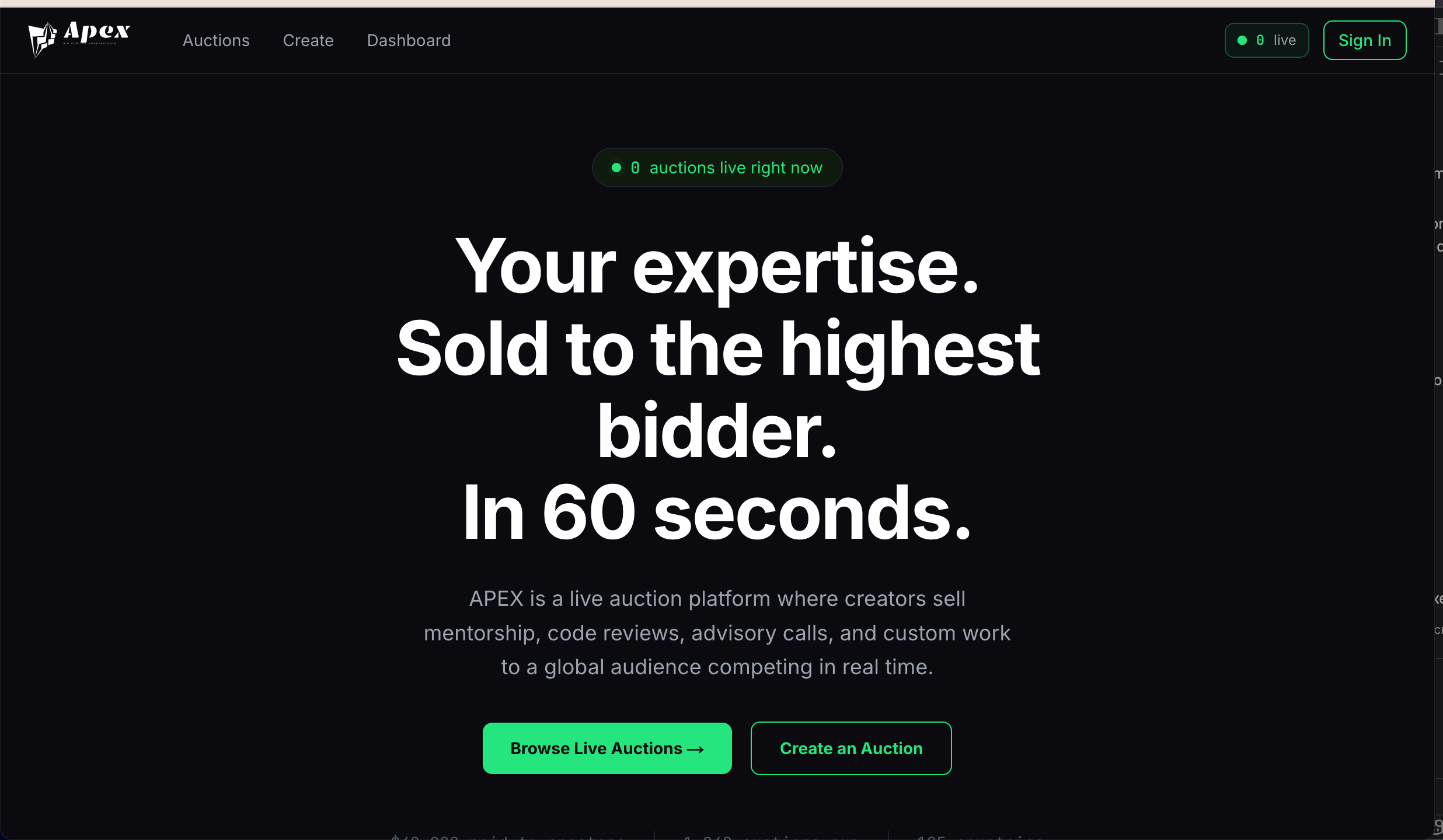
APEX is a real-time global experience auction platform where creators monetize exclusive digital experiences such as mentorship sessions, code reviews, consulting calls, advisory sessions, and personalized services by auctioning them to a worldwide audience.
Instead of guessing what their time is worth, creators launch live 60-second auctions where buyers compete in real time, allowing demand to determine the final price.
The highest valid bid wins, with funds securely held in escrow until the buyer confirms successful delivery. To ensure every auction remains fair, APEX automatically extends the timer when bids are placed during the final seconds, preventing auction sniping and giving every participant an equal opportunity to compete.
Powered by Amazon Aurora DSQL, APEX uses globally distributed transactions and Optimistic Concurrency Control (OCC) to ensure simultaneous bids are processed fairly, consistently, and without race conditions.
How we built it
We built APEX using v0 by Vercel as our primary AI development tool. We described the product vision, user flows, and interface requirements through prompts, and v0 generated much of the initial frontend structure and UI components.
We then iteratively reviewed the generated code, refined the user experience, customized components, and integrated the application with our backend services.
The application is built with Next.js, React, TypeScript, and Tailwind CSS, and deployed on Vercel. We used Clerk to handle user authentication and account management, providing a secure and seamless sign-in experience for creators and bidders.
For secure access to Amazon Aurora DSQL, we used Vercel's native AWS integration, which automatically provisions a federated IAM role through OIDC. This allows our application to authenticate securely with AWS without storing long-term AWS credentials or database passwords.
On the backend, we designed the Aurora DSQL database schema, built the auction APIs, and implemented the core business logic for live auctions, escrow workflows, and anti-sniping protection.
To guarantee fair bidding under concurrent traffic, we implemented Optimistic Concurrency Control (OCC) using version-based updates. When multiple users place bids at the same time, Aurora DSQL safely commits only one transaction while rejecting conflicting writes, ensuring a consistent and fair auction state.
We also integrated Pusher for real-time communication, allowing every connected bidder to instantly see new bids, price changes, and auction status without refreshing the page.
By combining v0, Vercel, Clerk, Pusher, and Amazon Aurora DSQL, we rapidly built a production-ready application that demonstrates how AI-assisted development and modern cloud infrastructure can be used to create globally scalable, real-time applications.
Challenges we ran into
One of our biggest challenges was learning and building with Amazon Aurora DSQL, which differs significantly from traditional databases. Because live auctions involve multiple users bidding simultaneously, we needed a way to guarantee that only one winning bid could be accepted while keeping the auction state consistent for every participant.
Implementing Optimistic Concurrency Control (OCC) was another major challenge. We had to design a version-based update system that could safely handle conflicting bids arriving at nearly the same time without creating race conditions or corrupting auction data.
We also faced challenges integrating multiple services into a seamless workflow. This included connecting Clerk authentication with our application, configuring Vercel's AWS integration for secure access to Aurora DSQL, and synchronizing real-time auction updates through Pusher so that all users could instantly see changes as bids were placed.
Since much of the frontend was generated with v0, another challenge was reviewing, understanding, and adapting the generated code to support custom auction logic, escrow workflows, anti-sniping protection, and real-time bidding requirements.
Finally, balancing a smooth user experience with distributed transactional consistency required careful design decisions throughout the project. We wanted auctions to feel instantaneous while still ensuring every bid was processed fairly and accurately across the system.
Accomplishments that we're proud of
We're proud of building a complete, production-ready prototype that demonstrates how globally distributed databases can power real-world applications.
APEX goes beyond a traditional auction platform by combining real-time bidding, escrow workflows, anti-sniping protection, and globally consistent transactions into a single user experience.
Some of our key accomplishments include:
Successfully integrating Amazon Aurora DSQL as the primary database for globally distributed transactions.
Implementing Optimistic Concurrency Control (OCC) to guarantee fair bidding when multiple users submit bids simultaneously.
Building a responsive, AI-assisted frontend using v0 by Vercel, then refining and integrating it into a fully functional application.
Using Clerk for secure authentication and Vercel's AWS integration for passwordless access to Aurora DSQL through federated IAM.
Delivering real-time bid updates with Pusher, creating a smooth live auction experience.
Deploying the entire application on Vercel, making it accessible without local setup.
Most importantly, we demonstrated a practical use case where Aurora DSQL's distributed architecture solves a genuine engineering challenge instead of simply acting as a storage layer.
What we learned
Building APEX gave us valuable experience designing applications for global scale rather than a single region.
We learned how Amazon Aurora DSQL differs from traditional relational databases, particularly how Optimistic Concurrency Control (OCC) can safely resolve simultaneous write conflicts without relying on database locks.
We also gained hands-on experience using v0 as an AI-assisted development tool, integrating generated code into a production application, securing cloud resources through Vercel's AWS integration, implementing authentication with Clerk, and building real-time applications using Pusher.
Perhaps our biggest takeaway was learning how modern AI development tools and cloud-native infrastructure can dramatically accelerate development while still requiring thoughtful engineering decisions around architecture, scalability, and transactional consistency.
What's next for Apex
Our vision is to evolve APEX into the leading global marketplace for auctioning digital experiences. The next phase includes integrating payment providers to automate escrow and payouts, adding AI-powered pricing recommendations to help creators estimate starting bids, and providing creators with analytics dashboards to better understand audience engagement and auction performance.
We also plan to introduce creator reputation systems, buyer verification, multilingual support, live-streamed auctions, mobile applications, and personalized auction recommendations. From an infrastructure perspective, we will continue leveraging Amazon Aurora DSQL to support larger numbers of concurrent users, expand fraud detection capabilities, and power additional globally distributed features as the platform scales.
Built With
- amazon-aurora-dsql
- clerk
- next.js
- pusher
- react
- tailwind-css
- typescript
- v0
- vercel


Log in or sign up for Devpost to join the conversation.