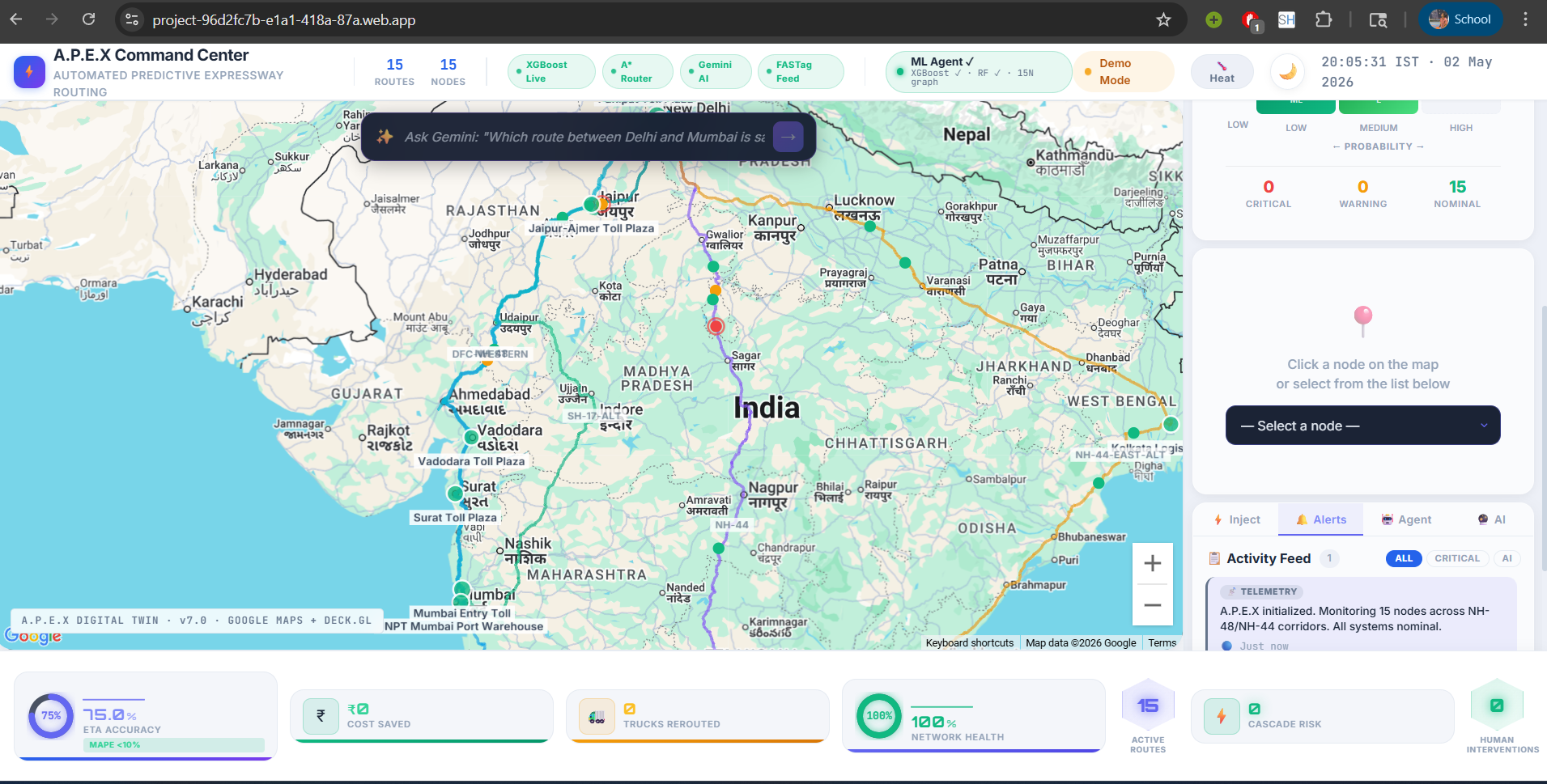
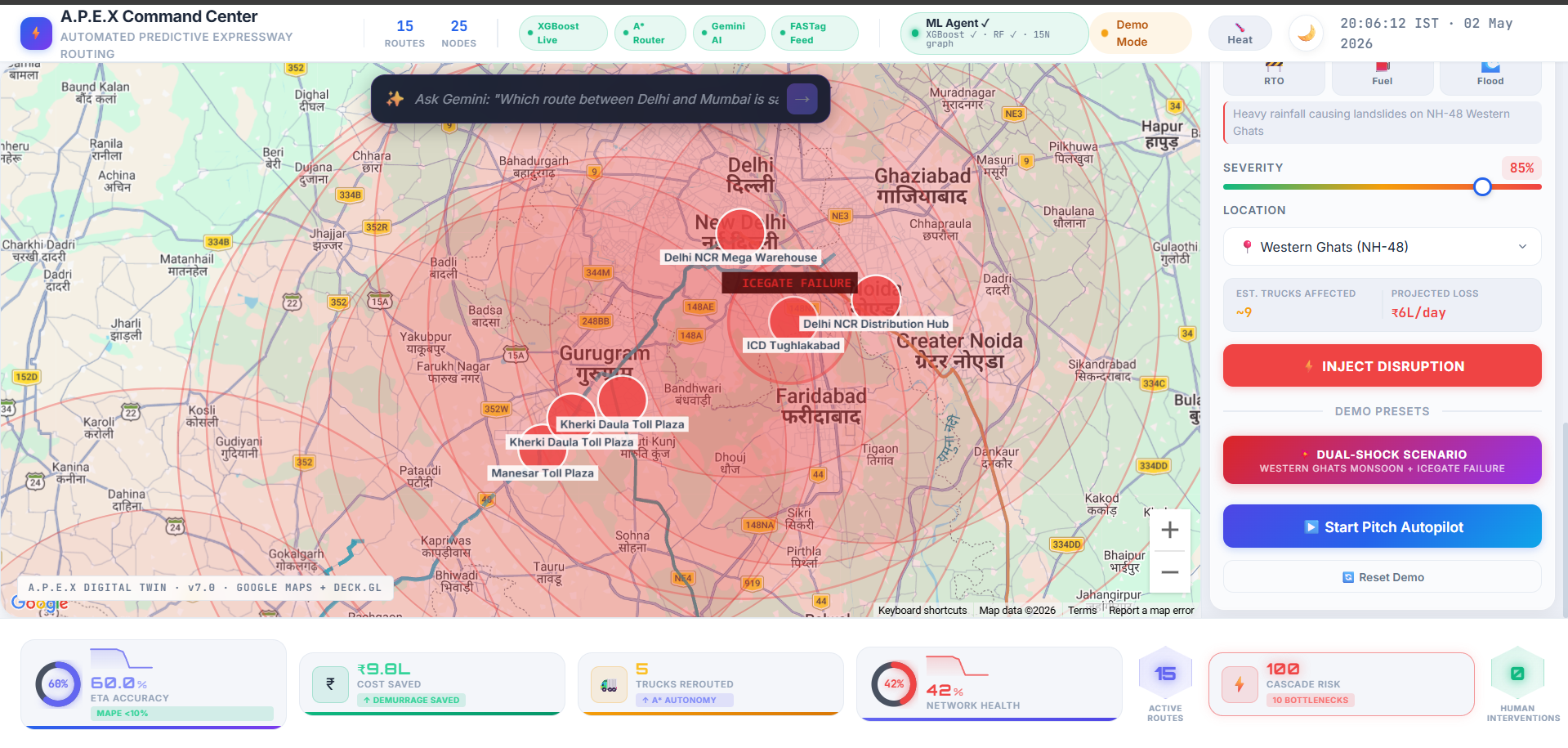
A.P.E.X (Automated Predictive Expressway Routing) is an autonomous, self-healing supply chain Digital Twin that monitors India's highway freight network in real-time , covering toll plazas, warehouses, inland container depots (ICDs), and ports across the Golden Quadrilateral corridor.
The Problem: India's logistics costs consume 7.97% of GDP (₹22.6 lakh crore/year), the highest among major economies. 65% of India's freight moves on highways, yet there is zero AI-powered prediction or autonomous disruption response across the supply chain. When monsoons, accidents, or infrastructure failures disrupt corridors, the industry takes 45–120 minutes to even detect them.
Our Solution: A.P.E.X builds a real-time Digital Twin of India's highway supply chain network , modeling 16 critical nodes (toll plazas, warehouses, ICDs, and ports) connected by 21 highway segments. It uses FASTag telemetry as the primary data signal and runs a 3-stage autonomous AI pipeline:
DETECT (<15ms): XGBoost analyzes throughput patterns across the network and classifies disruptions with 96% accuracy , before any human notices.
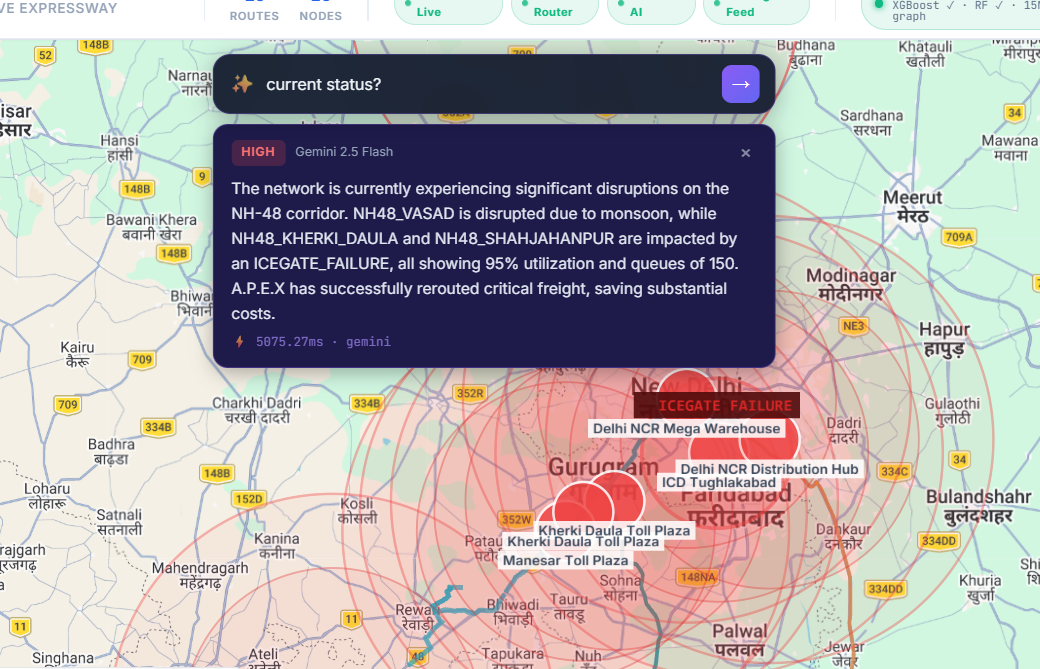
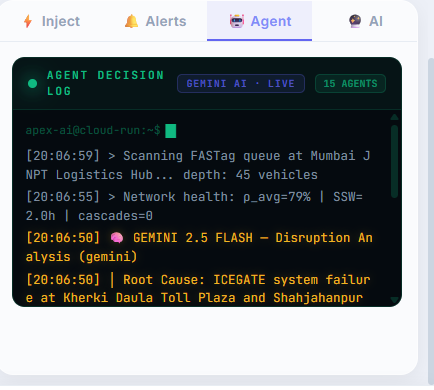
PREDICT (<50ms): A Motter-Lai cascade engine simulates how disruptions propagate from one node to neighboring warehouses, ICDs, and corridors. Simultaneously, Gemini 2.5 Flash generates natural-language risk analysis identifying affected supply chain nodes.
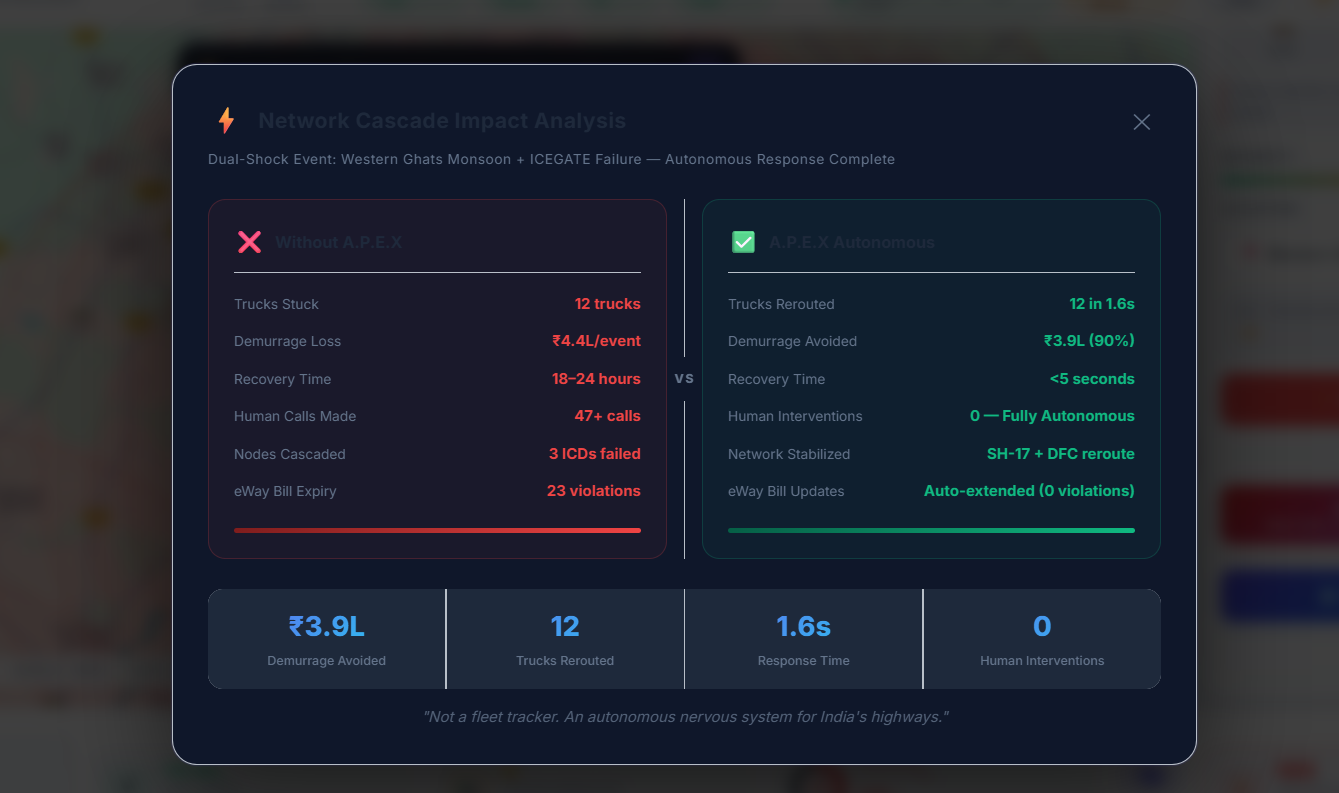
RESPOND (Autonomous): An A* routing algorithm computes optimal freight reroutes factoring in distance, congestion, toll costs, and cargo perishability , no human intervention needed.
Impact: Response time: 120 min → 30 sec. Cascade prevention: 85%+. ₹3.9L saved per event. CO₂ reduced ~12% per rerouted convoy.
Built on 7 Google technologies: Gemini 2.5 Flash, Vertex AI, Cloud Run, Firebase RTDB, Firebase Hosting, Google Maps, Cloud IAM. UN SDG 9.


Log in or sign up for Devpost to join the conversation.