Inspiration
F1 races are decided in milliseconds, where a single strategic decision can mean the difference between victory and defeat. While teams have access to powerful HPC systems that can simulate thousands of race scenarios, race engineers face a critical bottleneck: interpreting complex computational results and communicating optimal strategies to drivers during the intense 2-hour race window. We were inspired to bridge this gap between high-performance computing power and real-time human decision-making.
What it does
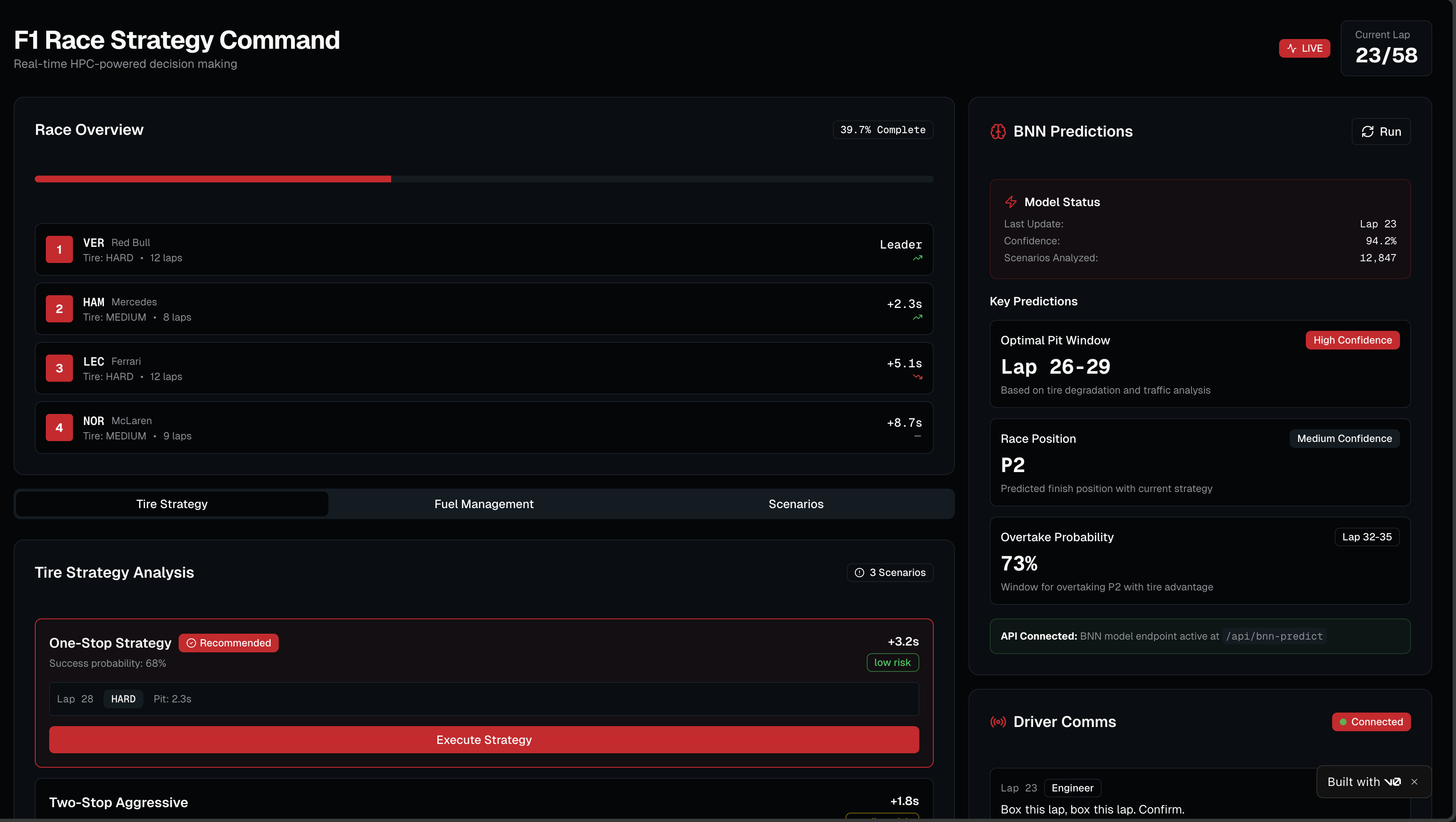
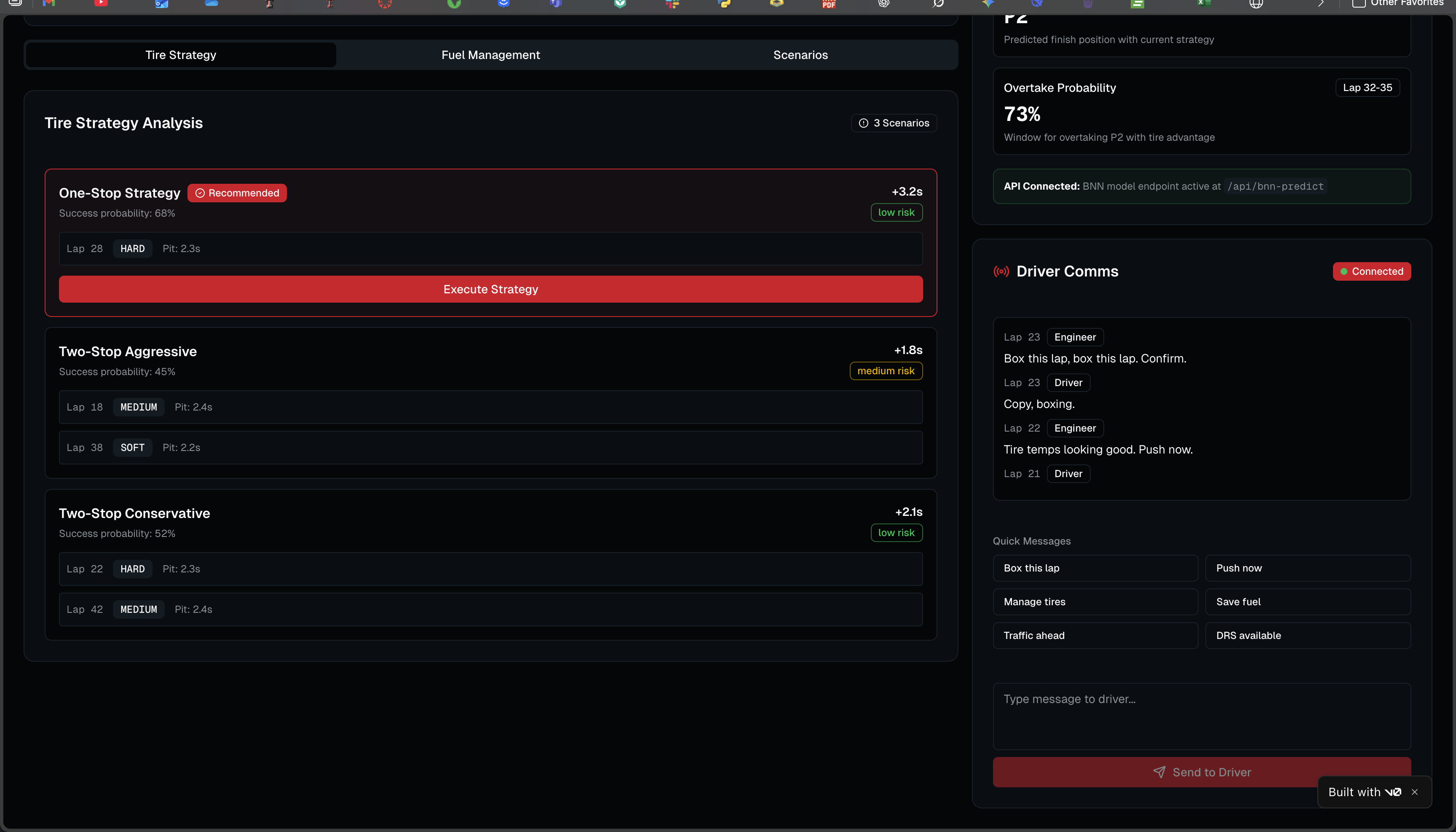
Apex F1 is a real-time race strategy command center that transforms complex HPC simulations into actionable insights for race engineers. The dashboard integrates a Bayesian Neural Network model that analyzes thousands of race scenarios to provide optimal pit stop windows, tire strategy recommendations, and overtake opportunity predictions. Engineers can visualize live telemetry data, compare multiple strategic scenarios side-by-side, monitor fuel consumption and tire degradation in real-time, and communicate strategy updates directly to drivers—all through a mission control-style interface designed for split-second decision-making under pressure.
How we built it
We built Apex F1 using Next.js for the frontend dashboard with React components optimized for real-time data visualization using Recharts. The core intelligence comes from a Bayesian Neural Network model that runs in Python, which we integrated via a Flask API server that connects seamlessly with Jupyter Notebook workflows. The architecture allows data scientists to iterate on models in their familiar Python environment while the Next.js application handles real-time data streaming, scenario comparison, and driver communications. We designed the UI following professional mission control aesthetics with a carefully selected color palette and typography optimized for high-stress, time-critical environments.
Challenges we ran into
The biggest challenge was creating a seamless bridge between Python-based machine learning models and a real-time web interface without sacrificing performance. We had to design an API architecture that could handle model inference requests quickly enough for race-time decisions while maintaining fallback mechanisms for reliability. Another significant challenge was designing a UI that could display dense, complex data without overwhelming engineers who need to make decisions in seconds. We also had to balance the need for comprehensive scenario analysis with the reality that race conditions change rapidly and predictions must update in near real-time.
Accomplishments that we're proud of
We're proud of creating a production-ready integration between HPC/ML workflows and real-time decision-making interfaces. The Jupyter Notebook integration means data scientists can deploy models without learning new frameworks, while the dashboard provides engineers with actionable insights instead of raw simulation data. We successfully designed an interface that presents complex multi-dimensional race data in an intuitive, scannable format. Most importantly, we built a system that genuinely solves the millisecond-decision problem in F1 racing by making HPC insights accessible when they matter most.
What we learned
We learned that the real challenge in applying AI to high-stakes environments isn't just model accuracy—it's the human interface. The best predictions are useless if engineers can't quickly understand and act on them during a race. We also gained deep insights into designing for time-critical decision-making, where every pixel and interaction must be optimized for speed and clarity. On the technical side, we learned effective patterns for integrating Python ML workflows with modern web applications, and how to design APIs that gracefully handle the unpredictability of real-time systems.
What's next for Apex F1
Next, we plan to add historical race data analysis to improve prediction accuracy, integrate live weather and track condition feeds for more dynamic strategy recommendations, and implement multi-driver team coordination features for managing race strategies across multiple cars. We want to add uncertainty visualization to help engineers understand prediction confidence levels, and explore integration with actual F1 telemetry systems. Long-term, we envision Apex F1 becoming a platform that democratizes advanced race strategy tools beyond just top-tier F1 teams, making HPC-powered insights accessible to Formula 2, Formula 3, and even amateur racing series.
Built With
- bnn
- machine-learning
- next-js
- python
- typescript


Log in or sign up for Devpost to join the conversation.