Inspiration
Trucking drives North America's supply chain, yet dispatchers and owner-operators still coordinate multimillion-dollar freight operations through static spreadsheets, manual phone checks, and fragmented portals. Two silent profit killers drain fleet margins across major freight corridors: unbilled detention bleed and deadhead fuel waste. When drivers sit waiting at loading docks without verifiable dwell tracking, detention revenue is routinely lost. Simultaneously, dispatchers frequently book loads without instant cross-validation against strict regulatory constraints—leading to costly compliance violations and empty return miles. We set out to build an intelligent, real-time operating system that automates the friction points between load boards, dispatch consoles, and in-cab drivers.
What it does
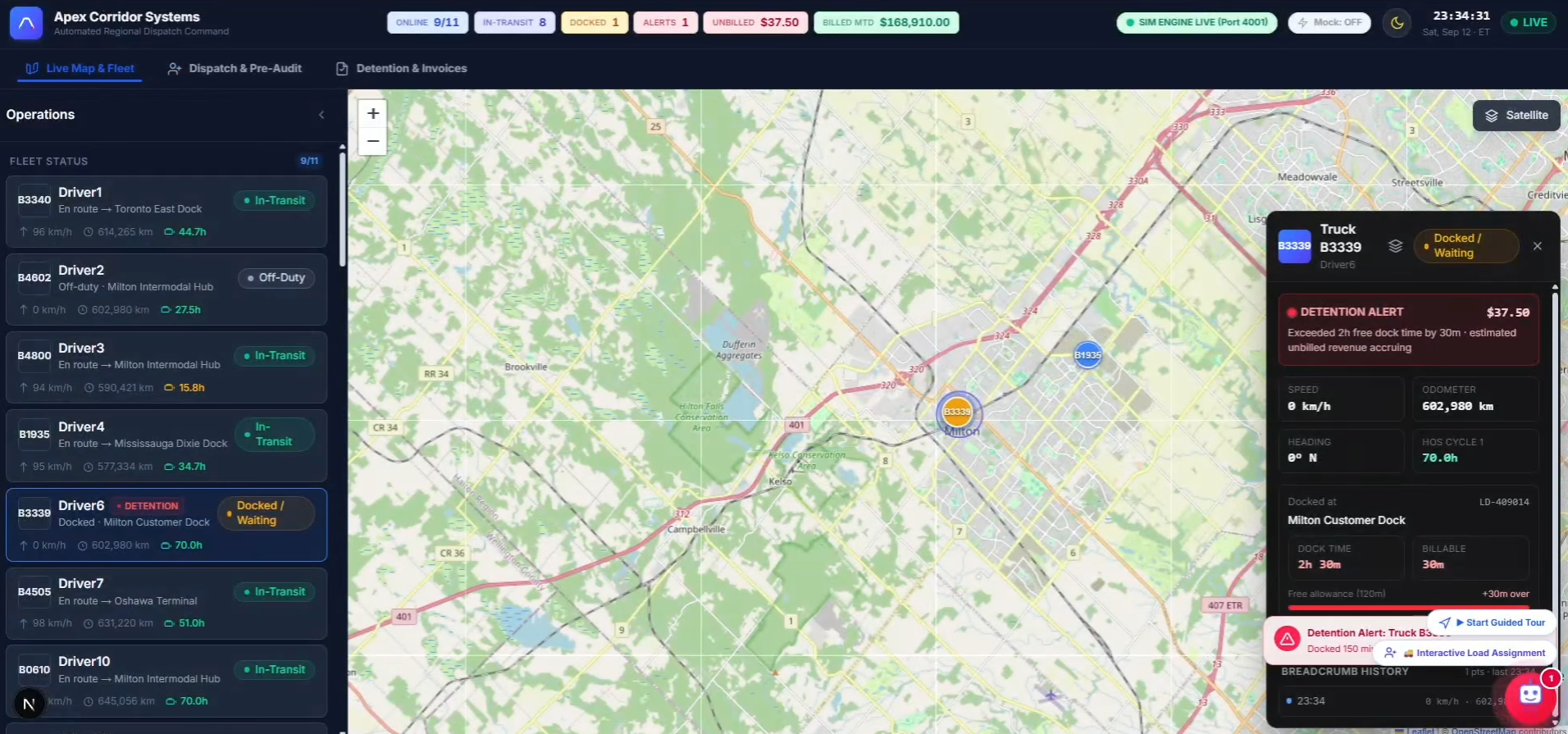
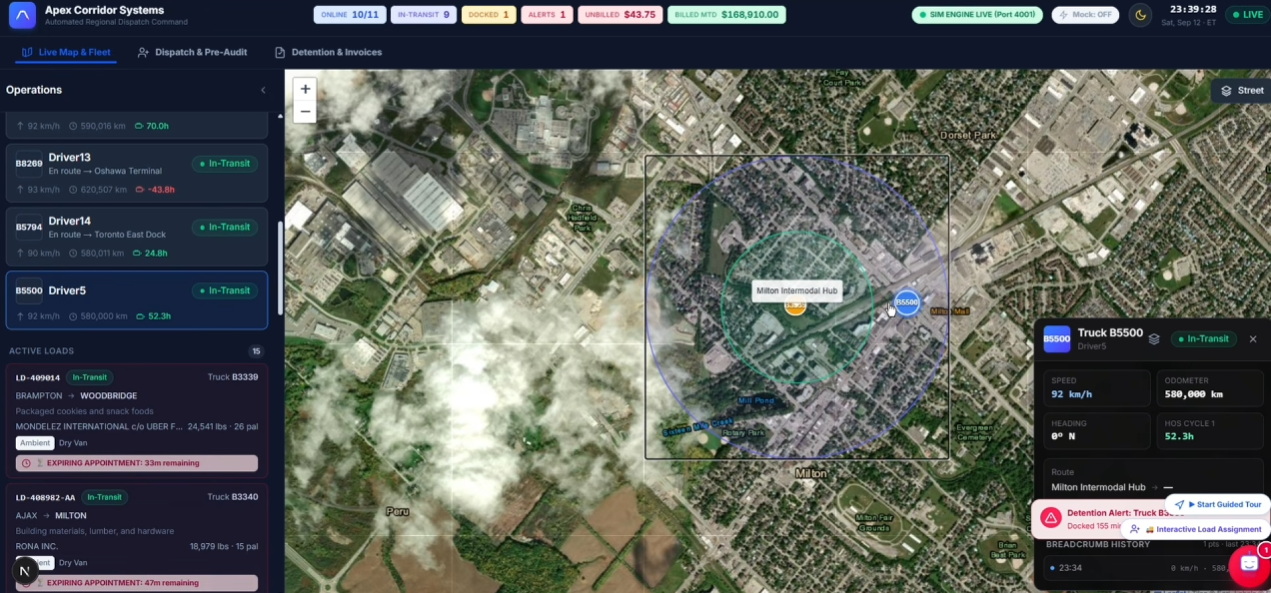
Apex Corridor Systems is an intelligent, AI-native trucking dispatch and fleet telemetry platform that automates regulatory compliance, load matching, and detention recovery.
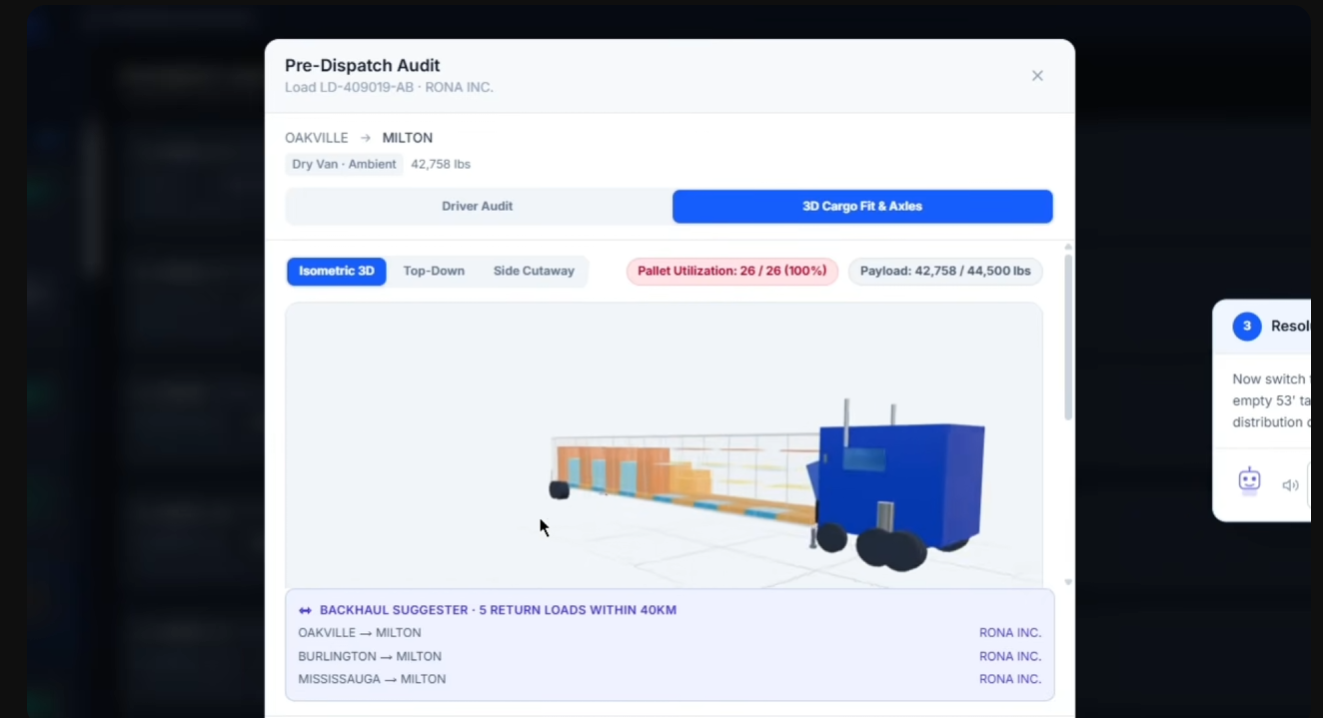
- AI Spot-Quote & Regulatory Load-Matching: Dispatches freight by auditing candidate drivers in real time against Transport Canada Hours of Service (HOS) rules and Ontario Ministry of Transportation (MTO) axle weight limits, targeting a 15–25% reduction in deadhead miles and zero compliance violations[cite: 6].
- Real-Time Fleet State Synchronization: Runs an event-driven, bidirectional WebSocket broker that keeps load broadcasts, offer acceptances, and driver ELD handshakes in sync between a Next.js dispatcher operations center and a Vite driver client[cite: 6].
- Automated Geofenced Detention Invoicing: Uses circular geofencing around freight yards to track exact dwell time, automatically triggering and generating prorated PDF detention invoices the moment waiting limits are exceeded[cite: 6].
- Hands-Free Driver Voice Co-Pilot: Integrates an embedded Spur AI assistant with local Kokoro-82M text-to-speech served over FastAPI and Cloudflare Tunnels, allowing drivers to interact with navigation and load data safely on the road[cite: 6].
- 3D Cargo & Axle Visualizer: Built with Three.js and Leaflet to provide dispatchers and drivers with spatial weight-distribution modeling across tractor and trailer axle groups[cite: 6].
How we built it
- Frontend Dashboards: Next.js for the centralized dispatcher command console and a fast, responsive Vite/React client tailored for mobile driver ELD interfaces[cite: 6].
- 3D & Spatial Visualization: Three.js for interactive cargo load and axle weight distribution models, alongside Leaflet for interactive geofence and corridor mapping[cite: 6].
- Backend Services & Messaging: Node.js WebSocket broker for bidirectional fleet state synchronization[cite: 6], paired with a high-performance Python FastAPI service managing core business logic and routing[cite: 6].
- Voice & Intelligence Pipeline: Spur AI engine combined with LangChain for agent orchestration[cite: 6] and a local Kokoro-82M TTS model tunneled securely via Cloudflare Tunnels[cite: 6].
- Storage & Data: PostgreSQL for relational load logs, driver telematics, and audit trails[cite: 6].
Challenges we ran into
- Sub-Second Bidirectional Synchronization: Coordinating high-frequency telemetry simulation alongside transactional state changes (such as load acceptance races and ELD handshakes) across independent dispatcher and driver views required careful race-condition handling and idempotent state updates over our WebSocket layer[cite: 6].
- Encoding Multi-Jurisdictional Rules: Translating Transport Canada HOS duty cycles and Ontario MTO axle-spacing formulas into deterministic constraints inside an AI dispatch optimizer required balancing rigid rule-based logic with flexible LLM prompt routing[cite: 6].
- Low-Latency Edge Voice Inference: Running an open-source speech synthesis model (Kokoro-82M) locally while piping real-time responses to a web client without lag required streaming raw audio chunks through FastAPI and optimizing Cloudflare Tunnel throughput[cite: 6].
Accomplishments that we're proud of
- Designed, engineered, and shipped a complete end-to-end telemetry, voice, and dispatch platform from scratch in just 7 days[cite: 6].
- Awarded 3rd Place ($500 prize) at the weeklong RoadStar Hackathon 2026 hosted at the SPUR Innovation Center[cite: 1, 6].
- Seamlessly unified heavy mathematical compliance (axle load geometry and HOS limits) with an intuitive UX featuring 3D cargo models and real-time audio interaction[cite: 6].
What we learned
- Building for the trucking industry requires zero tolerance for latency and ambiguities; dispatch tools must present actionable, verified facts rather than vague approximations.
- Real-time multi-client synchronization is most reliable when lightweight pub/sub brokers handle communication state while an asynchronous API handles compute-heavy validation.
- Local, small-footprint voice models (like Kokoro-82M) paired with intelligent cloud endpoints provide an ideal balance of privacy, speed, and cost efficiency for field-deployed AI co-pilots[cite: 6].
What's next for Apex Corridor Systems
- Cross-Border Cabotage & Customs Integration: Expanding the regulatory engine to automate US-Canada cross-border cabotage laws (19 CFR compliance) and automated PARS/PAPS customs manifest generation.
- Direct Telematics Hardware Telemetry: Moving from simulated ELD streams to direct J1939 CAN bus hardware integration via OBD-II edge adapters.
- Multi-Carrier Load Board Integrations: Connecting our spot-quote optimizer directly with live freight APIs (Loadlink, DAT, and Truckstop) for one-click external booking and automated broker backhaul matching.
Built With
- javascript
- leaflet.js
- nextjs
- postgresql
- python
- react
- sqlite
- typescript
- websocket

Log in or sign up for Devpost to join the conversation.