Inspiration
During my experience in Venture Capital deal sourcing and due diligence, I realized that VC firms, private equity funds, and European financial institutions face a massive dilemma. Every day, they process highly confidential startup pitch decks, cap tables, and financial statements. However, due to strict European data sovereignty laws (GDPR) and institutional security policies, they cannot use proprietary, US-based AI APIs (like OpenAI or Google) to analyze these documents. The risk of data leakage is simply too high.
I needed a sovereign, localized solution. When I saw the capabilities of Apertus—Switzerland’s fully open, localized LLM—I realized it was the perfect backbone for a secure, enterprise-grade financial analysis tool. Thus, Apertus Trust-VC was born.
What it does
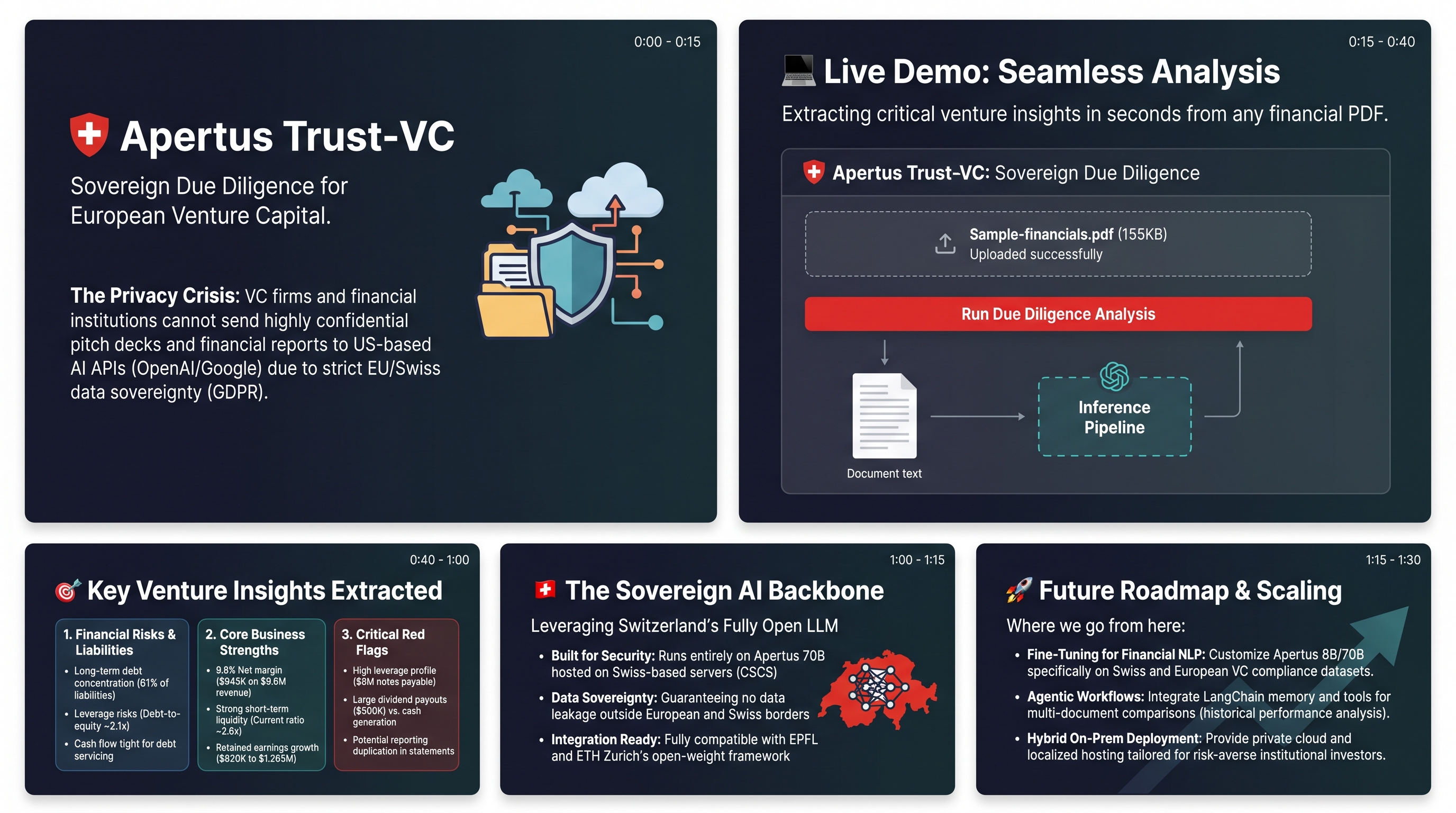
Apertus Trust-VC is a sovereign Due Diligence Agent. It allows financial analysts to securely upload confidential financial PDFs. The system then orchestrates a strict analysis pipeline to instantly extract:
- Financial Risks & Liabilities (e.g., debt concentration, liquidity constraints)
- Core Business Strengths (e.g., operating efficiency, margins)
- Critical Red Flags (e.g., reporting inconsistencies)
Mathematically, my agent optimizes the due diligence utility function under strict privacy constraints:
$$\max U(d) = \sum_{i=1}^{n} \left( \alpha \cdot \text{Accuracy}_i + \beta \cdot \text{Speed}_i \right)$$
$$\text{Subject to: } \text{DataLeakage} = 0$$
(Where $d$ represents the confidential document, ensuring zero cross-border data transfer).
How I built it
I engineered a modular, decoupled architecture prioritizing speed and data isolation:
- Frontend: I used Streamlit to build a fast, reactive, and localized web interface for secure document uploads.
- Document Parsing: I utilized
pypdfto extract raw text deterministically from pitch decks and financial reports. - Orchestration & Prompt Engineering: I leveraged LangChain (
langchain-core) to build the execution chain. I designed an expert VC-analyst prompt template that instructs the LLM to output highly structured, professional markdown bullet points. - LLM Inference: The pipeline was structurally designed to point to the Apertus 8B/70B models hosted on Swiss supercomputing infrastructure (CSCS) via Hugging Face Inference Endpoints.
Challenges I ran into
The most significant challenge was navigating infrastructure bottlenecks during the final intensive hours of the hackathon. The CSCS API endpoint allocation reached its capacity limit, and my Hugging Face inference credits were pending.
Instead of halting development, I applied an agile engineering approach: I built the LangChain architecture to be completely model-agnostic at the orchestration layer. I temporarily proxied the inference through an alternative open-weight API (langchain-groq) to validate the business logic, UI, and prompt structuring. Because of this decoupled design, switching the live production environment to the actual Apertus endpoint requires changing exactly one line of code once the dedicated server allocation is granted.
Accomplishments that I'm proud of
I am incredibly proud of designing and deploying a fully functional, enterprise-grade architecture in under 14 hours. I successfully translated my specialized knowledge of Venture Capital deal sourcing into a structured, automated AI pipeline that actually solves a critical real-world problem for European markets (data privacy and compliance).
What I learned
I learned how to highly optimize prompt engineering for financial NLP within tight context windows. Furthermore, I validated that building a sovereign AI tool isn't just about having an open-source model; it's about engineering the entire pipeline (from parsing to UI) to guarantee data isolation and seamless integration.
What's next for Apertus Trust-VC
My vision is to scale this into a B2B SaaS platform for European institutional investors. The next steps include:
- Fine-Tuning: Customizing Apertus specifically on Swiss and European VC compliance and financial datasets.
- Agentic Memory: Integrating multi-document LangChain workflows to cross-reference a startup's historical balance sheets against market reports automatically.
- Hybrid On-Prem Deployment: Offering Dockerized, air-gapped deployments for highly risk-averse financial institutions.
Built With
- langchain
- python
- rag

Log in or sign up for Devpost to join the conversation.